
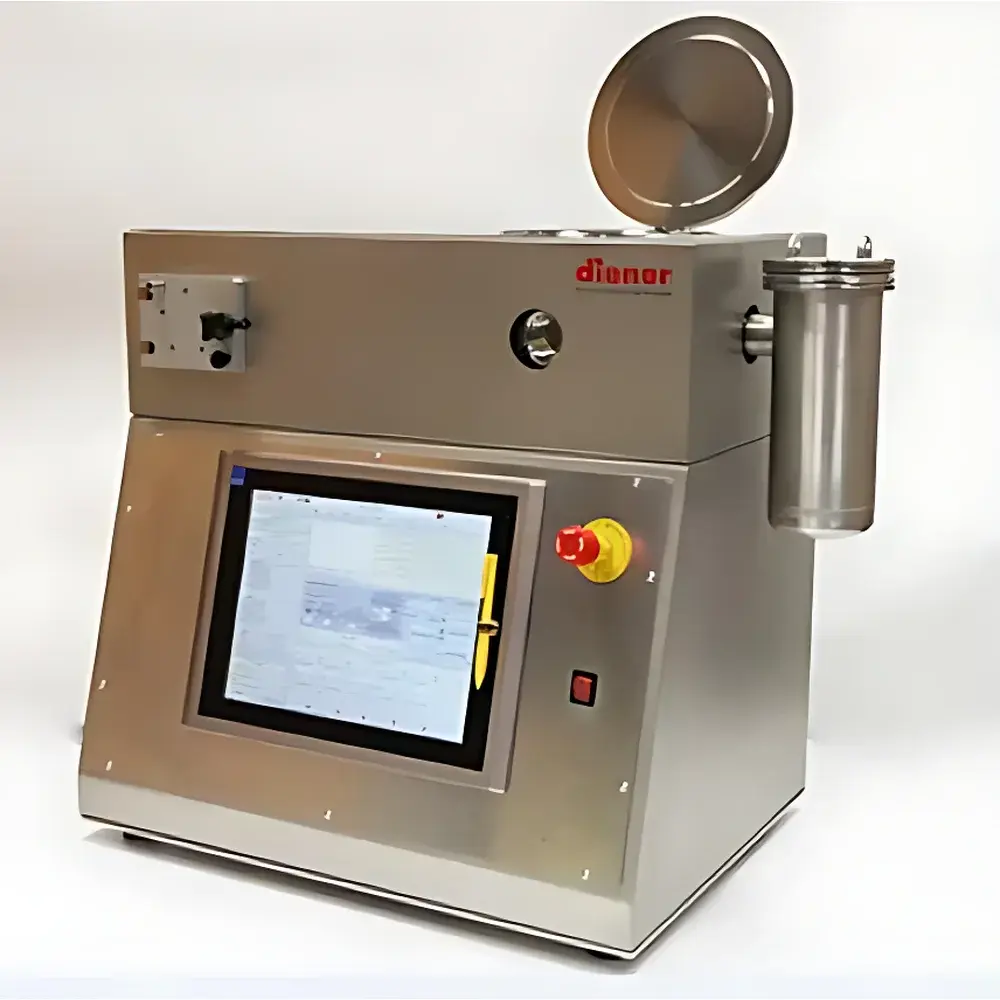
Diener P6 Parylene Coating System
| Brand | Diener |
|---|---|
| Origin | Germany |
| Model | P6 |
| Coating Types | Parylene N, C, D, F-VT4 |
| Coating Thickness Range | 0.05–20 µm |
| Chamber Dimensions (Ø × H) | 200 × 200 mm |
| Substrate Holder (Ø × H) | 170 × 170 mm |
| Pyrolyzer Power / Max Temp | 1.6 kW / 750 °C |
| Vacuum Pump | Dual-stage oil-sealed rotary vane pump |
| Pumping Speed | 16 m³/h |
| Base Pressure | ≤1 × 10⁻³ mbar |
| Control System | Integrated Windows-based PC |
| Electrical Supply | 230 V / 16 A / 50–60 Hz |
| Overall Dimensions (W × D × H) | 700 × 500 × 700 mm |
Overview
The Diener P6 Parylene Coating System is a fully integrated, benchtop-scale chemical vapor deposition (CVD) platform engineered for the reproducible, conformal deposition of high-performance Parylene polymer films—specifically Parylene N, C, D, and F-VT4—onto temperature-sensitive and geometrically complex substrates. Unlike conventional liquid-phase coating methods, the P6 employs a true vacuum-based CVD process comprising three thermally isolated zones: sublimation (solid dimer → vapor), pyrolysis (vapor → reactive monomer via thermal cleavage at up to 750 °C), and deposition (monomer adsorption and spontaneous polymerization on cooled substrates). This sequential, solvent-free pathway yields pinhole-free, ultra-uniform, and stress-free poly-p-xylylene films with thickness control down to ±0.01 µm—critical for functional integrity in microelectronics, implantable medical devices, and aerospace-grade components.
Key Features
- Three-zone thermal architecture with independent temperature control: sublimation furnace (up to 150 °C), pyrolyzer (up to 750 °C), and chilled deposition chamber (typically −20 °C to +25 °C via optional liquid nitrogen cold trap)
- Integrated dual-stage oil-sealed rotary vane vacuum pump delivering 16 m³/h pumping speed and stable base pressure ≤1 × 10⁻³ mbar
- Compact footprint (700 × 500 × 700 mm) optimized for ISO Class 5–7 cleanroom integration or controlled laboratory environments
- Windows-based full-PC control system with real-time monitoring of pressure, zone temperatures, deposition time, and total monomer mass flow
- Standard sample chamber accommodates substrates up to Ø200 mm × 200 mm height; custom fixtures available for MEMS wafers, PCB assemblies, stents, and sensor arrays
- Compliance-ready architecture supporting audit trails, user-level access control, and electronic signature capability per FDA 21 CFR Part 11 requirements
Sample Compatibility & Compliance
The P6 supports a broad range of substrate materials—including silicon wafers, FR-4 and polyimide PCBs, stainless steel surgical tools, nitinol stents, glass optics, and polymer-based microfluidic chips—without requiring surface primers or adhesion promoters. Film uniformity across vertical sidewalls, under overhangs, and within aspect ratios >10:1 is routinely verified per ASTM F1980 (accelerated aging of sterile barrier systems) and IPC-CC-830B (qualification and conformance of electrical insulating compounds). All Parylene variants deposited using the P6 meet USP Class VI biocompatibility requirements and are compliant with ISO 10993-5 (cytotoxicity) and ISO 10993-10 (irritation/sensitization) when processed under validated protocols. The system’s vacuum integrity and thermal stability support GMP-aligned process documentation and batch record generation.
Software & Data Management
The embedded Windows OS runs Diener’s proprietary Parylene Process Manager (PPM) software, which provides step-by-step recipe management, automated cycle sequencing, and real-time graphing of chamber pressure, pyrolyzer temperature ramp profiles, and deposition rate trends. All operational parameters—including start/stop timestamps, operator ID, vacuum history, and alarm logs—are timestamped and stored locally with optional network backup. Audit trail functionality meets GLP and ISO/IEC 17025 data integrity requirements. Export formats include CSV, PDF reports, and XML for LIMS integration. Remote diagnostics and firmware updates are supported via secure HTTPS connection.
Applications
- Microelectronics: Conformal dielectric passivation of RF antennas, MEMS sensors, flex circuits, and high-density IC packages
- Medical Devices: Biostable encapsulation of neurostimulators, cochlear implants, glucose biosensors, and drug-eluting balloon catheters
- Aerospace & Defense: Moisture and salt-fog barrier layers on avionics connectors, inertial measurement units (IMUs), and radar waveguide components
- Optoelectronics: Anti-reflective and environmental protection coatings for laser diodes, photodetectors, and OLED substrates
- Research & Development: Thin-film model studies in corrosion inhibition, gas permeation kinetics, and surface energy modulation
FAQ
What Parylene variants are compatible with the Diener P6 system?
The P6 supports Parylene N, C, D, and F-VT4 polymers using standard dimer sources; no hardware modification is required between chemistries.
Can the P6 deposit films thicker than 20 µm?
While the standard specification covers 0.05–20 µm, extended deposition cycles can achieve >50 µm thicknesses; however, mechanical stress and interfacial adhesion must be evaluated per application-specific validation.
Is cryogenic cooling mandatory for deposition?
Yes—substrate cooling (typically via liquid nitrogen cold trap or chiller) is essential to initiate and sustain monomer condensation and polymerization; ambient deposition is not feasible.
Does the system include a load-lock or glovebox interface?
The base P6 configuration uses a front-loading single-chamber design; optional load-lock modules and ISO-classified transfer ports are available for high-throughput or inert-atmosphere loading.
What maintenance intervals are recommended for the vacuum pump and pyrolyzer?
Oil changes every 500 operating hours for the rotary vane pump; pyrolyzer quartz tube inspection and replacement every 1,000–1,500 coating cycles depending on dimer purity and cycle profile.



