
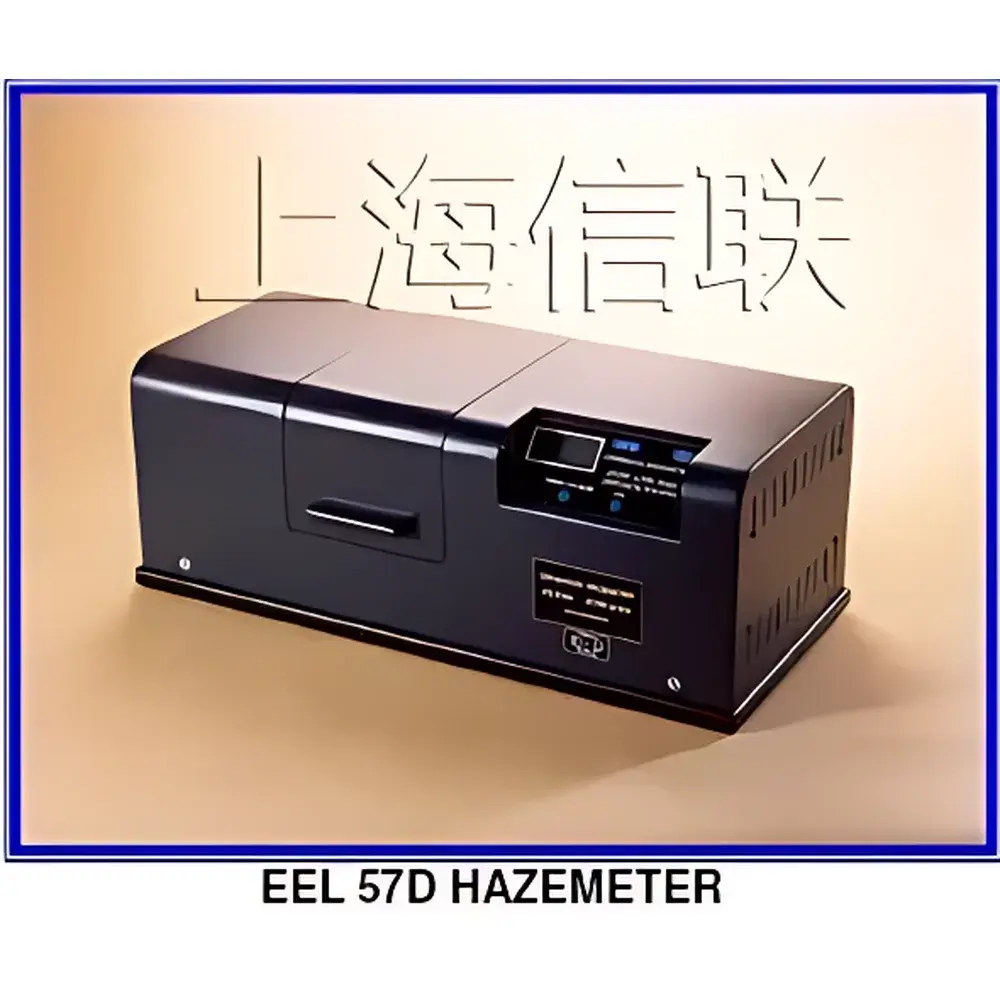
Diffusion EEL 57D Haze Meter
| Brand | Diffusion |
|---|---|
| Origin | United Kingdom |
| Model | EEL 57D |
| Type | Automatic |
| Haze Range | 1–30% |
| Transmittance Range | 1–100% |
| Haze Repeatability | ±0.1% |
| Transmittance Repeatability | ±0.5% |
| Optical Geometry | 0°/diffuse |
| Spectral Response | CIE Illuminant A and C |
| Sample Port Diameter | 22 mm (transmission) |
| Illumination Aperture | 15 mm |
| Source–Detector Separation | 90 mm |
| Warm-up Time | 1 min |
| Zero Drift | None |
| Full-Scale Drift | <0.1 units within 5 min after warm-up |
| Operating Temperature | 5–50 °C |
| Storage Temperature | −10–65 °C |
| Dimensions (H×W×D) | 200 × 530 × 240 mm |
| Weight | 12 kg |
| Shipping Weight | 14 kg |
| Optional Accessories | RS-232 interface, cuvettes for liquid measurement, Taber-abrasion-resistant sample holder |
Overview
The Diffusion EEL 57D Haze Meter is a precision optical instrument engineered for the quantitative assessment of haze and total transmittance in transparent and semi-transparent materials—including polymer films, rigid plastic sheets, tempered glass, optical lenses, and aqueous or organic solutions. It operates on the principle of 0°/diffuse geometry, where collimated incident light at normal incidence (0°) passes through the specimen, and the diffusely scattered component—defined as light deviating more than 2.5° from the incident beam—is captured by an integrating sphere detector. This configuration enables compliance with internationally recognized standards including ASTM D1003 (Standard Test Method for Haze and Luminous Transmittance of Transparent Plastics) and BS 2782-3:1991 (Methods of Testing Plastics). The instrument’s optical path is fully shielded against ambient light interference, ensuring stable photometric performance in both laboratory and production floor environments. Its 90 mm source-to-detector separation accommodates specimens up to 85 mm in thickness without mechanical obstruction, supporting robust measurement of laminated composites and thick molded parts.
Key Features
- 0°/diffuse optical geometry optimized for high-fidelity haze quantification per ASTM D1003 and BS 2782 requirements
- NPL-traceable calibration ensures metrological integrity and long-term measurement confidence
- CIE-standard spectral response aligned with Illuminants A and C for accurate colorimetric compatibility
- Integrated light-tight sample chamber eliminates external photometric contamination during operation
- Minimal warm-up time (≤60 seconds) and zero operational drift support rapid throughput in QC workflows
- Compact benchtop footprint (530 mm width) with ergonomic sample access—enabling handheld or fixed-position measurement
- Robust mechanical architecture with optional Taber-abrasion-resistant sample holder for durability in repetitive industrial testing
Sample Compatibility & Compliance
The EEL 57D accommodates a broad spectrum of physical forms: flat solid substrates (e.g., PET film, polycarbonate sheet, float glass), curved optics (within curvature limits defined by aperture geometry), and homogeneous liquids using supplied quartz or acrylic cuvettes. The 22 mm transmission port and 15 mm illumination aperture provide standardized beam definition while permitting minor dimensional tolerance in specimen positioning. All measurements are traceable to the UK’s National Physical Laboratory (NPL), satisfying ISO/IEC 17025 documentation requirements for accredited testing laboratories. The instrument meets essential regulatory expectations for optical instrumentation used in medical device packaging (ISO 11607), pharmaceutical primary containers (USP ), and automotive glazing (SAE J576), particularly where haze thresholds impact visual clarity, safety-critical perception, or light-diffusing functionality.
Software & Data Management
While the EEL 57D operates as a standalone meter with direct digital readout, its optional RS-232 serial interface enables integration into centralized quality data systems. When connected to host software (e.g., LabVIEW, custom SCADA, or LIMS platforms), it supports automated logging of timestamped haze/transmittance pairs, statistical process control (SPC) charting, and audit-ready export in CSV or XML format. The firmware implements non-volatile memory for calibration constants and user-defined pass/fail thresholds. Though not natively compliant with FDA 21 CFR Part 11, the instrument can be deployed within validated environments when paired with appropriate electronic record controls—including operator authentication, change logs, and electronic signatures implemented at the system level.
Applications
- Quality assurance of optical-grade polymers in extrusion and injection molding lines
- Release testing of anti-fog coatings on greenhouse films and display cover glasses
- Stability monitoring of colloidal suspensions and emulsions in pharmaceutical formulation development
- Validation of cleaning efficacy on architectural glazing and solar panel covers
- Comparative analysis of surface texturing effects on diffuser plates for LED lighting systems
- Regulatory submission support for ISO 10934-1 (Ophthalmic optics) and ASTM F2736 (Medical device packaging)
FAQ
Does the EEL 57D require annual recalibration?
Yes—while NPL-traceable factory calibration is provided with each unit, periodic recalibration (recommended annually or per internal SOP) is required to maintain measurement uncertainty within specification. Certified recalibration services are available through Diffusion-authorized metrology partners in EMEA and North America.
Can the EEL 57D measure haze in curved or textured surfaces?
It is designed for planar specimens. Curved samples may be measured if their radius of curvature exceeds 200 mm and the central region fits within the 22 mm aperture without edge occlusion; however, results should be interpreted with caution and validated against flat reference standards.
Is the instrument suitable for GMP-regulated environments?
Yes—its stable optical design, documented traceability, and repeatable performance meet foundational GLP/GMP expectations for equipment used in material release testing. Full compliance requires integration into a site-specific validation protocol covering IQ/OQ/PQ and associated change control procedures.






