
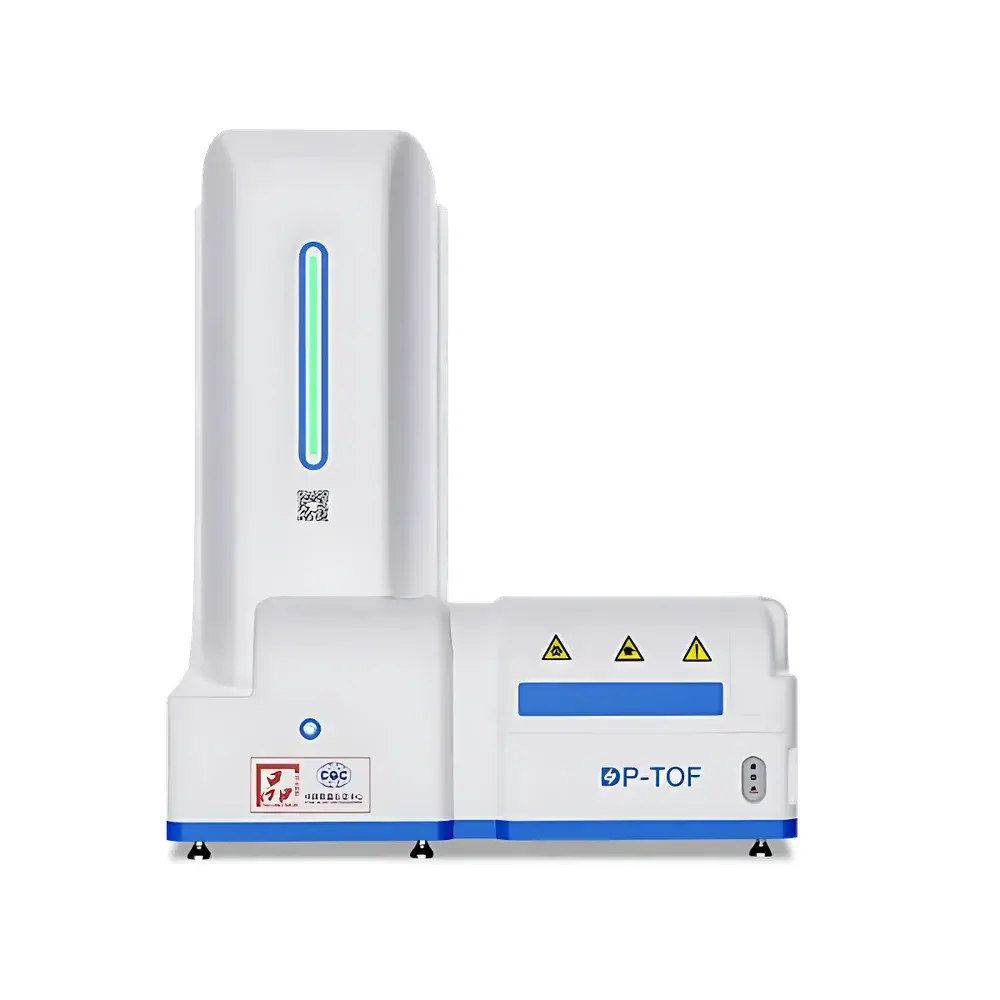
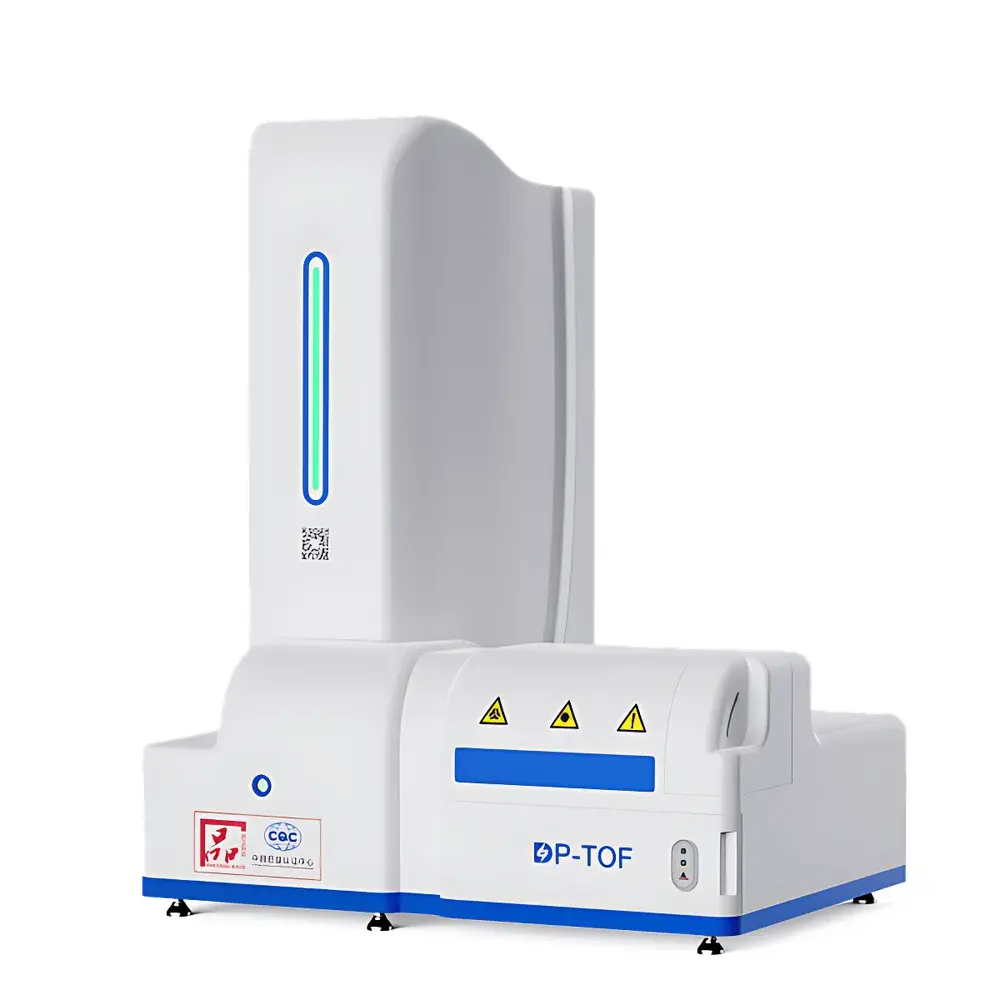
Digena DP-TOF MALDI-TOF Clinical Mass Spectrometry System
| Brand | Digena |
|---|---|
| Origin | Zhejiang, China |
| Manufacturer Type | Original Equipment Manufacturer (OEM) |
| Product Category | Domestic |
| Model | DP-TOF |
| Instrument Type | MALDI-TOF |
| Application Domain | Clinical Molecular Diagnostics |
| Mass Range | 4,000–10,000 Da |
| Sensitivity | ≥10:1 (S/N) |
| Resolution | ≥750 (FWHM at m/z 5,000) |
| Mass Stability | ≤±2×10⁻⁵ (over 24 h) |
| Acquisition Speed | 10 s per well |
| Laser Repetition Rate | 30 Hz |
| Mass Accuracy | <3×10⁻⁴ (relative error) |
Overview
The Digena DP-TOF MALDI-TOF Clinical Mass Spectrometry System is a CE-marked (under EU IVDR pathway) and NMPA-registered clinical-grade instrument engineered for targeted nucleic acid genotyping in routine diagnostic laboratories. It operates on the principle of matrix-assisted laser desorption/ionization time-of-flight mass spectrometry (MALDI-TOF MS), where PCR-amplified DNA fragments—chemically modified with single-base extension (SBE) or primer extension—are co-crystallized with an organic matrix on a conductive target plate. Upon pulsed UV laser irradiation (337 nm, 30 Hz), analyte ions are generated and accelerated into a field-free flight tube; their time-of-flight to the microchannel plate detector is directly proportional to the square root of their mass-to-charge ratio (m/z). This enables highly specific discrimination of allelic variants differing by as little as one nucleotide (e.g., SNP, indel, methylation status), without chromatographic separation or fluorescent labeling.
Key Features
- Integrated clinical workflow architecture: Fully automated sample spotting, laser acquisition, spectral processing, and genotype calling — minimizing hands-on time and operator dependency.
- Optimized for mid-throughput clinical labs: Supports 96-well and 384-well formats with 10-second acquisition per well, enabling up to 384 genotypes per run (≤65 min total cycle time including calibration and QC).
- Robust mass calibration and long-term stability: Dual-point internal calibration using synthetic oligonucleotide standards; mass drift ≤±2×10⁻⁵ over 24 hours under ambient lab conditions (20–25°C, 40–60% RH).
- High-fidelity detection: Resolution ≥750 (full width at half maximum, FWHM) at m/z 5,000 ensures baseline separation of adjacent peaks from multiplexed assays (e.g., 10-plex CYP2C19 + VKORC1 + SLCO1B1 panel).
- Validated analytical sensitivity: Signal-to-noise ratio ≥10:1 for 10 fmol input DNA per reaction, supporting direct analysis of extracted genomic DNA from whole blood, saliva, or FFPE tissue lysates.
- Regulatory-compliant design: Manufactured in ISO 13485:2016-certified GMP facility; system software adheres to IEC 62304 Class B requirements and supports audit trails per FDA 21 CFR Part 11 and EU Annex 11.
Sample Compatibility & Compliance
The DP-TOF system accepts purified double-stranded DNA samples prepared using CE-IVD or NMPA-registered nucleic acid extraction kits. Compatible specimen types include EDTA-anticoagulated whole blood, plasma, buccal swabs, and formalin-fixed paraffin-embedded (FFPE) tissue sections. All validated assay kits — including cardiovascular pharmacogenomic panels (e.g., CYP2C9, VKORC1, SLCO1B1), neuropsychiatric drug metabolism markers (CYP2D6, HTR2A), and oncology hotspot mutation panels (BRAF V600E, KRAS G12/G13) — are supplied as Class II medical devices under Chinese regulatory framework (Zhejiang Medical Device Filing Nos.: 20190815, 20210447, 20210448, 20211131). The platform conforms to ISO/IEC 17025:2017 requirements for testing laboratories and supports GLP-compliant validation protocols per CLSI EP12-A2 and EP17-A2 guidelines.
Software & Data Management
DP-TOF Control Suite v3.2 provides a locked-down, role-based user interface compliant with clinical informatics security policies. Key modules include: (i) Run Setup Wizard with pre-configured assay templates; (ii) Real-time spectral QC dashboard displaying peak intensity, resolution, and calibration deviation metrics; (iii) Automated genotype calling engine using dynamic thresholding and reference spectrum matching against curated local databases; (iv) Structured output in HL7 v2.5-compliant result files, exportable to LIS/HIS systems via ASTM E1384 or ORU^R01 messaging. Audit trail functionality logs all user actions, parameter changes, and data exports with immutable timestamps and digital signatures. Software validation documentation (IQ/OQ/PQ reports) and cybersecurity risk assessment (per UL 2900-2-1) are provided for regulatory submissions.
Applications
- Pharmacogenomic-guided prescribing: Rapid identification of loss-of-function alleles affecting drug metabolism (e.g., CYP2C19*2/*3 for clopidogrel response prediction).
- Oncology companion diagnostics: Detection of low-abundance somatic variants in liquid biopsy or tumor tissue with limit of detection (LOD) down to 5% variant allele frequency (VAF).
- Infectious disease resistance profiling: Multiplexed detection of rifampicin- and isoniazid-resistance mutations in Mycobacterium tuberculosis complex DNA.
- Newborn screening & hereditary disorder testing: High-accuracy genotyping of CFTR, PAH, and G6PD variants without sequencing infrastructure.
- HLA typing support: Allele-level resolution for Class I (HLA-A/B/C) and Class II (HLA-DRB1/DQB1) loci in transplant compatibility workflows.
FAQ
Is the DP-TOF system compatible with LIMS integration?
Yes — it supports bidirectional HL7 v2.5 ORU^R01 and ADT^A01 message exchange, with configurable mapping tables for custom LIS fields.
What maintenance intervals are required for the laser source?
The nitrogen laser module is rated for ≥1×10⁸ shots; preventive replacement is recommended every 18 months or after 500 operational hours, whichever occurs first.
Can raw spectra be exported for third-party bioinformatics analysis?
Yes — centroided .txt and .csv files (including m/z, intensity, signal-to-noise, and baseline-corrected values) are exportable without license restriction.
Does the system support retrospective re-analysis of archived spectra?
Yes — all acquired spectra are stored in vendor-neutral .d folder format compliant with ProteoSAFe and GNPS standards, enabling reprocessing with updated calibration or algorithm versions.
How is method validation performed for laboratory-developed tests (LDTs)?
The platform includes built-in tools for precision (within-run, between-run, inter-operator), accuracy (reference material comparison), linearity, and robustness testing per CLSI EP05-A3 and EP12-A2; full validation packages are available upon request.






