
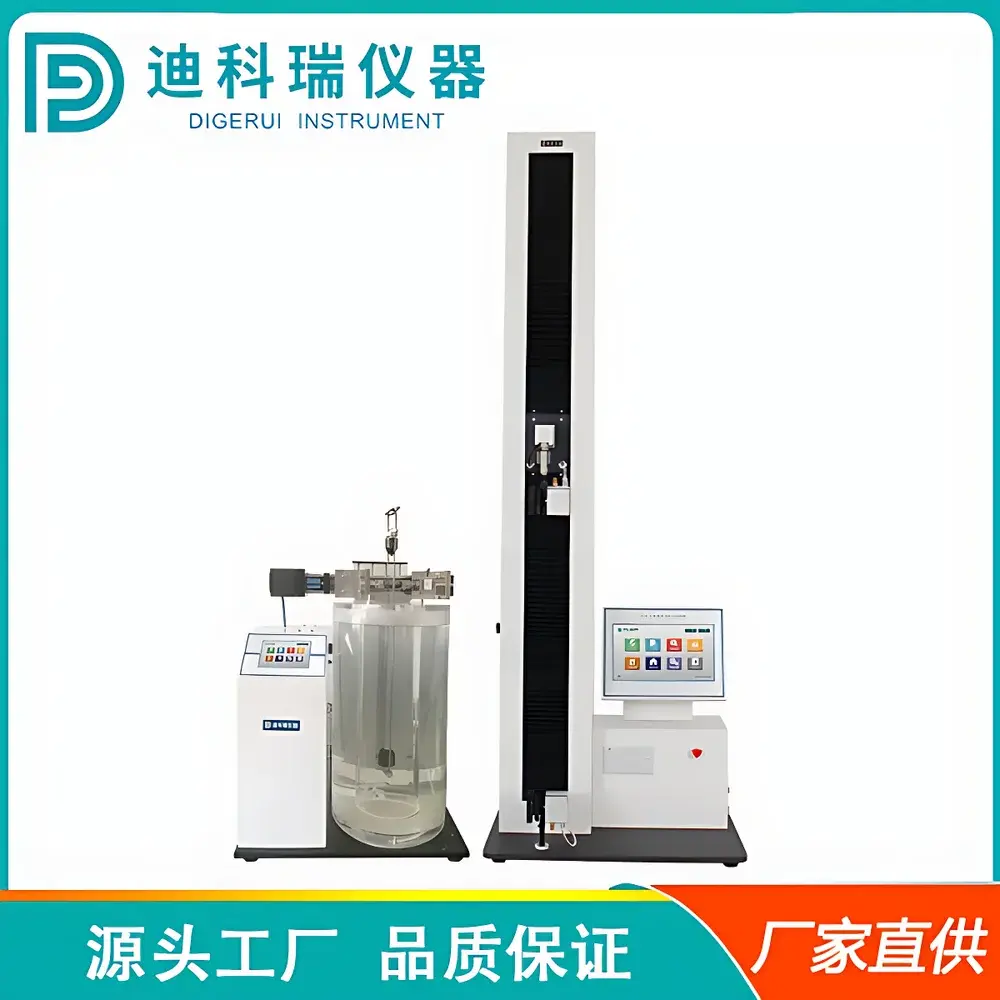
Digerui DKR-HCOF- Catheter Coefficient of Friction (COF) Tester
| Brand | Digerui |
|---|---|
| Origin | Shandong, China |
| Manufacturer Type | Direct Manufacturer |
| Model | DKR-HCOF- |
| Force Range | 10 N (standard) |
| Accuracy | Better than Class 0.5 |
| Force Resolution | 0.01 N |
| Displacement Accuracy | Class 0.5 |
| Displacement Resolution | 0.1 mm |
| Test Speed | 1–800 mm/min (infinitely variable) |
| Stroke | 1000 mm |
| COF Test Distance | >150 mm |
| Catheter Clamp Gap | 0–50 mm |
| Water Bath Temperature Control Range | Ambient to 40 °C |
| Sample Capacity | 1 catheter per test |
| Power Supply | AC 220 V, 50 Hz |
| Dimensions (L×W×H) | 540 × 450 × 1560 mm |
| Net Weight | 92 kg |
Overview
The Digerui DKR-HCOF- Catheter Coefficient of Friction (COF) Tester is a purpose-built mechanical testing system engineered for quantitative evaluation of static and kinetic friction behavior of single-use, non-vascular medical catheters and guidewires. It operates on the principle of controlled axial translation of a hydrated catheter segment through a standardized silicone interface under physiologically relevant conditions—specifically, immersion in temperature-regulated aqueous medium simulating human body temperature (up to 40 °C). The instrument captures real-time force versus displacement profiles during both insertion (forward stroke) and withdrawal (reverse stroke), enabling calculation of static friction force (Fs), kinetic friction force (Fk), static coefficient of friction (μs = Fs/N), and kinetic coefficient of friction (μk = Fk/N), where N represents the normal force exerted by the clamping system. Designed for compliance-driven environments, the DKR-HCOF- supports full traceability, audit-ready data management, and strict adherence to regulatory test protocols governing surface lubricity and handling performance of Class I and Class IIa medical devices.
Key Features
- High-precision imported load cell with ≤0.01 N resolution and better-than-Class-0.5 accuracy, featuring overload protection and automatic zero-point calibration at power-on
- Integrated thermostatic water bath system with PID-controlled heating, maintaining ±0.3 °C stability across 20–40 °C range to replicate in vivo thermal conditions
- Pneumatic sample clamping mechanism reducing operator variability and minimizing setup time per test cycle
- 10-inch industrial-grade capacitive touchscreen HMI with intuitive workflow navigation, real-time curve plotting, and on-device result summary
- Multi-axis precision motion platform utilizing ground-precision ball screws and servo-controlled drive, delivering smooth, jitter-free translation from 1 to 800 mm/min (infinitely variable)
- Comprehensive hardware safety architecture: mechanical end-stop limits, electronic over-travel cutoff, torque-based overload shutdown, auto-return-to-home on completion, and power-loss position memory
- Configurable reciprocating mode supporting up to 999 cycles per test, with independent forward/reverse force acquisition and directional coefficient differentiation
Sample Compatibility & Compliance
The DKR-HCOF- accommodates a broad spectrum of non-vascular catheter geometries—including urinary catheters, tracheal tubes, balloon catheters, and diagnostic guidewires—with adjustable clamp gap (0–50 mm) and minimum test length (>150 mm). Its mechanical design conforms to the dimensional and procedural requirements of YY/T 1536–2017 (“Test Method for Coefficient of Friction of Medical Catheters”), while also supporting harmonized international standards including ASTM D1894 (Standard Test Method for Static and Kinetic Coefficients of Friction of Plastic Film and Sheeting), ISO 8510-2 (Adhesives — Peel Resistance of Adhesive Tapes — Part 2: 90° Peel), and GB/T 13022 (Plastics — Determination of Coefficient of Friction). All firmware and software modules are validated for GMP-aligned operation, incorporating user role-based access control (administrator, operator, reviewer), immutable audit trails, electronic signatures compliant with FDA 21 CFR Part 11, and GLP/GMP-compliant data archiving.
Software & Data Management
Bundled PC-based analysis software provides synchronized acquisition, visualization, and post-processing of raw force–displacement datasets. Each test session generates timestamped, digitally signed reports containing metadata (operator ID, date/time, ambient conditions, calibration status), graphical overlays of forward/reverse curves, tabulated statistical outputs (mean μs, μk, SD, CV%), and exportable CSV/PDF files. The system supports USB 2.0 host connectivity and includes driver-level compatibility with Windows 10/11 platforms. All data records are stored in encrypted local databases with write-once-read-many (WORM) enforcement; historical entries cannot be edited or deleted without generating an auditable event log. Optional IQ/OQ documentation packages are available for laboratory qualification under ISO 13485 and Annex 11 frameworks.
Applications
- Pre-market validation of hydrophilic coating performance on urethral catheters per ISO 15223-1 labeling requirements
- Comparative friction assessment of alternative lubricants (e.g., PVP, hyaluronic acid, silicone oil) during R&D screening
- Batch release testing for consistency of surface treatment processes in contract manufacturing organizations (CMOs)
- Root cause analysis of catheter insertion resistance reported in field complaints or post-market surveillance
- Supporting biocompatibility dossier submissions requiring mechanical interface data under ISO 10993-1
- Quality control verification of extrusion lot uniformity for polymer tubing (e.g., PVC, PU, Pebax®)
FAQ
Does the DKR-HCOF- comply with YY/T 1536–2017 for regulatory submission?
Yes—the instrument’s mechanical configuration, sensor calibration protocol, water bath thermal profile, and test sequence logic fully satisfy the normative clauses and annexes of YY/T 1536–2017.
Can test parameters be locked to prevent unauthorized modification during production runs?
Yes—via multi-tiered user permissions, critical test settings (speed, distance, temperature, cycle count) can be restricted to administrator-level access only.
Is the force transducer calibrated traceable to national metrology institutes?
All standard load cells ship with a UKAS-accredited calibration certificate (ISO/IEC 17025), and internal recalibration routines support daily verification using certified deadweight standards.
What is the maximum catheter outer diameter supported by the clamping system?
The pneumatic clamp accommodates ODs up to 12 mm when configured with extended jaw inserts; custom fixtures are available for larger profiles upon request.
How is data integrity ensured during long-duration multi-cycle tests?
The embedded controller employs dual-buffered RAM logging with cyclic redundancy check (CRC) validation; loss of external power triggers immediate non-volatile flash storage of all acquired points up to that instant.



