
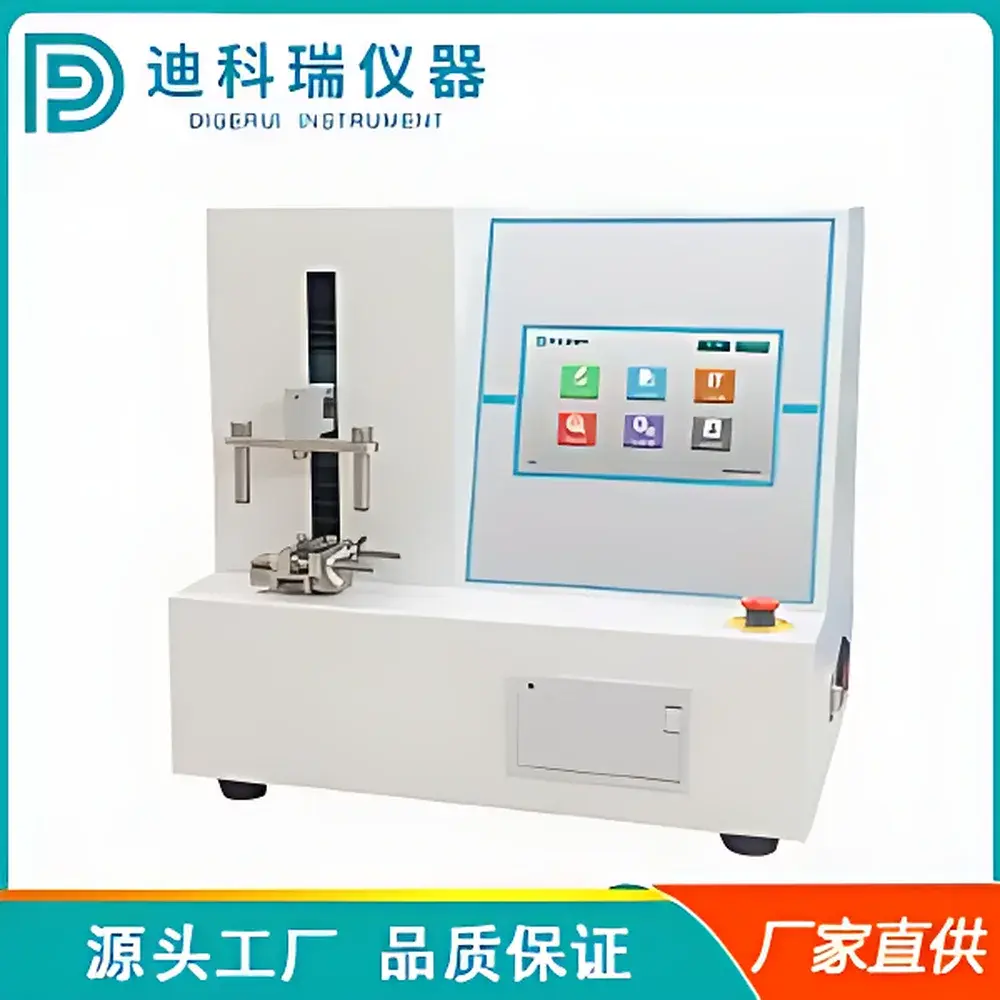

Digerui DKR-NT20 Linear Blade Sharpness and Cutting Performance Tester for Surgical Staplers
| Brand | Digerui |
|---|---|
| Model | DKR-NT20 |
| Type | Linear Mechanical Cutting Force & Edge Performance Tester |
| Origin | Shandong, China |
| Manufacturer | Digerui Instrument Co., Ltd. |
| Compliance | Designed per ISO 7740, ASTM F1935, YY/T 0245–2022 (Surgical Staplers), ISO 11607–2 (Packaging for Terminally Sterilized Medical Devices) |
| Measurement Principle | Controlled linear displacement with load-cell-based force acquisition during blade-to-tissue-simulant cutting |
Overview
The Digerui DKR-NT20 Linear Blade Sharpness and Cutting Performance Tester is an engineered mechanical property testing system designed specifically for quantitative evaluation of cutting performance in surgical staplers, linear cutters, and reusable or single-use blade-based medical devices. It operates on a calibrated linear actuation principle: a motor-driven carriage moves a standardized test blade at constant velocity across a compliant, homogeneous tissue-simulating substrate (e.g., polyurethane foam blocks per ISO 7740 or multilayered porcine tissue analogs). A high-resolution load cell (±0.5% FS accuracy) captures real-time cutting force profiles—including peak cutting force, average cutting resistance, and energy integral over displacement—enabling objective assessment of edge geometry, material hardness, heat treatment consistency, and lubrication efficacy. Unlike pendulum or drop-weight methods, the DKR-NT20 provides traceable, repeatable, and spatially resolved force-displacement data essential for design validation, supplier qualification, and regulatory submission under FDA 21 CFR Part 820 and ISO 13485 quality management systems.
Key Features
- Programmable linear motion control with adjustable stroke length (0–50 mm), speed range (1–50 mm/s), and acceleration profile to simulate clinical deployment conditions.
- Integrated 500 N capacity load cell with 0.01 N resolution and digital filtering to suppress mechanical noise during transient force events.
- Dual-mode operation: single-cycle testing for R&D screening and multi-cycle fatigue mode (up to 10,000 cycles) for durability assessment of blade coatings or hinge mechanisms.
- Modular fixture interface compatible with standard 30-mm and 60-mm linear stapler cartridges, as well as custom adapters for proprietary device geometries.
- Real-time graphical display of force vs. displacement curves with automatic annotation of key metrics: Fmax, Favg, work-of-cut (J), and coefficient of variation (CV%) across replicate tests.
- Rugged aluminum alloy frame with vibration-dampened base plate and precision-ground linear rails ensuring mechanical stability under repeated loading.
Sample Compatibility & Compliance
The DKR-NT20 accommodates a wide range of blade-integrated devices including titanium and stainless steel linear staplers, endoscopic cutters, and disposable trocar blades. Test substrates include certified ISO 7740 polyurethane foams (Type I–III), multilayer synthetic tissue analogs (e.g., Gelatin–Agar composites), and validated porcine tissue specimens. All test protocols align with internationally recognized standards: ISO 7740 (Performance requirements for surgical blades), ASTM F1935 (Standard Test Method for Measuring the Cutting Performance of Scalpels), YY/T 0245–2022 (Linear Staplers for Surgical Use – Requirements and Test Methods), and ISO 11607–2 Annex D (Validation of cutting performance for packaging integrity assessment). Data outputs support GLP-compliant audit trails when used with optional timestamped CSV export and user-access-level logging.
Software & Data Management
The embedded Windows-based control software (v3.2) supports full test method configuration, real-time visualization, and automated report generation in PDF/CSV formats. Each test record includes operator ID, environmental conditions (temperature/humidity metadata), calibration certificate reference, and raw force-displacement time-series data. Audit trail functionality complies with FDA 21 CFR Part 11 requirements when configured with electronic signatures and role-based access controls (admin/operator/viewer). Raw datasets are exportable for statistical analysis in JMP, Minitab, or Python-based SciPy workflows. Firmware updates are delivered via secure HTTPS channel with SHA-256 signature verification.
Applications
- Quantitative comparison of blade sharpness across manufacturing lots to ensure batch-to-batch consistency per ISO 13485 clause 7.5.1.
- Validation of edge-retention after sterilization (EtO, gamma, steam) per ISO 11135 and ISO 11137.
- Design verification of novel blade coatings (e.g., diamond-like carbon, TiN) against baseline stainless steel controls.
- Root cause analysis of premature blade dulling or tissue drag in clinical feedback investigations.
- Supporting technical documentation for CE Marking (Annex II) and FDA 510(k) submissions requiring mechanical performance evidence.
- Quality control screening for OEM suppliers of surgical stapler components under AS9100 or IATF 16949-aligned processes.
FAQ
What tissue-simulating materials are recommended for routine testing?
ISO 7740 Type II polyurethane foam is the default substrate for baseline qualification; multilayered synthetic gels may be used for application-specific correlation studies.
Does the DKR-NT20 support automated pass/fail decision logic based on predefined thresholds?
Yes—user-defined limits for Fmax, work-of-cut, and CV% can trigger visual alerts and auto-flag outliers in batch reports.
Is calibration traceable to national metrology institutes?
Load cell calibration is performed annually using NIST-traceable deadweight standards; certificate includes uncertainty budget per ISO/IEC 17025.
Can the system integrate with LIMS or MES platforms?
Via RESTful API and OPC UA protocol support (optional module), enabling bidirectional data exchange with LabVantage, Thermo Fisher SampleManager, or Siemens Opcenter.
What maintenance is required to sustain measurement accuracy?
Bi-weekly rail lubrication, quarterly load cell zero-check, and annual full recalibration—including mechanical alignment verification—are specified in the maintenance logbook.




