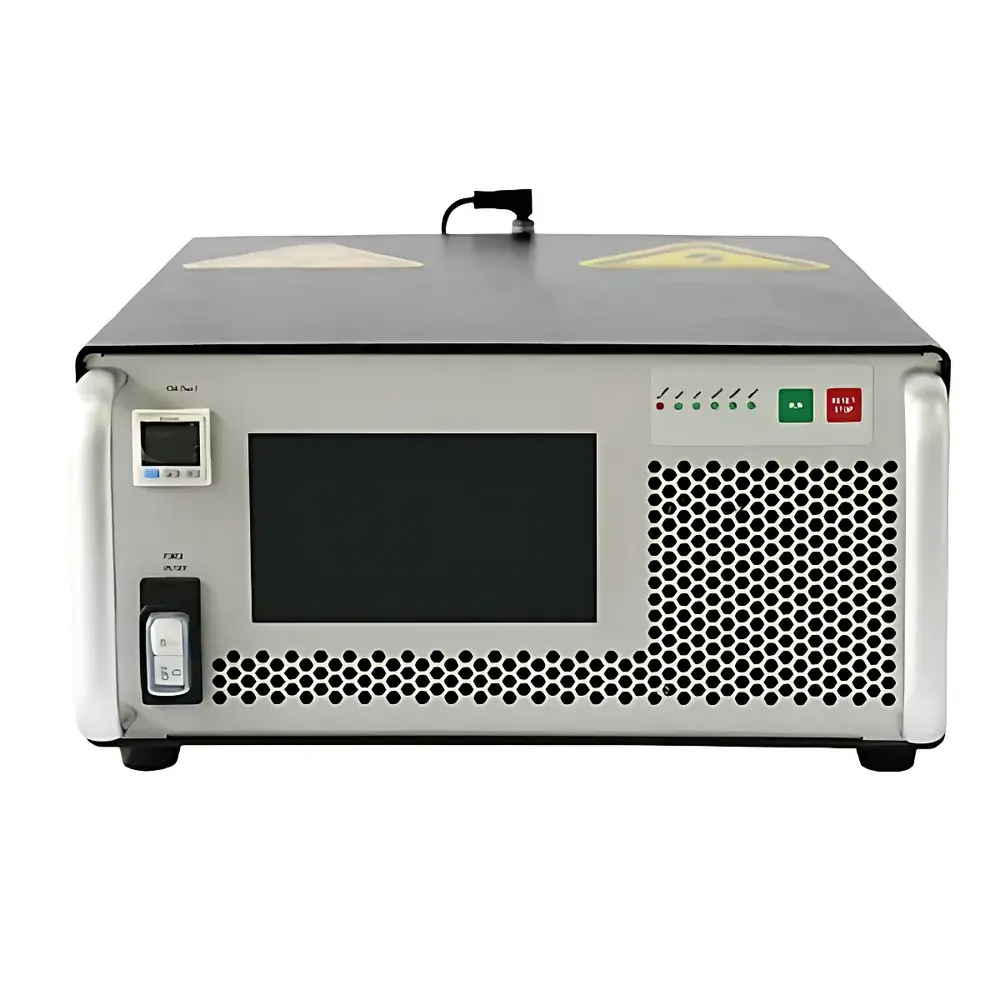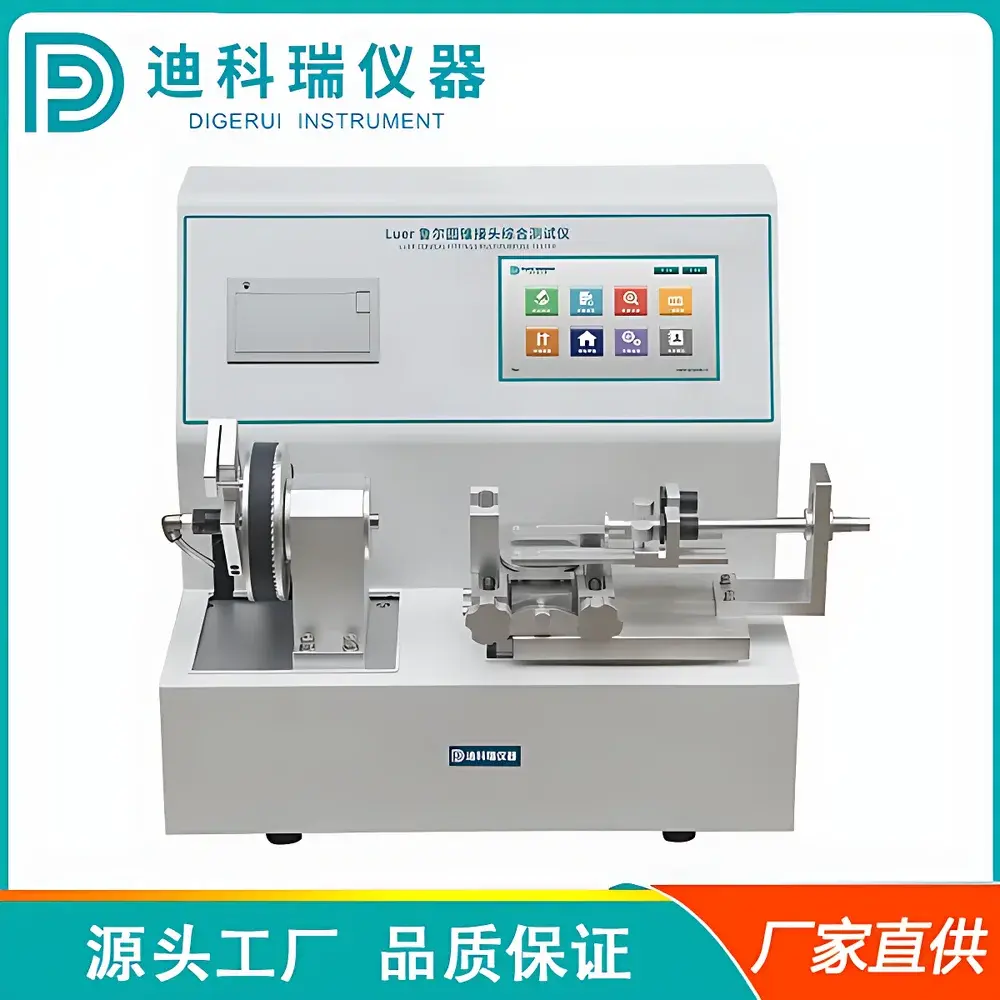
Digerui Luer-C2 Luer Cone Connector Comprehensive Tester
| Brand | Digerui |
|---|---|
| Origin | Shandong, China |
| Manufacturer Type | OEM/ODM Manufacturer |
| Country of Origin | China |
| Model | Luer-C2 |
| Price | USD 140 (approx. based on ¥1000) |
| Compliance | GB/T 1962.1–2015, GB/T 1962.2–2001, YY/T 0916.20–2019, ISO 80369 series |
| Axial Force Range | 1–100 N (±0.5% FS) |
| Internal Hydrostatic Pressure | 0–500 kPa (±0.25% FS) |
| Vacuum Pressure Range | −1 to −90 kPa (±0.25% FS) |
| Torque Measurement | 0.01–0.50 N·m (±0.5% FS) |
| Separation Force | 20–60 N (±0.5% FS) |
| Leak Rate Resolution | ±0.00001 kPa (positive/negative pressure) |
| Power Supply | AC 220 V, 50 Hz |
| Power Consumption | 70 W |
| Dimensions | 440 × 380 × 415 mm (L×W×H) |
| Net Weight | 31 kg |
Overview
The Digerui Luer-C2 Luer Cone Connector Comprehensive Tester is an automated, precision-engineered instrumentation platform designed for the full-spectrum mechanical and functional evaluation of 6% (Luer) conical connectors used in medical devices—including syringes, hypodermic needles, IV sets, infusion pumps, and fluid/gas delivery systems. It operates on a validated electromechanical test architecture that integrates high-fidelity force, torque, pressure, and leakage quantification within a single unified workflow. The system implements standardized loading protocols defined by ISO 80369 and its national harmonized counterparts (GB/T 1962.1–2015, GB/T 1962.2–2001, YY/T 0916.20–2019), enabling objective, repeatable assessment of critical performance parameters such as leak integrity under positive/negative pressure, axial separation resistance, rotational engagement/disengagement torque, assembly force profile, over-torque resilience, stress cracking susceptibility, and thread slippage resistance. Its design adheres to the metrological and procedural rigor required for quality control laboratories operating under ISO 13485, FDA QSR 21 CFR Part 820, and GMP-aligned environments.
Key Features
- Integrated multi-parameter measurement: Simultaneous real-time acquisition of axial force (1–100 N), torque (0.01–0.50 N·m), internal hydrostatic pressure (0–500 kPa), vacuum pressure (−1 to −90 kPa), and differential leakage rate (resolution ±0.00001 kPa).
- 7-inch HD capacitive touchscreen interface with intuitive icon-driven navigation—supports multilingual UI (English default), user-defined test sequences, and dynamic parameter visualization during execution.
- Automated electromechanical actuation system eliminates operator-induced variability in force application, rotation speed, dwell time, and pressure ramping—ensuring inter-laboratory reproducibility.
- High-stability load cells and piezoresistive pressure transducers calibrated to traceable NIST-equivalent standards; all sensors include over-range protection and auto-zero compensation.
- Onboard thermal printer outputs tamper-evident test reports with timestamp, operator ID, sample ID, pass/fail status, raw data traces, and audit trail metadata.
- GMP-compliant software architecture featuring role-based user authentication (admin/operator/auditor), electronic signatures per 21 CFR Part 11, immutable test record storage, and configurable audit log export (CSV/PDF).
Sample Compatibility & Compliance
The Luer-C2 accommodates all standard Luer taper geometries defined in ISO 80369-1 through -7, including Luer slip, Luer lock, small-bore (e.g., enteral, respiratory, urinary), and specialty variants (e.g., ISO 80369-6 for enteral applications). Test fixtures are modular and tool-free, supporting rapid reconfiguration between rigid, semi-rigid, and flexible connector assemblies. All test methods strictly implement the pass/fail criteria specified in GB/T 1962.1–2015 (leak detection at 300 kPa for 30 s, max allowable leak rate ≤0.005 Pa·m³/s), GB/T 1962.2–2001 (separation force ≥20 N, unscrewing torque ≥0.15 N·m for 5 s), and YY/T 0916.20–2019 (stress cracking evaluation under sustained torque and axial load). The system’s firmware and calibration documentation support regulatory submissions for CE marking, FDA 510(k), and NMPA registration.
Software & Data Management
Embedded firmware v3.2 provides full test method scripting, customizable pass thresholds, statistical process control (SPC) charting (X̄/R, Cp/Cpk), and batch-level summary reporting. Raw data—including time-stamped force/torque/pressure curves—are stored in encrypted SQLite databases with SHA-256 hashing. Export options include CSV (for Excel/LabVIEW integration), PDF (with digital signature), and XML (compatible with LIMS platforms such as LabWare, STARLIMS, and Thermo Fisher SampleManager). Audit trails record every user action—login/logout, parameter modification, test initiation, result override, and report generation—with immutable timestamps and IP address logging. Data retention policies are configurable per site requirements (default: 10-year archival).
Applications
- Quality assurance testing of Luer connectors during incoming inspection, in-process verification, and final release of Class II/III medical devices.
- Design validation and accelerated aging studies assessing long-term mechanical integrity and material compatibility (e.g., polycarbonate vs. polypropylene stress cracking behavior).
- Supplier qualification audits requiring objective, instrumented evidence of conformance to ISO 80369 specifications.
- Root cause analysis of field failures related to connector disengagement, fluid leakage, or thread deformation.
- Regulatory compliance preparation for ISO 13485:2016 Clause 7.5.2 (validation of production processes) and IEC 62304 (software lifecycle management).
FAQ
Does the Luer-C2 comply with ISO 80369-7 for small-bore connectors used in enteral applications?
Yes—the system supports all mechanical test protocols defined in ISO 80369-7 via dedicated fixture kits and firmware-configurable test templates.
Can test methods be exported and shared across multiple Luer-C2 units in a multi-site manufacturing network?
Yes—test method files (.lct format) are portable and interoperable; version-controlled deployment is supported via USB or Ethernet.
Is calibration certification included with shipment?
Each unit ships with a factory calibration certificate traceable to CNAS-accredited standards; optional UKAS/NIST-traceable calibration services are available upon request.
What is the maximum allowable deviation for torque measurement during routine verification?
Per internal SOPs aligned with ISO/IEC 17025, torque verification tolerance is ±0.5% of full scale at three points (10%, 50%, 90% FS) using certified torque calibrators.
How does the system handle non-conforming results during automated testing?
Upon detection of out-of-specification values, the instrument halts the cycle, triggers audible/visual alerts, logs the event with root-cause flags, and generates a non-conformance report (NCR) template compliant with ISO 9001 Clause 8.7.