
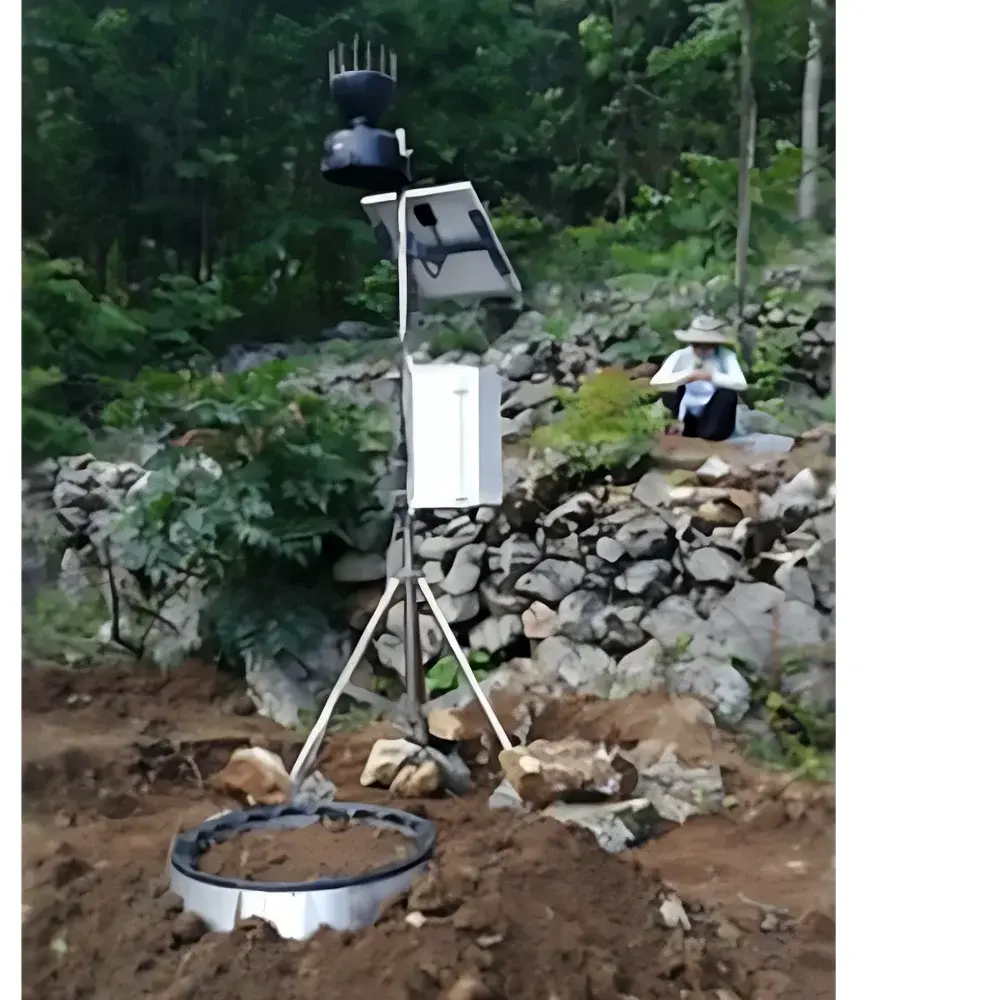
DiJiang DJ-212X Series Compact Dual-Chamber Soil Lysimeter System
| [Brand | DiJiang |
|---|---|
| Origin | Germany |
| Manufacturer Type | Authorized Distributor |
| Origin Category | Imported |
| Model | DJ-212X |
| Pricing | Upon Request |
| Data Logger | 8 single-ended analog inputs, 4 pulse inputs, 3 voltage excitation terminals, 12 x 12V switch outputs, 8 SDI-12 ports, 4 RS485/RS232 interfaces |
| Analog Resolution | 12-bit (0–5000 mV range, 1.47 mV basic resolution, ±(0.1% of reading + 2 LSB) accuracy from −20 °C to +40 °C) |
| Internal Storage | 32 MB (supports ≥64,384 records at 1-hr interval ≈ 7.3 years) |
| Power | 11–24 V DC (solar + 12 V / 65 Ah sealed lead-acid battery) |
| Sleep current | 0.24 mA, Measurement current: 12 mA (excl. sensors), LTE transmission avg.: 40 mA |
| Communication | Modbus RTU over RS485/RS232, SDI-12, LTE CAT1 (embedded SIM), GPS + barometric pressure + board temperature sensors onboard |
| Enclosure | IP65, 350 × 250 × 120 mm, 4.5 kg |
| Inner Chamber | SUS304 stainless steel, diameters φ300–φ900 mm × heights 300–900 mm |
| Outer Chamber | Food-grade PP polymer, diameters 500–1100 mm × heights 450–1050 mm |
| Load Cell | Alloy aluminum or stainless steel platform |
| Drainage Sensor | Tipping bucket with reed switch, 0.2 mm (4.28 mL) resolution, ±4% accuracy |
| Soil Tri-sensor | Volumetric water content 0.88–81.88%, temperature −40 to +80 °C, EC 0–23,000 µS/cm, IP68 |
| Water Level Sensor | 0–1 m range, RS485 output, 316L stainless steel housing, −40 to +60 °C medium temp |
| Drainage Flow Rate | 1800 mL/min @ 12 V |
| Tripod | 2 m height, full SUS304 construction, 42 mm OD mounting pole] |
Overview
The DiJiang DJ-212X Series Compact Dual-Chamber Soil Lysimeter System is a field-deployable, precision hydrological instrumentation platform engineered for direct, continuous quantification of soil water balance components—precipitation input, evapotranspiration loss, and deep drainage output—based on the fundamental principle of mass conservation. Unlike indirect estimation methods (e.g., Penman-Monteith modeling), this system provides empirical, high-temporal-resolution measurements of actual water fluxes across defined soil columns under ambient environmental conditions. Its dual-chamber architecture isolates the inner lysimeter core (SUS304 stainless steel) from external lateral flow and thermal interference via an outer containment sleeve (food-grade PP polymer), minimizing edge effects and enhancing measurement fidelity in heterogeneous or sloped terrain. Designed for long-term unattended operation, the system integrates solar-renewable power, embedded telemetry, and robust environmental hardening (IP65 enclosure, −20 °C to +70 °C operational range), making it suitable for deployment in remote ecological research stations, agricultural watershed monitoring networks, and climate change impact studies.
Key Features
- Dual-chamber physical isolation: Inner SUS304 stainless steel cylinder (diameters φ300–φ900 mm, heights 300–900 mm) nested within corrosion-resistant PP outer sleeve (diameters 500–1100 mm, heights 450–1050 mm) minimizes lateral water intrusion and thermal conduction artifacts.
- High-precision gravimetric measurement: Integrated C3-class load cell with ≥1 g resolution and ≥2 g repeatability, temperature-compensated (−10 to +40 °C), supports rated capacities up to 1500 kg.
- Modular sensor compatibility: Standardized interfaces (SDI-12, RS485, pulse, analog) enable seamless integration of optional sensors—including tipping-bucket rain gauge (0.2 mm resolution), tensiometers, multi-parameter soil probes (VWC, EC, temperature), water level transducers (0–1 m, RS485, 316L), and meteorological suites (wind, radiation, barometric pressure).
- Autonomous power & telemetry: 12 V / 60 W monocrystalline solar panel paired with 12 V / 65 Ah sealed lead-acid battery ensures >12 months of uninterrupted operation; embedded LTE CAT1 modem with pre-installed SIM enables real-time data upload to cloud infrastructure.
- Onboard intelligence: Integrated data logger features 8 configurable analog inputs (12-bit, ±0.1% + 2 LSB accuracy), 4 pulse counters, 12 programmable 12 V switch outputs, and 32 MB internal memory—capable of storing >64,000 records (≈7.3 years at 1-hour intervals).
- Field-deployable mechanical design: Total unit weight ≤4.5 kg (electronics module); full SUS304 tripod (2 m height, 42 mm OD pole) ensures rapid installation on flat or custom-sloped terrain without excavation-intensive foundations.
Sample Compatibility & Compliance
The DJ-212X accommodates undisturbed or repacked soil cores across texture classes (sand to clay loam) and organic matter contents typical of agricultural, forest, and semi-arid ecosystems. Inner chamber dimensions are selected to satisfy USDA NRCS and ISO 11274 minimum volume requirements for representative hydraulic characterization. All wetted components comply with EU Regulation (EC) No 1935/2004 for food-contact materials (PP outer sleeve) and ASTM A240/A240M for corrosion resistance (SUS304). The system meets IEC 60529 IP65 ingress protection standards for dust-tight and low-pressure water jet resistance. Data acquisition firmware adheres to GLP-aligned timestamping, audit-trail logging, and non-volatile memory write integrity protocols. While not certified for FDA 21 CFR Part 11 compliance out-of-the-box, the cloud API and private-platform integration options support traceable, validated data workflows required for regulatory submissions.
Software & Data Management
Raw sensor data are transmitted via encrypted LTE to a secure DiJiang-hosted cloud platform offering three tiers of access: (1) Free-tier dashboard with real-time visualization, historical trend plots, and automated water balance calculations (P − ET − D = ΔS); (2) RESTful API enabling direct ingestion into institutional databases (e.g., PostgreSQL, MATLAB, Python Pandas); (3) Private-cloud deployment option with SSO, role-based permissions, and full metadata schema control. All data packets include embedded GPS coordinates, barometric pressure, and board temperature—enabling post-hoc atmospheric correction of drainage and evaporation estimates. The platform retains raw sensor values (not just derived metrics), supports user-defined calibration coefficients, and generates ISO-compliant CSV/NetCDF exports. Firmware updates are delivered over-the-air (OTA) with SHA-256 signature verification.
Applications
- Quantifying crop water use efficiency (WUE) and irrigation scheduling thresholds across cultivars and soil types.
- Evaluating vadose zone solute transport dynamics (e.g., nitrate leaching, pesticide mobility) under controlled or natural rainfall regimes.
- Validating land surface model (LSM) parameterizations in regional climate models (e.g., CLM, Noah-MP).
- Monitoring long-term ecohydrological responses to drought, elevated CO₂, or land-use change in eddy-covariance tower footprints.
- Calibrating remote sensing-based ET algorithms (e.g., METRIC, SSEBop) using ground-truth lysimeter fluxes.
- Assessing landfill cap performance and contaminant migration pathways in waste containment research.
FAQ
What is the minimum recommended soil column height for reliable drainage measurement?
For most mineral soils, a minimum inner chamber height of 600 mm is advised to ensure adequate hydraulic gradient development during low-intensity rainfall events. For shallow-rooted species or sandy profiles, 300 mm may suffice—but validation against deeper columns is recommended.
Can the system operate continuously during extended cloudy periods?
Yes. The 65 Ah battery provides ≥14 days of autonomy at full measurement frequency (1-min intervals) with all sensors active. Solar recharge resumes automatically upon illumination; no manual intervention is required.
Is slope-specific installation supported beyond standard configurations?
Yes. DiJiang offers engineering consultation and mechanical customization—including angled base plates, differential leveling mounts, and reinforced anchoring kits—for deployments on gradients up to 25°, with documented case studies available upon request.
How is data integrity ensured during cellular network outages?
All measurements are stored locally in non-volatile memory (32 MB) with time-stamped indexing. Upon network restoration, queued data are transmitted sequentially with sequence-number verification to prevent duplication or omission.
Are calibration certificates provided for the load cell and tipping-bucket sensor?
Each unit ships with factory calibration reports traceable to NIST standards for both primary transducers. Field recalibration procedures—including dead-weight verification for load cells and volumetric validation for tipping buckets—are documented in the technical manual.
Related Products







