
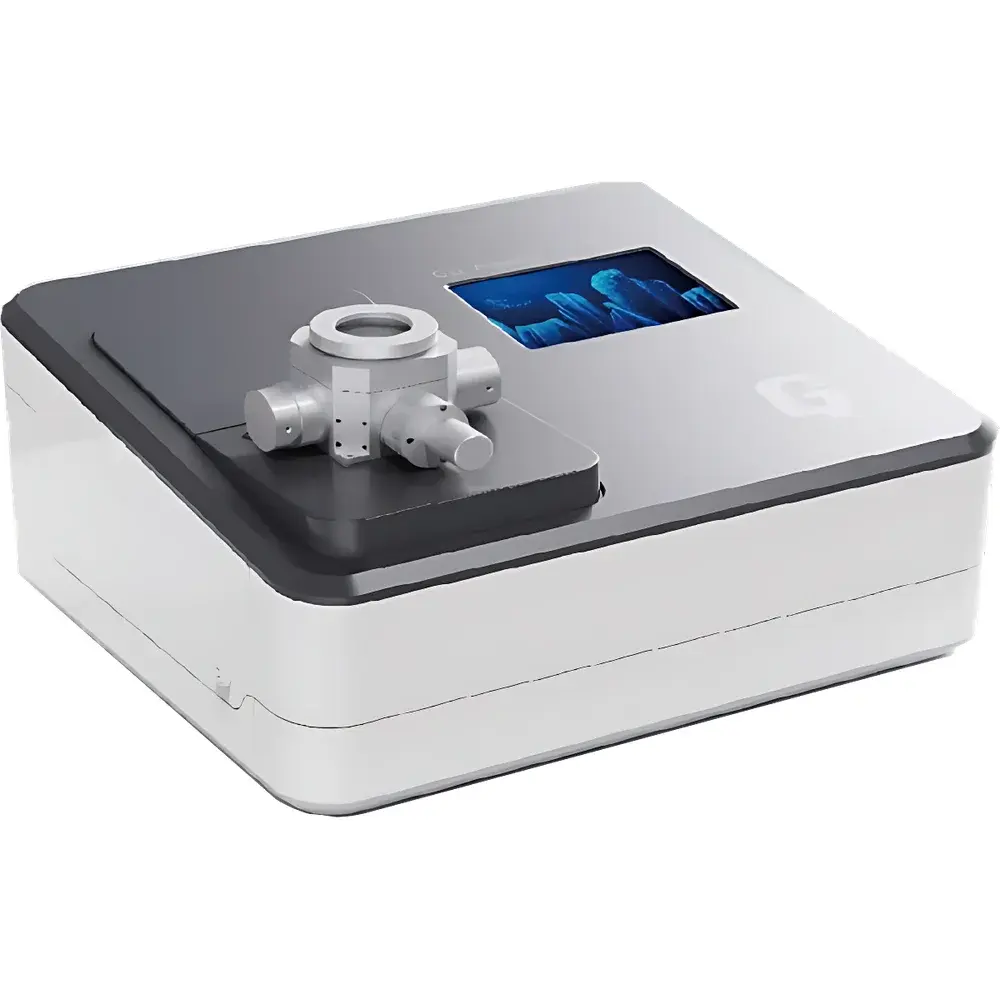
DingHong GU-AI8000 Ion Milling System
| Brand | DingHong |
|---|---|
| Origin | Jiangsu, China |
| Manufacturer Type | Authorized Distributor |
| Region Classification | Domestic (PRC) |
| Model | GU-AI8000 |
| Ion Energy Range | 0–10 keV |
| Milling Angles | 90° and 180° selectable |
| Maximum Sample Dimensions | Ø25 × 20 mm |
| Pumping Speed | 0.8 m³/h |
| Base Pressure (without gas ballast) | 5 × 10⁻¹ Pa |
| Ultimate Vacuum (with dual-stage rotary vane pump + turbomolecular pump) | 8 × 10⁻⁶ Pa |
| Cooling Range | –25 °C to +30 °C (Peltier-based) |
| Beam Spot Size | Large-area (≥10 mm diameter per source) |
| Remote Control | LAN-enabled, cross-platform (Windows/macOS/iOS/Android) |
Overview
The DingHong GU-AI8000 Ion Milling System is a high-precision, dual-source broad-beam ion milling instrument engineered for the preparation of artifact-free cross-sectional and planar surfaces in materials science laboratories. It operates on the principle of physical sputtering—using accelerated inert gas ions (typically Ar⁺) to remove surface material through momentum transfer—enabling controlled, low-damage thinning and polishing without introducing mechanical stress or thermal distortion. Unlike conventional mechanical polishing or focused ion beam (FIB) systems, the GU-AI8000 delivers uniform, large-area milling at nanometer-scale thickness control, making it especially suitable for transmission electron microscopy (TEM), scanning electron microscopy (SEM) cross-section analysis, and microstructural characterization of heterogeneous, brittle, or magnetic samples.
Key Features
- Dual independently controllable ion sources with adjustable angular configuration (90° or 180°), enabling simultaneous or asymmetric milling for enhanced versatility in sample geometry and damage mitigation.
- Large-diameter ion beam (>10 mm per source) ensures rapid, uniform removal across centimeter-scale areas—ideal for bulk sample polishing and efficient TEM lamella thinning.
- Peltier-based semiconductor cooling system with active temperature regulation from –25 °C to +30 °C, eliminating reliance on liquid nitrogen while minimizing thermal drift and heat-induced phase transformation during milling.
- Integrated dual-pump architecture: oil-free diaphragm pump (primary) + turbomolecular pump (high-vacuum stage), achieving ultimate pressure ≤8 × 10⁻⁶ Pa—critical for stable ion beam generation and contamination-free operation.
- Magnetic-field-free ion optics design prevents ferromagnetic sample deflection and eliminates metallic residue accumulation on beam optics, reducing maintenance frequency and improving long-term beam stability.
- Liquid-cooled chamber base and vibration-damped mechanical platform ensure sub-micron positional stability during extended milling cycles—essential for reproducible nano-thinning outcomes.
Sample Compatibility & Compliance
The GU-AI8000 accommodates diverse material classes—including ferromagnetic alloys, porous ceramics, polymer composites, battery electrode stacks, geological thin sections, and brittle intermetallics—without requiring conductive coating or special mounting protocols. Its non-contact, low-energy (<10 keV) ion beam minimizes preferential sputtering and amorphization, preserving native crystallographic and chemical integrity. The system meets baseline vacuum safety requirements per IEC 61000-6-2 (EMC immunity) and incorporates pressure interlocks compliant with ISO 14119 for guarded access during operation. While not certified for GMP/GLP environments out-of-the-box, its audit-ready logging architecture supports integration into regulated workflows adhering to FDA 21 CFR Part 11 when paired with validated third-party LIMS or ELN platforms.
Software & Data Management
The GU-AI8000 is operated via a web-native control interface accessible over local Ethernet—supporting concurrent remote sessions from Windows, macOS, iOS, and Android devices. All milling parameters (ion energy, angle, time, current, temperature setpoint) are logged with timestamped metadata and stored in SQLite-backed local databases, exportable as CSV or HDF5 for traceability. The software includes preconfigured milling recipes for common applications (e.g., “Cu/Ni multilayer TEM prep”, “SiC ceramic cross-section”), and supports user-defined scripting via Python API for automated multi-step protocols. Audit trails include operator ID, parameter changes, vacuum status history, and thermal sensor readings—facilitating internal QA reviews and regulatory documentation.
Applications
- Preparation of electron-transparent regions in bulk specimens for high-resolution TEM and STEM-EELS analysis.
- Generation of damage-free cross-sections in layered battery cathodes (e.g., NMC/LiCoO₂/graphite), solid-state electrolytes, and fuel cell membranes.
- Planar polishing of geological thin sections (shales, meteorites, volcanic glasses) prior to cathodoluminescence or Raman mapping.
- Surface decontamination and stress relief of mechanically polished metallographic samples prior to EBSD indexing.
- Controlled thinning of magnetic recording media, spintronic heterostructures, and soft-magnetic alloys without magnetic domain perturbation.
- Rapid sectioning of automotive composite brake pads, CFRP chassis components, and thermally sprayed coatings for failure analysis.
FAQ
What vacuum level is required for stable ion beam operation?
Stable beam generation requires a base pressure ≤5 × 10⁻⁴ Pa; the integrated turbomolecular pump achieves ≤8 × 10⁻⁶ Pa, ensuring consistent ion current density and beam collimation.
Can the GU-AI8000 prepare TEM samples directly from bulk blocks?
Yes—when combined with standard dimpling or tripod polishing pre-thinning, the GU-AI8000 routinely produces electron-transparent windows (<100 nm thickness) in <60 minutes for conductive samples and <120 minutes for insulators.
Is liquid nitrogen required for cryo-milling?
No—the Peltier cooling system reaches –25 °C without cryogens, sufficient for most heat-sensitive polymers, organics, and hydrated phases.
How is beam alignment verified and maintained?
Beam centering is performed using a retractable Faraday cup and real-time current monitoring; optical alignment aids (integrated red-dot laser) assist initial setup, and no magnetic steering coils require recalibration.
Does the system support automated recipe sequencing?
Yes—via the Python SDK, users can define cascaded steps (e.g., coarse milling → angle shift → fine polishing → cooldown hold), with conditional triggers based on elapsed time or vacuum stability.



