
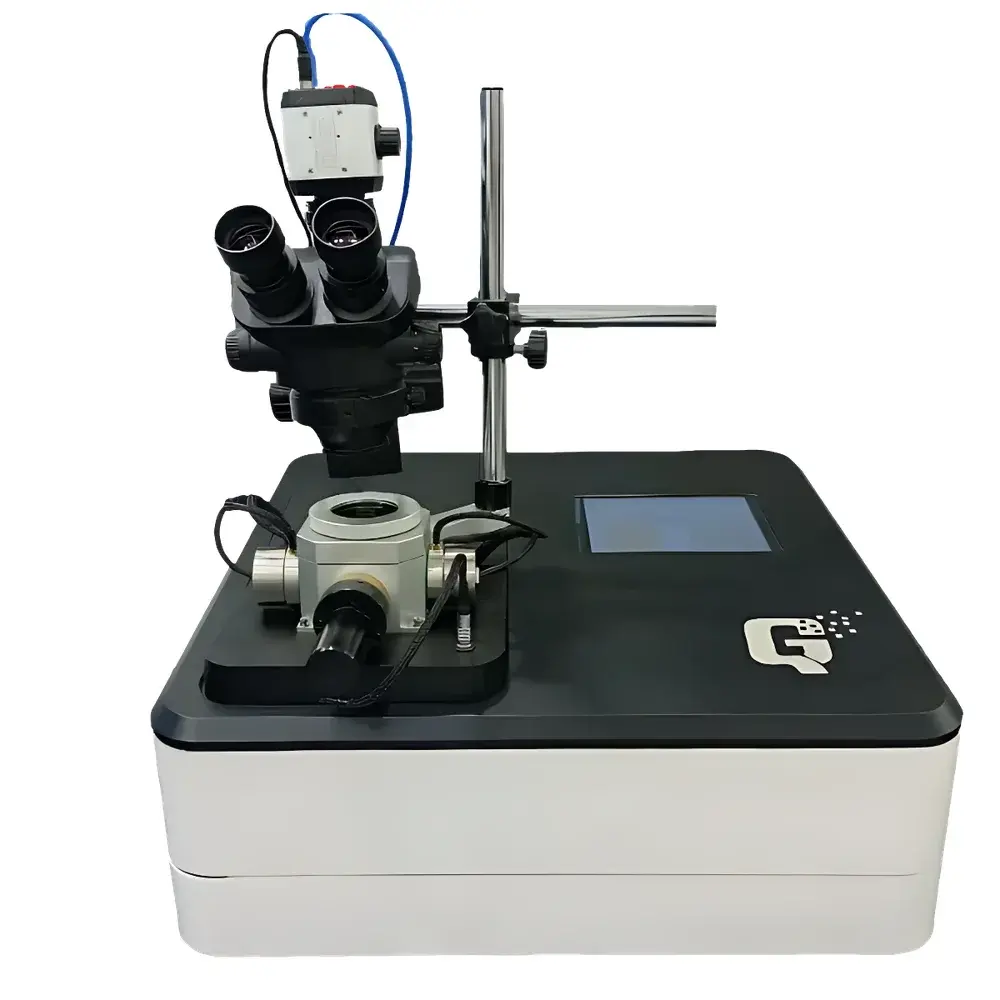
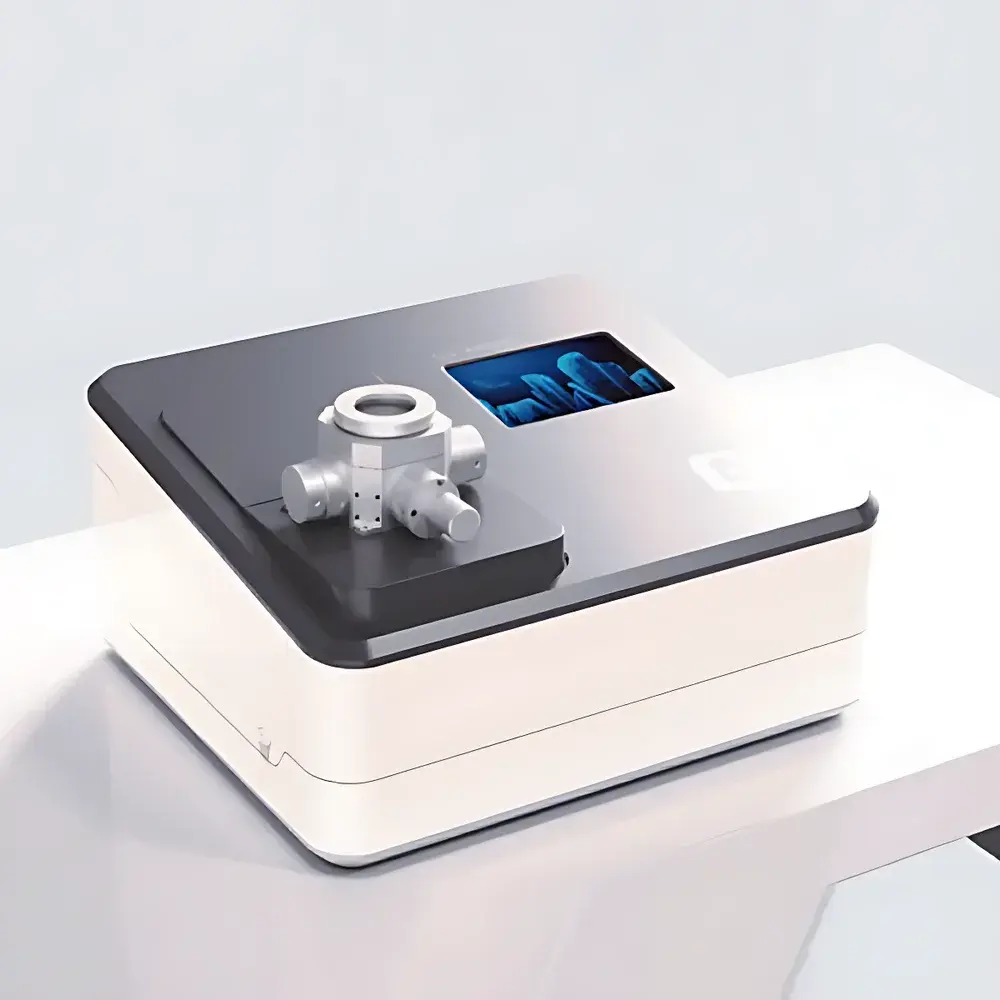
DingHong GU-AI9000 Ion Milling System
| Brand | DingHong |
|---|---|
| Origin | Jiangsu, China |
| Manufacturer Type | Authorized Distributor |
| Country of Origin | China |
| Model | GU-AI9000 |
| Ion Energy Range | 0–10 keV |
| Tilting Angle Range | 0–360° (continuous rotation) |
| Maximum Sample Dimensions | 25 × 25 × 20 mm |
Overview
The DingHong GU-AI9000 Ion Milling System is a high-precision, benchtop ion beam thinning instrument engineered for the preparation of electron-transparent specimens for transmission electron microscopy (TEM), scanning transmission electron microscopy (STEM), and atom probe tomography (APT). It operates on the principle of physical sputtering using a focused, magnetically unshielded (non-magnetic focusing) argon ion beam. Unlike conventional magnetic lens-based ion sources—which introduce beam distortion and localized heating—the GU-AI9000 employs an electrostatic collimation architecture that delivers uniform ion flux across large-area samples while minimizing preferential sputtering, surface amorphization, and subsurface damage. This design enables reproducible removal of material at controlled rates (typically 0.1–5 nm/s depending on material and energy), preserving crystallographic integrity and enabling high-fidelity structural analysis of grain boundaries, interfaces, precipitates, and defect structures.
Key Features
- Non-magnetic ion beam optics: Eliminates magnetic field interference with sensitive TEM grid holders and ferromagnetic samples; ensures stable beam alignment over extended operation cycles.
- Continuous 360° sample rotation and precise angular tilt control (0–360°): Enables uniform thinning from multiple incidence angles, critical for reducing curtaining effects in multilayer or heterogeneous materials.
- Adjustable ion energy range (0–10 keV): Optimized for both aggressive bulk removal (≥6 keV) and low-damage final polishing (≤2 keV), supporting application-specific protocol tuning.
- Compact vacuum chamber with integrated cryo-cooling option (optional): Maintains sample temperature below −120°C during milling to suppress radiation-induced diffusion and thermal migration in beam-sensitive materials (e.g., polymers, battery cathodes, biological composites).
- Integrated dual-view CCD monitoring system: Real-time optical observation of milling progress through front- and side-view ports, synchronized with stage position and beam parameters.
- Modular chamber design compliant with ISO 10110-7 cleanroom-compatible flange standards (CF35/CF63): Facilitates rapid pump-down (<30 min to 5×10⁻⁵ Pa) and seamless integration into shared microscopy facility workflows.
Sample Compatibility & Compliance
The GU-AI9000 accommodates a broad spectrum of inorganic and composite materials, including but not limited to: austenitic and ferritic steels, Ni-based superalloys, SiC and Al₂O₃ ceramics, TiN/TiAlN hard coatings, Cu/low-k interconnect stacks, perovskite photovoltaic layers, and sintered metal powders. Samples up to 25 × 25 × 20 mm (L × W × H) are supported via standard pin-type holders compatible with standard 3-mm TEM grids. The system meets essential safety and operational requirements per IEC 61000-6-2 (EMC immunity) and GB/T 19001–2016 (equivalent to ISO 9001:2015). While not certified to FDA 21 CFR Part 11, its parameter logging and user-access audit trail functionality support GLP-compliant documentation when deployed in regulated R&D environments.
Software & Data Management
Control is managed via DingHong’s proprietary IonMillPro™ v3.2 software suite, running on an embedded industrial PC with Windows 10 IoT Enterprise. The interface provides real-time display of ion current, chamber pressure, stage coordinates, beam voltage/current, and elapsed milling time. All operational parameters—including tilt profile sequences, energy ramping steps, and rotation speed—are programmable and stored with timestamped metadata. Export formats include CSV (for post-processing in MATLAB or Python), XML (for LIMS integration), and PNG/JPEG (for optical monitoring snapshots). Audit logs record operator ID, session start/end times, and parameter modifications—supporting traceability in academic, industrial, and contract research settings.
Applications
- Preparation of site-specific cross-sections from FIB-lifted lamellae for high-resolution STEM-EDS/EELS analysis.
- Thin-edge preparation of brittle ceramics and intermetallics where mechanical polishing induces cracking or phase transformation.
- Final thinning of coated systems (e.g., automotive Zn–Ni plating, aerospace thermal barrier coatings) to expose intact interface morphology without interdiffusion artifacts.
- Routine TEM sample production for metallurgical failure analysis, semiconductor process development, and advanced battery electrode characterization.
- Complementary use with SEM-FIB workstations to extend throughput by offloading bulk thinning tasks from expensive FIB resources.
FAQ
What vacuum level is required for stable ion beam operation?
The GU-AI9000 requires a base pressure ≤5×10⁻⁵ Pa, achieved using a turbomolecular pump backed by a dry scroll pump. Chamber bake-out is not mandatory but recommended for ultra-low contamination applications.
Can the system be used for argon ion cleaning prior to XPS or AES analysis?
Yes—ion energy can be reduced to 0.5–2 keV with beam current limited to ≤10 µA, enabling gentle surface cleaning without significant subsurface mixing.
Is remote operation supported?
Remote desktop access is enabled via secure LAN connection; however, physical intervention (e.g., sample loading, shield alignment) requires local presence.
What maintenance intervals are recommended?
Ion source filament replacement every 1,200 operating hours; turbomolecular pump oil refresh every 6,000 hours; O-ring inspection and replacement every 12 months or after 500 vacuum cycles.
Does the system support automated multi-sample batch processing?
No—manual sample exchange is required between runs. However, repeatable protocols can be saved and recalled per sample type to minimize setup variability.



