
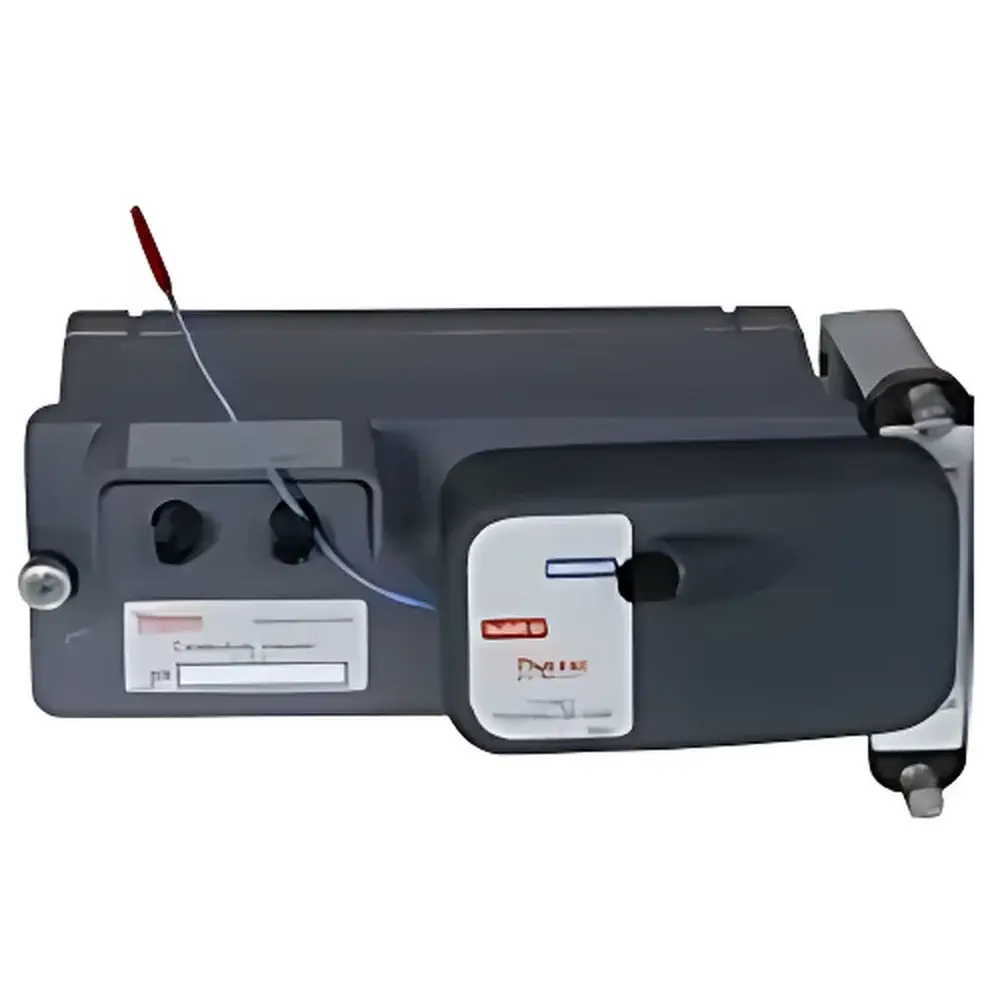
Dionex ICS-4000 QD Charge Detector and Detection Cell
| Brand | Thermo Fisher Scientific |
|---|---|
| Origin | USA |
| Manufacturer Type | Original Equipment Manufacturer (OEM) |
| Product Category | Imported Laboratory Instrument |
| Model | ICS-4000 QD |
| Pump Pressure Rating | 6000 psi |
| Flow Rate Range | 0.001–0.100 mL/min |
| Eluent Flow Rate | 0.001–0.100 mL/min |
| Maximum Operating Pressure | 6000 psi |
| Operating Temperature Range | 10–40 °C |
| Temperature Reproducibility | ±0.2 °C |
| Eluent Concentration Range | 0.1–200 mM |
Overview
The Dionex ICS-4000 QD Charge Detector and Detection Cell is a high-sensitivity, universal detection module engineered for integration with Thermo Fisher Scientific’s ICS-4000 Reagent-Free Ion Chromatography (RFIC) system. Unlike conventional conductivity detectors (CD), the QD operates on the principle of direct charge measurement—quantifying the total ionic charge carried by analyte species eluting from the separation column. This electrochemical detection method provides near-uniform molar response across monovalent, divalent, and polyvalent ions—including weakly dissociated species such as organic acids (e.g., acetic, citric), transition metal complexes, and low-pKa anions—without reliance on ion suppression or post-column derivatization. The QD thus bridges a critical analytical gap between traditional conductivity detection and mass spectrometry (MS), offering quantitative capability for unknown or non-standard ions where reference standards are unavailable or impractical.
Key Features
- Universal charge-based detection with linear, stoichiometric response independent of ion mobility or hydration radius
- Enhanced sensitivity for weakly dissociated and multivalent ions—enabling quantification without external calibration standards in many cases
- Integrated thermostatted detection cell with precise temperature control (±0.2 °C) to ensure baseline stability and retention time reproducibility
- Compatible with RFIC gradient elution and electrolytically generated eluents across 0.1–200 mM concentration range
- Robust pressure-rated design supporting up to 6000 psi, enabling use with sub-2-µm particle size columns and high-resolution separations
- Low-maintenance architecture: no suppressor regeneration, no reagent consumption, and extended consumable lifetime compared to conventional CD/MS hybrid workflows
Sample Compatibility & Compliance
The ICS-4000 QD supports broad sample matrix compatibility—including environmental water extracts, pharmaceutical excipient solutions, battery electrolytes, semiconductor process chemicals, and biological fluids—provided samples are pre-filtered (≤0.2 µm) and free of particulates or non-volatile organics that could foul the detection cell. It complies with ISO/IEC 17025 requirements for validated analytical instrumentation and supports audit-ready data integrity when operated within Thermo Fisher’s Chromeleon Chromatography Data System (CDS) under 21 CFR Part 11-compliant configuration. The detector meets ASTM D4327 (anion analysis in water) and USP (conductivity of purified water) performance criteria when used in conjunction with appropriate ICS-4000 system configurations and certified reference materials.
Software & Data Management
The QD is fully controlled via Chromeleon CDS v7.3 or later, enabling synchronized acquisition of charge signal, conductivity baseline, and retention time metadata. Peak purity assessment is performed through co-elution analysis using dual-channel signal correlation (QD vs. CD), supporting identification confidence without MS confirmation. All raw and processed data—including detector voltage output, integrated charge values (nC), and normalized response factors—are stored in vendor-neutral .cdf format with embedded instrument method parameters, audit trail logs, and electronic signature support. Data export options include CSV, PDF reports, and direct integration into LIMS via ODBC or API interfaces.
Applications
- Quantitative analysis of low-abundance, weakly ionized species in environmental monitoring (e.g., fluoride, phosphate, silicate in rainwater)
- Stability-indicating assays for acidic/basic degradation products in biopharmaceutical formulations
- Trace anion/cation profiling in ultrapure water systems for semiconductor manufacturing
- Speciation analysis of transition metals (e.g., Cr(III)/Cr(VI), Fe(II)/Fe(III)) in electroplating baths
- Method development for novel ionic liquid characterization where standard reference materials are absent
FAQ
How does the QD differ fundamentally from a conventional conductivity detector?
The QD measures total ionic charge per unit time (nC/s), whereas CD measures solution conductance (µS/cm). This eliminates mobility-dependent bias and enables uniform response across ion valence states.
Can the QD replace mass spectrometry for unknown ion identification?
No—it does not provide structural or mass information. However, it delivers unambiguous charge-based quantitation and peak purity verification when combined with retention time and complementary CD data.
Is the QD compatible with suppressed and nonsuppressed IC modes?
Yes—optimized for both Thermo Fisher’s eluent generator-based suppressed mode and nonsuppressed isocratic methods, provided flow rates remain within 0.001–0.100 mL/min.
What maintenance is required for long-term QD operation?
Annual calibration verification using certified KCl standards; routine cleaning of the detection cell with 10% nitric acid every 200 injections; no consumable replacement beyond standard IC tubing and filters.
Does the QD support GLP/GMP-compliant workflows?
Yes—when deployed with Chromeleon CDS in 21 CFR Part 11 mode, including electronic signatures, audit trails, and secure user access controls.
Related Products




