
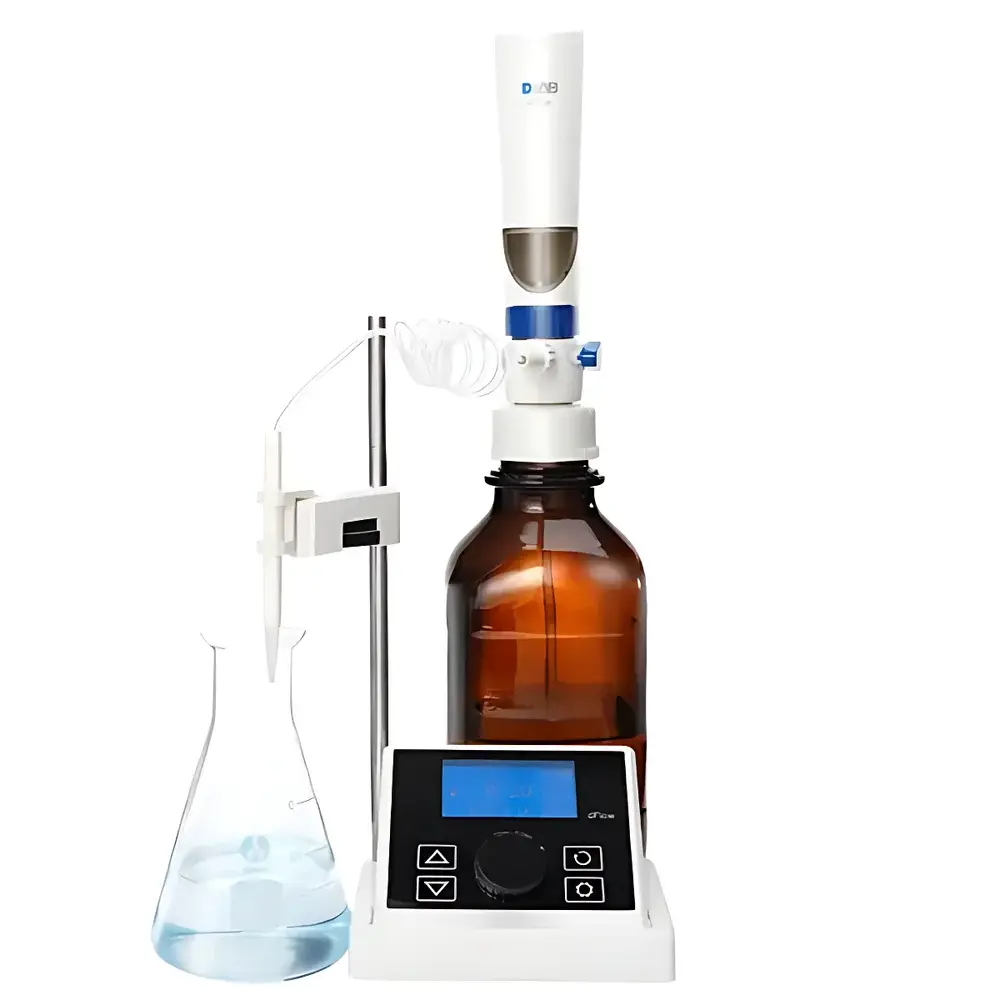
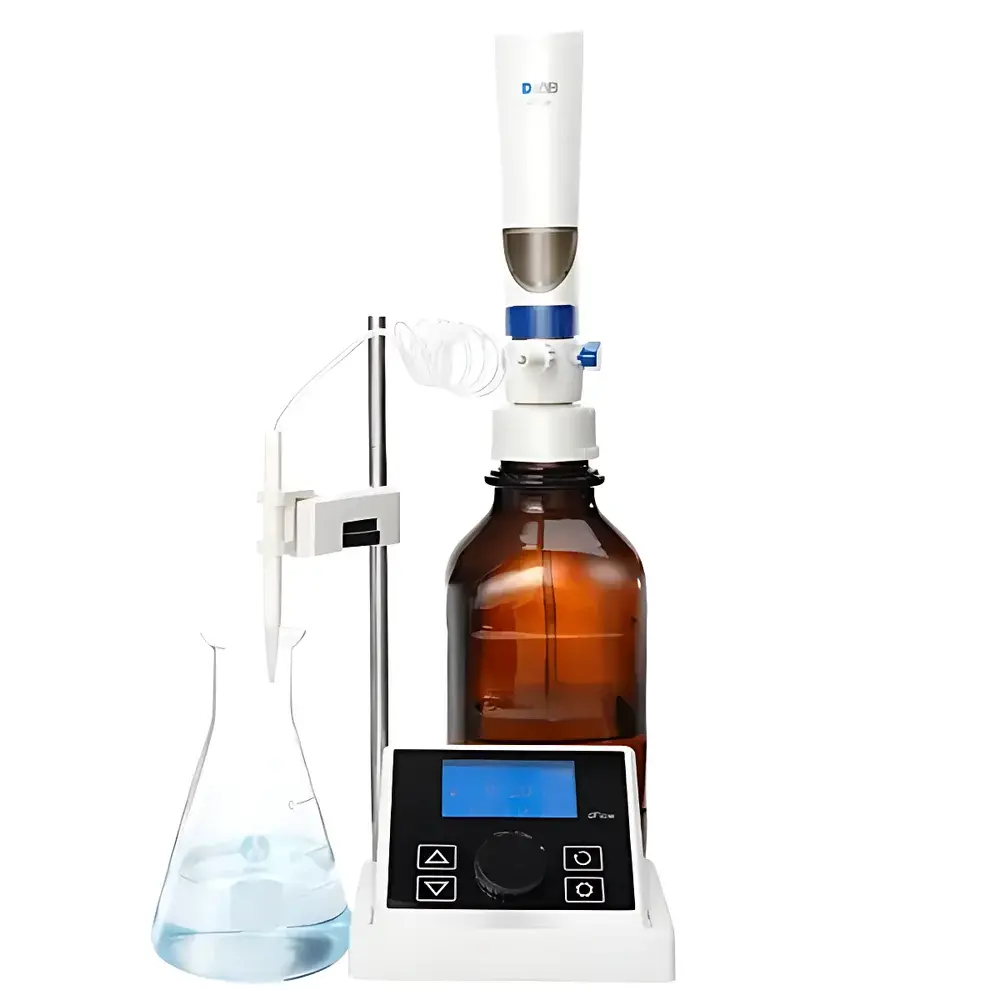
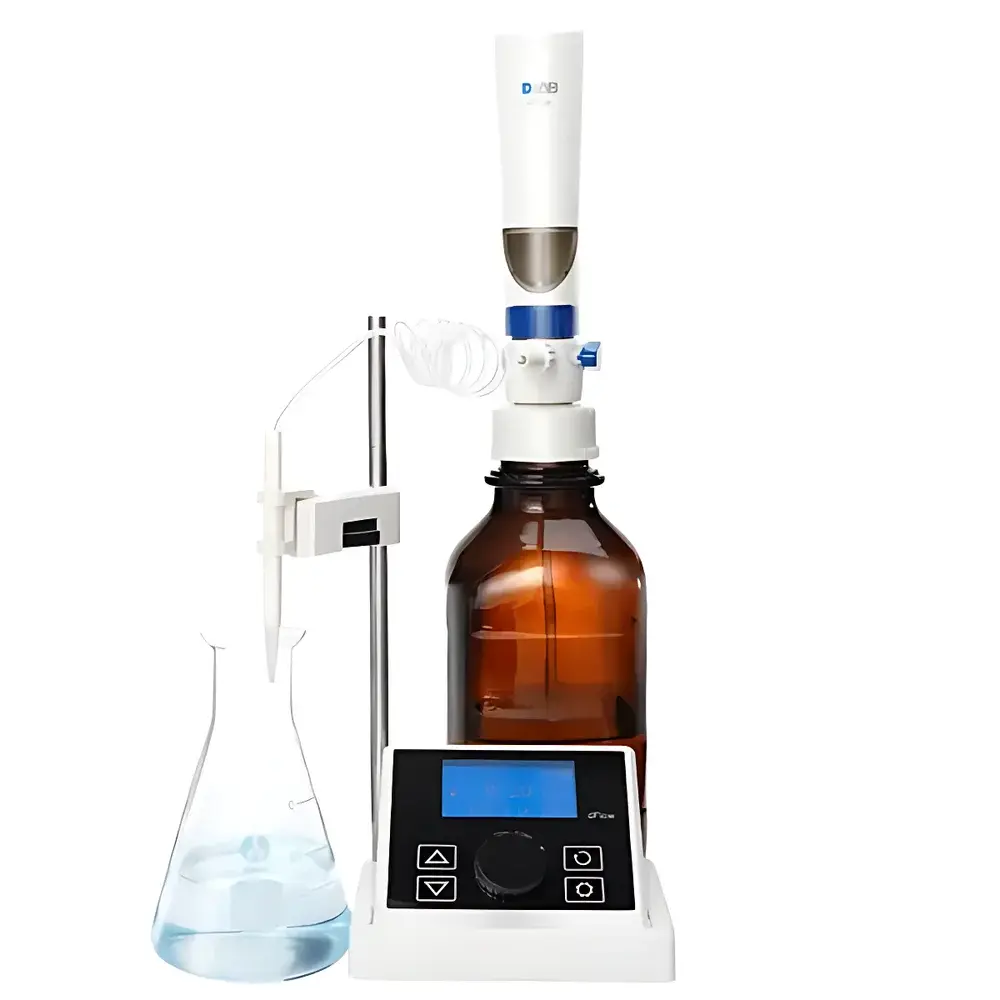
DLAB dFlow Electronic Bottle Top Dispenser
| Brand | DLAB |
|---|---|
| Origin | Beijing, China |
| Model | dFlow |
| Dispensing Range | 0.1–99.9 mL |
| Minimum Increment | 0.01 mL (100 µL) |
| Accuracy | ≤ ±0.5% (at ≥1 mL) |
| Precision | CV ≤ 0.3% (10 mL), CV ≤ 0.6% (5 mL), CV ≤ 3.0% (1 mL) |
| Adjustable Speed | 16 levels |
| Operating Temperature | 15–40 °C |
| Compliance | ISO 8655-5:2022 (Bottle-top dispensers) |
| Control Interface | Local keypad + optional remote control (RS-232 or USB) |
Overview
The DLAB dFlow Electronic Bottle Top Dispenser is a precision-engineered liquid handling instrument designed for repeatable, traceable, and operator-independent volumetric dispensing in analytical, quality control, and research laboratories. Based on motor-driven piston displacement technology compliant with ISO 8655-5:2022, the dFlow eliminates manual variability inherent in mechanical bottle top dispensers by integrating a high-torque micro-stepping motor, closed-loop position feedback, and digital volume calibration. Its core architecture ensures consistent delivery across viscosity ranges—from aqueous buffers to moderately viscous reagents (up to ~500 mPa·s)—without requiring recalibration between volumes. Unlike analog counterparts, the dFlow’s electronic control system maintains volumetric integrity through real-time torque compensation during aspiration and dispense cycles, making it suitable for GLP- and GMP-aligned workflows where auditability and procedural consistency are mandatory.
Key Features
- Digital volume setting with 0.01 mL (100 µL) resolution across a full range of 0.1–99.9 mL—enabling precise method-defined transfers without mechanical dial ambiguity.
- 16-step adjustable dispensing speed, allowing optimization for volatile solvents (fast mode) or high-viscosity media (slow, pulse-free mode) while minimizing foaming, splashing, or residual film formation.
- Large backlit LCD display with intuitive menu navigation—supports simultaneous visualization of set volume, current speed level, battery status, and error codes (e.g., air-in-line detection, motor stall).
- Dual operating modes: discrete single-shot dispensing and continuous flow mode—programmable for timed or volume-triggered output, ideal for serial dilution or bulk reagent distribution.
- Included universal adapter kit (S40, GL25, GL28, GL32, GL38) ensures compatibility with standard laboratory reagent bottles (DIN/ISO threading), eliminating need for custom fittings or third-party adapters.
- Integrated rechargeable Li-ion battery (≥8 hours continuous operation) with low-power sleep mode and USB-C charging—designed for benchtop mobility and uninterrupted workflow in multi-station labs.
Sample Compatibility & Compliance
The dFlow accommodates a broad spectrum of laboratory liquids, including aqueous solutions, organic solvents (e.g., methanol, acetonitrile, chloroform), diluted acids/bases (≤1 M), and surfactant-containing buffers. It is not intended for use with strongly oxidizing agents (e.g., concentrated HNO₃, H₂O₂ >30%), halogenated hydrocarbons with high vapor pressure, or suspensions containing particles >10 µm. All wetted parts—including piston seal (FKM fluoroelastomer), barrel (borosilicate glass), and valve body (PEEK and PTFE)—are chemically resistant and autoclavable (121 °C, 20 min, non-submerged). Device certification includes ISO 8655-5:2022 conformance for bottle-top dispensers, with factory calibration traceable to NIM (National Institute of Metrology, China) standards. Full compliance documentation—including calibration certificate, materials declaration (RoHS/REACH), and ISO 8655 test report—is supplied with each unit.
Software & Data Management
While the dFlow operates autonomously via front-panel controls, optional PC connectivity (USB or RS-232) enables integration into centralized lab management systems. The companion DLAB DispenseLink™ software (Windows/macOS) supports method saving, usage logging (user ID, timestamp, volume, speed setting), and export of CSV-formatted audit trails compatible with LIMS and electronic lab notebooks (ELN). All parameter changes and dispensing events are timestamped and stored locally on-device memory (non-volatile EEPROM), satisfying FDA 21 CFR Part 11 requirements for electronic records when used with appropriate access controls and electronic signatures. Remote firmware updates preserve long-term regulatory alignment without hardware replacement.
Applications
- Preparation of calibration standards and QC reference solutions in environmental testing (EPA Method 502.2, ISO 17993) and pharmaceutical analysis (USP <1058>).
- Accurate dispensing of titrants (e.g., NaOH, HCl, EDTA) in volumetric analysis workflows where repeatability impacts endpoint determination.
- High-throughput reagent addition in ELISA, cell culture media preparation, and PCR master mix assembly—reducing inter-operator variation in clinical and biotech labs.
- Controlled solvent addition during sample extraction (e.g., QuEChERS), derivatization, or cleanup steps in food safety and forensic toxicology labs.
- Teaching laboratories requiring demonstrable metrological rigor—supporting student understanding of volumetric uncertainty, ISO 8655 principles, and Good Laboratory Practice fundamentals.
FAQ
Is the dFlow compatible with narrow-neck reagent bottles?
Yes—the included GL25 and GL28 adapters support bottles with neck diameters down to 25 mm; S40 fits wide-mouth containers up to 40 mm. All adapters feature dual-seal geometry to prevent leakage under vacuum or positive pressure.
Can the dFlow be calibrated in-house?
Yes—users may perform routine verification using gravimetric methods per ISO 8655-6. Factory calibration certificates include correction factors; advanced users may input custom offset values via service mode.
Does the device support multi-user authentication?
Not natively—but when connected via USB to a networked PC running DispenseLink™, user-specific profiles and role-based permissions can be enforced through host system authentication (Active Directory or local OS accounts).
What maintenance is required?
Monthly cleaning of the piston seal and valve seat with isopropanol; annual replacement of the FKM seal kit (part #DF-SEAL-KIT) is recommended for daily high-volume use. No lubrication is required.
Is the dFlow suitable for sterile applications?
The glass barrel and PEEK/PTFE components are autoclavable (121 °C, 20 min). However, the electronics housing and motor assembly are not sterilizable—sterile operation requires aseptic assembly post-autoclaving and use within laminar flow hoods.
Related Products



