
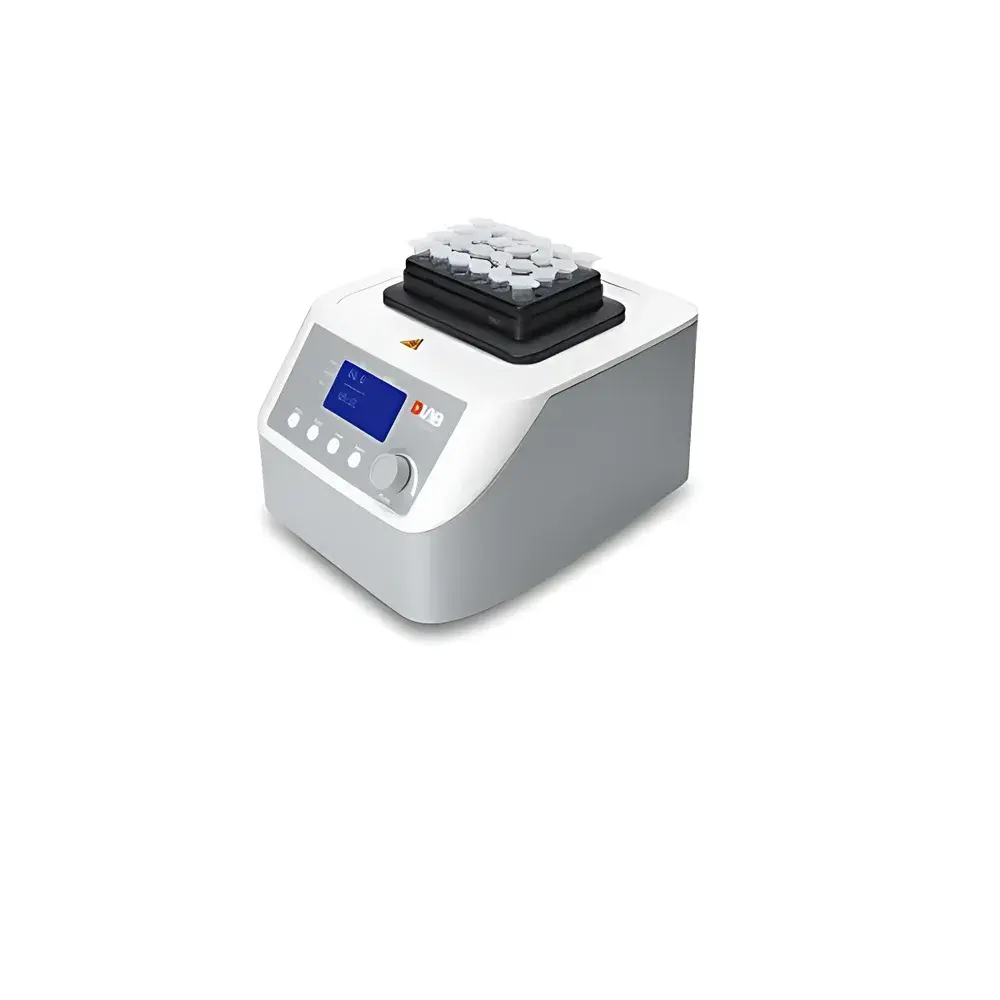
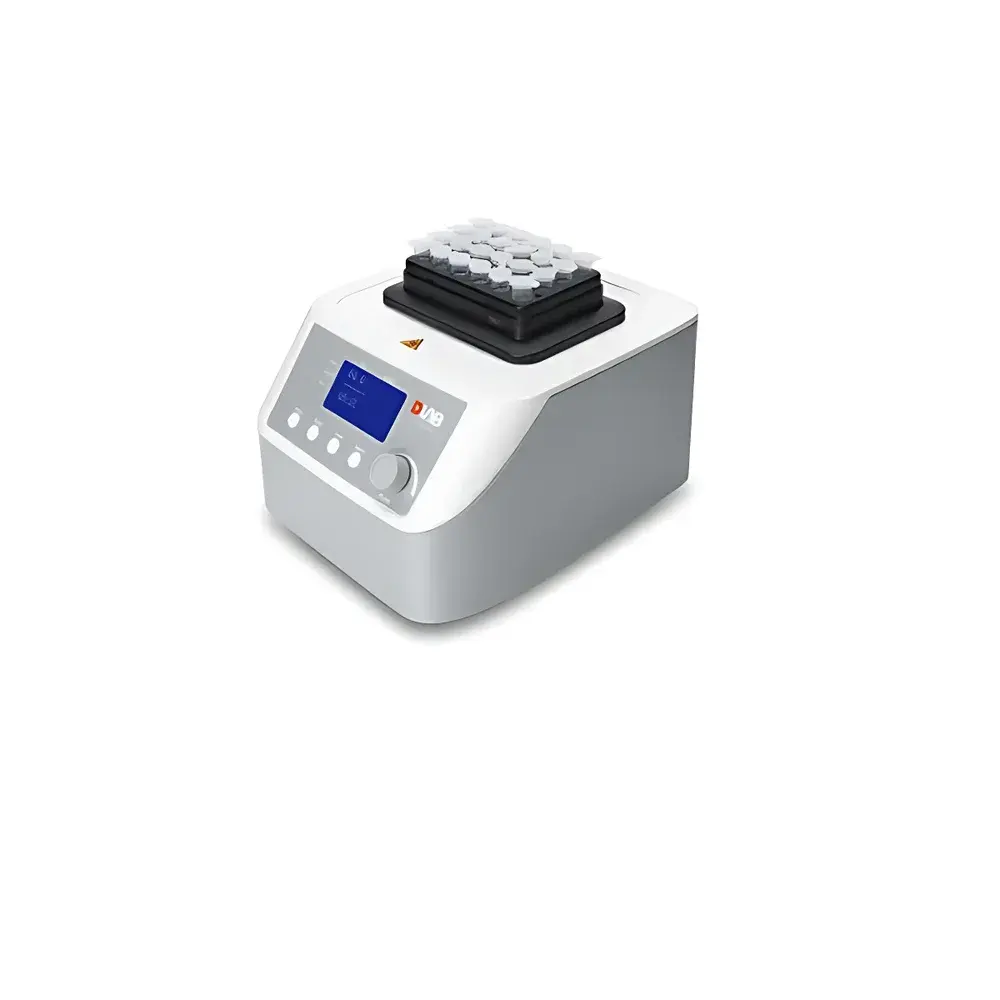
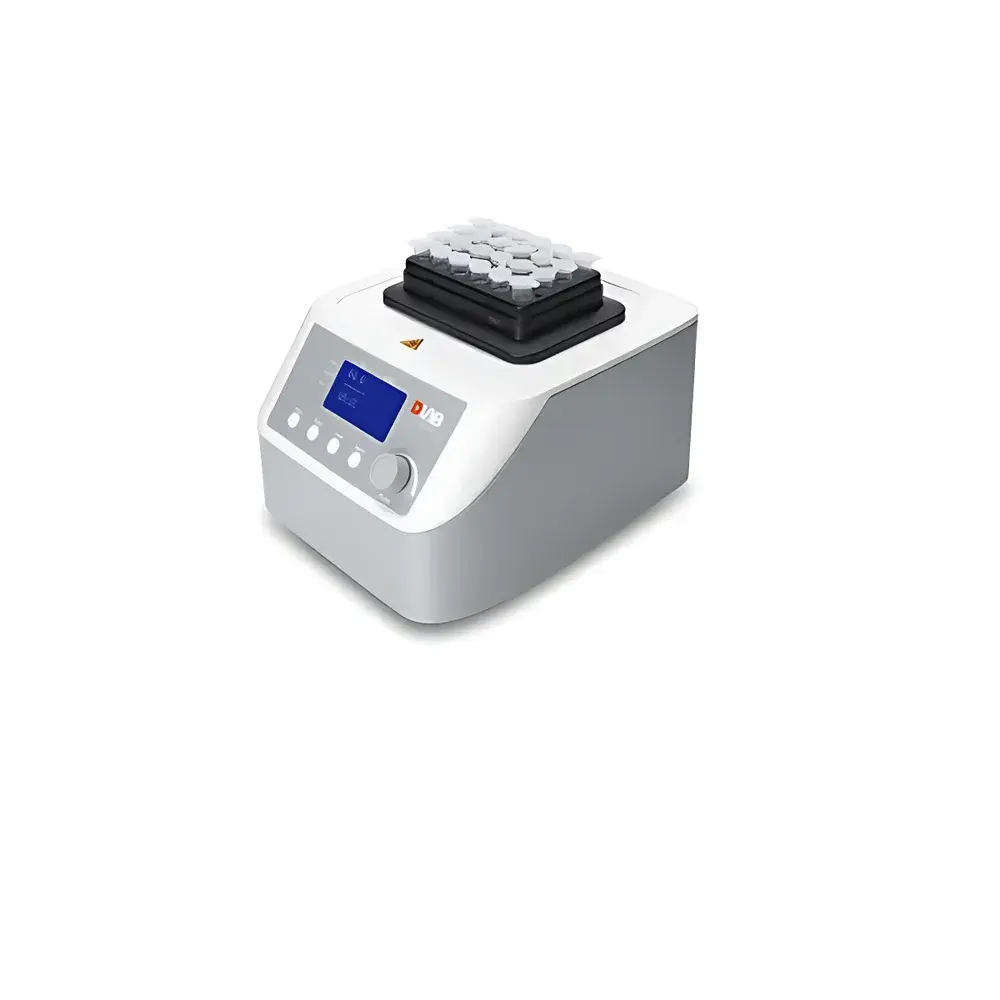
DLAB HCM100-pro Thermostatic Orbital Shaking Metal Bath with Pin-Insert Modules
| Brand | DLAB |
|---|---|
| Origin | Beijing, China |
| Model | HCM100-pro |
| Temperature Range | −15°C to 100°C |
| Temperature Accuracy (20–45°C) | ±0.5°C |
| Temperature Uniformity (20–45°C) | ±0.5°C |
| Heating Rate | 5.5°C/min |
| Cooling Rate | 5°C/min (100°C → ambient), 0.5°C/min (ambient → −15°C) |
| Orbital Speed | 200–1500 rpm |
| Orbit Diameter | 3 mm |
| Timer Range | 0 min – 99 h 59 min |
| Over-Temperature Protection | 150°C |
| Power Consumption | 200 W |
| Dimensions (L×W×H) | 200 × 235 × 120 mm |
| Net Weight | 7.3 kg |
| Input Voltage | 110/220 V, 50/60 Hz |
| Ambient Operating Conditions | 10–40°C, <80% RH |
| Display | TFT LCD |
| Programmable Profiles | Yes |
| Module Interface | Magnetic Auto-Recognition Pin-Insert System |
| Insulated Lid | Included |
Overview
The DLAB HCM100-pro Thermostatic Orbital Shaking Metal Bath with Pin-Insert Modules is an integrated benchtop instrument engineered for precise concurrent thermal control and orbital mixing of small-volume samples in microtubes, PCR strips, and deep-well plates. Unlike conventional water baths or dry-block heaters, this metal bath employs solid aluminum heating/cooling blocks with direct Peltier-based thermoelectric elements and a high-efficiency brushless DC motor for oscillatory motion. Its operational principle combines resistive heating, active thermoelectric cooling, and controlled orbital agitation—enabling accurate incubation, enzymatic reactions, cell lysis, and sample homogenization under defined thermal and mechanical conditions. The system operates across a broad temperature range from −15°C to 100°C, supporting cryogenic applications such as cold enzyme storage and low-temperature hybridization protocols, as well as high-temperature denaturation steps up to boiling point. Designed for reproducibility in regulated environments, the HCM100-pro meets essential functional requirements for GLP-compliant laboratories performing routine QC testing, molecular biology workflows, and pharmaceutical stability studies.
Key Features
- Wide operational temperature range: −15°C to 100°C, with independent heating and cooling capability enabled by dual-mode Peltier architecture
- High-precision temperature control: ±0.5°C accuracy and uniformity within the critical 20–45°C range—validated per ISO/IEC 17025 calibration practices
- Orbital shaking at 200–1500 rpm with fixed 3 mm orbit diameter, ensuring consistent mixing energy without splashing or cross-contamination
- Magnetic pin-insert module interface: enables tool-free, auto-recognized attachment of interchangeable aluminum blocks (e.g., 0.2 mL, 0.5 mL, 1.5 mL, 2.0 mL, 15 mL, and 50 mL tube formats)
- TFT LCD display with intuitive menu navigation, real-time parameter monitoring, and password-protected settings lock for multi-user lab environments
- Programmable thermal profiles: up to 9 user-defined time–temperature–speed sequences stored locally; supports ramp-hold-cool cycles with logging-ready timestamps
- Integrated insulated lid minimizes convective heat loss during low-temperature operation and improves energy efficiency across all setpoints
- Over-temperature safety cutoff at 150°C, plus automatic shutdown on lid removal or abnormal current draw—compliant with IEC 61010-1 Class II electrical safety standards
Sample Compatibility & Compliance
The HCM100-pro accommodates standard laboratory consumables via its modular pin-insert system, including single tubes (0.2–50 mL), 8-tube strips, 96-well PCR plates, and custom microplate adapters. All contact surfaces are electropolished aluminum with non-reactive anodized finish, resistant to common solvents and compatible with sterilization via 70% ethanol wipe-down. The device complies with key international standards for laboratory equipment: IEC 61010-1 (safety), IEC 61326-1 (EMC), and ISO 13485-aligned design controls for medical device-related R&D use. While not FDA-cleared as a diagnostic instrument, its programmability, audit-trail-capable timer, and stable thermal performance support alignment with USP Analytical Instrument Qualification (AIQ) guidelines and 21 CFR Part 11 readiness when paired with validated LIMS integration.
Software & Data Management
The HCM100-pro operates autonomously without external software; however, its embedded firmware supports timestamped event logging (start/stop times, temperature deviations >±1.0°C, speed changes) accessible via USB export to CSV. Optional RS-232 or USB-to-serial interface enables integration into centralized lab automation systems using Modbus RTU protocol. Logged data includes cycle count, total runtime, maximum observed deviation, and fault codes—facilitating internal audit preparation and preventive maintenance scheduling. Firmware updates are performed via USB flash drive, with version history and checksum verification to ensure integrity. No cloud connectivity or remote access functionality is included, preserving data sovereignty in sensitive research or regulated manufacturing settings.
Applications
- Molecular biology: DNA/RNA hybridization, restriction digestion, ligase reactions, and plasmid transformation requiring simultaneous temperature control and gentle mixing
- Clinical diagnostics: Sample thawing and homogenization prior to ELISA, lateral flow assay prep, or nucleic acid extraction workflows
- Pharmaceutical development: Accelerated stability testing of formulations under variable thermal-mechanical stress conditions
- Microbiology: Bacterial culture resuspension, phage titering, and biofilm dispersion assays with reproducible shear input
- Protein biochemistry: Solubilization of inclusion bodies, antibody conjugation, and buffer exchange via repeated thermal cycling with agitation
- Quality control labs: Standardized sample conditioning for viscosity, turbidity, or particle size analysis where thermal history must be documented
FAQ
What is the minimum operating temperature, and how is sub-ambient cooling achieved?
The HCM100-pro achieves −15°C using a multi-stage thermoelectric (Peltier) cooling system with forced-air heat dissipation. Performance is dependent on ambient conditions; optimal sub-zero operation requires ambient ≤25°C and relative humidity <60% RH.
Can the instrument maintain temperature stability during continuous shaking at 1500 rpm?
Yes—thermal uniformity remains within ±0.5°C across the block surface at all speeds between 200–1500 rpm in the 20–45°C range, as verified by NIST-traceable PT100 probe mapping.
Is the magnetic module recognition system compatible with third-party aluminum blocks?
No—the pin-insert geometry and Hall-effect sensor array are proprietary to DLAB-certified modules. Non-OEM blocks may compromise thermal transfer, safety interlocks, or calibration validity.
Does the device support GMP documentation requirements?
While the unit itself does not generate electronic signatures, its programmable profiles, timestamped logs, and hardware-level over-temperature protection meet foundational criteria for Phase 1–2 IQ/OQ validation per ASTM E2500 and EU Annex 15.
What maintenance is required for long-term reliability?
Annual inspection of fan filters, thermal paste reapplication on Peltier junctions (by authorized service technician), and verification of lid switch actuation are recommended. No routine lubrication or belt replacement is needed due to brushless motor and solid-state thermal design.



