
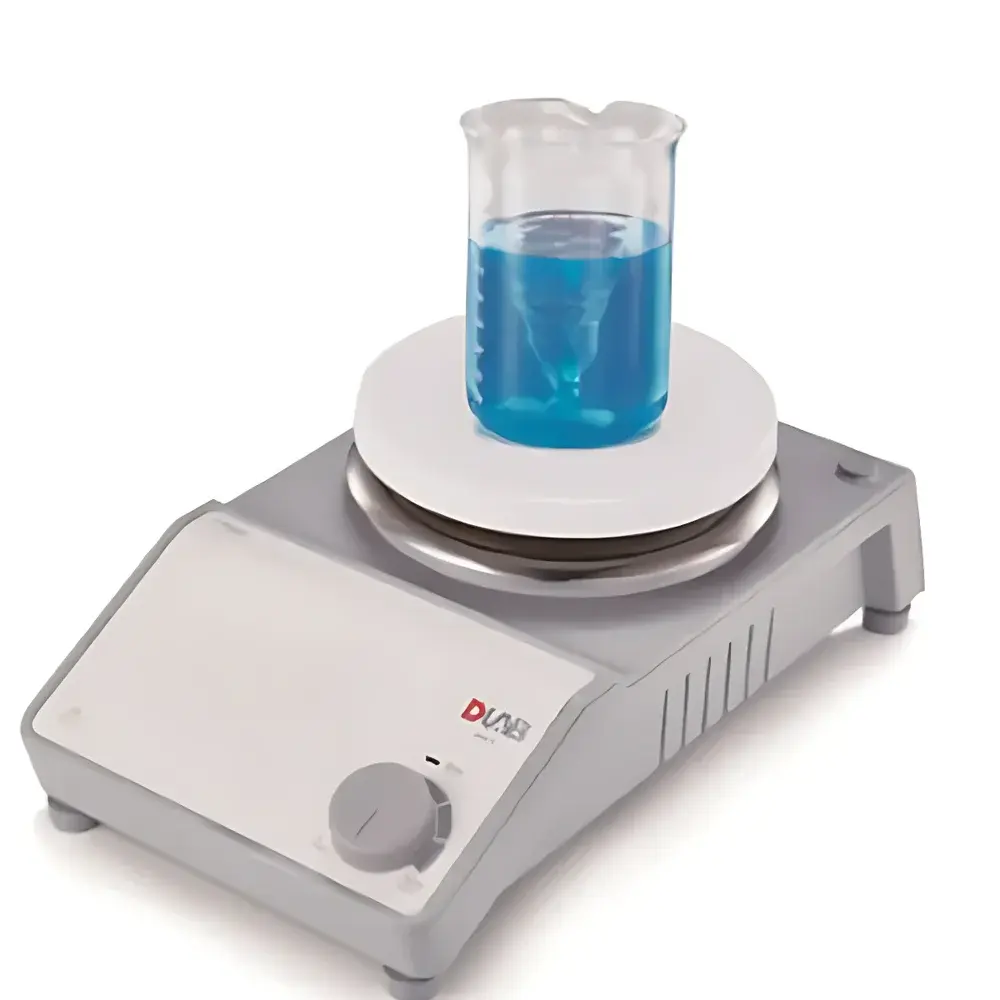
DLAB MS-S 20L Magnetic Stirrer
| Brand | DLAB |
|---|---|
| Origin | Beijing, China |
| Model | MS-S 20L |
| Maximum Stirring Volume | 20 L |
| Speed Range | 0–1500 rpm |
| Plate Diameter | Ø135 mm (5") |
| Plate Material | Stainless Steel with Ceramic Coating |
| Motor Type | Brushless DC Motor |
| Input Power | 18 W |
| Output Power | 10 W |
| Rated Power | 30 W |
| Voltage | 100–240 VAC |
| Frequency | 50/60 Hz |
| Protection Rating | IP42 |
| Dimensions (W×D×H) | 160 × 280 × 85 mm |
| Weight | 2.8 kg |
| Operating Temperature | 5–40 °C |
| Operating Humidity | ≤80% RH |
| Max Stir Bar Length | 80 mm |
Overview
The DLAB MS-S 20L Magnetic Stirrer is an engineered solution for reliable, low-maintenance liquid homogenization in academic, industrial, and quality control laboratories. Based on the principle of magnetic coupling—where a rotating permanent magnet beneath a non-magnetic plate induces synchronous rotation of a stir bar immersed in the sample—the MS-S delivers consistent torque transfer without mechanical contact or shaft seals. Its design prioritizes operational safety, chemical resistance, and long-term stability under continuous use. Unlike gear-driven or overhead stirrers, this unit eliminates lubrication requirements, bearing wear, and contamination risks associated with moving parts penetrating vessel walls. The device is optimized for aqueous and moderately aggressive reagent systems up to 20 L volume, making it suitable for buffer preparation, dissolution testing, titration support, and pre-analytical sample conditioning.
Key Features
- Brushless DC motor ensures stable speed output across the full 0–1500 rpm range, with minimal thermal drift and no brush replacement required over its service life.
- Ceramic-coated stainless steel top plate provides high resistance to corrosion from acids, bases, and organic solvents—critical for repeated exposure in multi-user lab environments.
- IP42-rated fully enclosed housing protects internal electronics from dust ingress and incidental splashes, supporting compliance with general laboratory safety protocols.
- Single-point stirring configuration with precise centering alignment ensures uniform torque delivery and minimizes vortex asymmetry during high-speed operation.
- Wide-input universal power supply (100–240 VAC, 50/60 Hz) enables seamless deployment across global laboratory infrastructures without voltage conversion hardware.
- Compact footprint (160 × 280 × 85 mm) and lightweight construction (2.8 kg) facilitate integration onto fume hoods, laminar flow cabinets, or mobile lab carts.
Sample Compatibility & Compliance
The MS-S accommodates standard PTFE- or glass-coated stir bars up to 80 mm in length, compatible with round-bottom flasks, beakers, and jacketed reactors commonly used in synthesis, extraction, and standardization workflows. It supports ISO 8573-1-compliant clean air environments when operated within specified ambient conditions (5–40 °C, ≤80% RH). While not certified for GMP or GLP-regulated production processes, its repeatable speed control, sealed architecture, and absence of consumable wear components make it appropriate for method development, QC sample prep, and teaching labs where traceability and reproducibility are foundational—not regulatory-grade audit trails. No integrated temperature control is provided; external heating mantles or water baths must be used separately if thermal management is required.
Software & Data Management
The MS-S operates as a standalone analog-controlled instrument with manual speed adjustment via calibrated dial. It does not incorporate digital interfaces, USB connectivity, or embedded firmware—therefore no software drivers, data logging, or remote control capabilities are available. This architecture aligns with IEC 61000-6-3 emission standards for laboratory electromagnetic compatibility and avoids cybersecurity considerations associated with networked instruments. For laboratories requiring electronic recordkeeping per FDA 21 CFR Part 11, external validation of operator-set parameters (e.g., via video recording or procedural SOP documentation) remains the recommended practice.
Applications
- Preparation of large-volume buffers and media (e.g., PBS, LB broth, phosphate-based eluents) in molecular biology and microbiology labs.
- Homogenization of suspensions prior to filtration, centrifugation, or particle size analysis.
- Supporting dissolution testing in pharmaceutical QA/QC according to USP <711>, where consistent agitation is required but temperature regulation is managed externally.
- Reaction mixing in small-scale organic synthesis where inert atmosphere compatibility is maintained via sealed vessels and magnetic coupling.
- Calibration and verification of viscometers or conductivity meters using standardized reference solutions.
- Undergraduate and graduate teaching labs where robustness, ease of use, and cost-efficiency are prioritized over advanced automation.
FAQ
Does the MS-S include heating functionality?
No. The MS-S is a non-heating magnetic stirrer. External heating sources must be used independently.
What is the maximum viscosity this stirrer can handle at full capacity?
While rated for up to 20 L of water, effective stirring of higher-viscosity fluids (e.g., glycerol/water mixtures >100 mPa·s) depends on stir bar geometry, vessel shape, and target homogeneity—DLAB recommends empirical validation for non-aqueous applications.
Is the ceramic coating resistant to hydrofluoric acid (HF)?
No. Although highly resistant to common laboratory acids and alkalis, the ceramic layer is not HF-compatible. Alternative containment strategies are advised for HF-containing systems.
Can the MS-S be used inside a CO₂ incubator?
Only if ambient temperature and humidity remain within specifications (5–40 °C, ≤80% RH) and airflow does not compromise the IP42 enclosure integrity. Condensation risk must be evaluated case-by-case.
What maintenance is required for the brushless DC motor?
None. The motor contains no brushes, commutators, or lubricated bearings—routine cleaning of the plate surface and periodic inspection of stir bar integrity constitute the full maintenance protocol.



