
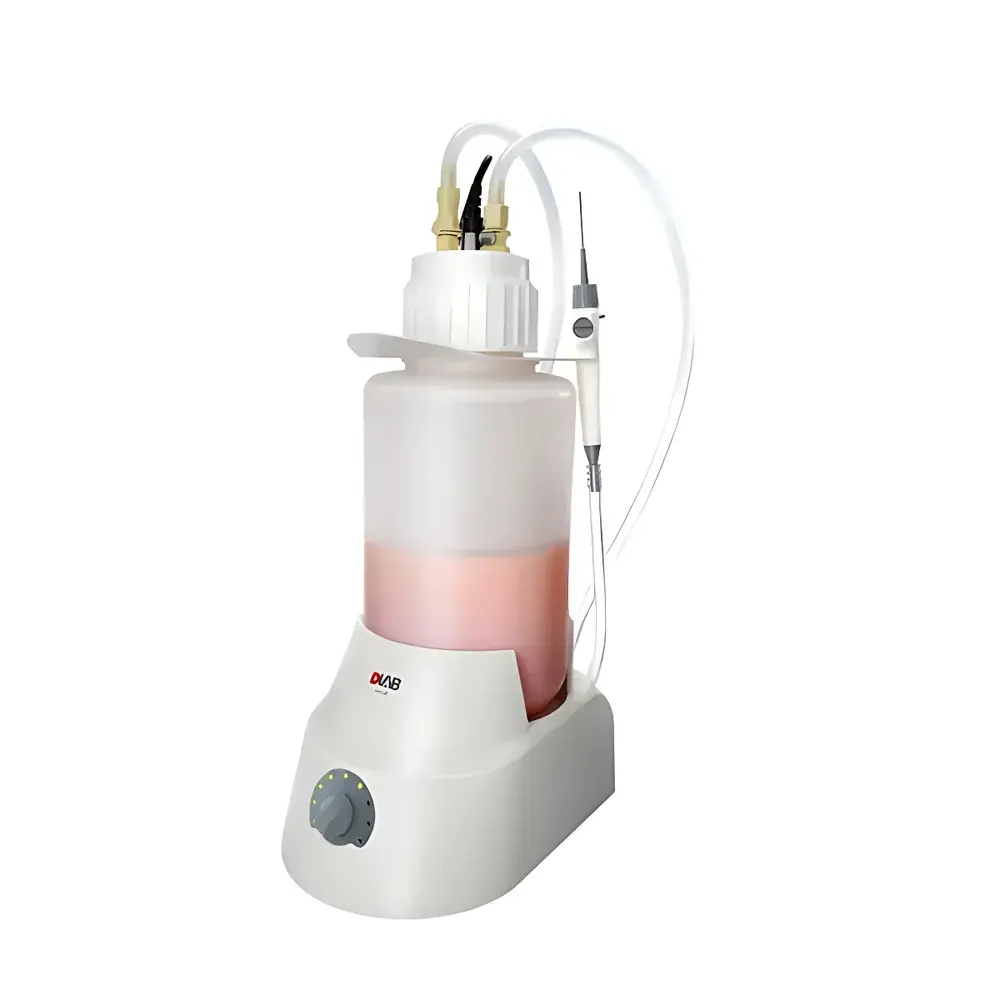
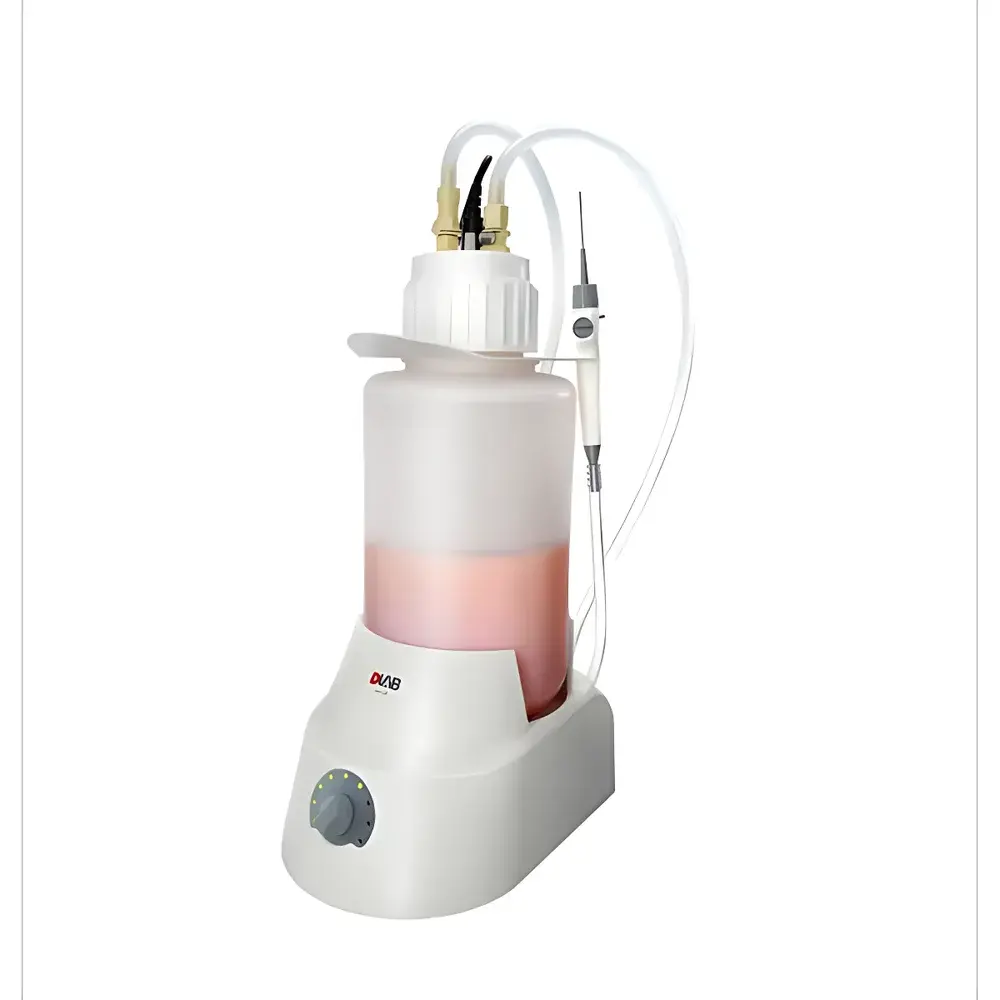
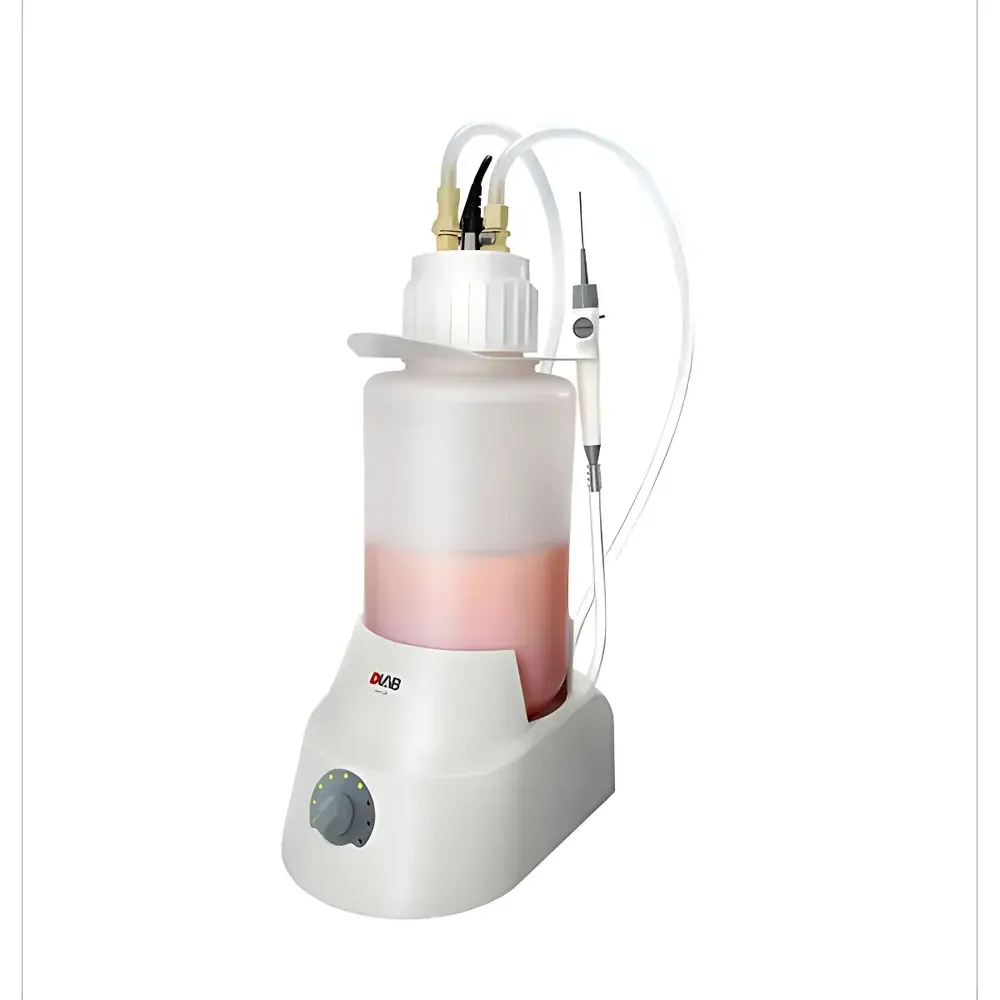
DLAB SafeVac 4L Vacuum Liquid Aspiration System
| Brand | DLAB |
|---|---|
| Origin | Beijing, China |
| Model | SafeVac |
| Ultimate Vacuum | ≤20 kPa |
| Maximum Pumping Speed | ≥18 L/min |
| Dimensions | 180 × 240 × 450 mm |
| Operating Vacuum Range | 0–600 mbar |
| Rated Air Flow Rate | 15 L/min |
| Liquid Aspiration Rate | 17 mL/s |
| Collection Bottle Capacity | 4 L |
| Sterilizable Components | Fluid-path parts compatible with autoclaving (121°C, 2 bar, 20 min) |
| Motor Type | Brushless DC Motor |
| Noise Level | ≤55 dB(A) |
| Power Supply | 100–240 VAC, 50/60 Hz |
| Weight | 3 kg |
Overview
The DLAB SafeVac 4L Vacuum Liquid Aspiration System is an engineered solution for safe, controlled, and repeatable liquid removal in bioscience, clinical, and general laboratory environments. Designed around a brushless DC motor-driven vacuum pump, the system operates on the principle of negative pressure aspiration—generating adjustable vacuum levels (0–600 mbar) to draw liquids through sterile-filtered tubing into a 4 L autoclavable collection bottle. Its core architecture prioritizes operator safety and process integrity: integrated liquid-level detection triggers simultaneous audible and visual alarms and automatic pump shutdown before overflow occurs, mitigating cross-contamination risks and protecting downstream vacuum sources. The compact footprint (180 × 240 × 450 mm) and lightweight construction (3 kg) support benchtop deployment in laminar flow hoods, biosafety cabinets, and shared core facilities without compromising ergonomic access or workflow integration.
Key Features
- Adjustable vacuum control via intuitive rotary dial with LED indicators corresponding to discrete vacuum setpoints—enabling precise adaptation to sensitive cell suspensions, viscous media, or rapid bulk aspiration tasks.
- Real-time liquid-level monitoring using capacitive sensing technology; immediate dual-mode (audible + visual) alert and pump cutoff upon detection of liquid reaching the critical threshold within the collection vessel.
- Autoclavable fluid path: All wetted components—including bottle, cap, tubing adapter, and internal valve assemblies—are constructed from polypropylene and silicone materials validated for repeated steam sterilization at 121°C, 2 bar for 20 minutes per ISO 17665-1, supporting GLP-compliant decontamination protocols.
- Self-locking quick-connect fittings prevent accidental disconnection and aerosol release during operation or tube changes—reducing exposure risk during high-risk procedures such as viral supernatant handling or cytotoxic waste removal.
- Brushless DC motor ensures maintenance-free operation, consistent torque delivery across voltage fluctuations (100–240 VAC, 50/60 Hz), and low acoustic emission (≤55 dB[A]) suitable for quiet laboratory zones.
Sample Compatibility & Compliance
The SafeVac 4L accommodates aqueous buffers, culture media, serum-containing solutions, enzymatic digests, and low-viscosity biological supernatants. It is not intended for use with organic solvents, strong acids/bases, or particulate-laden slurries exceeding 5 µm in diameter without inline filtration. All plastic components comply with USP Class VI biocompatibility standards. The device meets IEC 61010-1:2010 for electrical safety in laboratory equipment and carries CE marking under the EU Low Voltage Directive and EMC Directive. While not certified for use in explosion-proof environments, its non-sparking motor design minimizes ignition hazards in standard biosafety Level 2 (BSL-2) settings.
Software & Data Management
The SafeVac 4L is a standalone, hardware-controlled system with no embedded microprocessor or digital interface. Vacuum regulation, alarm triggering, and pump actuation are managed by analog circuitry with discrete component-level reliability—eliminating firmware dependencies, cybersecurity vulnerabilities, or software validation requirements. This architecture aligns with FDA 21 CFR Part 11 Annex A guidance for “non-electronic record” devices and simplifies audit readiness in regulated QC/QA laboratories where traceability relies on procedural documentation rather than electronic logs.
Applications
- Removal of supernatant following centrifugation of mammalian or microbial cultures without disturbing pelleted cells.
- Aspiration of spent media from adherent cell monolayers in T-flasks or multiwell plates during passaging or assay preparation.
- Drainage of wash buffers during immunostaining, ELISA plate processing, or histology tissue processing workflows.
- Safe collection of biohazardous liquid waste under negative pressure containment in BSL-2 hoods, minimizing aerosol generation compared to manual pipetting or gravity drainage.
- Routine aspiration of conditioned media for metabolite profiling or extracellular vesicle isolation protocols requiring sterility preservation.
FAQ
Can the SafeVac 4L be used with corrosive or flammable liquids?
No. Only aqueous, non-corrosive, non-flammable, and low-viscosity biological liquids are compatible. Solvents such as ethanol, acetone, or concentrated acids/bases may degrade seals and compromise structural integrity.
Is the collection bottle certified for autoclaving?
Yes—the 4 L polypropylene bottle and associated fluid-path components are validated for repeated autoclaving at 121°C, 2 bar, for 20 minutes per ISO 17665-1.
Does the system support external vacuum source integration?
No. The SafeVac 4L is a self-contained unit with an integrated brushless vacuum pump and does not offer inlet/outlet ports for connection to centralized vacuum networks.
What maintenance is required?
Routine cleaning of the bottle, cap, and tubing; periodic inspection of O-rings for compression set; and verification of alarm function using distilled water—no lubrication or filter replacement is necessary.
How is compliance with GLP/GMP documented?
Users maintain a calibration log (vacuum gauge verification), preventive maintenance records, and sterilization cycle logs (time, temperature, pressure). No electronic audit trail is generated, consistent with analog-device validation practices outlined in WHO TRS 961 Annex 11.



