
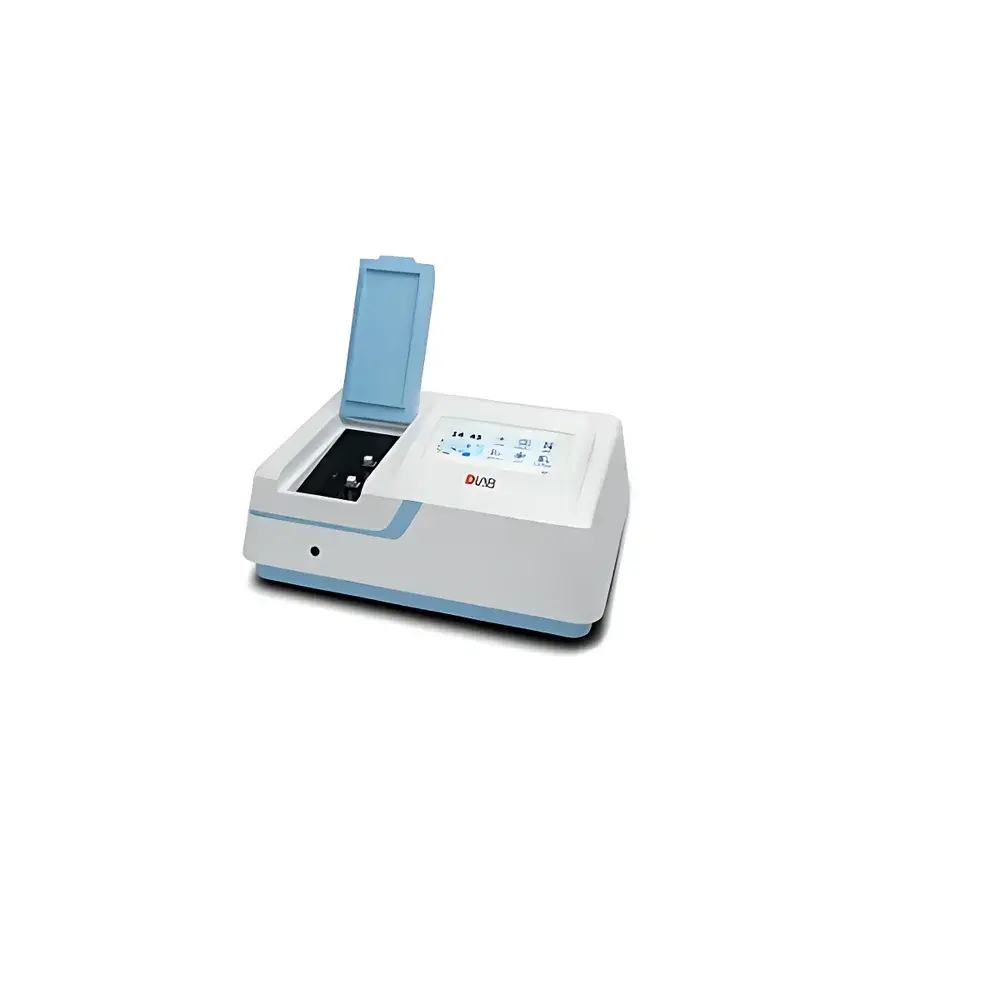
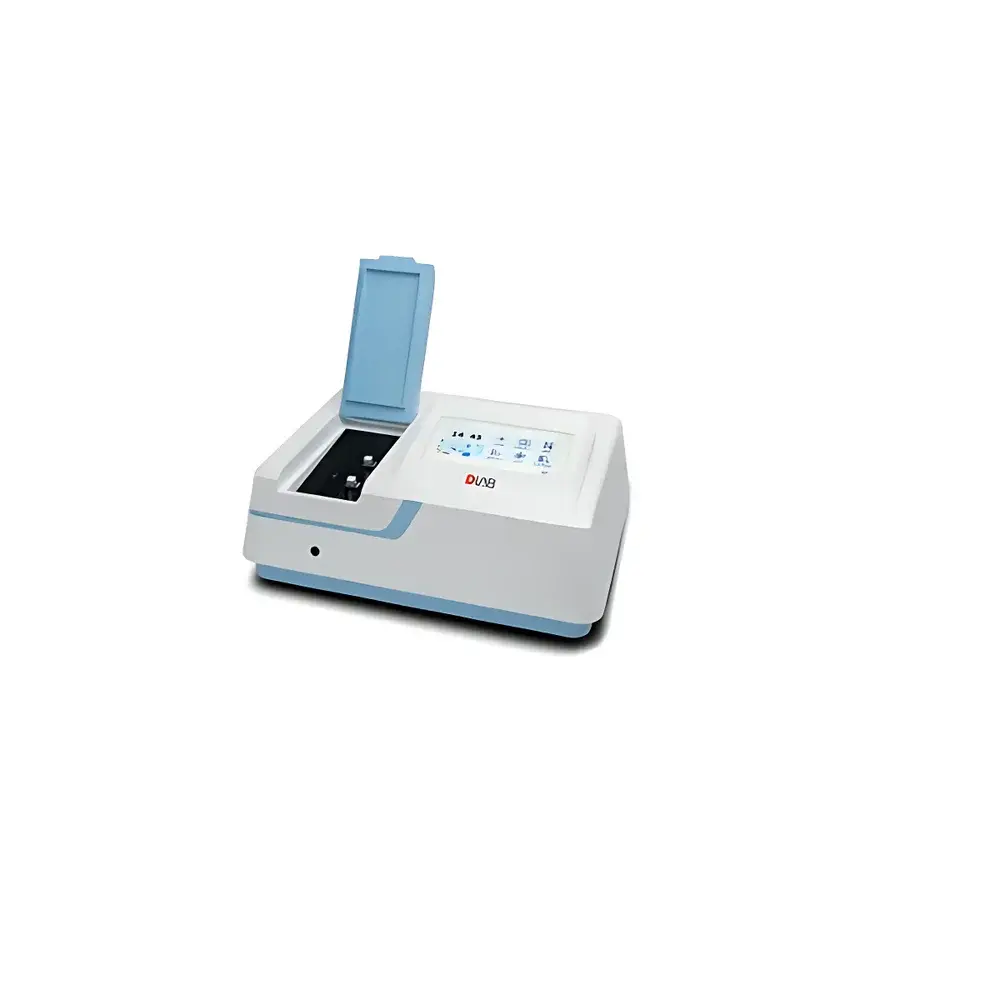
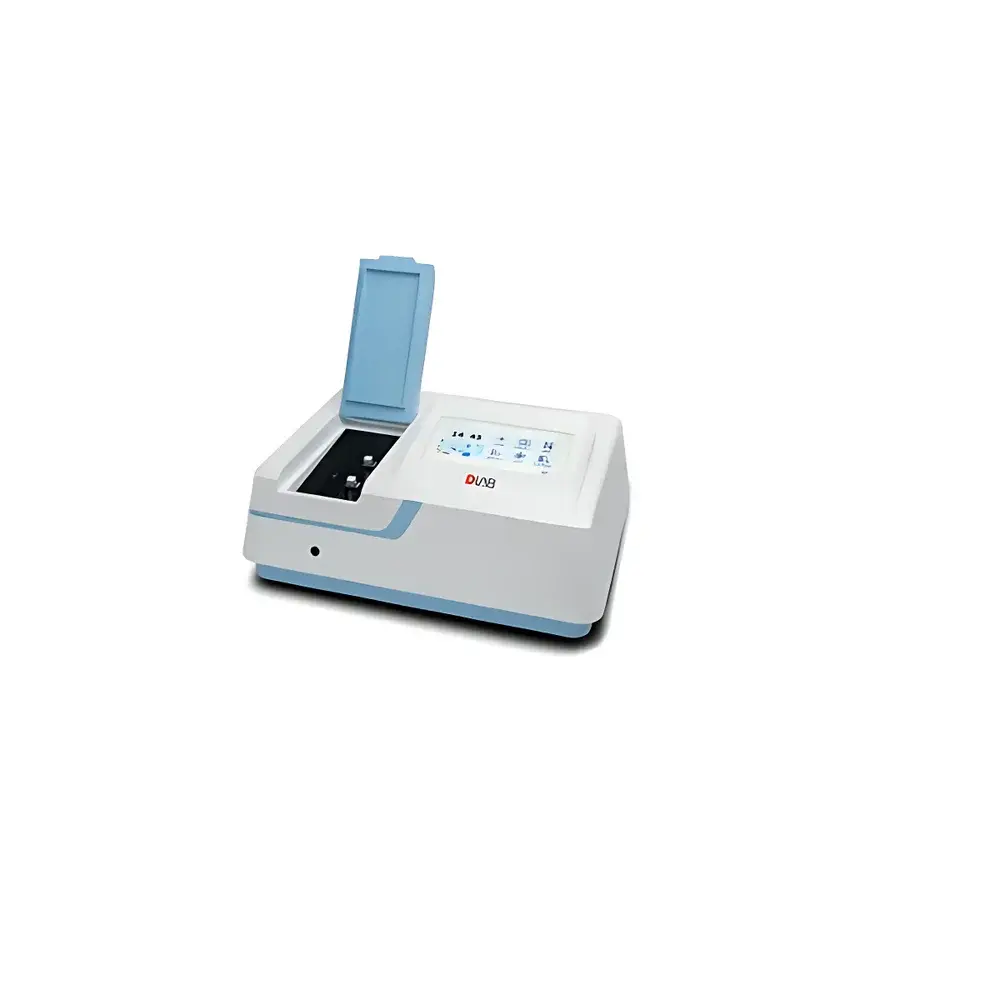
DLAB SP-UV3102 Dual-Beam Ultraviolet-Visible Spectrophotometer
| Brand | DLAB (Beijing) |
|---|---|
| Origin | Beijing, China |
| Model | SP-UV3102 |
| Optical System | Dual-beam |
| Wavelength Range | 190–1100 nm |
| Spectral Bandwidth | 2.0 nm |
| Wavelength Accuracy | ±0.1 nm at 656.1 nm, ±0.3 nm across full range |
| Wavelength Repeatability | ≤0.1 nm |
| Stray Light | ≤0.03% T at 220 nm and 360 nm |
| Photometric Accuracy | ±0.002 A (0–0.5 A), ±0.003 A (0.5–1 A) |
| Photometric Repeatability | ±0.001 A (0–0.5 A), ±0.0015 A (0.5–1 A) |
| Baseline Stability | ≤0.001 A/h at 500 nm (after 1 h warm-up) |
| Display | 10.1-inch color capacitive touchscreen (1024 × 600) |
| Interface | USB port |
| Power Supply | 110/220 V, 50/60 Hz, 120 W |
| Dimensions (L×W×H) | 570 × 440 × 210 mm |
| Weight | 20 kg |
Overview
The DLAB SP-UV3102 is a high-performance dual-beam ultraviolet-visible (UV-Vis) spectrophotometer engineered for precision quantitative and qualitative analysis in academic research laboratories, quality control environments, and routine analytical workflows. Operating on the principle of Beer–Lambert law-based absorbance measurement, the instrument employs a double-beam optical architecture to continuously compensate for source intensity drift and detector variability—ensuring exceptional photometric stability and long-term measurement reproducibility. Its wavelength coverage spans 190–1100 nm, enabling seamless analysis from deep UV through visible to near-infrared regions. The system integrates a holographic grating monochromator and a digitally calibrated photodiode array detector, delivering low stray light (≤0.03% T), minimal electronic noise, and high signal-to-noise ratio across the entire spectral range. Designed for compliance with fundamental spectroscopic performance standards—including ISO 9001-aligned manufacturing protocols and alignment with ASTM E275 and USP guidelines—the SP-UV3102 supports traceable, auditable measurements essential for regulated environments.
Key Features
- Dual-beam optical design with real-time reference beam compensation for enhanced baseline stability and reduced drift during extended scans or kinetic measurements.
- 10.1-inch high-resolution capacitive touchscreen (1024 × 600) with intuitive graphical user interface—enabling standalone operation without external PC for common tasks including photometric mode, quantitative analysis, spectrum scanning, kinetics, and nucleic acid/protein assays.
- Holographic grating monochromator with 2.0 nm spectral bandwidth ensures optimal resolution for narrow absorption peaks while maintaining sufficient radiant throughput for low-concentration samples.
- Advanced wavelength drive mechanism achieving ≤0.1 nm repeatability and ±0.1 nm accuracy at the deuterium lamp emission line (656.1 nm), supporting rigorous method validation per ICH Q2(R2) requirements.
- Integrated thermal management and vibration-damped optical bench minimize thermal drift and mechanical noise—critical for sub-milliaabsorbance-level precision in pharmaceutical assay development.
- Comprehensive onboard data handling: internal storage for spectra, calibration curves, and method files; USB export capability for raw data (ASCII, CSV, JCAMP-DX formats); power-fail recovery with non-volatile memory retention.
Sample Compatibility & Compliance
The SP-UV3102 accommodates standard 10 mm pathlength cuvettes in its fixed sample compartment and supports optional accessories—including temperature-controlled cell holders (±0.1 °C stability), integrating spheres for diffuse reflectance, variable-pathlength cells (1–10 cm), solid-sample stages with adjustable incidence angles, and micro-volume adapters. All hardware and firmware comply with electromagnetic compatibility (EMC) directive 2014/30/EU and low-voltage directive 2014/35/EU. Software functionality aligns with GLP/GMP operational expectations: role-based user authentication (administrator/operator), audit-trail-enabled event logging (login/logout, method modification, data export), electronic signature support, and timestamped data archiving. While not certified for FDA 21 CFR Part 11 out-of-the-box, the system’s architecture permits configuration to meet Part 11 requirements when deployed with validated third-party LIMS or ELN integrations.
Software & Data Management
The instrument operates natively via embedded firmware and optionally connects to PC-based DLAB UVWin software—a Windows-compatible application developed under ISO/IEC 17025-aligned software lifecycle controls. UVWin provides advanced spectral processing (baseline correction, peak identification, derivative spectroscopy), multi-component quantitation using simultaneous equation solving, DNA/RNA concentration calculation (A260/A280 ratios with built-in extinction coefficients), and customizable report generation compliant with ISO/IEC 17025 clause 7.8. All data files include embedded metadata (instrument ID, operator, date/time, method parameters, calibration history), ensuring full traceability. Export formats support interoperability with statistical packages (e.g., JMP, Minitab) and laboratory informatics systems. Internal memory retains ≥10,000 scan records; USB mass storage mode allows direct file transfer without proprietary drivers.
Applications
- Pharmaceutical QC: Assay of active pharmaceutical ingredients (APIs), excipient purity screening, dissolution testing, and stability-indicating methods per USP chapters , , and .
- Biochemical analysis: Quantification of nucleic acids (dsDNA, ssDNA, RNA) and proteins (Bradford, BCA, Lowry), enzyme kinetics (NADH/NADPH monitoring at 340 nm), and ligand-binding studies.
- Environmental testing: Nitrate/nitrite determination in water (EPA Method 353.2), phosphate analysis (ascorbic acid reduction), and heavy metal complexation studies.
- Materials science: Thin-film thickness estimation via interference fringe analysis, bandgap energy calculation for semiconductors, and pigment dispersion characterization.
- Food & beverage: Colorimetric assessment (CIELAB), antioxidant capacity (DPPH assay), and adulterant detection (e.g., melamine in dairy).
FAQ
What is the minimum detectable absorbance change supported by the SP-UV3102?
The instrument achieves photometric repeatability of ±0.001 A in the 0–0.5 A range, enabling reliable detection of absorbance differences as low as 0.002 A under optimized conditions.
Can the SP-UV3102 be integrated into a networked laboratory environment?
Yes—via USB-connected PC running UVWin software, it supports scheduled remote acquisition, centralized data backup, and integration with enterprise-grade LIMS platforms using standardized data exchange protocols.
Is the deuterium and tungsten lamp assembly field-replaceable?
Yes—both lamps are user-accessible modular components with factory-calibrated alignment fixtures, minimizing downtime during maintenance.
Does the system support automatic wavelength calibration verification?
It includes built-in holmium oxide and didymium glass filters for periodic verification; automated calibration routines are available in UVWin software.
What regulatory documentation is provided with the instrument?
Each unit ships with a Factory Calibration Certificate (traceable to NIST SRM 2034), Electrical Safety Test Report (IEC 61010-1), and Declaration of Conformity (CE marking). Optional IQ/OQ documentation packages are available upon request.
Related Products







