
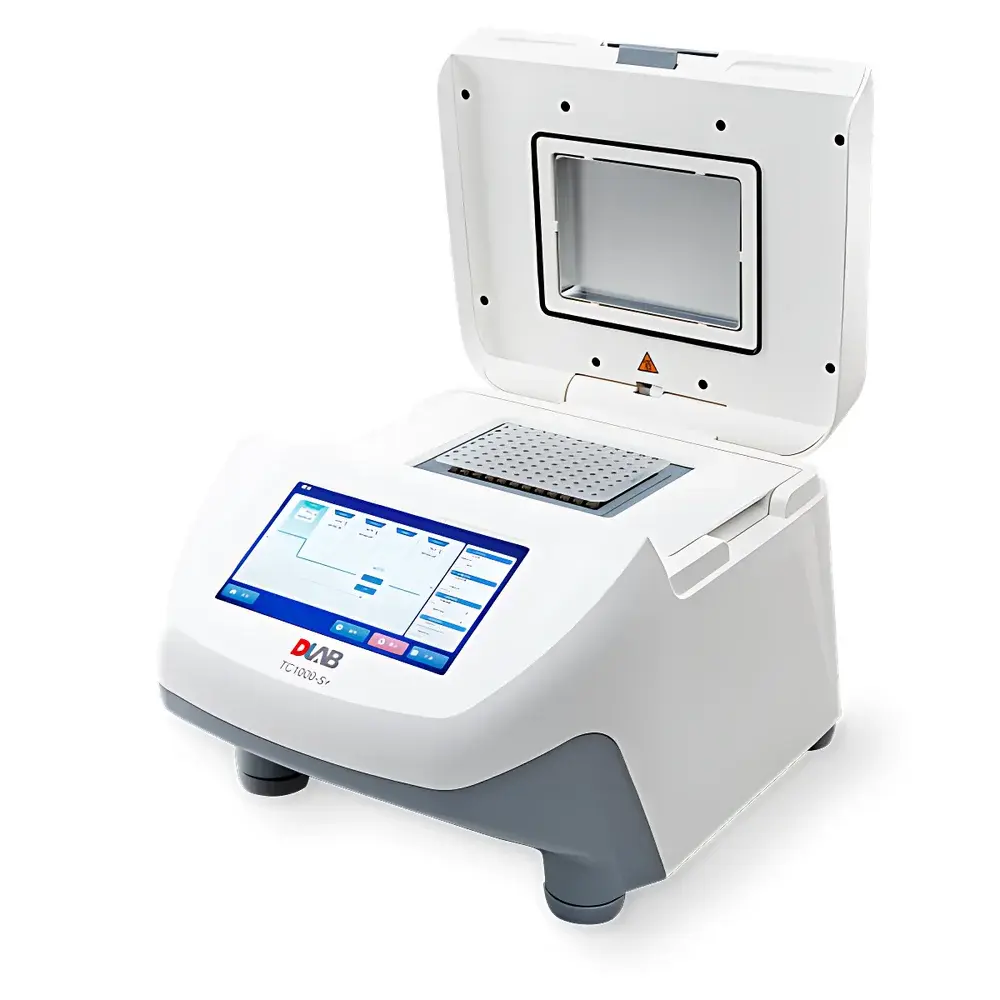
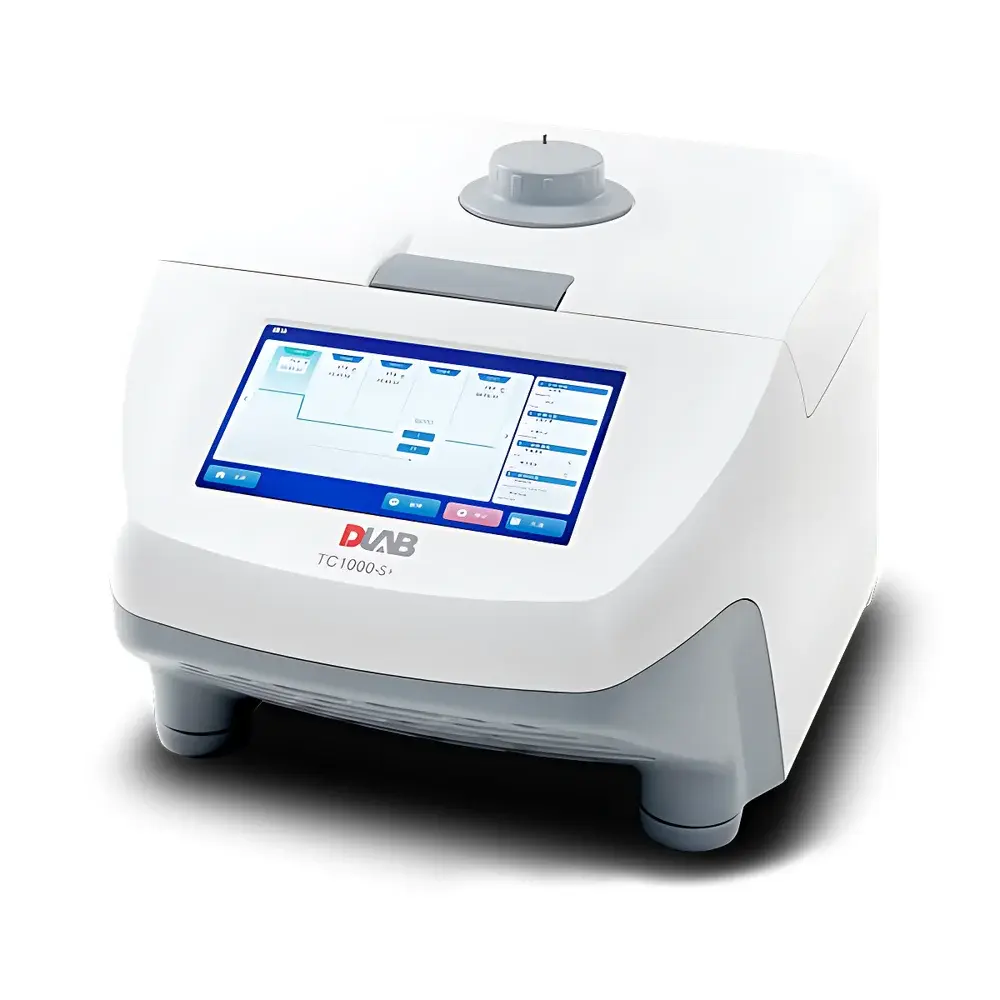
DLAB TC1000-S+ Isothermal and Standard Thermal Cycler
| Brand | DLAB |
|---|---|
| Origin | Beijing, China |
| Manufacturer Type | Direct Manufacturer |
| Region of Origin | Domestic (China) |
| Model | TC1000-S+ |
| Temperature Accuracy | ±0.1°C |
| Temperature Uniformity | ±0.2°C @ 55°C |
| Block Temperature Range | 4–105°C |
| Heat Lid Temperature Range | 30–110°C |
| Temperature Resolution | 0.1°C |
| Max Ramp Rate | 5°C/sec |
| Gradient Span | Programmable |
| Block Material | Aluminum |
| Display | 7-inch LCD (800×480) |
| Input Method | Capacitive Touchscreen |
| Program Capacity | >200 protocols |
| Steps per Protocol | Up to 30 |
| Max Cycles per Protocol | 99 |
| Power Supply | 100–120 V / 200–240 V, 50/60 Hz |
| Dimensions (L×W×H) | 296×370×295 mm |
| Weight | 9.5 kg |
| Sample Compatibility | 96×0.2 mL tubes, 12×0.2 mL strip tubes, 0.2 mL 96-well PCR plates |
| Features | Touchdown PCR (±9.9°C offset), Long PCR timing adjustment (±9 min 59 sec), Auto heat lid shutdown (<30°C block temp), power-fail recovery, edge temperature compensation |
Overview
The DLAB TC1000-S+ is a high-precision thermal cycler engineered for both standard PCR and isothermal nucleic acid amplification workflows in molecular biology laboratories. It employs Peltier-based thermoelectric modules for rapid, bidirectional heating and cooling—enabling precise control across the full operational range of 4–105°C. Unlike conventional cyclers relying on resistive heaters and passive cooling, the TC1000-S+ delivers superior thermal fidelity through active semiconductor regulation, ensuring minimal overshoot and tight dwell-time stability. Its aluminum reaction block provides excellent thermal conductivity and mechanical rigidity, while integrated edge compensation algorithms dynamically adjust local power delivery to counteract peripheral heat loss—a critical factor in achieving ±0.2°C uniformity at 55°C across all 96 positions. Designed as a foundational instrument for academic research, clinical diagnostics development, and industrial QC labs, the TC1000-S+ supports reproducible amplification under GLP-aligned operating conditions and meets essential requirements for method validation per ISO/IEC 17025 and CLSI EP05-A3 guidelines.
Key Features
- Peltier-driven thermal control with 5°C/sec maximum ramp rate and programmable gradient capability for empirical optimization of annealing conditions
- Advanced edge compensation technology ensures ±0.2°C temperature uniformity across the entire 96-well aluminum block at 55°C
- Touchdown PCR mode with adjustable offset (±9.9°C) and Long PCR timing extension (±9 min 59 sec) for complex template amplification
- Intelligent heat lid management: automatically disengages when block temperature falls below 30°C to prevent condensation and energy waste
- Robust data integrity architecture including non-volatile memory with >200 protocol storage, power-fail recovery, and audit-trail-capable program versioning
- 7-inch capacitive touchscreen interface (800×480 resolution) with intuitive icon-driven navigation and real-time thermal profile visualization
Sample Compatibility & Compliance
The TC1000-S+ accommodates standard consumables without adapter requirements: 96×0.2 mL single tubes, 12×0.2 mL strip tubes, and full-skirted or semi-skirted 0.2 mL 96-well PCR plates. All contact surfaces are chemically inert anodized aluminum, compliant with ISO 10993-5 for cytotoxicity and resistant to common decontamination agents (e.g., 70% ethanol, 10% bleach). The instrument conforms to IEC 61010-1:2010 safety standards for laboratory equipment and meets electromagnetic compatibility requirements per EN 61326-1:2013. Firmware supports timestamped event logging aligned with FDA 21 CFR Part 11 principles—including user authentication, electronic signatures, and immutable audit trails—facilitating GMP-compliant documentation in regulated environments.
Software & Data Management
No external PC dependency is required for routine operation; however, optional USB export enables protocol transfer and raw thermal log retrieval in CSV format. Each stored program includes metadata fields for operator ID, date/time stamp, and modification history. The embedded file system enforces hierarchical naming conventions and prevents overwriting of protected master protocols. All temperature transitions, dwell durations, and gradient settings are recorded with millisecond-level temporal resolution during run execution—supporting retrospective analysis of thermal performance deviations against SOP-defined tolerances.
Applications
The TC1000-S+ serves as a versatile platform for endpoint PCR, RT-PCR, colony PCR, and isothermal amplification methods including LAMP and RPA when paired with appropriate enzyme kits. Its precision thermal control supports applications demanding stringent denaturation fidelity (e.g., GC-rich target amplification), multiplex assays requiring narrow annealing windows, and library preparation steps in NGS workflows. In translational research, it facilitates genotyping, SNP detection, methylation-specific PCR, and CRISPR-based editing validation. Industrial users deploy it for pathogen screening in food safety testing (ISO 16140-2), GMO detection (EN ISO 21569), and bioprocess monitoring in upstream biomanufacturing.
FAQ
Does the TC1000-S+ support gradient PCR?
Yes—the instrument allows user-defined gradient spans across the block, enabling simultaneous evaluation of up to 12 annealing temperatures in a single run.
Is the firmware validated for use in regulated laboratories?
Firmware v2.3.1 and later include configurable audit trail logging, role-based access control, and electronic signature support—aligned with FDA 21 CFR Part 11 Annex 11 expectations.
Can I import/export protocols via USB?
Yes—protocols and thermal logs may be transferred using FAT32-formatted USB drives; no proprietary software is required.
What maintenance is required for long-term accuracy?
Annual verification using NIST-traceable calibrated probes is recommended; no routine calibration is needed due to factory-trimmed Peltier feedback loops.
Is the heat lid pressure adjustable?
No—the lid applies consistent, spring-loaded contact force optimized for standard 0.2 mL plate formats; manual override is not provided.





