
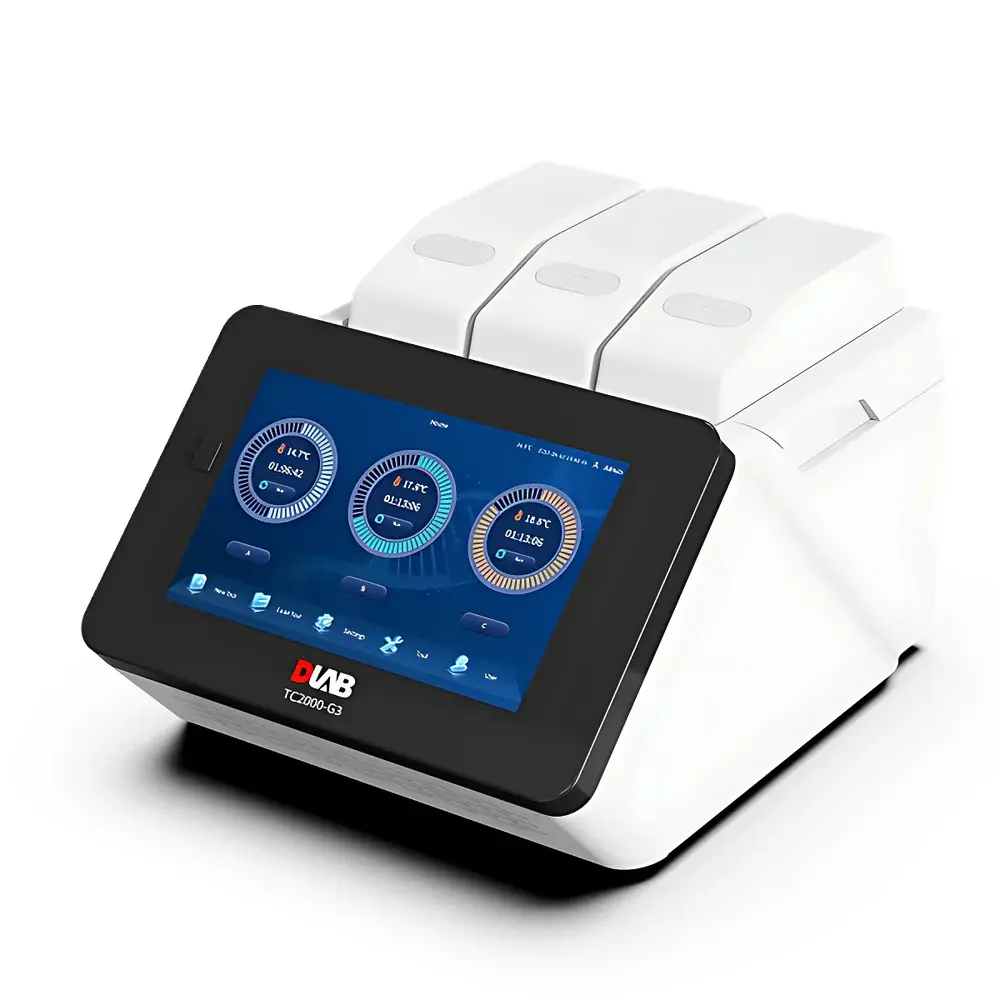
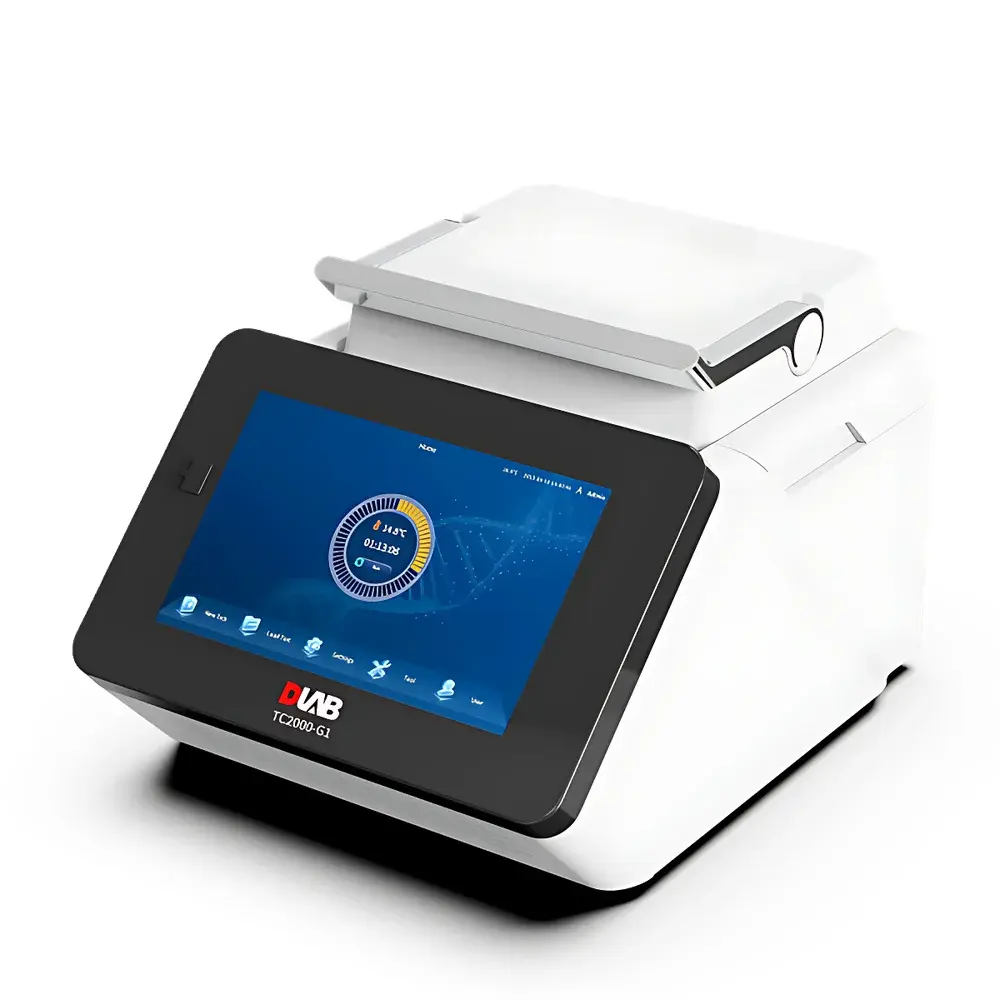
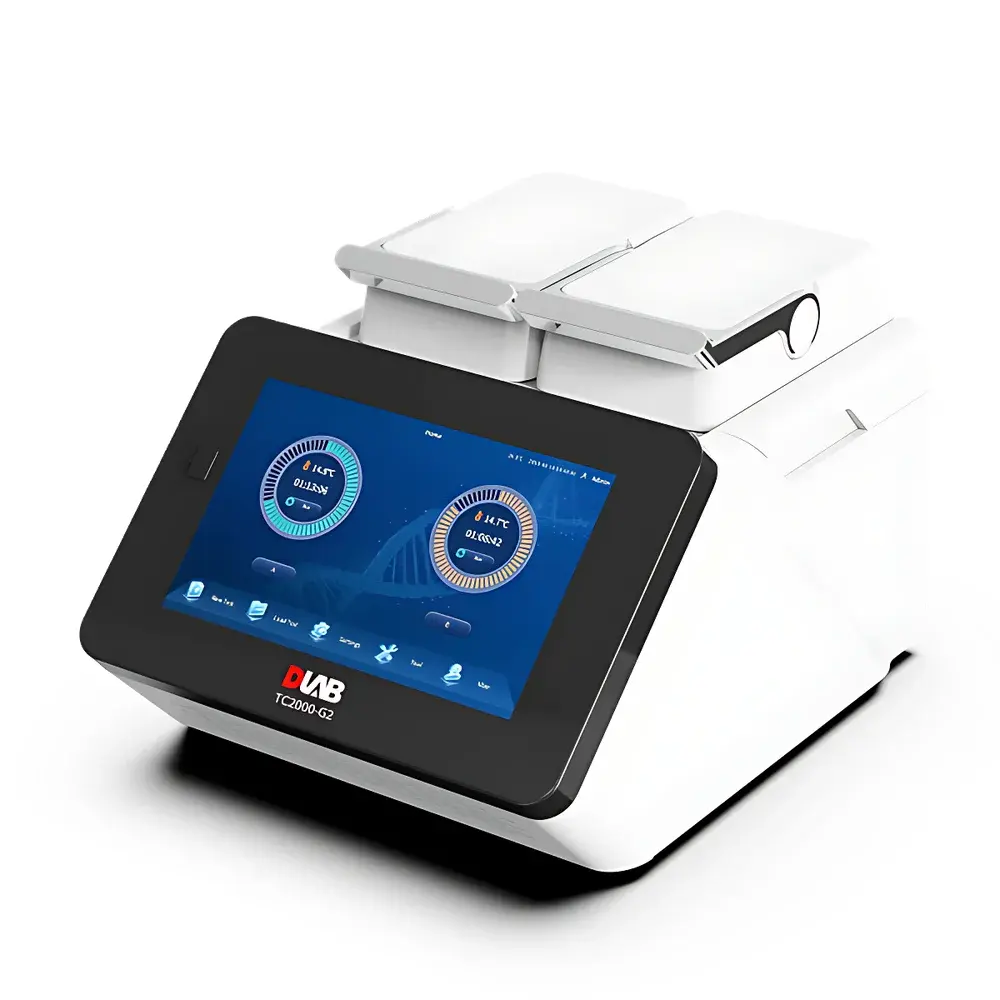
DLAB TC2000-G1/G2/G3 Gradient Thermal Cycler
| Brand | DLAB |
|---|---|
| Origin | Beijing, China |
| Manufacturer Type | Direct Manufacturer |
| Product Origin | Domestic (China) |
| Model | TC2000-G1/G2/G3 |
| Temperature Range | 0–105 °C |
| Heating Rate | 5 °C/s |
| Temperature Accuracy | ±0.1 °C |
| Temperature Uniformity | ±0.2 °C |
Overview
The DLAB TC2000-G1/G2/G3 Gradient Thermal Cycler is a modular, high-precision nucleic acid amplification platform engineered for rigorous molecular biology workflows. Based on Peltier-based thermoelectric heating and cooling, it delivers rapid thermal transitions and exceptional spatial temperature control across independently addressable thermal blocks. Unlike conventional single-block cyclers, the TC2000 series integrates up to three parallel thermal modules—G1 (single-channel), G2 (dual-channel), and G3 (triple-channel)—each capable of executing distinct gradient PCR programs simultaneously. This architecture supports true multi-experiment concurrency without cross-program interference, significantly increasing lab throughput while maintaining full compliance with ISO/IEC 17025 traceability requirements for thermal performance validation. The instrument operates under a deterministic real-time control loop, enabling reproducible ramping profiles and precise endpoint stabilization critical for demanding applications including touchdown PCR, long-range PCR, and high-fidelity amplification of GC-rich templates.
Key Features
- 10.1-inch capacitive touchscreen with intuitive, context-aware UI optimized for glove-compatible operation and multilingual support (English, Spanish, German, French)
- Modular thermal block design: Selectable G1 (1×96-well), G2 (2×96-well), or G3 (3×96-well) configurations—each block independently programmable with user-defined gradient profiles (0.1–40.0 °C span)
- Adaptive pressure-sensing hot lid with auto-calibrating downward force (0.5–2.5 kgf range), accommodating tube heights from 0.2 mL PCR tubes to full-skirted 96-well plates
- Edge-compensated thermal uniformity algorithm ensures ≤±0.2 °C well-to-well variation across all block zones—even at extreme setpoints (4 °C hold or 105 °C denaturation)
- Integrated power-loss recovery: Automatically resumes interrupted runs upon grid restoration, preserving cycle count integrity and timestamped audit logs per ICH-GCP and FDA 21 CFR Part 11 requirements
- USB 2.0 host interface supporting encrypted UDF-formatted USB drives for secure program import/export, firmware updates, and GLP-compliant data archiving with SHA-256 checksum verification
Sample Compatibility & Compliance
The TC2000 series accepts standard consumables without adapter modification: 0.2 mL thin-wall PCR tubes, 8-tube strips, and 96-well plates—including non-skirted, semi-skirted, and fully skirted formats. All thermal block surfaces are electropolished stainless steel with passivated edges to prevent nucleic acid adsorption and facilitate decontamination via ethanol or 10% bleach. The system meets EN 61010-1:2019 safety standards for laboratory equipment and complies with electromagnetic compatibility per EN 61326-1:2021. Firmware includes configurable user access levels (Operator, Supervisor, Administrator) with password-protected parameter locking and mandatory electronic signature logging for method changes—supporting audit-ready workflows in ISO 13485-certified diagnostic labs and GLP-regulated preclinical studies.
Software & Data Management
DLAB’s proprietary CycloneControl™ software (v3.2+) provides local and networked management via Ethernet or Wi-Fi. It enables remote monitoring of real-time block temperature traces, cycle progress, and error diagnostics—including predictive failure alerts based on Peltier junction resistance trending. All run data (including gradient maps, ramp profiles, and thermal history) are stored in vendor-neutral CSV and XML formats compliant with MIAME and MIAPE metadata standards. Audit trails record operator ID, timestamp, parameter modifications, and export events with immutable hash signatures. Software supports automated report generation aligned with CLIA and CAP checklist requirements for clinical PCR laboratories.
Applications
The TC2000-G series serves as a foundational platform across regulated and discovery research domains: pathogen detection (SARS-CoV-2, HPV, MRSA), SNP genotyping (TaqMan®-compatible assays), cDNA synthesis optimization, CRISPR gRNA validation, forensic STR amplification, GMO screening per EU Regulation (EC) No 1829/2003, environmental DNA (eDNA) metabarcoding (16S/18S/ITS), and ancient DNA library preparation where low-cycle fidelity and thermal consistency directly impact damage-pattern preservation. Its gradient flexibility accelerates assay development for qPCR probe design, primer annealing optimization, and multiplex reaction balancing—reducing empirical optimization time by up to 60% compared to fixed-block instruments.
FAQ
Does the TC2000-G series support external LIMS integration?
Yes—via RESTful API endpoints and HL7 v2.5 message support for bidirectional sample tracking and result ingestion.
What is the maximum number of cycles supported per protocol?
Up to 199 cycles with nested subroutines; unlimited repeat loops permitted within memory constraints.
Can gradient profiles be saved and recalled across different channel modules?
Yes—gradient definitions are stored as portable .gpf files and retain positional mapping when transferred between G1/G2/G3 configurations.
Is calibration traceable to NIST or equivalent national standards?
Yes—DLAB provides optional annual calibration certificates accredited to ISO/IEC 17025 by CNAS-accredited labs, with uncertainty budgets reported per EURAMET cg-18.
How is data integrity ensured during USB transfer?
All file operations use atomic write protocols with CRC32 validation; corrupted transfers trigger automatic rollback and event logging.




