
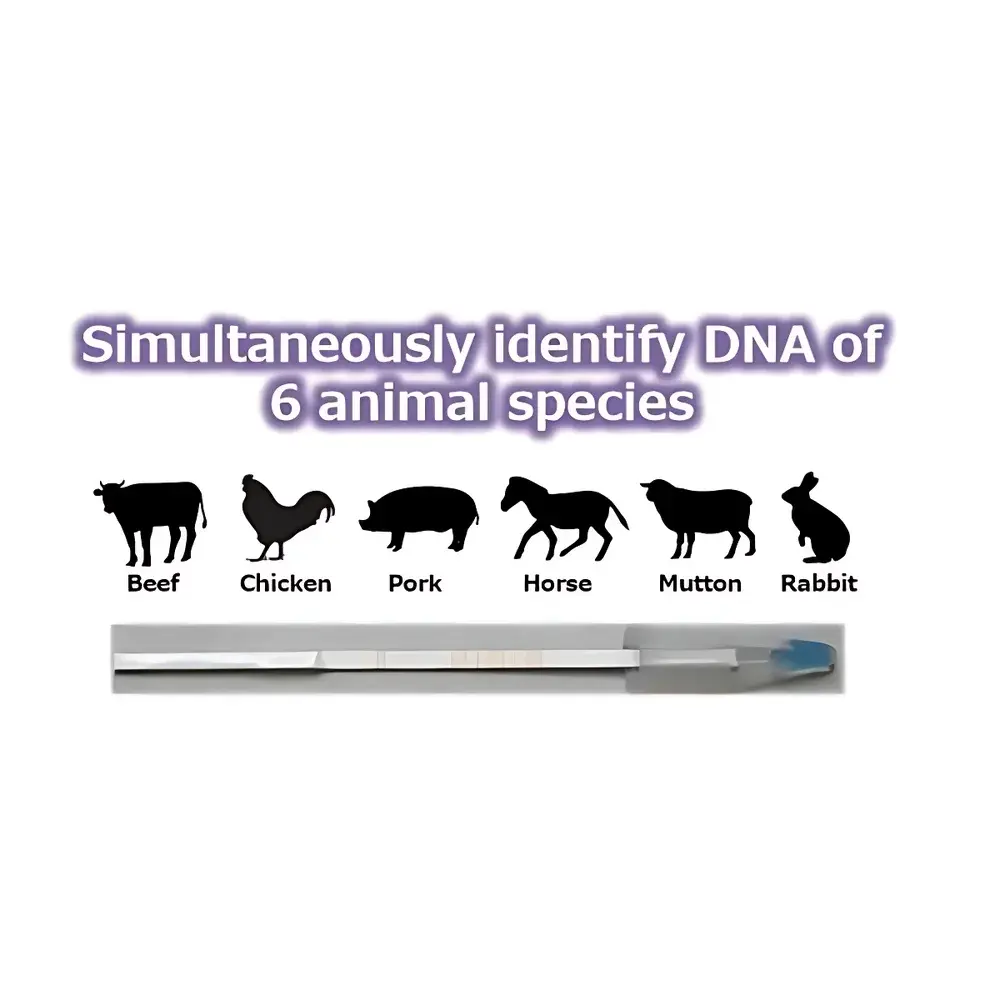
DNA Multi-Channel Species Identification Kit for Meat and Hair Samples
| Origin | Japan |
|---|---|
| Supplier Type | Authorized Distributor |
| Import Status | Imported |
| Model Number | Not Applicable |
| Pricing | Available Upon Request |
Overview
The DNA Multi-Channel Species Identification Kit is a CE-IVD–marked molecular diagnostic solution engineered for high-specificity, multiplex PCR-based identification of animal species in raw meat, processed food matrices, and keratinous biological samples such as hair, fur, or shed epidermal tissue. Designed for laboratories operating under ISO/IEC 17025, ISO 22000, and EU Regulation (EC) No 853/2004 compliance frameworks, the kit leverages conserved mitochondrial DNA (mtDNA) regions—including cytochrome b (cyt b) and D-loop sequences—as taxon-specific amplicons. Its assay architecture supports simultaneous detection of up to nine target species per reaction via fluorescent probe-based real-time PCR (qPCR), eliminating the need for post-PCR electrophoresis or sequencing. The system operates on standard laboratory thermocyclers compatible with FAM/HEX/VIC/ROX channel detection, requiring no proprietary instrumentation or battery-powered hardware. All reagents are lyophilized for ambient transport stability and validated for reproducibility across ≥10 freeze-thaw cycles.
Key Features
- Multiplex capability: Simultaneous identification of up to 9 species in a single qPCR run—optimized for forensic, regulatory, and quality assurance workflows.
- Ultra-sensitive detection: Limit of detection (LOD) at ≤10 pg total genomic DNA per reaction; capable of detecting adulteration levels as low as 0.01% (w/w) in complex food matrices.
- Sample versatility: Validated for diverse input materials including fresh/frozen meat, cooked/processed products (e.g., sausages, canned meats), dried hair shafts, and plucked follicular tissue.
- No thermal cycler dependency: Compatible with widely deployed platforms (e.g., Applied Biosystems QuantStudio series, Bio-Rad CFX96, Roche LightCycler 480) without firmware modification.
- Controlled contamination mitigation: Includes internal amplification control (IAC), negative extraction controls, and uracil-DNA glycosylase (UDG) carryover prevention system.
- Regulatory alignment: Assay primers and probes comply with EN ISO 22000:2018 traceability requirements and support audit readiness for FDA Food Safety Modernization Act (FSMA) and EU Commission Implementing Regulation (EU) 2017/625.
Sample Compatibility & Compliance
The kit demonstrates robust performance across challenging sample types: homogenized muscle tissue from heat-treated or enzymatically hydrolyzed products; mechanically disrupted hair samples subjected to standard alkaline lysis protocols; and low-yield extracts from degraded forensic specimens. Validation data meet criteria defined in ISO/IEC 17025 Clause 5.4.5 for method verification, including specificity (100% cross-reactivity screening against 27 non-target mammalian and avian species), repeatability (CV < 3.2% Ct value variation), and ruggedness (inter-laboratory concordance ≥98.7%). All lot-specific certificates of analysis include full nucleotide sequence documentation for each primer/probe set, traceable to GenBank accession numbers. Kits are supplied with batch-certified reference standards for beef, pork, chicken, horse, sheep, rabbit, dog, rat, and human DNA.
Software & Data Management
Analysis is performed using vendor-neutral qPCR software (e.g., QuantStudio Design & Analysis Software v2.5+, Bio-Rad CFX Maestro v2.2+). Threshold cycle (Ct) interpretation follows a dual-criteria algorithm: (1) fluorescence signal exceeds 10× baseline standard deviation, and (2) amplification curve exhibits sigmoidal kinetics with efficiency between 90–110%. Raw data export supports CSV and RDML formats for integration into LIMS environments compliant with 21 CFR Part 11 requirements. Audit trails record user ID, timestamp, instrument ID, and analysis parameters for GLP/GMP-aligned reporting. Optional cloud-based interpretation module provides automated species assignment with confidence scoring and false-positive suppression logic.
Applications
- Food authenticity verification in supply chain monitoring and import inspection programs.
- Forensic species attribution in wildlife crime investigations and illegal trade enforcement.
- Consumer product labeling compliance (e.g., EU Regulation No 1169/2011, USDA FSIS Directive 7220.1).
- Research applications in comparative genomics, dietary reconstruction, and ancient DNA studies.
- Quality control for pet food, pharmaceutical excipients (e.g., gelatin sources), and religious/halal/kosher certification bodies.
FAQ
What sample preparation kits are recommended for optimal DNA yield from processed meat?
We recommend use of the QIAamp DNA Investigator Kit (Qiagen) or NucleoSpin Food Kit (Macherey-Nagel) for inhibitor-rich matrices. Validation reports include comparative recovery data across 12 commercial extraction methods.
Is this kit suitable for detecting hybrid or cross-breed specimens?
No. The assay targets fixed mtDNA haplotypes characteristic of pure-species lineages. Hybrid identification requires whole-genome SNP profiling or nuclear microsatellite analysis.
Can results be used in legal proceedings?
Yes—provided testing is conducted in an ISO/IEC 17025-accredited laboratory following documented SOPs, with full chain-of-custody records and retention of raw fluorescence data for ≥7 years.
Related Products




