
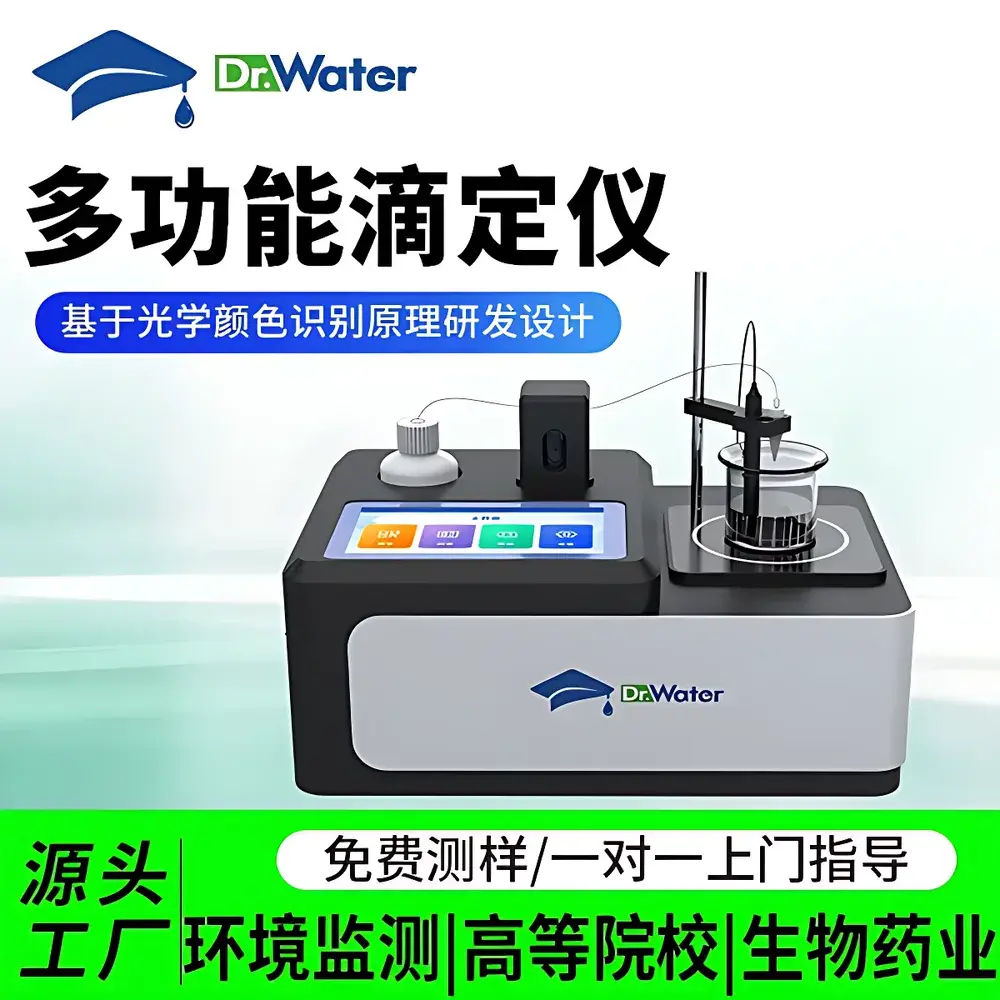
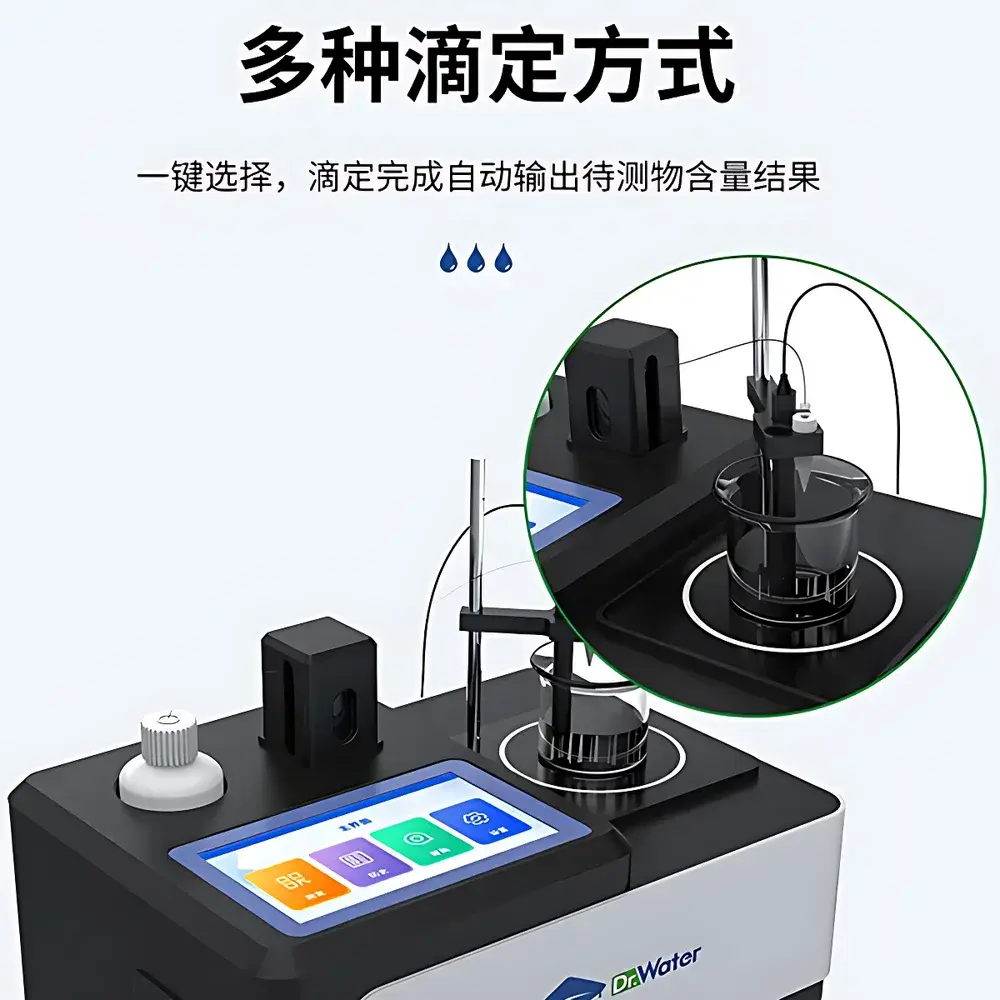
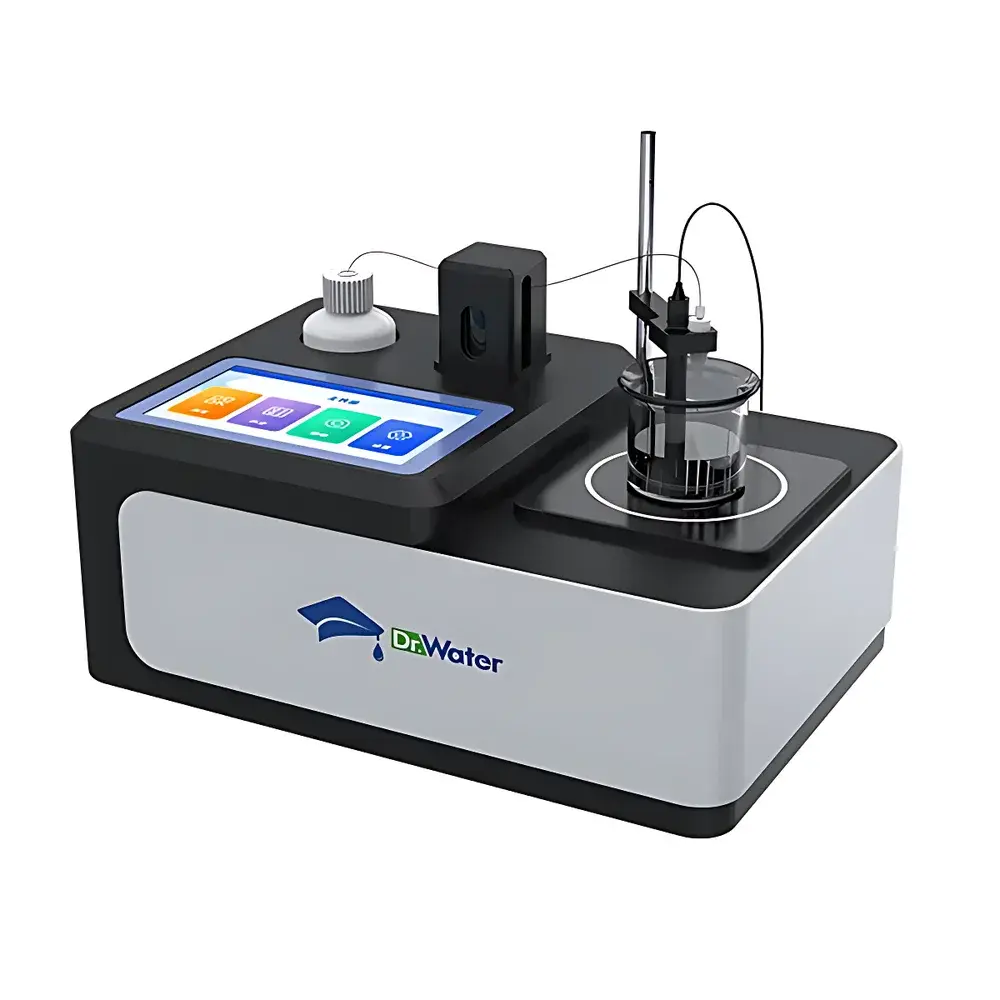
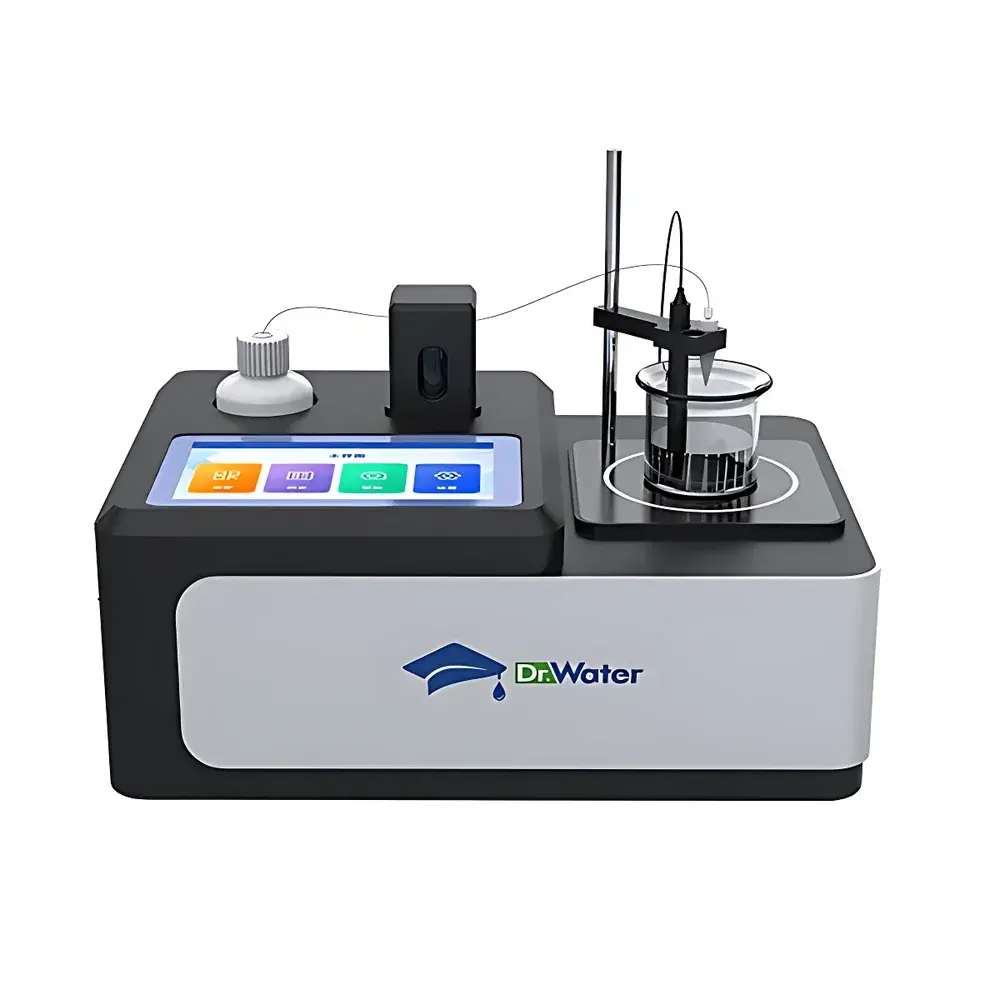
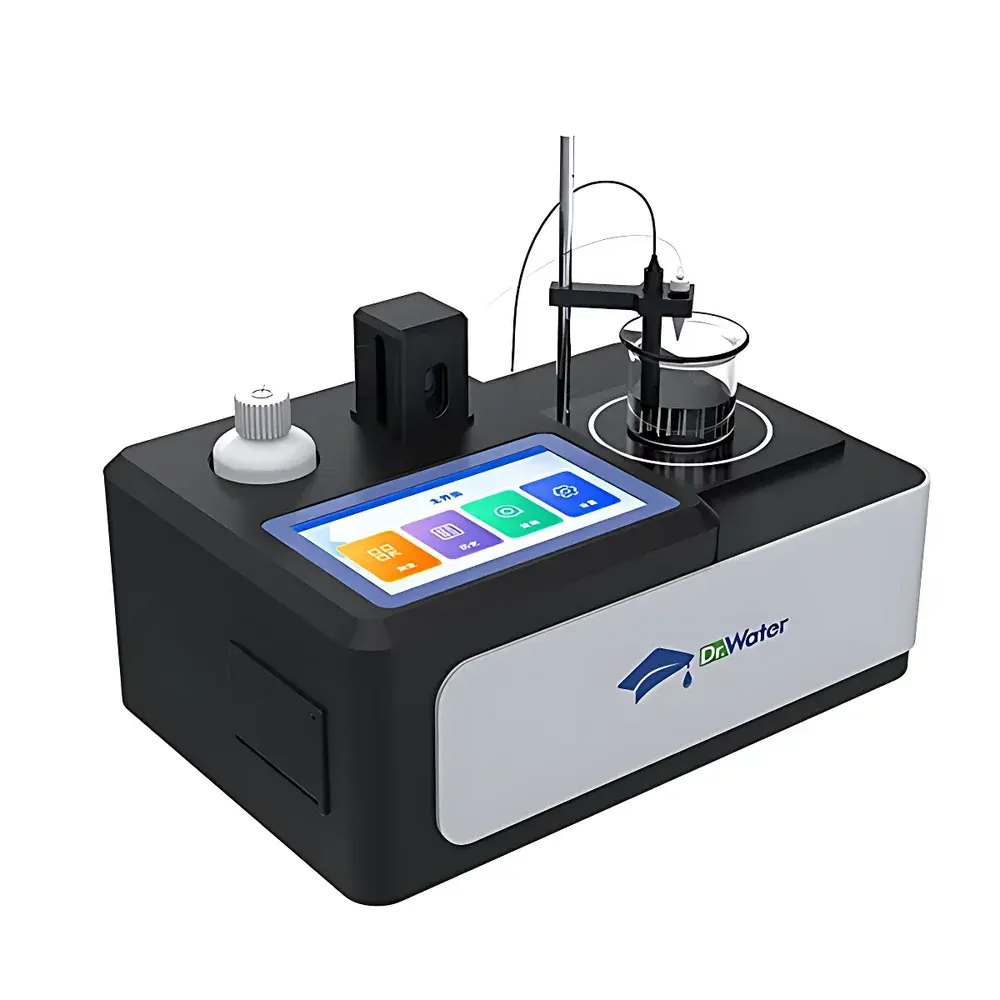
DoctorWater Dr-W1000 Automatic Potentiometric and Colorimetric Titrator
| Brand | DoctorWater |
|---|---|
| Origin | Hunan, China |
| Manufacturer Type | Authorized Distributor |
| Product Category | Domestic |
| Model | Dr-W1000 |
| Instrument Type | Universal Automatic Potentiometric Titrator |
| Application Scope | General-purpose |
| Titration Accuracy | ≤0.01 mL |
| Titration Resolution | 0.01 mL |
| Burette Capacity Options | 10 mL / 25 mL |
| Maximum Error | ±0.05% |
| Liquid Handling | Medical-grade precision syringe pump |
| Mixing Method | Magnetic stirring |
| Display | 7-inch HD capacitive touchscreen |
| Interface Language | Default Chinese, optional English firmware |
| Data Storage | 10,000 test records with timestamp, operator ID, and location metadata |
| Built-in Thermal Printer | Yes |
| Operating Environment | 5–40 °C, RH <85% (non-condensing) |
| Power Supply | AC 100–240 V input, DC 24 V output |
Overview
The DoctorWater Dr-W1000 is a dual-mode automatic titrator engineered for high-reproducibility quantitative chemical analysis in regulated and research laboratory environments. Unlike conventional potentiometric-only systems, the Dr-W1000 integrates both potentiometric endpoint detection and optical colorimetric endpoint recognition—enabling reliable determination of endpoints in redox, acid-base, precipitation, and complexometric titrations where visual or electrode-based detection is required. Its architecture follows ISO/IEC 17025-aligned design principles for analytical instrumentation, with modular separation between fluidic actuation (titration unit) and control logic (control unit), ensuring serviceability and long-term calibration stability. The system operates on a closed-loop syringe-pump-driven dispensing mechanism, eliminating reliance on gravity-fed burettes and minimizing hydrostatic error. All critical fluid pathways are chemically resistant (PTFE, borosilicate glass, and PEEK components), supporting compatibility with aggressive titrants including KMnO₄, EDTA, AgNO₃, and Na₂S₂O₃.
Key Features
- Hybrid endpoint detection: Simultaneous support for potentiometric (via standardized reference/indicator electrode inputs) and colorimetric (RGB-sensor-based chromatic transition analysis) modes—validated for USP <541>, ASTM D129, and ISO 9297 applications.
- Three-tier titration speed control (high/medium/low), enabling adaptive addition rates during steep pH or potential inflection zones—critical for minimizing overshoot in low-buffer-capacity samples.
- Pre-programmed titration methods for 8 standardized water quality parameters: Permanganate Index (CODMn), Total Hardness (as CaCO₃), Chloride (Mohr method), Sulfide (iodometric), Available Chlorine (DPD), Total Alkalinity, Phenolphthalein Alkalinity, and Dissolved Oxygen (Winkler).
- Automated fluidic sequence management: Integrated rinse, purge, homogenization, aspiration, and waste evacuation routines—reducing carryover risk and meeting GLP requirements for traceability.
- User-definable pre-dose volume setting (0.01–25.00 mL in 0.01 mL increments), allowing precise sample conditioning prior to endpoint-driven titration.
- Full audit trail capability: Timestamped records include operator ID, lab location, instrument serial number, method version, raw sensor data (mV or RGB values), and final calculated concentration (mg/L, mmol/L, or ppm).
Sample Compatibility & Compliance
The Dr-W1000 accommodates aqueous matrices across environmental, pharmaceutical, and industrial sectors—including wastewater, drinking water, process streams, biological extracts, and electroplating baths. It complies with electrical safety standards IEC 61010-1 and electromagnetic compatibility per IEC 61326-1. For regulatory workflows, the instrument supports 21 CFR Part 11-compliant electronic signatures when paired with validated networked software (optional). All preloaded methods align with EPA Method 310.1 (chloride), APHA Standard Methods 2320B (hardness), and ISO 5813 (dissolved oxygen). Sample vessels range from standard 100 mL beakers to optional 250 mL tall-form titration cups, with magnetic stir bar compatibility up to 1500 rpm.
Software & Data Management
The embedded firmware provides real-time graphical display of titration curves (potential/mV vs. volume or ΔRGB vs. volume), with adjustable smoothing filters and derivative-based inflection point calculation. Data export is supported via USB flash drive in CSV and PDF formats—both containing full metadata headers for LIMS integration. Internal storage retains 10,000 complete assay records with search-by-date, parameter, or operator. Optional PC software (Dr-Titration Suite v3.x) enables method development, remote calibration verification, and automated report generation compliant with ISO/IEC 17025 clause 7.8.2.
Applications
The Dr-W1000 serves as a primary titration platform in municipal water quality labs (e.g., compliance testing per GB/T 5750), university teaching laboratories (quantitative analysis courses), QC units in biopharma (raw material chloride testing per USP <251>), and third-party environmental testing facilities accredited to CNAS-CL01. Its dual detection mode eliminates manual endpoint judgment errors in color-sensitive assays such as iodometric sulfide analysis or DPD-based free chlorine measurement—reducing inter-operator variability by >40% compared to manual titration (based on internal inter-laboratory study, n=12).
FAQ
Does the Dr-W1000 support electrode calibration verification per ISO 17025 requirements?
Yes—built-in calibration check routines log mV offset, slope (% recovery), and asymmetry potential for pH and redox electrodes, with pass/fail flags against user-defined acceptance criteria.
Can custom titration methods be imported or edited without vendor assistance?
Yes—the method editor allows modification of titrant concentration, equivalence point logic, pre-dose volume, and endpoint threshold settings via password-protected admin mode.
Is the thermal printer compatible with external label printers for sample tube tagging?
No—the integrated thermal printer is dedicated to assay reports; however, CSV exports support direct import into common LIMS barcode-labeling modules.
What maintenance intervals are recommended for the syringe pump and fluidic path?
Syringe pump calibration verification every 6 months; full fluidic path cleaning (with 10% nitric acid flush) after every 200 titrations involving heavy-metal or precipitating titrants.
Does the instrument meet IP rating requirements for humid laboratory environments?
The enclosure meets IP20 classification per IEC 60529—suitable for indoor laboratory use but not for splash-prone or washdown areas.




