Dolomite Microfluidic PLGA Nanoparticle Encapsulation System
| Brand | Dolomite |
|---|---|
| Origin | United Kingdom |
| Manufacturer Type | Authorized Distributor |
| Origin Category | Imported |
| Model | PLGA Nanoparticle Encapsulation System |
| Carrier Material | Poly(lactic-co-glycolic acid) (PLGA) |
| Encapsulation Method | Continuous-Flow Microfluidics |
| Particle Uniformity (CV) | ≤5% |
| Typical Particle Size Range | 100–500 nm |
| Encapsulation Efficiency | 30–100% |
| Batch-to-Batch Reproducibility | High |
| Compliance Context | Designed for R&D and preclinical GMP-aligned nanomedicine process development |
Overview
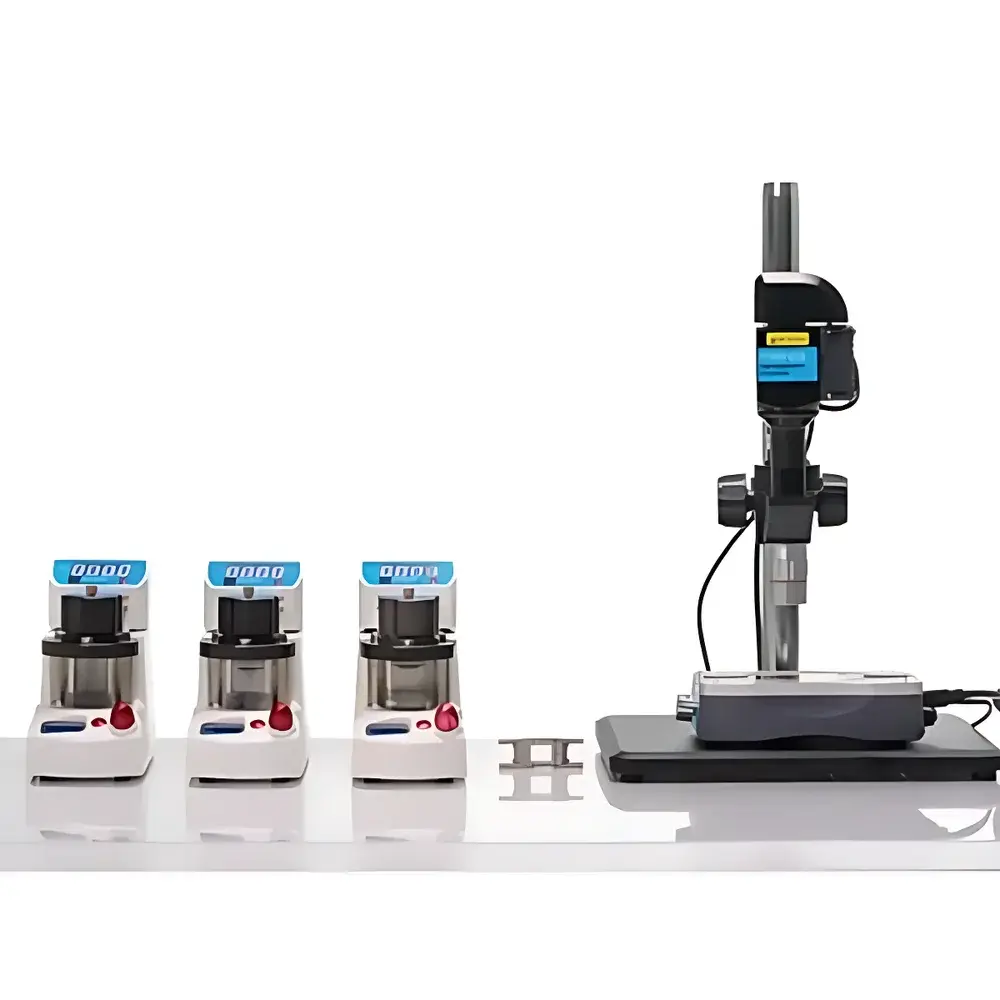
The Dolomite Microfluidic PLGA Nanoparticle Encapsulation System is an engineered platform for the continuous, scalable synthesis of monodisperse poly(lactic-co-glycolic acid) (PLGA) nanoparticles intended for controlled drug delivery applications. It operates on the principle of hydrodynamic flow focusing within precision-machined glass or thermoplastic microfluidic chips, enabling deterministic control over nanoprecipitation kinetics, solvent diffusion rates, and interfacial polymer solidification. Unlike conventional bulk emulsification or nanoprecipitation methods—which rely on turbulent mixing and stochastic nucleation—the system achieves laminar, diffusion-controlled assembly under precisely regulated residence time, flow rate ratio (aqueous:organic phase), and temperature conditions. This results in reproducible formation of spherical, non-aggregated PLGA particles with narrow size distribution (CV ≤5%), consistent surface morphology, and predictable encapsulation efficiency across diverse active pharmaceutical ingredients (APIs), including hydrophobic small molecules, peptides, and nucleic acids.
Key Features
- Continuous-flow microfluidic architecture enabling real-time process monitoring and closed-system operation
- Interchangeable chip designs supporting multiple particle size regimes (100–500 nm) without hardware modification
- Integrated syringe pump modules with sub-microliter per minute flow resolution and dual-channel synchronization
- Temperature-controlled collection module (4–40 °C) to stabilize labile payloads during particle formation and quenching
- On-chip solvent exchange capability for immediate buffer exchange post-formation, minimizing post-processing steps
- Modular design compliant with ISO 13485-aligned cleanroom integration protocols and compatible with Class A/B environmental enclosures
Sample Compatibility & Compliance
The system accommodates a broad range of PLGA formulations—including varying lactide:glycolide ratios (50:50 to 85:15), molecular weights (10–150 kDa), and end-group chemistries (carboxyl-, ester-, or PEG-functionalized). It supports co-encapsulation of APIs with surfactants (e.g., PVA, poloxamers), stabilizers, and targeting ligands without compromising monodispersity. All wetted components are USP Class VI-certified and autoclavable. The platform is designed to support development workflows aligned with ICH Q5A(R2), Q5C, and Q5D guidelines for biopharmaceutical nanocarriers. While not a GMP manufacturing system per se, its operational traceability—via timestamped flow logs, pressure sensor outputs, and thermal profiles—supports GLP documentation and FDA 21 CFR Part 11-compliant data archiving when integrated with validated LIMS or ELN systems.
Software & Data Management
Control is managed via Dolomite’s proprietary Microfluidic Control Software (v4.x), a Windows-based application offering intuitive graphical workflow configuration, real-time parameter visualization (flow rate, pressure, temperature), and automated method saving with versioned metadata tagging. All operational parameters—including pump calibration coefficients, chip ID, and user-defined SOP identifiers—are embedded in exported CSV/JSON datasets. Audit trail functionality records operator login, method execution timestamps, parameter changes, and system alerts. Raw data files include embedded checksums for integrity verification. Exported datasets are structured to align with FAIR (Findable, Accessible, Interoperable, Reusable) principles and integrate natively with MATLAB, Python (via Pandas), and commercial statistical platforms such as JMP or Minitab for DoE-driven optimization.
Applications
- Rapid screening of PLGA formulation variables (polymer MW, LA:GA ratio, solvent selection) for optimal encapsulation yield and release kinetics
- Preclinical development of sustained-release injectables (e.g., depot formulations for oncology, neurology, or immunomodulation)
- Production of reference standards for analytical method validation (e.g., DLS, TEM, HPLC-SEC quantification)
- Co-encapsulation studies evaluating synergistic payload combinations (e.g., siRNA + small-molecule inhibitor)
- Process transfer support from bench-scale microfluidics to semi-continuous membrane emulsification or T-junction scale-up systems
- Teaching and training in nanomedicine process engineering, emphasizing first-principles understanding of nucleation, growth, and stabilization dynamics
FAQ
What is the typical throughput range for this system?
Typical volumetric throughput ranges from 0.1 to 5 mL/h per chip, depending on target particle size and viscosity of the organic phase. Multiple chips can be operated in parallel using Dolomite’s Multi-Channel Flow Controller.
Can the system handle viscous polymer solutions (e.g., >10 cP PLGA in ethyl acetate)?
Yes—provided appropriate chip geometry (e.g., widened channel cross-sections) and pre-filtration (<0.45 µm) are implemented. Backpressure monitoring is recommended for real-time detection of potential clogging events.
Is chip cleaning and reuse supported?
Glass chips are fully cleanable using sequential rinses of ethanol, chloroform, and deionized water, followed by nitrogen drying. Thermoplastic chips are single-use and supplied sterile-packed.
Does Dolomite provide application support for API-specific encapsulation optimization?
Yes—Dolomite’s Application Scientists offer remote and on-site protocol development services, including DoE-based parameter sweeps, stability assessment, and analytical correlation (e.g., encapsulation efficiency vs. DLS size shift).