
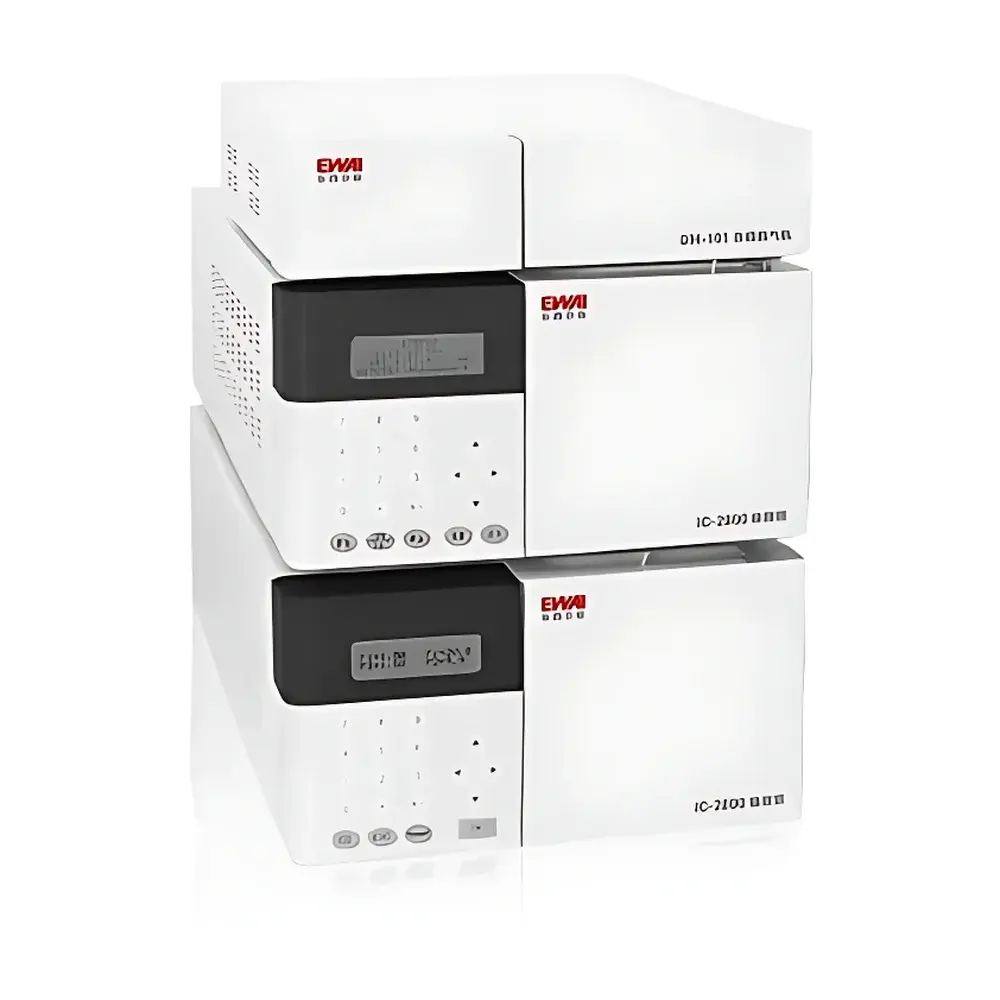
Dongxi Analysis IC-2800 Ion Chromatograph
| Brand | Dongxi Analysis |
|---|---|
| Origin | Beijing, China |
| Manufacturer Type | Original Equipment Manufacturer (OEM) |
| Product Origin | Domestic (China) |
| Model | IC-2800 |
| Instrument Type | Benchtop Laboratory System |
| Pump Maximum Pressure | 35 MPa |
| Flow Rate Range | 0.01–10.00 mL/min |
| Eluent Flow Rate Accuracy | ±0.1% RSD |
| Maximum Operating Pressure | 35 MPa |
| Eluent Concentration Range | 1–100 mM (KOH, MSA, Na₂CO₃/NaHCO₃, etc.) |
Overview
The Dongxi Analysis IC-2800 Ion Chromatograph is a high-performance, dual-mode benchtop system engineered for precise, reproducible separation and quantitative detection of anions and cations in complex aqueous matrices. It operates on the principle of suppressed conductivity detection following ion-exchange chromatography—where analyte ions are separated on high-efficiency, low-capacity ion-exchange columns and subsequently detected via a low-noise, temperature-stabilized digital conductivity detector. Suppression is achieved using proprietary electrochemical self-regenerating suppressors, eliminating the need for chemical regenerants or external reagent reservoirs. This architecture enables sub-ppb detection limits for common inorganic ions (e.g., F⁻, Cl⁻, NO₂⁻, NO₃⁻, SO₄²⁻, Na⁺, NH₄⁺, K⁺, Ca²⁺, Mg²⁺), while maintaining long-term baseline stability and robustness across variable sample loads and eluent compositions.
Key Features
- Electrochemical self-regenerating suppressor (anion and cation variants available): Utilizes electrolytically generated H⁺ or OH⁻ to continuously regenerate ion-exchange membranes; achieves background conductivity 100 µeq/mL.
- Dual-piston, PEEK-bodied high-pressure pump: Delivers flow rates from 0.01 to 10.00 mL/min with pulse dampening <0.1% RSD; compatible with strong acids (e.g., methanesulfonic acid), strong bases (e.g., KOH), and carbonate/bicarbonate buffers.
- Digital thermostatically controlled conductivity detector: Temperature stability ±0.01 °C; adjustable cell constant (0.01–100 mS/cm); linear dynamic range >10⁴.
- Entire fluidic path constructed from biocompatible, corrosion-resistant PEEK: Fully inert to concentrated acids (up to 1 M HNO₃), alkalis (up to 100 mM KOH), and organic modifiers (e.g., acetone, methanol, acetonitrile).
- Real-time system diagnostics and hardware monitoring: Embedded microcontroller logs pressure, flow, temperature, detector signal, and suppressor status; supports predictive maintenance alerts and fault isolation.
- Optional Eluent Generator Module (EGM): On-demand generation of KOH or MSA eluents (1–100 mM) with <±2% concentration accuracy; eliminates manual preparation, reduces inter-batch variability, and supports gradient elution protocols.
Sample Compatibility & Compliance
The IC-2800 accommodates direct injection of filtered aqueous samples (0.22 µm or 0.45 µm PVDF membrane), including environmental waters (rainwater, groundwater, wastewater), food extracts, pharmaceutical excipients, battery electrolytes, and semiconductor process chemicals. Its design conforms to ISO 17025:2017 requirements for analytical method validation and instrument qualification. When operated with validated methods, it supports compliance with ASTM D4327 (anions in water), ASTM D6919 (cations in water), USP (conductivity of purified water), and EPA Methods 300.0, 300.1, and 317.0. Data integrity features—including user-access logging, electronic signatures, and audit trail generation—are configurable to meet FDA 21 CFR Part 11 and EU Annex 11 expectations when integrated with compliant LIMS or ELN platforms.
Software & Data Management
Controlled by Ace Chromatography Software (v4.x), the IC-2800 provides intuitive graphical workflow management: method setup, sequence definition, real-time chromatogram visualization, peak integration (with customizable baselines and retention time windows), calibration curve fitting (linear, quadratic, or weighted), and report generation (PDF, CSV, XML). The software supports multi-user role-based access control (administrator, analyst, reviewer), full audit trail recording (including parameter changes, data reprocessing, and report exports), and raw data archiving in vendor-neutral formats. Integration with third-party laboratory information management systems (LIMS) is enabled via ASTM E1384-compliant interfaces and OPC UA protocol support.
Applications
- Environmental monitoring: Quantification of regulated anions (Cl⁻, NO₃⁻, SO₄²⁻) and cations (Na⁺, Ca²⁺, Mg²⁺) in drinking water per WHO guidelines and national standards (e.g., GB/T 5750.5–2023).
- Pharmaceutical quality control: Residual counterion analysis (e.g., Na⁺ in sodium heparin, Cl⁻ in amoxicillin trihydrate), excipient purity testing (e.g., sulfate in lactose monohydrate), and cleaning validation swab extracts.
- Food & beverage safety: Nitrate/nitrite in cured meats, bromide in soft drinks, iodide in dairy products, and ammonium in fermentation broths.
- Electrochemical materials: Trace anion impurities (F⁻, Cl⁻, SO₄²⁻) in Li-ion battery electrolytes; cation leachables (Ni²⁺, Co²⁺, Mn²⁺) from cathode slurries.
- Power generation: Chloride and sulfate monitoring in boiler feedwater and steam condensate per ASTM D4582 and IAPWS guidelines.
FAQ
Does the IC-2800 support both anion and cation analysis on a single platform?
Yes—the system is field-upgradable between anion and cation modes via column and suppressor exchange; no hardware modification is required.
Is the electrochemical suppressor truly maintenance-free?
It requires no consumable regenerants or periodic replacement of membranes under normal operation; routine maintenance is limited to annual seal inspection and column regeneration per manufacturer guidelines.
Can the IC-2800 be integrated into a GLP/GMP-compliant laboratory environment?
When deployed with Ace Software’s 21 CFR Part 11 module enabled and accompanied by IQ/OQ/PQ documentation packages, it meets core ALCOA+ data integrity principles and supports regulatory audits.
What eluent options are supported without the Eluent Generator Module?
Manually prepared solutions of potassium hydroxide (KOH), methanesulfonic acid (MSA), sodium carbonate/sodium bicarbonate (Na₂CO₃/NaHCO₃), and lithium hydroxide (LiOH) are fully supported.
Is PEEK tubing compatible with organic solvent-containing eluents?
Yes—PEEK exhibits excellent chemical resistance to ≤30% (v/v) methanol, acetonitrile, or acetone in aqueous eluents; higher organic content requires optional PTFE-lined capillaries.




