
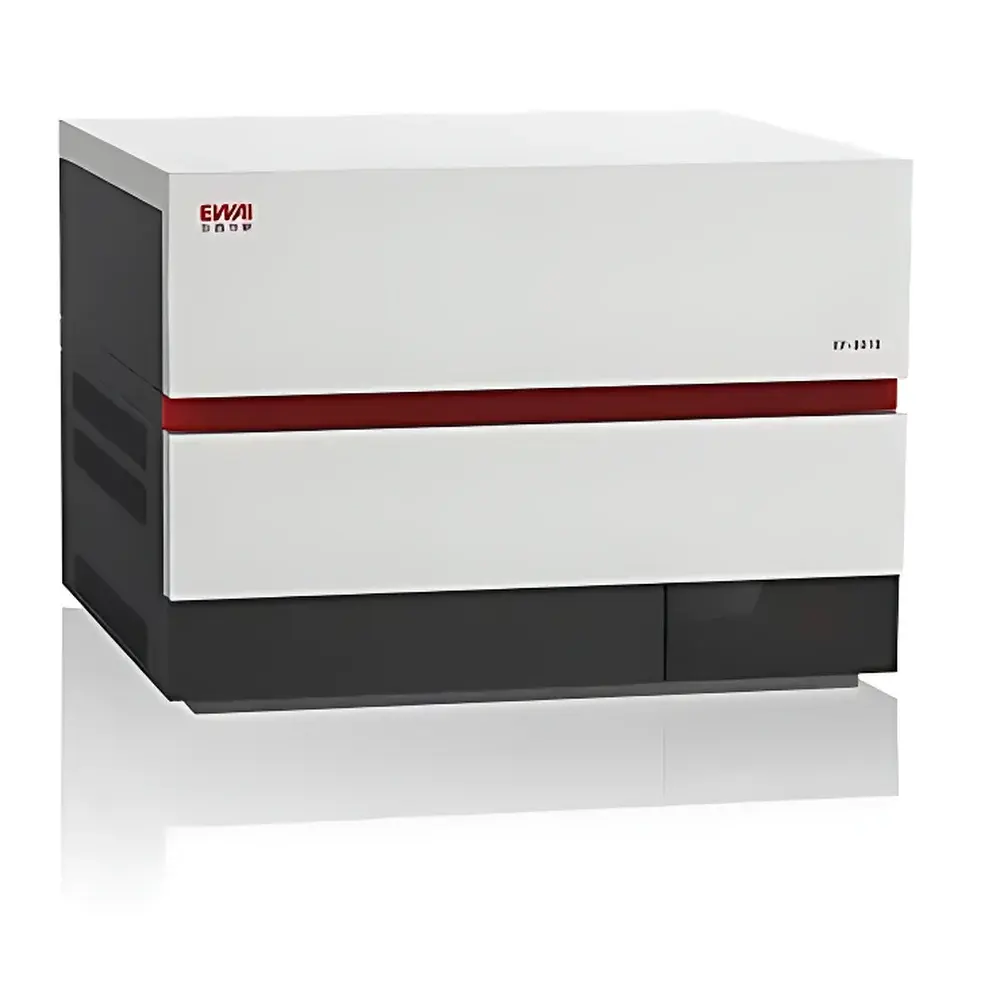
Dongxi Analysis XD-8010 Energy Dispersive X-Ray Fluorescence Spectrometer
| Brand | Dongxi Analysis |
|---|---|
| Origin | Beijing, China |
| Manufacturer Type | Direct Manufacturer |
| Product Category | Domestic |
| Model | XD-8010 |
| Form Factor | Benchtop/Floor-standing |
| Industry Application | Geological & Mineralogical Analysis |
| Elemental Range | S (Z=16) to U (Z=92) |
| Quantification Range | ppm to wt% |
| Filter Options | 15-position automatic filter wheel |
| Beam Diameter | 1–7 mm adjustable |
| Sample Chamber | Large-volume, non-destructive chamber |
| Software | Integrated EDXRF workstation with real-time video imaging, report customization (PDF/Excel), spectral comparison, and GLP-compliant data archiving |
Overview
The Dongxi Analysis XD-8010 Energy Dispersive X-Ray Fluorescence (EDXRF) Spectrometer is a benchtop-to-floor-standing analytical instrument engineered for rapid, non-destructive elemental composition analysis of solid, powdered, and irregularly shaped geological and mineralogical samples. Operating on the fundamental principle of X-ray fluorescence—where primary X-rays excite atoms in the sample, inducing emission of characteristic secondary (fluorescent) X-rays—the XD-8010 delivers qualitative and quantitative results across the full elemental range from sulfur (Z = 16) to uranium (Z = 92). Its design prioritizes operational safety, analytical flexibility, and regulatory readiness: the triple-layer radiation protection system integrates software interlocks, hardware-based shutter controls, and a labyrinth-style mechanical shielding architecture—fully compliant with IEC 61010-1 and GB/T 18871 national radiation safety standards. The spectrometer employs a high-efficiency silicon drift detector (SDD) coupled with a low-power micro-focus X-ray tube, enabling stable count rates and robust signal-to-noise performance without cryogenic cooling.
Key Features
- Triple-redundant radiation safety architecture: software-triggered beam shutdown, hardware-enabled shutter lockout, and physical maze-style enclosure design—validated per ISO 20816-1 for occupational exposure limits.
- Optimized short-path optical geometry: proprietary coaxial collimator and compact detector positioning minimize scattering losses and enhance peak intensity, directly improving detection sensitivity and lowering practical quantification limits.
- Large-volume sample chamber (≥300 × 250 × 150 mm): accommodates bulk rock specimens, drill cores, polished thin sections, and irregular mineral aggregates without grinding, pressing, or fusion—preserving sample integrity and reducing preparation bias.
- 15-position motorized filter wheel: enables precise excitation optimization by selecting appropriate absorption filters (e.g., Al, Cu, Ti, Pb) matched to target elements and matrix composition—critical for mitigating spectral overlaps in complex geological matrices.
- Variable beam collimation: selectable X-ray spot sizes from 1 mm to 7 mm diameter support both high-spatial-resolution micro-analysis and macro-homogeneity assessment across heterogeneous samples.
- Integrated HD CMOS camera and real-time video feed: allows precise sample positioning, visual documentation, and direct embedding of annotated images into final analytical reports.
Sample Compatibility & Compliance
The XD-8010 accepts solids, pressed pellets, fused beads, and loose powders—ideal for exploration geochemistry, ore grade control, soil screening, and mining QA/QC workflows. No vacuum or helium purge is required; ambient air operation ensures rapid turnaround for field-lab or core logging applications. All firmware and measurement protocols adhere to ASTM D7359 (standard test method for elemental analysis of petroleum products by EDXRF), ISO 22048 (geological materials – XRF analysis), and support audit-ready GLP/GMP data handling. Radiation emission testing documentation is provided per CNAS-CL01 and meets China NMPA Class II medical device safety equivalency requirements for industrial X-ray equipment.
Software & Data Management
The embedded EDXRF workstation provides fully automated acquisition, spectrum deconvolution (using fundamental parameter + empirical calibration algorithms), and multi-element quantification. It supports customizable reporting templates—users define layout, metadata fields, pass/fail thresholds, and statistical summaries—and export finalized reports directly to PDF or Excel (XLSX) formats. All raw spectra, processed results, acquisition parameters, and timestamped operator logs are stored in a relational SQLite database with immutable audit trails. Spectral comparison tools enable side-by-side overlay of up to six spectra for phase identification, batch consistency checks, or reference material validation. The system supports 21 CFR Part 11-compliant user access control (role-based permissions), electronic signatures, and secure data backup via network share or USB 3.0.
Applications
- Geochemical mapping and lithogeochemical characterization of igneous, metamorphic, and sedimentary rocks
- Rapid screening of critical raw materials (e.g., Li, Co, Ni, REEs) in battery-grade ores and recycling streams
- Soil contamination assessment (As, Cd, Cr, Pb, Hg) per EPA Method 6200 and China HJ 803-2016
- Mineral processing plant feed/product assays for Fe, SiO₂, Al₂O₃, CaO, MgO, P, S, and trace metals
- Archaeometric provenance studies using trace element fingerprinting of ceramics and obsidian
- Regulatory compliance testing for RoHS, WEEE, and China’s GB/T 26572 restricted substances in mining-related equipment components
FAQ
Is the XD-8010 certified for radiation safety in international markets?
Yes—type examination reports confirm compliance with IEC 61010-1, IEC 62471 (photobiological safety), and EU Directive 2013/59/Euratom for industrial X-ray equipment. CE marking documentation is available upon request.
Can the system be calibrated for specific geological reference materials?
Absolutely—the open calibration platform supports custom FP+empirical curve development using CRM sets such as USGS AGV-2, GSP-2, or BHVO-2, with full uncertainty propagation and ISO/IEC 17025 traceability pathways.
Does the software support multi-language interfaces and LIMS integration?
The workstation includes English, Spanish, Russian, and Simplified Chinese UI options. Native CSV export and optional OPC UA or ASTM E1384-compliant HL7 messaging enable seamless LIMS connectivity.
What maintenance is required for long-term stability?
Annual detector resolution verification (Mn Kα FWHM) and X-ray tube output calibration are recommended. No consumables are required beyond standard cleaning of the beryllium window and sample chamber.
Is remote diagnostics and software update capability available?
Yes—secure SSH-enabled remote support is included, with over-the-air firmware updates delivered via encrypted HTTPS channel and version-controlled release notes.
Related Products




