
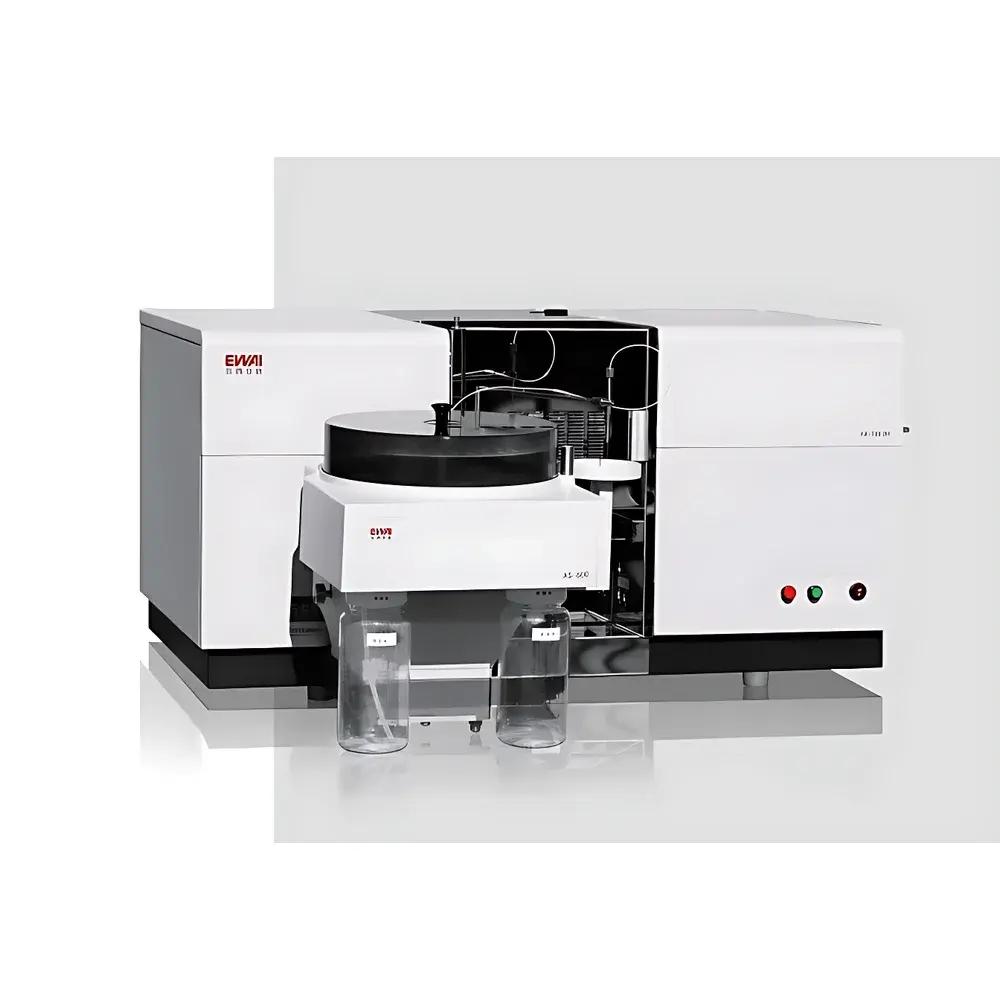
Dongxi Analytical AA-7003M Medical Atomic Absorption Spectrometer
| Brand | Dongxi Analytical |
|---|---|
| Origin | Beijing, China |
| Manufacturer Type | Direct Manufacturer |
| Instrument Type | Flame and Graphite Furnace AAS |
| Monochromator | Plane Grating |
| Detector | Photomultiplier Tube (PMT) |
| Background Correction | Deuterium Lamp |
| Resolution | ≤0.2 nm ± 0.02 nm |
| Sensitivity (Graphite Furnace) | Cu at 20 µg/mL yields ≥0.04 Abs |
| Repeatability (RSD) | ≤3% |
| Detection Limit (Pb) | ≤1 µg/L |
| Sample Introduction | Integrated Flame/Graphite Furnace Module with Auto-Sampling |
| Safety System | Automatic Acetylene Flow Control, Leak Alarm, Air Pressure Monitoring, Electromagnetic Valve Cut-off on Power Loss |
| Optical Design | Patented Suspended Optical Bench |
| Nebulization System | Titanium Alloy雾化 Chamber (Investment-Cast, Aerospace-Grade) |
| Software Platform | Windows XP-based Clinical AAS Software with HL7-compliant LIS/HIS Integration |
| Compliance | Designed for CLIA-equivalent clinical laboratories |
Overview
The Dongxi Analytical AA-7003M Medical Atomic Absorption Spectrometer is a dual-mode benchtop instrument engineered for trace elemental quantification in clinical diagnostics, public health screening, and biomedical research. It operates on the fundamental principle of atomic absorption spectroscopy—measuring the attenuation of characteristic hollow cathode lamp radiation as ground-state atoms in a flame or graphite furnace absorb specific wavelengths. The AA-7003M integrates flame atomization (for higher-concentration elements such as Ca, Mg, Fe, Zn) and electrothermal graphite furnace atomization (for ultra-trace analysis of Pb, Cd, As, etc.) within a single, thermally isolated optical platform. Its design prioritizes analytical robustness in high-throughput clinical environments, where reproducibility, matrix tolerance, and operator safety are non-negotiable. Unlike general-purpose laboratory AAS systems, the AA-7003M is purpose-built to meet the operational and regulatory expectations of hospital core labs, CDC-affiliated reference laboratories, and occupational health testing centers—particularly for blood lead level (BLL) determination in accordance with WHO and CDC-recommended protocols.
Key Features
- Integrated flame/graphite furnace module with seamless mode switching—no manual hardware reconfiguration required between sample types.
- Stabilized Temperature Platform Furnace (STPF) technology ensures uniform thermal profiles across the graphite tube, minimizing volatilization-induced memory effects and improving accuracy for biological matrices like whole blood and serum.
- Dual-sample introduction capability: optimized workflows for both venous and capillary (fingerstick) blood specimens using standardized reagent kits—eliminating offline digestion, centrifugation, or dilution steps.
- Automated sample handling with programmable autosampler, including integrated rinse cycles, calibration bracketing, and multi-point standard addition sequences.
- Full-spectrum safety architecture: real-time acetylene pressure monitoring, automatic gas cutoff under low-air-pressure or power-failure conditions, and redundant flame-out detection via photodiode feedback.
- Suspended optical system decouples the monochromator and detector assembly from mechanical vibrations and ambient thermal drift—critical for maintaining wavelength stability during extended clinical shifts.
- Aerospace-grade titanium alloy nebulizer chamber fabricated via investment casting—resistant to chloride corrosion from saline-based clinical samples and compatible with organic solvent carriers.
Sample Compatibility & Compliance
The AA-7003M is validated for direct analysis of minimally processed human biological fluids—including EDTA-anticoagulated whole blood, serum, urine, and cord blood—without acid digestion when used with STPF-optimized pyrolysis and atomization programs. It complies with ISO 80601-2-65 (medical electrical equipment safety), meets IEC 61000-6-3 electromagnetic compatibility standards, and supports audit-ready data integrity through time-stamped, user-locked method files and electronic signatures aligned with FDA 21 CFR Part 11 Annex 11 requirements. Its performance specifications satisfy CLIA-waived and moderate-complexity testing criteria for Pb, Cd, and Cu quantification in clinical settings, and its methodology aligns with CDC’s Laboratory Guidelines for Blood Lead Testing and ASTM D3559 for trace metal analysis in biological matrices.
Software & Data Management
The instrument runs on a dedicated Windows XP-based control suite designed explicitly for clinical laboratory integration. It features HL7 v2.x message support for bidirectional communication with LIS and HIS platforms, enabling automated patient ID transfer, result auto-reporting, and QC flagging. The software includes a relational patient database with customizable fields (e.g., age, sex, exposure history), configurable report templates compliant with CAP and COLA accreditation formats, and built-in statistical process control (SPC) tools for Levey-Jennings charting and Westgard multirule evaluation. All raw spectral data, background-corrected absorbance traces, and furnace temperature profiles are archived with SHA-256 hash verification to ensure data provenance and immutability.
Applications
- Routine blood lead level (BLL) screening and confirmation in pediatric and occupational health programs.
- Quantitative assessment of essential (Ca, Mg, Zn, Cu) and toxic (Pb, Cd, As, Ni) elements in serum, plasma, and urine for nutritional status evaluation and heavy metal toxicity diagnosis.
- Monitoring elemental imbalances in chronic kidney disease patients undergoing hemodialysis.
- Supporting pharmacokinetic studies involving metal-based therapeutics (e.g., cisplatin, lithium).
- Environmental exposure surveillance in community health initiatives—especially in regions with legacy lead paint or industrial contamination.
FAQ
Does the AA-7003M require external cooling water for the graphite furnace?
No—the furnace cooling system uses closed-loop air convection with thermoelectric regulation, eliminating dependency on tap water or chillers.
Can the instrument be upgraded to support hydride generation or cold vapor techniques?
Yes—its modular optical path and open software API allow integration of third-party hydride generators and mercury analyzers without hardware modification.
Is method validation documentation provided for clinical use?
Yes—each shipment includes IQ/OQ/PQ protocols, linearity verification reports (5–500 µg/L Pb), and inter-laboratory comparison data aligned with NIST SRM 955c Blood Lead Standard.
What maintenance intervals are recommended for clinical operation?
Daily: Nebulizer cleaning and burner head inspection; Quarterly: Graphite tube replacement and PMT gain calibration; Annually: Full optical alignment and gas system leak testing per ISO/IEC 17025 guidelines.






