
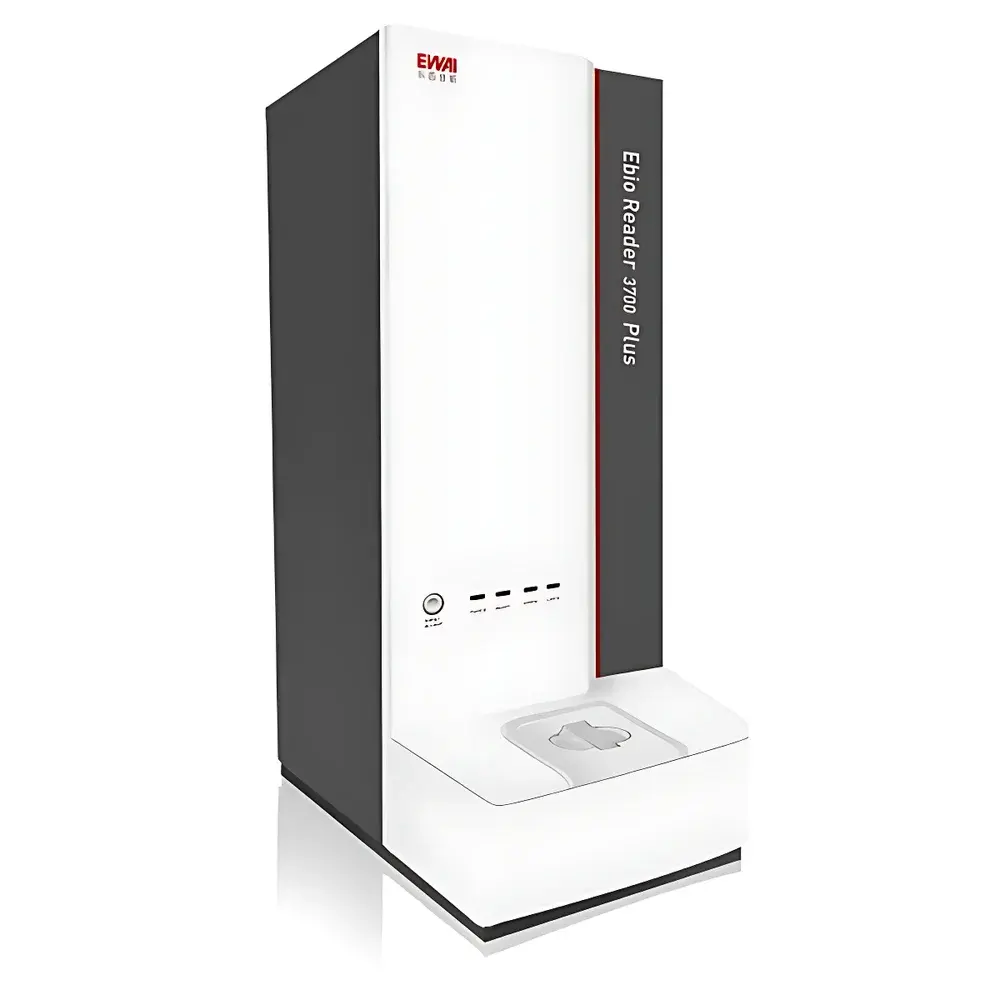
Dongxi Analytical Ebio Reader 3700 Plus MALDI-TOF Mass Spectrometer
| Brand | Dongxi Analytical |
|---|---|
| Origin | Beijing, China |
| Manufacturer Type | Original Equipment Manufacturer (OEM) |
| Instrument Type | Matrix-Assisted Laser Desorption/Ionization Time-of-Flight (MALDI-TOF) Mass Spectrometer |
| Model | Ebio Reader 3700 Plus |
| Regulatory Status | Class II Medical Device (Registration No.: Tianjin NMPA Approval No. 20222220402) |
| Intended Use | Clinical Microbiology Identification, Biomarker Profiling, SNP Genotyping, Viral Peptide Detection, Foodborne Pathogen Screening |
| Compliance | Meets GB/T 19001–2016 (ISO 9001:2015), YY/T 0287–2017 (ISO 13485:2016), and relevant Chinese NMPA medical device technical requirements |
Overview
The Dongxi Analytical Ebio Reader 3700 Plus is a clinical-grade, benchtop MALDI-TOF mass spectrometer engineered for high-throughput, label-free biomolecular profiling in regulated healthcare and diagnostic environments. Operating on the fundamental principle of time-of-flight mass analysis following matrix-assisted laser desorption/ionization, the system measures the mass-to-charge ratio (m/z) of intact peptides, proteins, nucleic acid fragments, and microbial ribosomal proteins by precisely timing their flight across a field-free drift tube under vacuum. Unlike quadrupole or ion trap platforms, MALDI-TOF delivers exceptional mass accuracy (≤ 100 ppm RMS), high sensitivity (sub-femtomole detection limits for standard peptides), and rapid acquisition (< 2 seconds per spectrum), making it uniquely suited for routine microbial identification, clinical proteomics, and targeted genetic variant screening. The instrument is designed and validated as a Class II medical device under China’s NMPA regulatory framework (Registration No. 20222220402), with full traceability to ISO 13485:2016 quality management standards and alignment with international clinical laboratory best practices.
Key Features
- Long-lifetime solid-state Nd:YAG laser (355 nm wavelength), operating at adjustable repetition rates from 0 to 1000 Hz with tunable pulse energy—capable of >1010 total laser shots without degradation in spectral reproducibility.
- Thermally stable flight tube constructed from ultra-low thermal expansion alloy (coefficient < 0.5 × 10⁻⁶/°C), minimizing m/z drift across ambient temperature fluctuations (15–30 °C) and relative humidity variations (30–70 %RH).
- High-efficiency grid-based ion source architecture that enhances ion transmission efficiency and signal-to-noise ratio for low-abundance analytes—including bacterial ribosomal proteins and short oligonucleotides.
- Pulsed Ion Extraction (PIE) high-voltage control module enabling precise delayed extraction timing (±0.5 ns resolution), significantly improving mass resolution (resolving power > 8,000 FWHM at m/z 2,000) and peak shape fidelity.
- Integrated oil-free diaphragm roughing pump with acoustic damping enclosure (< 45 dB(A)), eliminating hydrocarbon contamination risk and supporting continuous operation in ISO Class 7 cleanroom or clinical laboratory settings.
- Embedded neural network classification engine trained on >15,000 reference spectra, enabling robust discrimination between phylogenetically proximal species (e.g., Escherichia coli vs. Shigella spp.) based on subtle peptide mass profile differences.
- User-expandable spectral library architecture compliant with mzML 1.1.0 format, supporting secure import/export of proprietary datasets and local database curation under audit-trail-enabled workflow management.
Sample Compatibility & Compliance
The Ebio Reader 3700 Plus accepts standard 96-well stainless steel MALDI target plates and supports direct analysis of cultured microorganisms (including Gram-positive/negative bacteria, yeasts, and mycobacteria), purified serum/plasma protein fractions, PCR-amplified SNP amplicons (up to 150 bp), and synthetic oligonucleotide standards. All sample preparation protocols adhere to CLSI M58-A and ISO 15189:2022 pre-analytical validation requirements. The system meets GB/T 29791.3–2013 (equivalent to IEC 61010-1:2012) for electrical safety and electromagnetic compatibility. Its software architecture incorporates role-based access control, electronic signature support, and full 21 CFR Part 11–compliant audit trail functionality—including user action logging, parameter change history, and raw data integrity verification—enabling deployment in GLP- and GMP-regulated environments.
Software & Data Management
The instrument is operated via Dongxi’s proprietary BioSpectra Suite v4.2—a Windows 10–based application certified for clinical use under China’s NMPA Software as a Medical Device (SaMD) guidelines. The suite features automated peak detection (SNR ≥ 5 threshold), internal calibration using dual-point calibrants (e.g., Angiotensin II + Bradykinin fragment), and batch processing for up to 96 samples with auto-rejection of low-quality spectra. Spectral matching employs weighted correlation scoring against embedded reference libraries (Bacterial ID Library v3.1, Human Proteome Panel v2.0, SNP Genotype Database v1.4). All raw .raw files are stored in vendor-neutral HDF5 format; metadata export complies with MIAME and MIAPE reporting standards. Data backup, version-controlled library updates, and remote diagnostics are supported via TLS 1.2–secured enterprise server integration.
Applications
- Clinical microbiology: Identification of >350 bacterial and fungal species directly from isolated colonies within ≤3 minutes per sample—validated per CLSI M58-A for bloodstream infection pathogen characterization.
- Thrombotic microangiopathy (TMA) screening: Detection of complement factor H (CFH) and ADAMTS13 proteolytic fragments in plasma, supporting differential diagnosis of atypical HUS and TTP.
- Viral peptide fingerprinting: Discrimination of influenza A subtypes (H1N1, H3N2) and SARS-CoV-2 spike protein variants via conserved epitope mass shifts.
- Food safety surveillance: Rapid detection of Listeria monocytogenes, Salmonella enterica, and Campylobacter jejuni from enrichment cultures without subculturing.
- Pharmacogenomic SNP typing: Multiplexed detection of CYP2C19*2, VKORC1 −1639G>A, and TPMT*3A alleles using single-base extension (SBE) chemistry coupled with MALDI-TOF readout.
FAQ
Is the Ebio Reader 3700 Plus approved for in vitro diagnostic use in the United States or European Union?
No—it holds NMPA Class II registration for clinical use in China only. CE marking and FDA 510(k) clearance are not currently held; users intending deployment outside China must verify local regulatory pathway eligibility.
Can the system be integrated with laboratory information systems (LIS)?
Yes—via ASTM E1384-compliant HL7 v2.5.1 interface supporting automated result transmission, bidirectional order routing, and patient demographic synchronization.
What maintenance intervals are recommended for optimal performance?
Laser energy calibration and mass calibration verification every 72 hours; ion source cleaning every 500 shots; annual preventive maintenance including flight tube vacuum integrity test and detector gain recalibration.
Does the instrument support quantitative analysis?
It provides semi-quantitative relative abundance data for comparative profiling (e.g., biomarker fold-change across cohorts); absolute quantification requires external calibration standards and is not part of the core IVD claim.
How is data security ensured during remote software updates?
All firmware and library updates are cryptographically signed using SHA-256 and delivered over HTTPS with certificate pinning; update packages are verified prior to installation and rolled back automatically upon checksum mismatch.






