
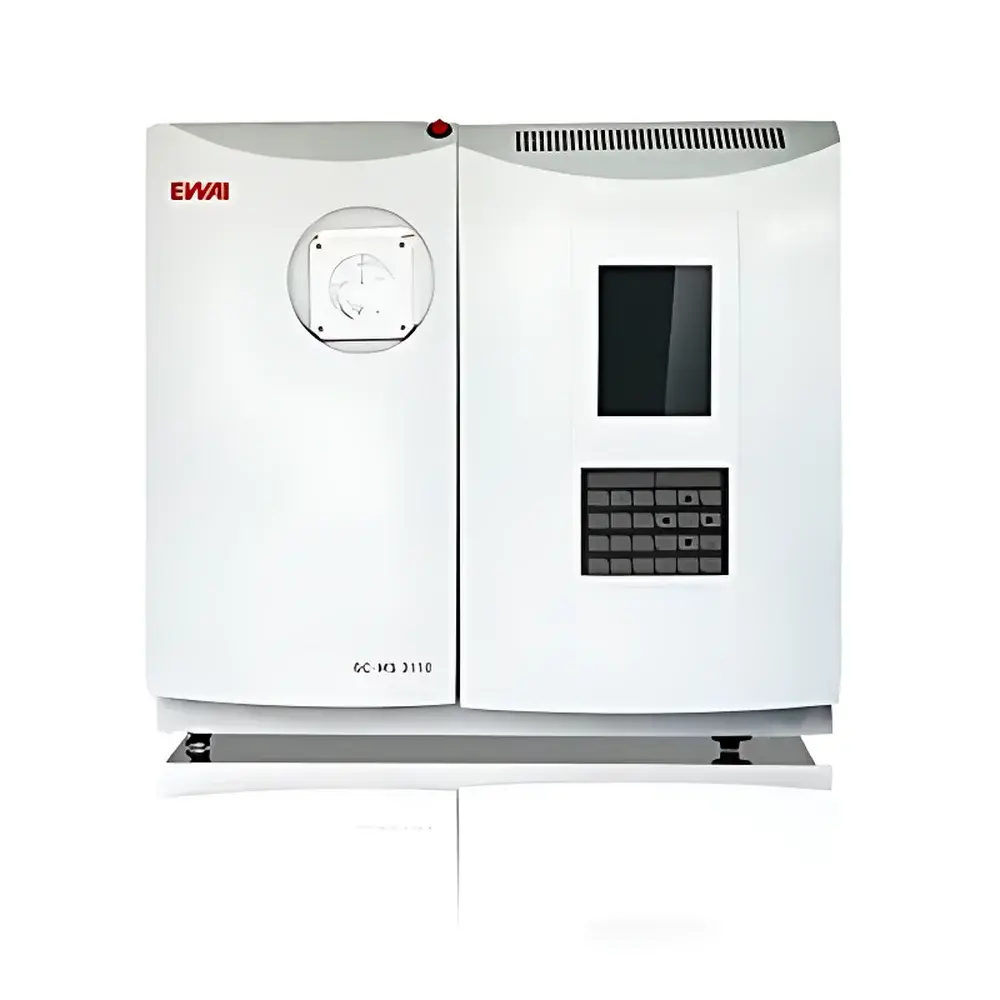
Dongxi Analytical GC-MS3110 Gas Chromatography-Mass Spectrometry System
| Brand | Dongxi Analytical |
|---|---|
| Origin | Beijing, China |
| Manufacturer Type | Direct Manufacturer |
| Regional Classification | Domestic (China) |
| Model | GC-MS3110 |
| Instrument Type | Single Quadrupole Mass Spectrometer |
| GC/MS Configuration | Conventional Benchtop GC-MS |
| Mass Range | 1.5–800 Da |
| Resolution | 2 M (10% valley definition) |
| Sensitivity | 30:1 (S/N for 1 pg octafluoronaphthalene, m/z 272, in full-scan mode) |
| Scan Speed | 6000 u/sec |
Overview
The Dongxi Analytical GC-MS3110 is a purpose-engineered single quadrupole gas chromatography-mass spectrometry (GC-MS) system designed for routine qualitative and quantitative analysis of volatile and semi-volatile organic compounds in environmental, food safety, forensic, and pharmaceutical quality control laboratories. Operating on the principle of electron ionization (EI) coupled with quadrupole mass filtering, the GC-MS3110 delivers robust separation via capillary gas chromatography followed by high-fidelity mass spectral detection. Its architecture integrates a thermally stable, directly coupled GC-MS interface, a precision-machined hyperbolic quadrupole mass analyzer, and a low-noise microcurrent detection system—enabling reliable trace-level identification and quantification across diverse sample matrices under both laboratory and mobile deployment conditions.
Key Features
- Dual-Filament Electron Ionization Source: Equipped with a sealed ionization chamber, dual independently switchable filaments, auxiliary focusing magnets, and optimized ion optics—enabling uninterrupted operation and filament replacement without full source disassembly. Ensures long-term ion current stability and analytical reproducibility (RSD < 3% over 24 h).
- High-Precision Quadrupole Mass Analyzer: Features a machined hyperbolic rod set with sub-micron surface finish and rigid thermal management. Paired with a high-stability RF/DC voltage generator delivering < ±0.05% voltage drift over 8 h, ensuring consistent mass calibration and peak shape fidelity.
- Low-Noise Microcurrent Detection System: Incorporates a high-gain (107) analog amplification chain with active noise suppression, maintaining baseline integrity and achieving a signal-to-noise ratio of ≥30:1 (1 pg OFN, m/z 272, full scan), thereby extending method detection limits without compromising dynamic range.
- Direct-Insertion GC-MS Interface: A thermally controlled, zero-dead-volume interface with precise column positioning mechanism and uniform temperature distribution (±0.5 °C). Eliminates cold spots, catalytic decomposition, and analyte adsorption—preserving labile compounds and maximizing transfer efficiency (>95% recovery for polar pesticides).
- Mobile-Ready Mechanical Architecture: Includes secondary vibration isolation via industrial-grade pneumatic dampers, reinforced chassis rigidity, suspended quadrupole mounting, and an integrated shock-absorbing instrument workstation. Validated for operation on paved roads; undergoing field testing on unpaved and mountainous terrain per ISO 5344:2021 transport vibration protocols.
Sample Compatibility & Compliance
The GC-MS3110 supports standard 0.25–0.32 mm ID fused-silica capillary columns (up to 30 m length) and accommodates split/splitless, PTV, and cold-on-column injection techniques. It complies with core regulatory frameworks for analytical instrumentation, including ASTM D5845-22 (petroleum hydrocarbon analysis), EPA Method 8270D (semivolatile organics), and ISO 17025:2017 requirements for method validation. The system’s hardware and firmware support audit-trail-enabled data acquisition, user-access controls, and electronic signature capability—aligning with FDA 21 CFR Part 11 readiness when deployed with validated software configurations.
Software & Data Management
The GC-MS3110 operates with a real-time acquisition and processing workstation featuring dual-mode operation: live monitoring during acquisition and post-run retrospective analysis. Key software capabilities include automated tune optimization (mass calibration, resolution verification, sensitivity adjustment), library search against NIST MS Search 2.4g (with customizable custom libraries), SIM/Scan hybrid acquisition, retention time locking, and batch processing with QC flagging. All raw data files adhere to ANDI/NetCDF format for cross-platform compatibility. Audit trails record user actions, parameter changes, and calibration events with timestamped, non-erasable entries—supporting GLP/GMP-compliant workflows.
Applications
The system is routinely deployed in environmental monitoring (PAHs, PCBs, chlorinated pesticides in soil/water), food contaminant screening (mycotoxins, plasticizers, residual solvents), forensic toxicology (drugs of abuse, volatiles in arson debris), and pharmaceutical impurity profiling (ICH Q3A/B compliant). Its ruggedized design also enables rapid-response field deployment for emergency chemical incident assessment—including VOC leak identification, hazardous waste characterization, and on-site contamination mapping—without sacrificing laboratory-grade data quality.
FAQ
What mass calibration standards are supported?
The system supports internal calibration using perfluorotributylamine (PFTBA) and external calibration via discrete mass standards; automated calibration routines follow ASTM E1948-20 guidelines.
Is the GC-MS3110 compatible with third-party GC systems?
Yes—via standardized IEEE-488 (GPIB) or RS-232 interfaces; full timing synchronization and event triggering are supported for Agilent, Thermo, and Shimadzu GC platforms.
Does the software meet FDA 21 CFR Part 11 requirements?
Out-of-the-box functionality includes role-based access, electronic signatures, and audit trail generation; formal validation documentation and IQ/OQ/PQ protocols are available upon request for regulated environments.
What maintenance intervals are recommended for the ion source?
Routine cleaning every 2–3 weeks under typical use; filament replacement frequency depends on sample load but averages 6–12 months; source bake-out capability supports extended uptime.
Can the system perform quantitative analysis with isotopic dilution?
Yes—the software supports multi-point calibration curves with internal standard normalization, including stable isotope-labeled surrogates (e.g., d4-naphthalene, 13C6-benzene) for high-accuracy quantitation.





