
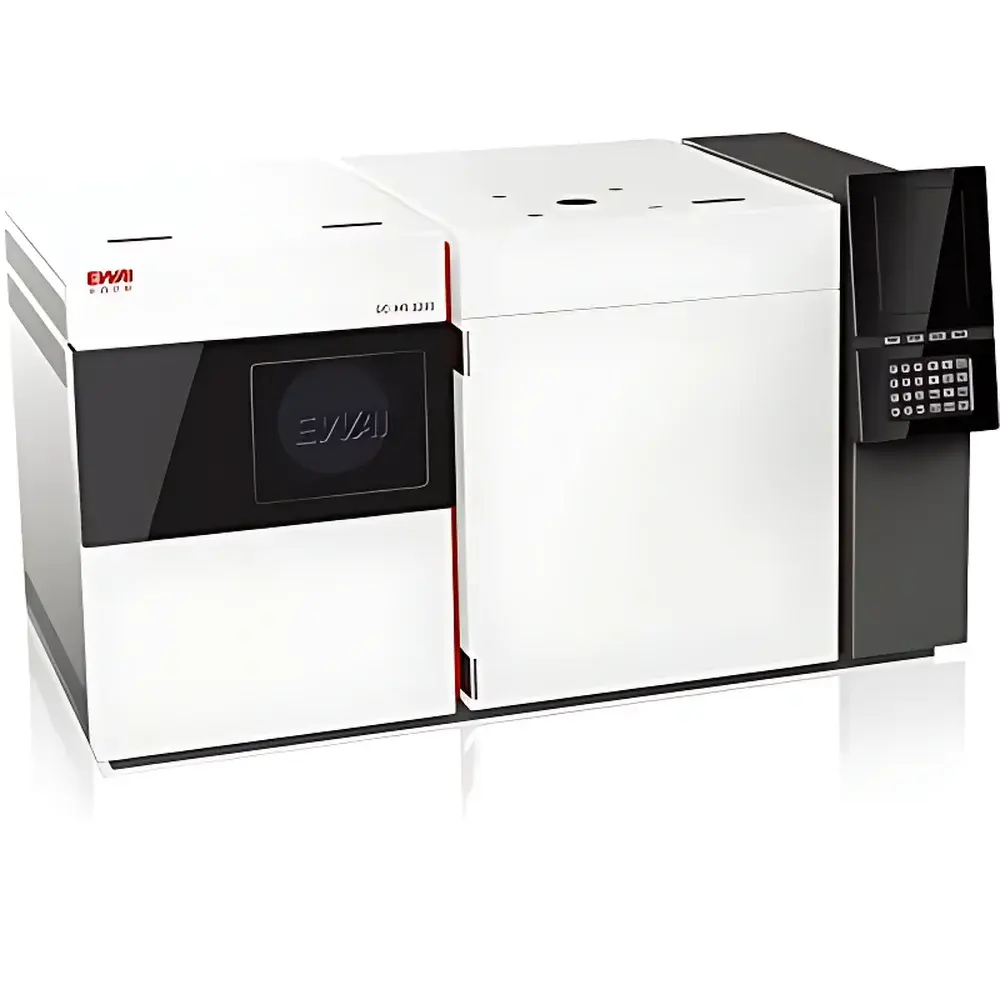
Dongxi Analytical GC-MS3200 Quadrupole Gas Chromatography-Mass Spectrometer
| Brand | Dongxi Analytical |
|---|---|
| Origin | Beijing, China |
| Manufacturer Type | Original Equipment Manufacturer (OEM) |
| Instrument Type | Single Quadrupole GC-MS |
| GC Configuration | Conventional Capillary GC-MS |
| Mass Range | 1–1000 amu |
| Mass Resolution | Unit Mass Resolution (UMR) |
| Sensitivity | 100:1 (Signal-to-Noise Ratio, S/N, for m/z 69 of perfluorotributylamine, PFTBA, at 1 pg on-column) |
| Scan Speed | Up to 10,000 amu/s |
| Ion Source | Dual-Mode Electron Ionization (EI) and Programmable Positive Chemical Ionization (PCI) |
| Ion Optics | DC Compensation Voltage Tuning |
| Filament Control | Adaptive Emission Current & Electron Energy Regulation |
| GC Oven Temperature Stability | ±0.01 °C |
| Pressure/Flow Control | Third-Generation Electronic Pneumatic Control (EPC) Module |
| Optional Accessory | In-House Designed Low-Noise Mechanical Pump Enclosure |
Overview
The Dongxi Analytical GC-MS3200 is a purpose-engineered single quadrupole gas chromatography-mass spectrometry (GC-MS) system designed for routine qualitative and quantitative analysis in environmental monitoring, food safety, pharmaceutical QC, and forensic laboratories. It operates on the fundamental principle of coupling capillary gas chromatographic separation with mass-selective detection via a radiofrequency (RF)/DC-stabilized quadrupole mass analyzer. Volatile and semi-volatile organic compounds are separated by retention time in the GC column and subsequently ionized—primarily via electron ionization (EI)—before being filtered and detected according to their mass-to-charge ratio (m/z). The system integrates second-generation commercial GC-MS architecture developed indigenously in China, incorporating hardware refinements that enhance analytical robustness without compromising compatibility with internationally accepted method standards.
Key Features
- Adaptive filament control module: Dynamically regulates emission current and electron energy based on operational history and vacuum conditions, extending source lifetime and ensuring consistent ionization efficiency across extended run sequences.
- Proprietary DC compensation technology: Applies tunable axial DC bias to the quadrupole rod set, improving ion transmission efficiency—particularly for low-abundance ions—and enhancing signal stability under variable scan speeds and dwell times.
- Dual-mode ion source: Supports both standard 70 eV EI and programmable positive chemical ionization (PCI), enabling softer ionization for molecular weight confirmation and structural elucidation of thermally labile or low-ionization-efficiency analytes.
- Third-generation electronic pressure/flow control (EPC): Delivers sub-milliliter-per-minute flow precision and ±0.01 psi pressure stability, directly contributing to superior retention time reproducibility (RSD < 0.05% over 50 injections) and method transfer reliability.
- High-speed acquisition electronics: Capable of scanning up to 10,000 amu/s with ≥12 data points per peak at 1 Hz scan rate—ensuring adequate spectral fidelity for deconvolution and library matching in complex matrices.
- Modular mechanical pump enclosure (optional): Engineered in-house to reduce acoustic emissions below 48 dB(A) at 1 m distance, facilitating installation in shared laboratory spaces without dedicated sound-dampened rooms.
Sample Compatibility & Compliance
The GC-MS3200 supports standard 0.1–0.53 mm ID fused-silica capillary columns and accommodates common inlet configurations including split/splitless, PTV, and direct sample introduction. It complies with key regulatory frameworks governing analytical instrumentation: its data acquisition and processing software architecture supports audit trail generation, user access control, and electronic signature capability in alignment with FDA 21 CFR Part 11 requirements when configured with appropriate IT infrastructure. Method validation workflows align with ISO/IEC 17025:2017 and ASTM D5845-18 (for pesticide residue analysis) and EPA Methods 8270/8260. Routine operation meets GLP/GMP documentation expectations for QC release testing in pharmaceutical and agrochemical manufacturing environments.
Software & Data Management
The instrument is operated via Dongxi’s proprietary MS Workstation v3.x software, a Windows-based platform supporting real-time spectral acquisition, automated tune optimization (mass calibration, resolution verification, sensitivity adjustment), and integrated NIST-compatible spectral library search (NIST 2022, Wiley 9th Ed.). Raw data files adhere to ANDI/NetCDF format for cross-platform interoperability. Batch processing includes automatic peak detection, integration, calibration curve fitting (linear, quadratic, weighted), and report generation compliant with LIMS export templates (e.g., CSV, XML). Audit trail logs record all parameter modifications, tune results, and user actions with timestamps and operator IDs—enabling full traceability during internal audits or regulatory inspections.
Applications
The GC-MS3200 is routinely deployed in accredited laboratories for targeted and non-targeted screening of regulated contaminants: polycyclic aromatic hydrocarbons (PAHs) in soil extracts per EPA 8270D; phthalate esters in packaging materials per ISO 14389; residual solvents in APIs per ICH Q3C; pesticide multiresidues in fruits and vegetables per SANTE/11312/2021; and volatile organic compounds (VOCs) in indoor air per ISO 16000-6. Its PCI capability extends utility to applications requiring intact molecular ions—such as steroid profiling in doping control labs or flavor compound characterization in beverage R&D—where EI-induced fragmentation limits interpretability.
FAQ
Is the GC-MS3200 compatible with third-party GC systems?
Yes—the mass spectrometer features industry-standard analog and digital interfaces (RS-232, Ethernet TCP/IP) and accepts external trigger signals for synchronized acquisition, enabling integration with select Agilent, Thermo, and Shimadzu GC platforms.
Does the system support method transfer from legacy GC-MS platforms?
Method parameters—including temperature ramps, carrier gas flows, and scan ranges—are fully configurable and exportable. Retention index alignment tools and retention time locking functionality facilitate straightforward migration from older single-quadrupole instruments.
What maintenance intervals are recommended for the ion source and quadrupole?
Under typical usage (≤8 hrs/day, 5 days/week), source cleaning is advised every 2–3 months; quadrupole bake-out and vacuum system inspection are recommended annually—or after exposure to high-boiling matrix components—as part of scheduled preventive maintenance.
Can the software generate 21 CFR Part 11-compliant reports without additional licensing?
Full Part 11 compliance requires deployment on a validated Windows domain environment with enabled Group Policy controls; the base software includes all functional components (audit trails, e-signatures, role-based access), but formal validation documentation must be executed by the end-user’s QA department.






