
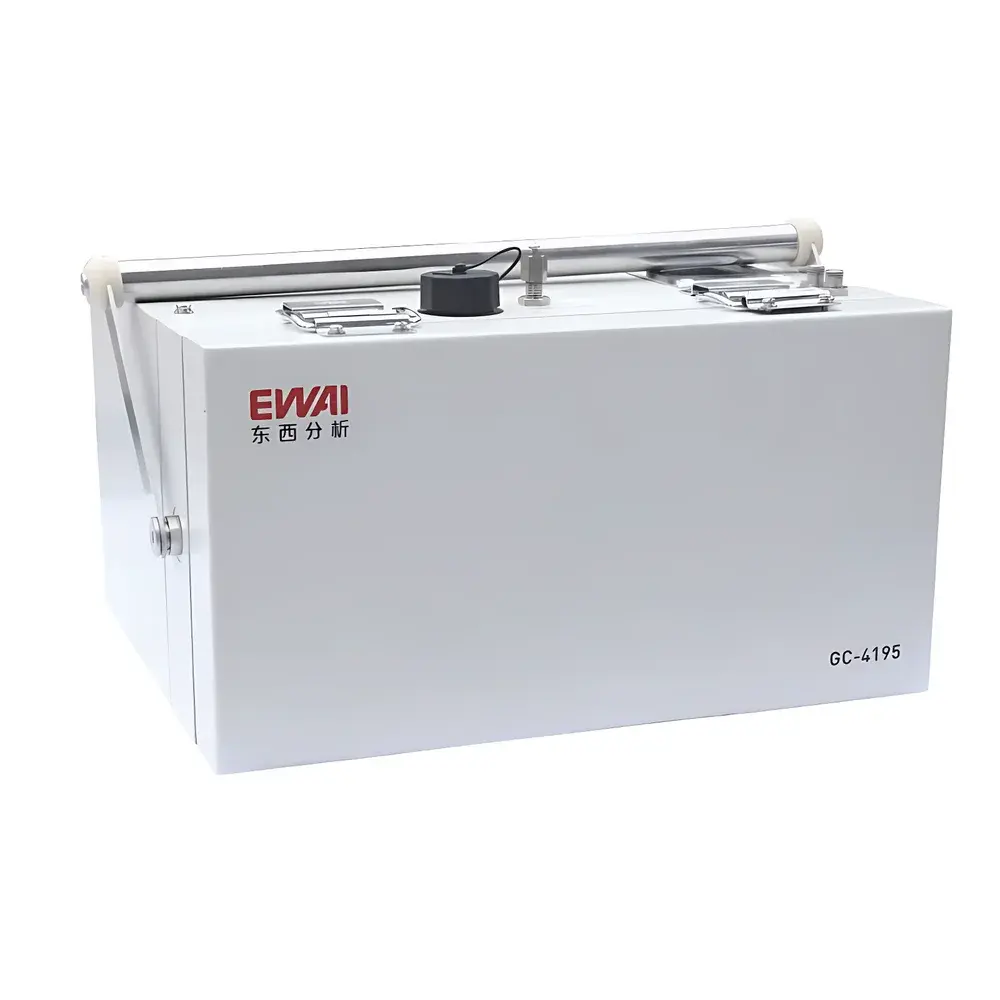
Dongxi GC-4195 Portable Mine Gas Analyzer
| Brand | Dongxi |
|---|---|
| Origin | Beijing, China |
| Manufacturer Type | Manufacturer |
| Country of Origin | China |
| Model | GC-4195 |
| Pricing | Upon Request |
| Certification | MA (Mine Safety Mark), Ex ib I Mb (Intrinsically Safe for Coal Mines) |
| Detection Gases | CO, CO₂, CH₄, C₂H₄, C₂H₆, C₂H₂, O₂, N₂ |
| Sensor Technology | High-Precision Thermal Conductivity Detectors (TCD) with Silicon Micromachined Elements |
| Sampling | 10-Port Rotary Valve |
| Analysis Channels | 3 Independent Parallel Channels (A: O₂/N₂/CH₄ |
| B | CO₂/C₂H₆/C₂H₄/C₂H₂ |
| C | CO) |
| Total Analysis Time | ≤8 min (full multi-component profile) |
| Communication | Integrated Wireless Module (RS485 + Bluetooth/WiFi optional) |
| Software Integration | EW-GC-195 Mine Gas Data Processing System with Explosion Triangle Analysis Engine |
Overview
The Dongxi GC-4195 Portable Mine Gas Analyzer is a certified intrinsically safe chromatographic instrument engineered specifically for real-time, on-site analysis of critical gaseous species in underground coal mine environments. It operates on the principle of gas chromatography coupled with high-stability thermal conductivity detection (TCD), optimized for robust performance under variable temperature, humidity, and mechanical stress conditions typical of shafts, roadways, and goaf zones. Unlike generic portable GC systems, the GC-4195 integrates explosion-proof hardware architecture, MA-certified component layout, and a triple-channel parallel separation configuration to deliver rapid, repeatable quantification of eight key gases—O₂, N₂, CH₄, CO, CO₂, C₂H₂, C₂H₄, and C₂H₆—within a single 8-minute analytical cycle. Its design complies fully with AQ 1013–2005 (Technical Specification for Gas Chromatographs Used in Coal Mines) and GB 3836.4–2021 (Explosion-Protected Electrical Equipment – Intrinsic Safety “i”).
Key Features
- Intrinsically safe construction certified to Ex ib I Mb per GB 3836.4–2021 and MA-marked by the National Mine Safety Product Quality Supervision and Inspection Center.
- Triple-channel GC architecture enabling simultaneous analysis across three independent separation paths: Channel A resolves O₂, N₂, and CH₄; Channel B resolves CO₂, C₂H₆, C₂H₄, and C₂H₂; Channel C isolates CO with dedicated column conditioning and baseline stabilization.
- Silicon micromachined thermal conductivity detectors offering extended operational temperature range (−10 °C to +50 °C), low power consumption (<8 W standby), and sub-ppm detection limits for CO and C₂H₂—critical for early-stage spontaneous combustion monitoring.
- 10-port rotary sampling valve with automated sequence control ensures precise, contamination-free injection and eliminates manual valve manipulation in hazardous atmospheres.
- Integrated wireless data transmission module supports real-time telemetry via Bluetooth 5.0 or optional WiFi 802.11n, enabling secure transfer of chromatograms and quantitative reports to surface-based command centers without physical cable deployment.
Sample Compatibility & Compliance
The GC-4195 accepts direct gas samples from standard mine sampling bags (e.g., Tedlar®), active grab samplers, or continuous draw lines equipped with particulate filters and moisture traps. It is validated for use with air-diluted mine atmospheres containing up to 10% vol CH₄ and trace hydrocarbons. All wetted materials—including sample lines, valves, and detector housings—are constructed from 316 stainless steel and PTFE to resist corrosion from acidic gases (e.g., CO₂-saturated condensate) and sulfur compounds. The instrument meets mandatory requirements for coal mine instrumentation under China’s MT/T 768–2019 (Standard for Chromatographic Analyzers in Coal Mines) and supports audit-ready operation under GLP-aligned mine safety management systems.
Software & Data Management
The analyzer interfaces exclusively with the EW-GC-195 Mine Gas Data Processing System—a Windows-based application preloaded on the device’s embedded industrial PC. This software provides automated peak integration, retention time locking, multi-point calibration curve generation, and real-time explosion triangle visualization per ISO 8573-1 Annex D methodology. All raw chromatographic data, method parameters, user actions, and calibration logs are timestamped and stored locally with SHA-256 hashing. Audit trails comply with internal QA protocols required for MSHA-equivalent reporting and are exportable in CSV, PDF, and ASTM E2500-compliant XML formats. No cloud dependency: all processing occurs offline to maintain data sovereignty and network isolation in restricted mine IT infrastructures.
Applications
- Spontaneous combustion forecasting through trend analysis of CO/C₂H₄/C₂H₂ ratios and their evolution over time (based on the “Three-Ratio Method” per DL/T 722–2014).
- Post-blast atmosphere verification following blasting operations in development headings.
- Goaf gas composition profiling to assess inertization efficiency and ventilation effectiveness.
- Pre-shift atmospheric screening at working faces prior to personnel entry.
- Calibration validation of fixed-point gas sensors installed in continuous monitoring systems (e.g., KJ90, KJ101N networks).
FAQ
Is the GC-4195 approved for use in gassy mines classified as Category I (Methane)?
Yes—the instrument carries the MA safety certification and Ex ib I Mb marking, permitting deployment in all underground coal mine areas where methane-air mixtures may be present.
Can the GC-4195 operate unattended during shift transitions?
It supports scheduled auto-calibration and batch analysis mode; however, due to regulatory requirements for operator presence during sample introduction in active mining zones, unsupervised operation is not permitted per AQ 1029–2019.
Does the system support external calibration gas cylinders?
Yes—standard 10 L aluminum calibration cylinders with certified gas mixtures (traceable to NIM China) can be connected via the integrated pressure-regulated inlet manifold.
How is firmware updated in field conditions?
Firmware updates are performed offline using encrypted USB drives; no internet connectivity is required or supported to preserve intrinsic safety integrity.
What maintenance intervals are recommended for the TCD sensors?
Silicon micromachined TCD elements require no routine replacement; biannual verification of thermal drift and zero stability against certified span gases is advised per manufacturer’s maintenance logbook.
Related Products






