
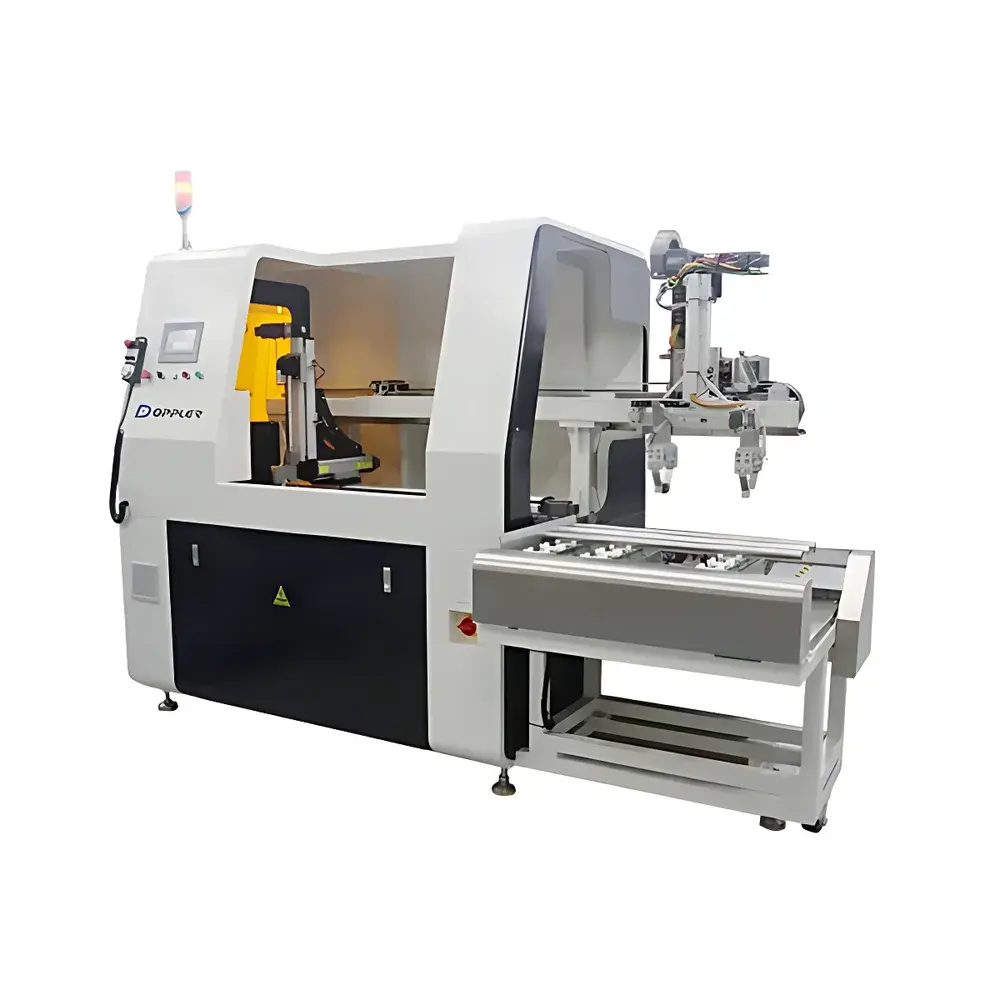
Doppler PAUT Automated Water-Coupled Ultrasonic Inspection System for Rods
| Brand | Doppler |
|---|---|
| Model | Doppler-3 |
| Origin | Guangdong, China |
| Detection Principle | Phased Array Ultrasonic Testing (PAUT) with Immersion Technique |
| Scan Mode | B-scan |
| Probe Type | Concave Linear Phased Array Probe (Configurable: 2.5–15 MHz, 64–256 elements) |
| Positioning Accuracy | ±0.05 mm |
| Cycle Time | ≤3 min per 1 m rod (high-resolution mode) |
| Compliance | Designed for ASME Section V Art. 4, ASTM E2700, ISO 16810, and nuclear-grade QA/QC workflows |
| Software | Real-time C-scan visualization, automated defect sizing & classification, statistical reporting (defect count, depth, length, amplitude), audit-trail-enabled data export |
| Automation Level | Fully integrated robotic handling (loading/unloading, rotational clamping, XYZ probe positioning), optional portable PAUT unit for manual verification |
| Application Domain | Nuclear energy components (fuel cladding, control rod sleeves, structural alloy rods) |
Overview
The Doppler PAUT Automated Water-Coupled Ultrasonic Inspection System for Rods is an engineered solution for high-throughput, high-reliability non-destructive evaluation (NDE) of short-length alloy steel rods used in nuclear energy infrastructure. It implements phased array ultrasonic testing (PAUT) in a water-immersion configuration, enabling precise volumetric inspection without couplant variability or surface contact limitations. The system employs synthetic aperture focusing technique (SAFT)-enhanced beam steering and dynamic depth focusing across multiple focal laws, allowing simultaneous detection of internal volumetric flaws (e.g., voids, inclusions, porosity) and subsurface indications (e.g., near-surface cracks, decarburization zones) in cylindrical geometry. Its fixed-tank immersion architecture ensures consistent acoustic coupling, while the programmable angular step rotation of the workpiece—combined with linear raster scanning of a concave phased array probe—enables full circumferential coverage with optimized near-field resolution and lateral discrimination.
Key Features
- Fully automated robotic material handling: Integrated gantry-mounted manipulator performs precise loading, centering, rotational clamping, and unloading of rods up to specified diameter/length limits; eliminates manual intervention and positional variability.
- High-stability mechanical architecture: XYZ precision motion stages with ±0.05 mm repeatability, coupled with motorized rotary chuck capable of programmable angular increments (0.1°–5° steps), ensure geometric fidelity across repeated inspections.
- ROBUST-series phased array acquisition hardware: High-bandwidth (90 MB/s) digital beamformer supporting up to 256-element probes, enabling real-time multi-focal law execution, full matrix capture (FMC), and post-processing flexibility including total focusing method (TFM).
- Intelligent defect recognition engine: Rule-based algorithm compliant with ASME BPVC Section V Appendix IV and ISO 16810 criteria; automatically classifies echoes by amplitude, depth, lateral extent, and signal-to-noise ratio; generates traceable defect logs with pass/fail flags per inspection zone.
- Multi-modal visualization suite: Synchronized B-scan cross-sections, sectorial S-scans, and quantitative C-scan intensity maps; optional real-time 3D volumetric reconstruction for spatial localization of clustered defects.
Sample Compatibility & Compliance
The system accommodates rods ranging from Ø10 mm to Ø120 mm in diameter and up to 3,000 mm in length, with customizable water tank dimensions and probe standoff optimization. It supports inspection of austenitic stainless steels, zirconium alloys (e.g., Zr-4), nickel-based superalloys (e.g., Inconel 600/690), and low-alloy reactor pressure vessel steels. All operational parameters—including pulse repetition frequency, gain ramping, time-corrected gain (TCG), and gate settings—are configurable per ASTM E2700 Annex A2 and ASME Section V Article 4 requirements. Data integrity meets GLP/GMP-aligned documentation standards: timestamped raw RF data storage, electronic signatures, and FDA 21 CFR Part 11–compliant audit trails are supported via optional software licensing.
Software & Data Management
The embedded inspection platform runs on a deterministic real-time OS with dual-channel display output (operator HMI + engineering workstation). Acquired data is stored in industry-standard formats (e.g., .uf, .ctf, .bin) with metadata embedding (probe ID, calibration date, operator ID, inspection sequence number). Reporting modules generate ISO/IEC 17025–compatible PDF reports featuring summary statistics (defect count per length segment, maximum flaw depth, confidence interval estimates), annotated C-scan overlays, and traceable calibration verification records. Export interfaces include OPC UA, FTP/S, and direct SQL database integration for enterprise-level quality management systems (QMS).
Applications
This system is deployed in nuclear component manufacturing and in-service inspection facilities for: fuel rod cladding tube screening prior to pellet loading; qualification of control rod drive mechanism sleeves; dimensional stability assessment of neutron absorber rods; and periodic examination of steam generator tubing support structures. Its capability to resolve sub-millimeter indications at depths exceeding 100 mm in coarse-grained materials makes it suitable for legacy alloy verification where conventional pulse-echo methods exhibit limited penetration or resolution.
FAQ
What standards does this system comply with for nuclear applications?
It is configured to meet ASME Section V Article 4 (PAUT), ASTM E2700 (Standard Guide for PAUT), and ISO 16810 (Ultrasonic Testing — General Principles). Calibration and performance verification follow ISO 16811 and EN 12668-1 protocols.
Can the system be validated for ASME NQA-1 compliance?
Yes—full validation documentation (IQ/OQ/PQ), traceable to NIST-certified reference blocks (e.g., IIW Type 2, ASTM E2491), is available upon request.
Is remote diagnostics and software update capability supported?
The system includes secure TLS-encrypted remote access via dedicated maintenance port, enabling firmware updates, log retrieval, and real-time troubleshooting under ITAR-compliant network policies.
How is probe wear or coupling degradation monitored during continuous operation?
Integrated acoustic impedance monitoring tracks backwall echo amplitude decay and noise floor drift; automatic alerts trigger recalibration or probe replacement recommendations based on user-defined thresholds.
Does the system support integration with factory MES or SAP QM modules?
Yes—via configurable RESTful API and prebuilt SAP QM interface adapters, enabling bidirectional transfer of inspection results, non-conformance reports (NCRs), and certificate of conformance (CoC) generation.



