
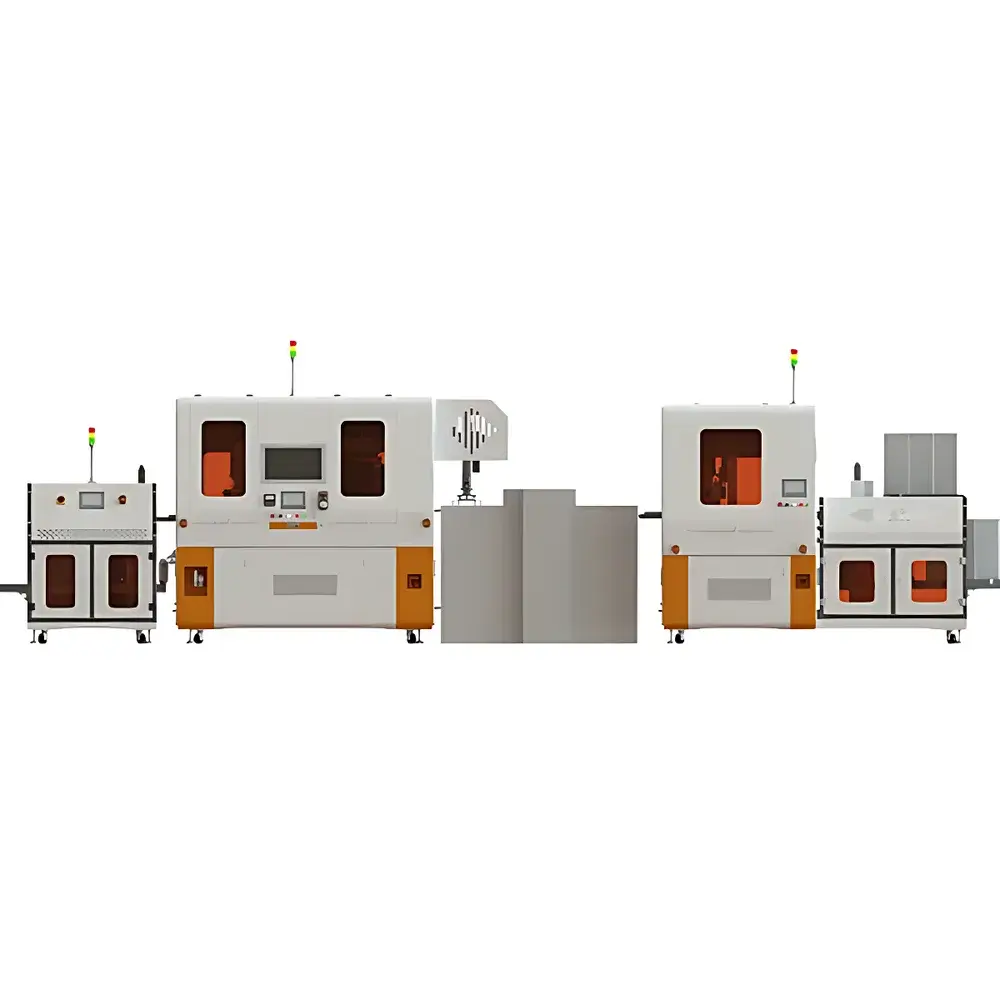
Doppler SAM-450C Automated Scanning Acoustic Microscope for Copper-Clad Ceramic Substrate Inspection
| Brand | Doppler |
|---|---|
| Origin | Guangdong, China |
| Model | SAM-450C |
| Scan Mode | B-scan |
| Transducer | Single-element focused transducer |
| Scan Volume | 450 × 300 × 120 mm |
| Maximum Image Resolution | 10,000 × 10,000 pixels (subject to configuration) |
| Max Scan Speed | 1200 mm/s |
| Ultrasonic Frequency Range | 10–300 MHz |
| X/Y-axis Repeatability | ±0.5 µm |
| Ambient Temperature Range | 19–25 °C |
| Relative Humidity Limit | ≤65% RH |
| Imaging Modes Supported | A-scan, B-scan, C-scan, D-scan, X-scan |
| System Positioning Accuracy | ±0.03 mm |
| Effective Imaging Resolution | 0.2 × 0.2 mm |
| Minimum Detectable Defect Size | <25 µm (at 100 MHz) |
| Operating Frequency Range (Typical) | ≥20 MHz |
Overview
The Doppler SAM-450C is a high-precision, fully automated Scanning Acoustic Microscope (SAM) engineered specifically for non-destructive evaluation (NDE) of copper-clad ceramic substrates (e.g., Al₂O₃, AlN, Si₃N₄) used in high-reliability power electronics and aerospace applications. Leveraging pulse-echo ultrasonic time-of-flight (TOF) principles with water-coupled immersion scanning, the system detects sub-surface discontinuities—including delamination, voids, cracks, solder joint anomalies, and interfacial debonding—without physical contact or sample preparation. Its core architecture integrates piezoelectric transduction, high-speed three-axis motion control, real-time RF signal acquisition, and phase-coherent digital beamforming (in optional phased-array configurations). Designed for integration into Class 1000 cleanroom-compatible production lines, the SAM-450C meets stringent requirements for repeatability, traceability, and metrological stability across thermal cycling and long-duration operational cycles.
Key Features
- Fully automated inline workflow: integrated auto-loading, robotic flip mechanism, QR-code-based sample tracking, water-level-regulated immersion scanning, post-scan drying, and pass/fail binning via servo-driven sorting.
- Multi-modal acoustic imaging: simultaneous acquisition and synchronized rendering of A-scan (depth waveform), B-scan (cross-sectional slice), C-scan (planar projection at user-defined depth), D-scan (oblique plane), and X-scan (multi-angle composite).
- Dynamic water management system: closed-loop deionized water circulation with level-sensing feedback, temperature stabilization (±0.3 °C), and automatic refill/purge to eliminate buoyancy-induced Z-axis drift and acoustic impedance variation.
- Sub-micron positional fidelity: granite-based motion platform with air-bearing linear stages, dual-encoder feedback loops, and active vibration isolation yielding ±0.5 µm X/Y repeatability and ±0.03 mm system-level positioning accuracy.
- Configurable transducer support: optimized coupling for 10–300 MHz broadband transducers; standard 50–100 MHz focused elements deliver lateral resolution down to 25 µm with axial resolution <10 µm in ceramic.
- Automated calibration suite: per-channel gain/offset compensation, time-gain compensation (TGC) profiling, and reference echo normalization ensure uniform contrast and quantitative amplitude reproducibility across full scan fields.
Sample Compatibility & Compliance
The SAM-450C accommodates rigid and semi-rigid planar substrates up to 450 mm × 300 mm × 120 mm (L×W×H), including DBC (Direct Bonded Copper), AMB (Active Metal Brazed), and DBA (Direct Bonded Aluminum) ceramics. It supports inspection of metallized layers (Cu, Ag, Ni, TiW), solder joints (SnAgCu, Pb-free alloys), sintered Ag pastes, and embedded passive components. The system complies with ISO 17845 (acoustic emission testing terminology), ASTM E1781 (standard guide for SAM use), and IEC 60749-25 (microelectronic device mechanical stress testing). Data integrity adheres to FDA 21 CFR Part 11 requirements via electronic signatures, audit trails, and immutable raw RF data archiving. All software modules are validated under GLP/GMP-aligned protocols for regulated manufacturing environments.
Software & Data Management
Doppler AcousticVision™ v5.2 provides a deterministic, deterministic real-time acquisition engine with multi-threaded RF streaming (up to 2 GB/s sustained bandwidth). The GUI enables parametric scan planning, ROI masking, layer-specific gating, and defect thresholding based on amplitude, duration, and spatial clustering algorithms. Quantitative outputs include defect area, volume estimation (via depth-integrated C-scan segmentation), interface bond strength index (IBSI), and statistical process control (SPC) charting aligned with Minitab-compatible CSV exports. Raw RF datasets are stored in HDF5 format with embedded metadata (timestamp, operator ID, calibration log, environmental sensor readings). Optional API integration supports MES/SCADA linkage via OPC UA or RESTful endpoints for automated report generation and OEE analytics.
Applications
- Quality assurance of IGBT, SiC, and GaN power modules: detection of die-attach voids, substrate microcracks, and baseplate delamination prior to burn-in.
- Aerospace-grade ceramic packaging: verification of hermetic seal integrity in RF transceiver housings and radiation-hardened DC-DC converters.
- EV traction inverter substrate screening: monitoring Cu-ceramic interfacial adhesion after thermal shock (−40 °C to +175 °C, 1000-cycle) and power cycling.
- Research & development of next-generation substrates: comparative analysis of AMB vs. DBC bond quality under accelerated aging conditions.
- Failure analysis lab support: correlation of SAM findings with cross-section SEM/EDS and thermographic mapping for root-cause determination.
FAQ
What is the minimum detectable defect size for a 100 MHz transducer on 0.635 mm thick Al₂O₃?
Under optimal coupling and signal-to-noise ratio, planar defects ≥25 µm in diameter can be reliably resolved with contrast-to-noise ratio (CNR) >6 dB.
Can the system perform through-silicon via (TSV) inspection on hybrid ceramic-Si substrates?
Yes—when equipped with high-frequency (>200 MHz) needle transducers and custom wedge couplers, the SAM-450C supports TSV fill assessment and sidewall defect detection in stacked architectures.
Is raw RF data export supported for third-party algorithm development?
Yes—HDF5-formatted RF streams include full digitized echo waveforms, trigger timestamps, and motor position vectors, enabling custom machine learning model training.
Does the system support automated retest logic for borderline defects?
Yes—configurable re-scan triggers based on statistical outliers (e.g., amplitude variance >3σ within local neighborhood) initiate secondary high-resolution interrogation without operator intervention.
How is thermal drift compensated during extended 8-hour production runs?
Real-time water bath temperature monitoring feeds into adaptive TGC correction and dynamic focus zone adjustment, maintaining consistent focal depth and lateral resolution across ambient fluctuations.



