
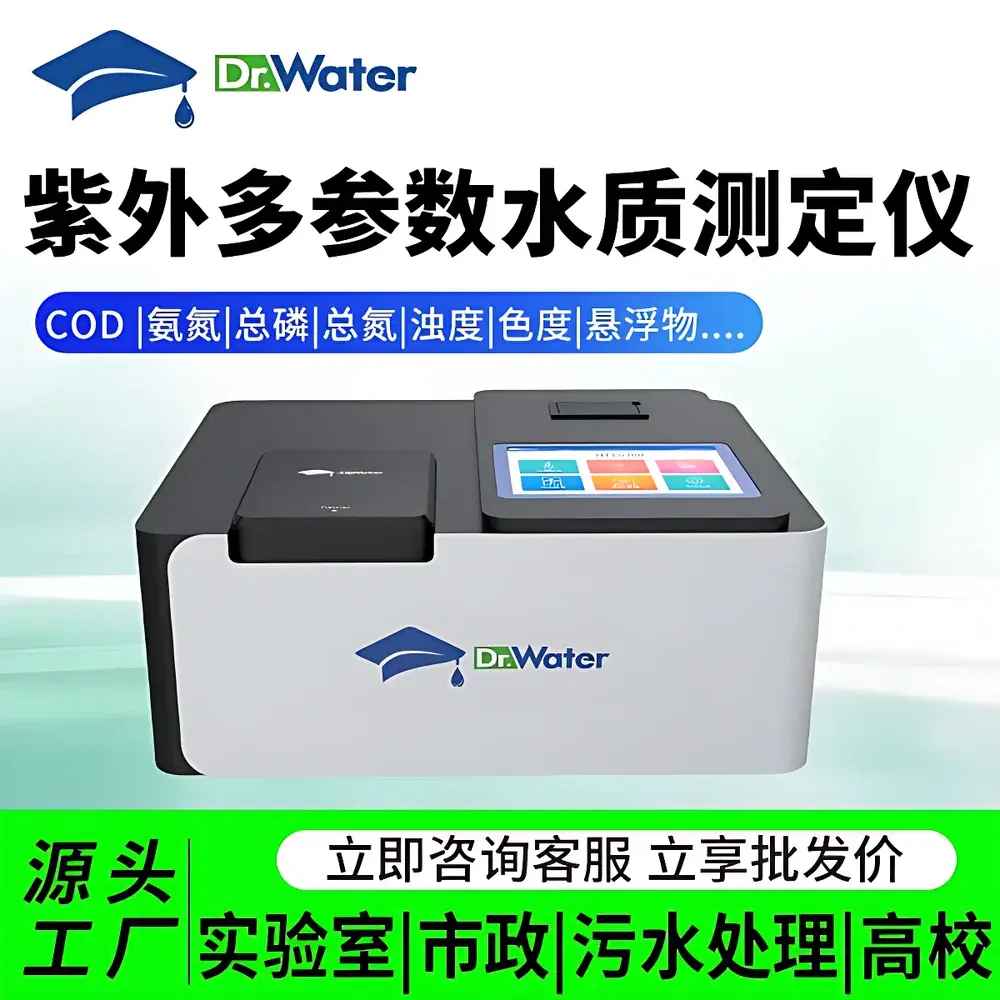
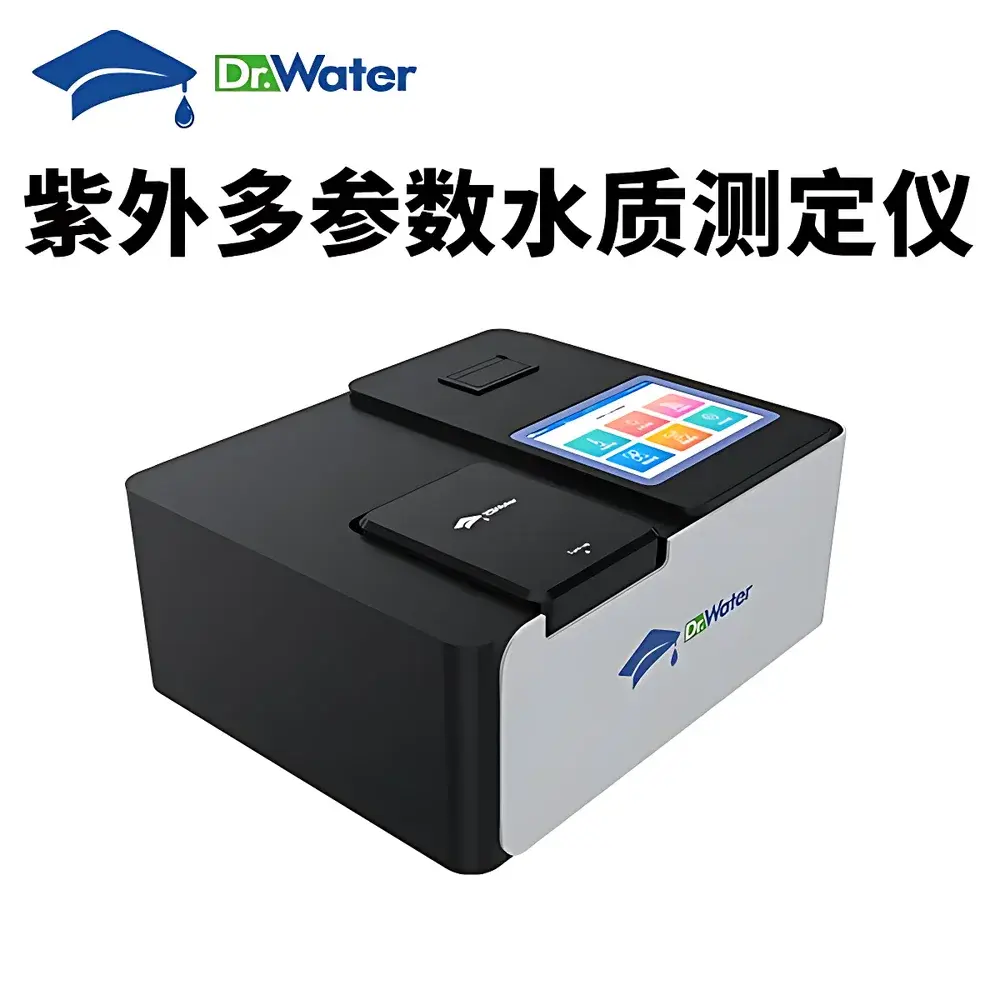
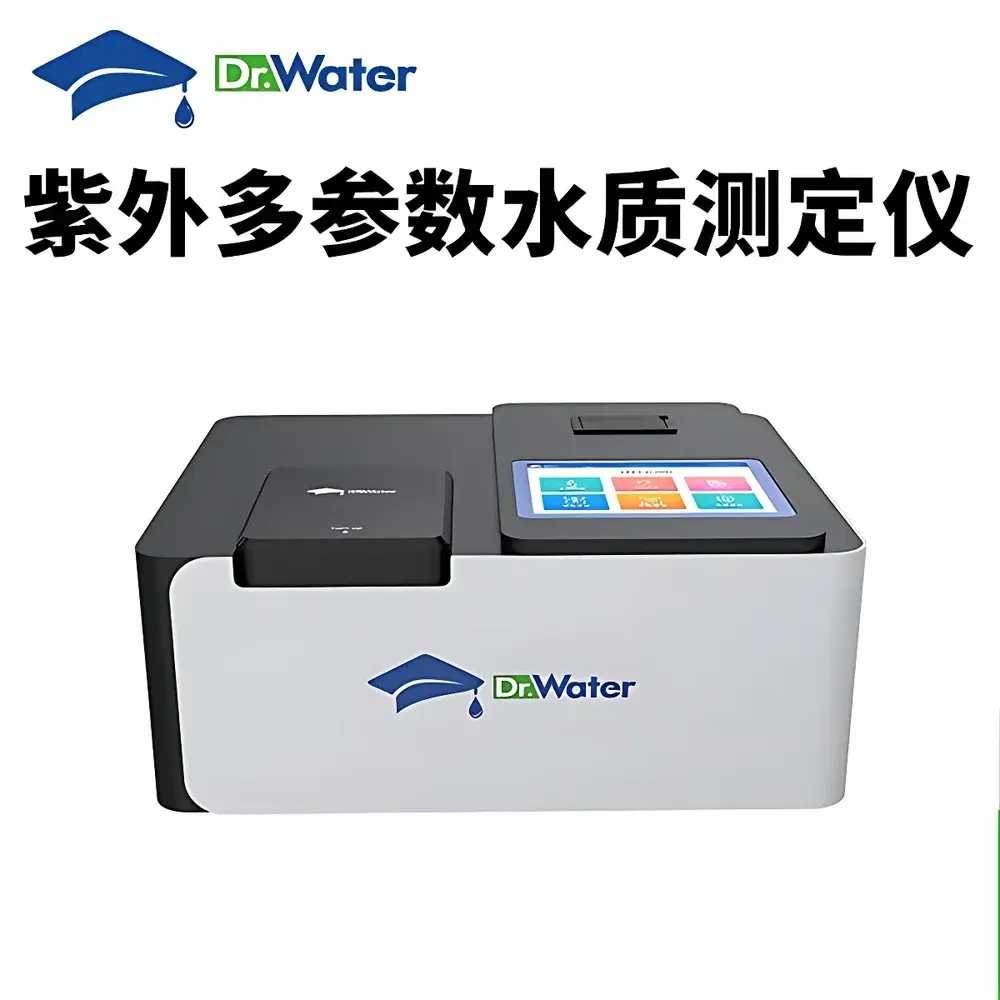
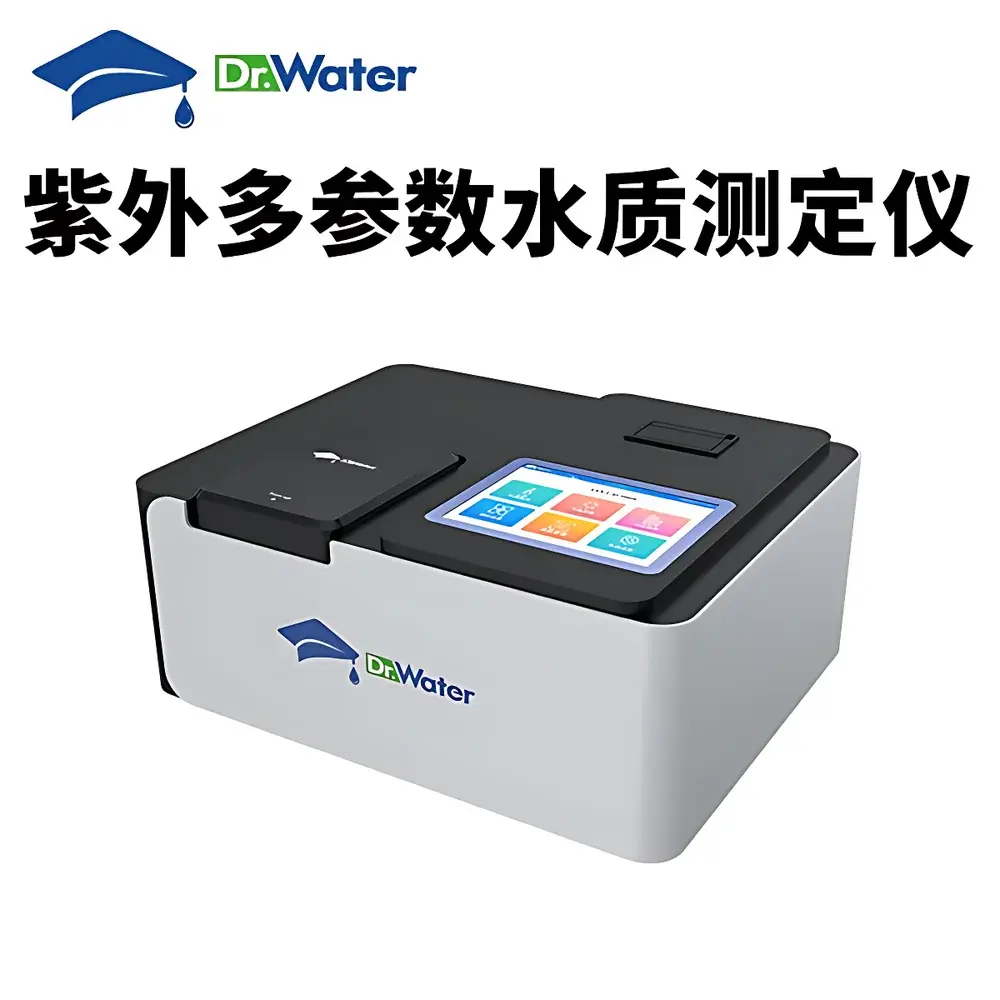
Dr-T8000 UV-Vis Multi-Parameter Water Quality Analyzer by DoctorWater
| Brand | DoctorWater |
|---|---|
| Origin | Hunan, China |
| Model | Dr-T8000 |
| Instrument Type | Laboratory Water Quality Analyzer |
| Detection Principle | Spectrophotometry (UV-Vis) |
| Measurable Parameters | COD, Ammonia Nitrogen, Total Phosphorus, Total Nitrogen, Turbidity, Color, Suspended Solids, Heavy Metals, and >50 additional water quality indicators |
| Wavelength Range | 190–1100 nm |
| Wavelength Accuracy | ±1 nm |
| Wavelength Repeatability | <0.2 nm |
| Spectral Bandwidth | 2 nm |
| Photometric Accuracy (Transmittance) | ±0.5% |
| Photometric Repeatability | ≤0.2% T |
| Absorbance Resolution | 0.001 Abs |
| COD Range | 2–20,000 mg/L |
| Measurement Repeatability | ≤±2% |
| Optical System | Dual-beam with Grating Monochromator |
| Light Sources | Imported Deuterium Lamp (UV), Imported Tungsten-Halogen Lamp (Vis) |
| Display | 7-inch HD capacitive touchscreen |
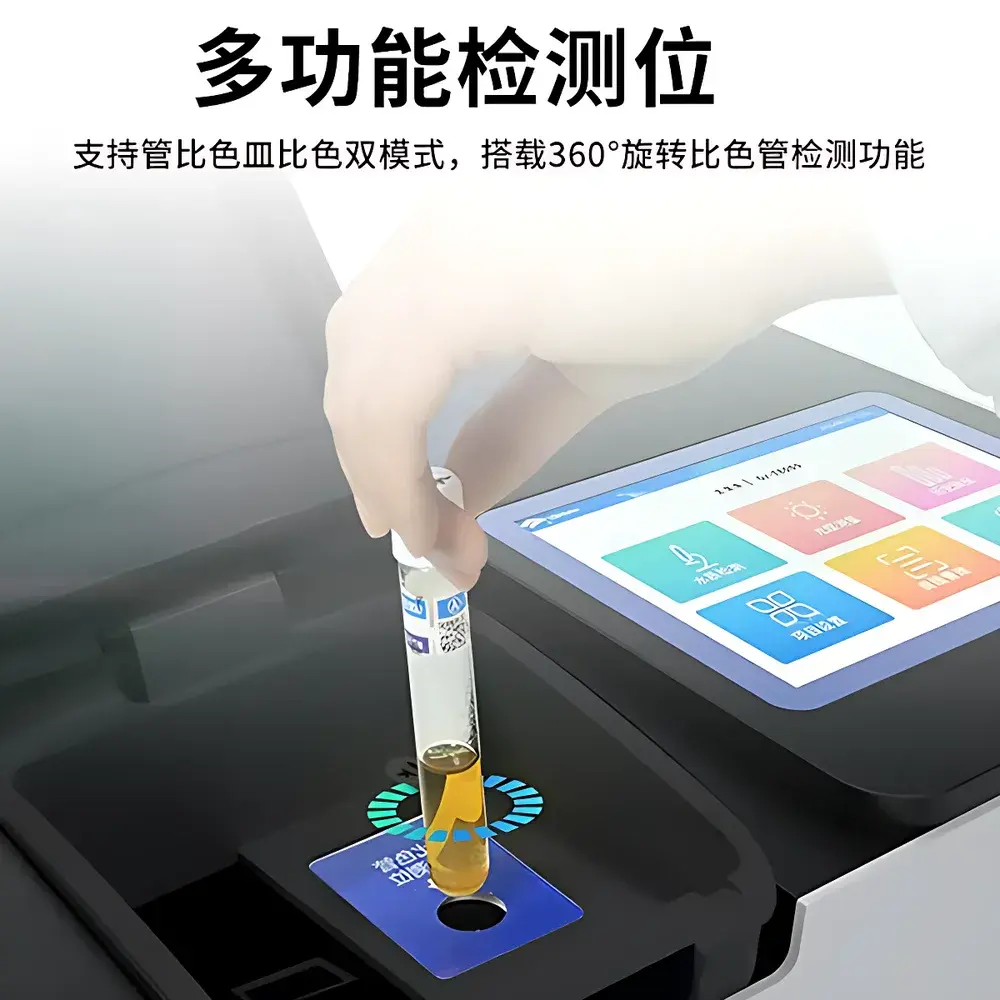
| Sample Holders | Dual independent positions — for 16-mm round cuvettes (360° rotational detection) and standard 10-mm square cuvettes |
| Calibration | Single-point and multi-point calibration |
| Pre-stored Calibration Curves | 1200+ (compliant with HJ/T 399–2007, HJ 535–2009, GB 11893–1989, HJ 636–2012) |
| Data Storage | 1,000,000 measurement records |
| Output | Built-in thermal printer |
| Interface | USB port for data export |
| Compliance | Designed to meet Chinese environmental monitoring standards |
Overview
The Dr-T8000 UV-Vis Multi-Parameter Water Quality Analyzer is a laboratory-grade spectrophotometric instrument engineered for high-precision, multi-analyte quantification in aqueous matrices. It operates on the fundamental principle of ultraviolet–visible absorption spectroscopy, utilizing a dual-beam optical architecture with a precision grating monochromator to deliver stable, interference-resistant photometric measurements across a continuous spectral range of 190–1100 nm. The system integrates two calibrated light sources—an imported deuterium lamp for deep-UV performance (190–350 nm) and an imported tungsten-halogen lamp for visible and near-IR regions—ensuring optimal signal-to-noise ratio across all regulated wavelength bands. Its 360° rotational cuvette detection module actively compensates for radial non-uniformity in glass or quartz tubes, minimizing path-length variability and improving inter-cuvette reproducibility. This design directly addresses a known source of systematic error in routine COD, ammonia nitrogen, and total phosphorus analysis per HJ/T 399–2007, HJ 535–2009, GB 11893–1989, and HJ 636–2012 methodologies.
Key Features
- Dual independent sample compartments: one optimized for 16-mm round test tubes with motorized 360° rotation; another for standard 10-mm square cuvettes—enabling simultaneous method validation or cross-platform verification.
- High-fidelity optical train: dual-beam configuration with real-time reference beam compensation eliminates drift from lamp aging or ambient temperature fluctuations.
- 7-inch capacitive touchscreen interface with customizable language support (English firmware option available); fully navigable without external peripherals.
- Pre-loaded analytical curves: 1200+ validated calibration functions, including EPA-aligned and China MEE-standardized protocols for COD, NH₃-N, TP, TN, turbidity, color, suspended solids, and selected heavy metals (e.g., Cr(VI), Cu²⁺, Ni²⁺).
- Robust data integrity architecture: each measurement record includes timestamp, operator ID (if enabled), cuvette orientation angle, absorbance at primary/secondary wavelengths, and raw transmittance values—supporting retrospective audit under GLP/GMP frameworks.
- Built-in thermal printer and USB 2.0 interface enable direct report generation and secure offline data archiving without network dependency.
Sample Compatibility & Compliance
The Dr-T8000 accommodates diverse sample types—including raw wastewater, treated effluent, groundwater, surface water, drinking water pre-treatment streams, and industrial process liquors—without hardware modification. Its dual-mode detection supports both digestion-coupled assays (e.g., alkaline persulfate oxidation for total nitrogen) and direct-read methods (e.g., Nesslerization for ammonia). All pre-programmed methods align with national regulatory requirements: HJ/T 399–2007 (COD), HJ 535–2009 (ammonia nitrogen), GB 11893–1989 (total phosphorus), and HJ 636–2012 (total nitrogen). While not CE-marked or FDA 510(k)-cleared, its photometric performance parameters (±1 nm wavelength accuracy, ≤0.2% T repeatability) satisfy the instrumental qualification criteria outlined in ISO 7027 (turbidity), ISO 6226 (color), and ASTM D1208 (absorbance-based organics screening). Routine operation requires no consumable optics—only certified reagent kits and Class A volumetric glassware.
Software & Data Management
The embedded firmware implements a hierarchical user permission system (administrator, analyst, viewer) with configurable password policies and session timeouts. All calibration events, curve edits, and method modifications are logged with immutable timestamps and operator identifiers—providing full traceability for internal QA reviews or external accreditation audits (e.g., CNAS, CMA). Data storage capacity exceeds 1 million entries, each retaining raw Aλ and %T values alongside calculated concentrations. Exported CSV files include column headers compliant with LIMS ingestion schemas (e.g., “Sample_ID”, “Analysis_Date”, “Method_Code”, “Result_mg_L”, “Uncertainty_%”). No cloud connectivity or remote telemetry is implemented—ensuring data sovereignty and eliminating cybersecurity exposure vectors common in IoT-enabled analyzers.
Applications
This analyzer serves as a core platform in municipal water quality control laboratories, third-party environmental testing facilities, and industrial EHS departments requiring rapid, standardized compliance reporting. Typical use cases include daily effluent monitoring at WWTPs (per GB 18918–2002 discharge limits), pretreatment verification in electroplating and textile dyeing operations, nutrient load assessment in watershed management programs, and method development for emerging contaminants (e.g., nitrate/nitrite speciation, UV₂₅₄ as surrogate for DOC). Educational institutions utilize its open-wavelength scanning mode for undergraduate spectroscopy pedagogy, while research groups deploy its high-resolution absorbance mapping capability for kinetic studies of Fenton-driven COD degradation or phosphate adsorption isotherms.
FAQ
Does the Dr-T8000 comply with US EPA or ISO methods?
It is configured for Chinese Ministry of Ecology and Environment (MEE) standard methods. While its optical specifications meet ISO/IEC 17025 technical requirements for spectrophotometers, formal method validation against EPA 410.4 or ISO 6060 must be performed by the end user.
Can the instrument be integrated into a LIMS environment?
Yes—via USB mass-storage mode for manual CSV import; no native HL7 or ASTM E1384 driver is provided.
Is regular lamp replacement required?
Deuterium lamps have a rated lifetime of ≥1,000 hours; tungsten-halogen lamps exceed 2,000 hours. The system monitors cumulative usage and alerts at 90% end-of-life.
What maintenance is needed beyond standard cleaning?
Annual verification of wavelength accuracy using holmium oxide and didymium filters is recommended. No optical alignment tools or factory recalibration are required under normal operating conditions.
Is the 360° rotation function mandatory for all tests?
No—it is selectively activated per method. For turbidity or colorimetric assays where tube wall imperfections affect readings, rotation is enabled by default; for cuvette-based analyses, it remains inactive.







