
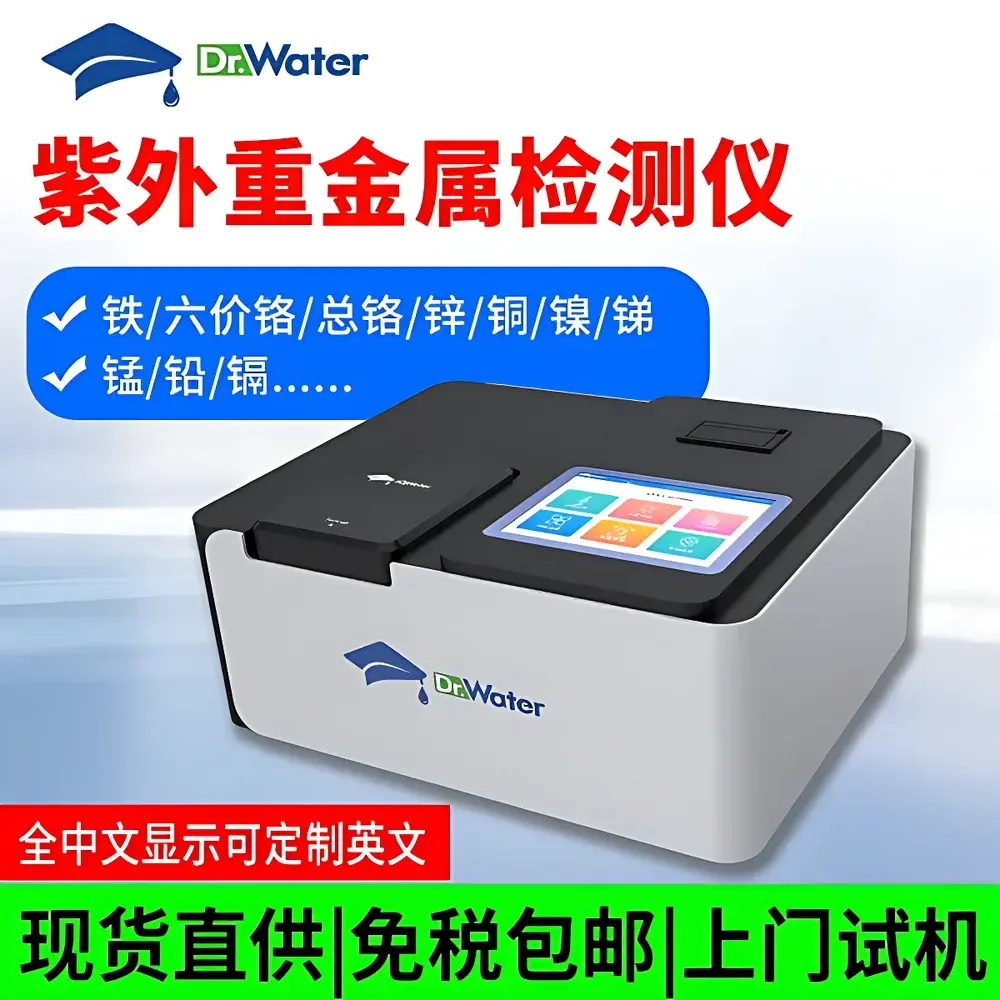
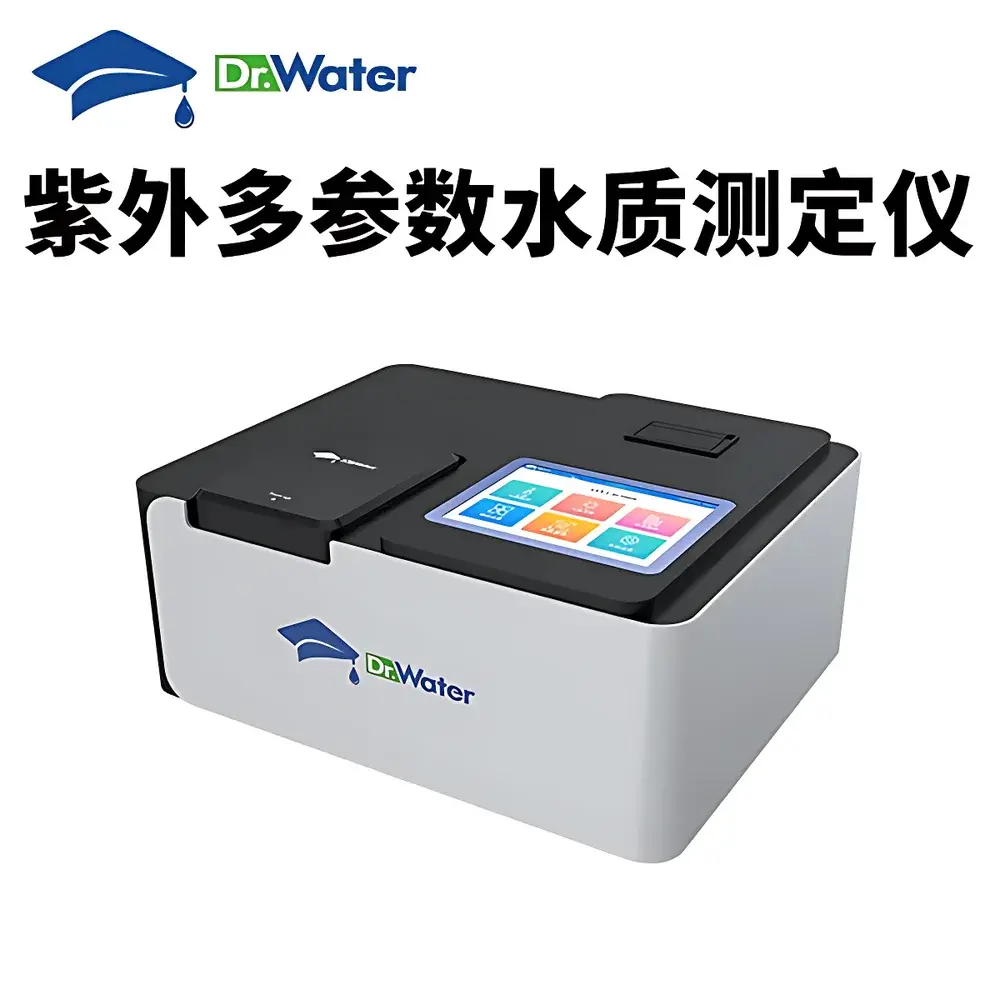
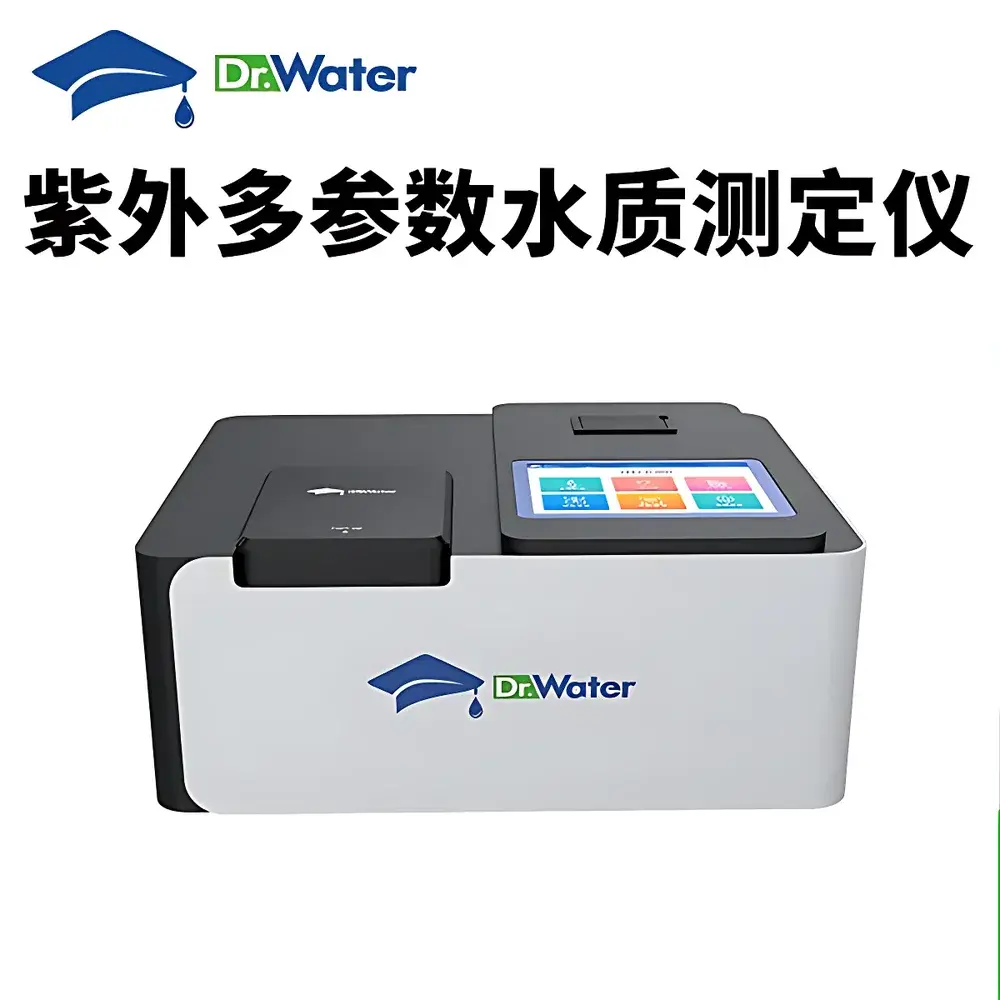
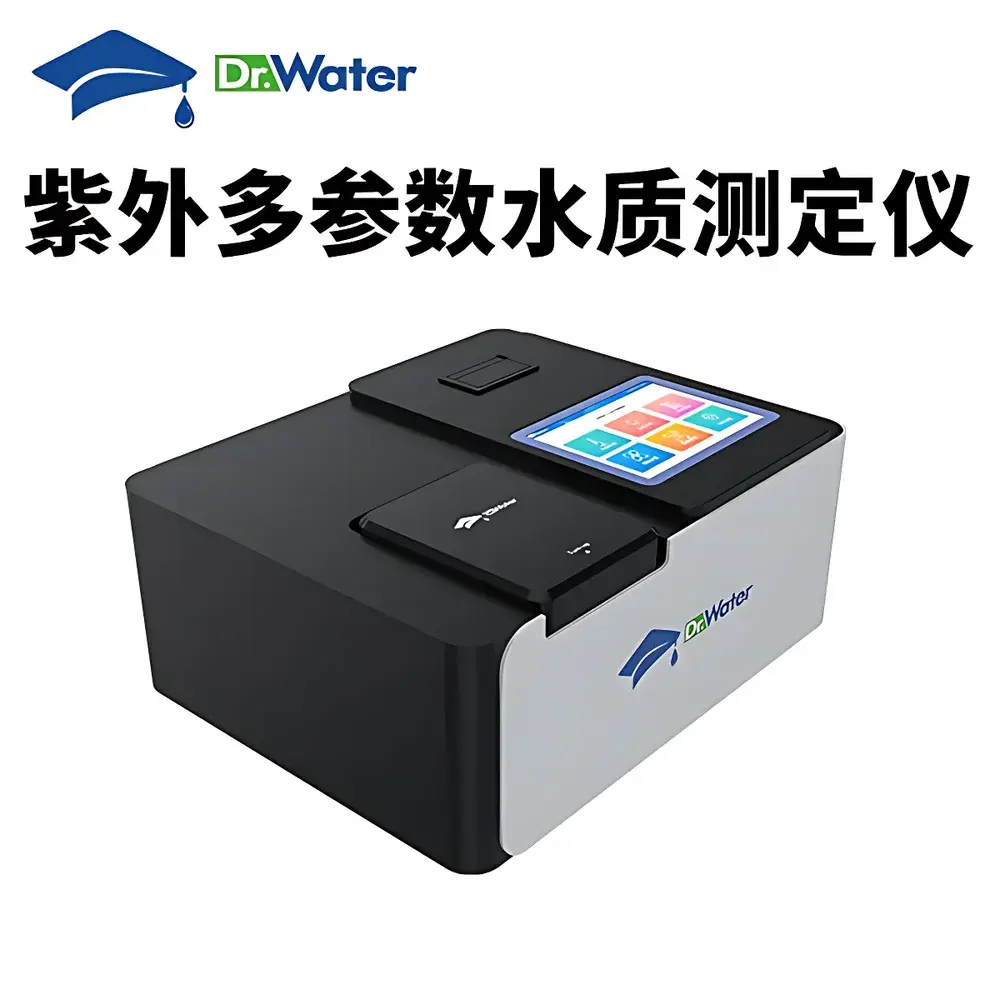
Dr-T8100 UV-Vis Spectrophotometer for Heavy Metal Analysis (WaterDoctor Brand)
| Brand | WaterDoctor |
|---|---|
| Origin | Hunan, China |
| Model | Dr-T8100 |
| Instrument Type | Benchtop Laboratory Spectrophotometer |
| Detection Elements | Chromium (Cr) |
| Detection Time | 10 min per sample |
| Accuracy | ≤ ±5% |
| Absorbance Resolution | 0.001 Abs |
| Wavelength Range | 190–1100 nm |
| Wavelength Accuracy | ±1 nm |
| Wavelength Repeatability | < 0.2 nm |
| Spectral Bandwidth | 2 nm |
| Transmittance Error | ±0.5% |
| Transmittance Repeatability | ≤ 0.2% T |
| Absorbance Repeatability | ≤ ±2% |
| Optical System | Dual-beam with Grating Monochromator |
| Light Sources | Imported Deuterium Lamp (UV), Imported Tungsten-Halogen Lamp (Vis) |
| Display | 7-inch HD capacitive touchscreen |
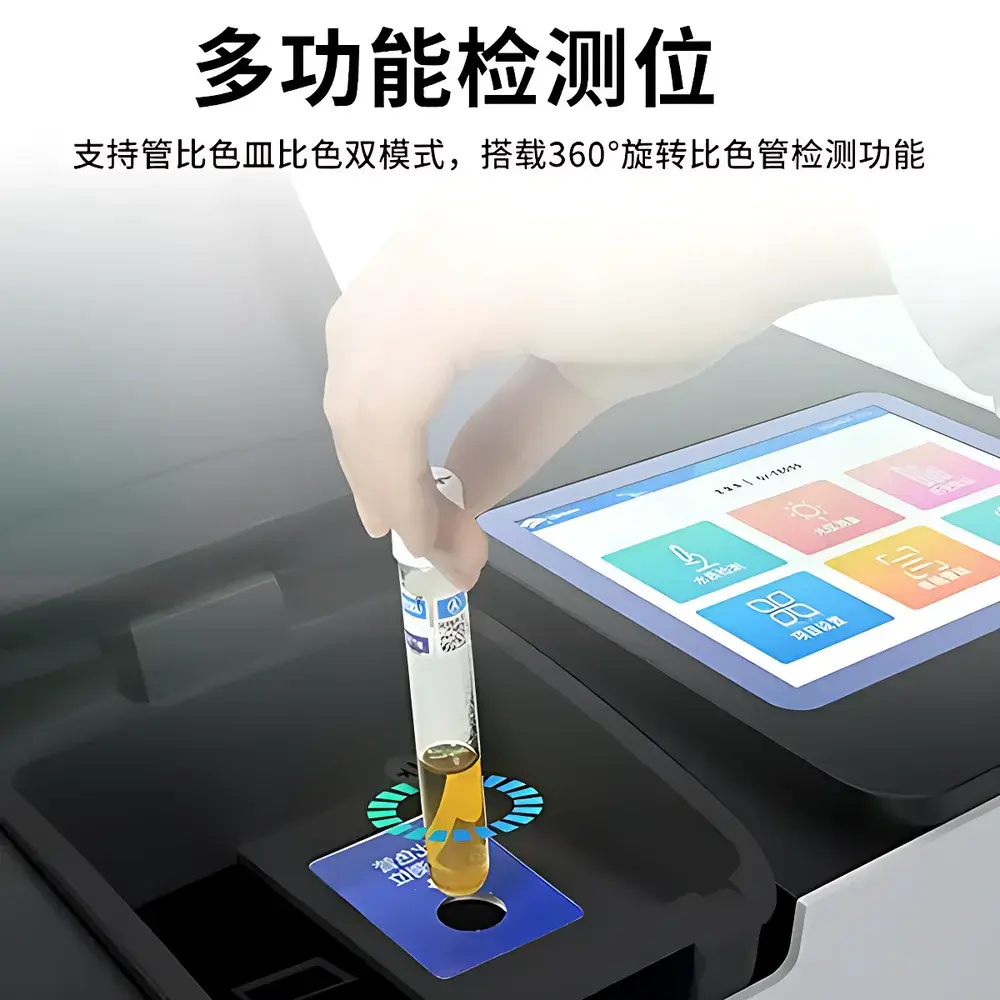
| Sample Holders | Dual independent positions — cylindrical cuvette (360° rotational alignment) and rectangular quartz/glass cuvette |
| Preloaded Calibration Curves | 1200 built-in methods |
| Data Storage | 1,000,000 measurement records |
| Interface | USB port for data export |
| Software Language | Chinese UI standard |
Overview
The Dr-T8100 UV-Vis Spectrophotometer is a benchtop laboratory-grade analytical instrument engineered for quantitative determination of trace heavy metals—primarily chromium (Cr)—in aqueous matrices using absorbance-based spectrophotometric methods. It operates on the principle of Beer–Lambert law, where analyte-specific chromogenic reactions generate colored complexes whose absorbance intensity at defined wavelengths (e.g., 540 nm for diphenylcarbazide-Cr(VI) complex) is directly proportional to concentration. The instrument integrates a dual-beam optical architecture with a precision Czerny–Turner grating monochromator, enabling real-time baseline correction and minimizing drift-induced errors. Its full-spectrum coverage (190–1100 nm) supports not only heavy metal analysis but also standardized photometric assays for COD, ammonia nitrogen, total phosphorus, total nitrogen, and turbidity—making it a modular platform compliant with multiple ISO, ASTM, and EPA-referenced test protocols (e.g., ISO 11905-1 for Cr(VI), ASTM D3559 for lead, EPA Method 3500-Cr for chromium speciation).
Key Features
- Dual optical path design ensures high photometric stability and compensates for source intensity fluctuations and detector aging over time.
- 360° rotational cuvette holder for cylindrical tubes eliminates orientation-dependent scattering artifacts and corrects for minor tube wall imperfections—critical for reproducible absorbance readings in routine water testing.
- Independent dual-sample positioning: one optimized for round glass/plastic cuvettes (10–50 mm pathlength), the other for standard 10-mm square quartz or glass cuvettes—enabling method flexibility without hardware reconfiguration.
- Imported deuterium and tungsten-halogen lamps provide continuous spectral output across UV and visible ranges, with calibrated intensity profiles traceable to NIST standards.
- 7-inch capacitive touchscreen interface supports intuitive workflow navigation, method selection, calibration execution, and real-time spectral preview.
- Preloaded library of 1200 validated calibration curves—including those aligned with HJ 586–2010 (China), ISO 6603-1, and APHA Standard Methods 3111B—reduces method development time and supports GLP-compliant documentation.
- Built-in thermal printer delivers immediate hard-copy reports with timestamp, operator ID, sample ID, and measured absorbance/concentration values.
Sample Compatibility & Compliance
The Dr-T8100 accepts liquid samples from diverse water sources including municipal wastewater, industrial effluents, groundwater, surface water, reclaimed water, and process streams. Sample preparation follows standard digestion and derivatization procedures per applicable regulatory methods (e.g., acid digestion per EPA 200.2 for total Cr; colorimetric Cr(VI) reduction via diphenylcarbazide). The system meets core performance criteria outlined in ISO/IEC 17025:2017 for testing laboratories, particularly in terms of wavelength accuracy (±1 nm), photometric linearity (R² ≥ 0.999 over 0–2.0 Abs), and repeatability (≤ ±2% RSD for absorbance, ≤ ±5% for concentration). While not FDA 21 CFR Part 11-certified out-of-the-box, its audit trail-capable firmware (with user login, change logs, and electronic signature support upon English UI activation) facilitates validation under GMP/GLP frameworks when deployed in regulated QC environments.
Software & Data Management
Instrument control and data handling are managed through an embedded Linux-based OS with localized firmware supporting both Chinese and optional English language modes. All measurements—including raw absorbance spectra, kinetic scans, and multi-point calibrations—are stored with metadata (date/time, operator, method ID, cuvette position, lamp usage hours). Internal storage retains up to one million records with searchable filters by date range, parameter, or sample ID. Data export via USB mass-storage mode produces CSV files compatible with LIMS integration, Microsoft Excel, and statistical software (e.g., JMP, Minitab). Firmware updates are delivered via encrypted USB key to maintain integrity and version traceability—essential for ISO 17025 internal audits.
Applications
The Dr-T8100 serves as a primary quantification tool in environmental monitoring laboratories, municipal water quality control centers, industrial pretreatment facilities (e.g., electroplating, tannery, semiconductor fabs), and academic research groups studying aquatic toxicology or remediation kinetics. Typical use cases include: compliance verification against discharge limits (e.g., Cr ≤ 0.1 mg/L per China’s GB 8978–1996); batch release testing of treated effluent prior to environmental discharge; method validation studies comparing spectrophotometric vs. ICP-MS results; and teaching labs demonstrating fundamental spectroscopic principles and standard curve construction. Its adaptability to open-method development enables extension to emerging contaminants when paired with literature-based reaction chemistries.
FAQ
Does the Dr-T8100 comply with international regulatory standards such as ISO or ASTM?
Yes—it meets technical specifications referenced in ISO 6603-1 (spectrophotometer performance), ISO 11905-1 (chromium determination), and ASTM D3559 (lead in water), though formal certification requires third-party verification per local accreditation body requirements.
Can the instrument perform simultaneous multi-wavelength analysis?
No—it is a single-beam-scanning (dual-path referenced) instrument; spectral acquisition is sequential, not simultaneous. However, full-spectrum scanning (190–1100 nm) is completed in under 15 seconds with 1-nm data intervals.
Is remote data access or network connectivity supported?
Not natively—the device lacks Ethernet/Wi-Fi modules. Data transfer occurs exclusively via USB interface. Integration with centralized LIMS requires manual or scheduled export workflows.
What maintenance is required for long-term photometric accuracy?
Annual lamp replacement (deuterium and tungsten-halogen), biannual grating alignment verification using certified holmium oxide or didymium filters, and quarterly absorbance calibration with neutral density filters traceable to NIST SRM 930e are recommended.
Can custom calibration curves be uploaded and saved?
Yes—users may import CSV-formatted calibration data (wavelength, concentration, absorbance pairs) and assign them to specific parameters; all user-defined curves persist across power cycles and firmware updates.







