
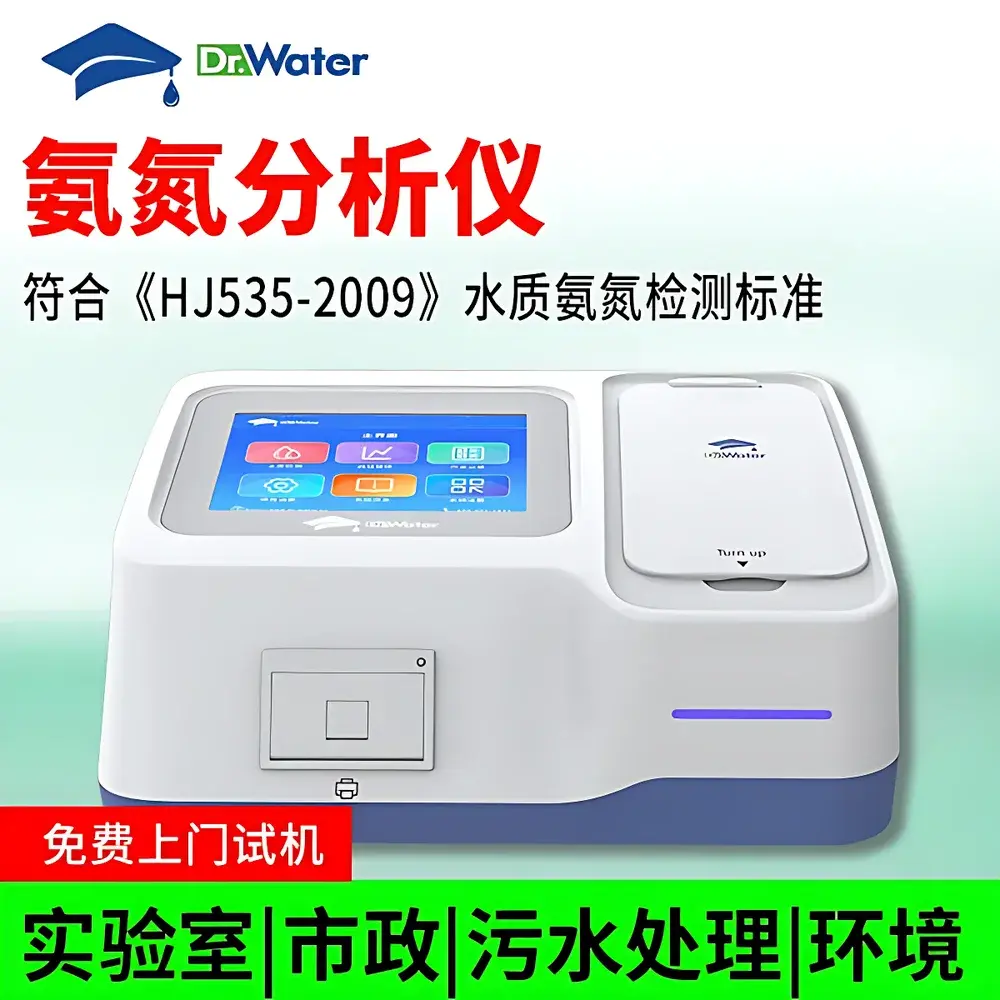
Dr-T9002 Ammonia Nitrogen Analyzer by DoctorWater
| Brand | DoctorWater |
|---|---|
| Origin | Hunan, China |
| Model | Dr-T9002 |
| Instrument Type | Laboratory Benchtop Analyzer |
| Measurement Principle | Colorimetric Method (Nesslerization or Salicylate, compliant with HJ 535–2009) |
| Measurement Range | 0–100 mg/L NH₃–N |
| Accuracy | ≤ ±5% |
| Detection Limit | Not specified (method-dependent |
| Analysis Time | 10 min per sample |
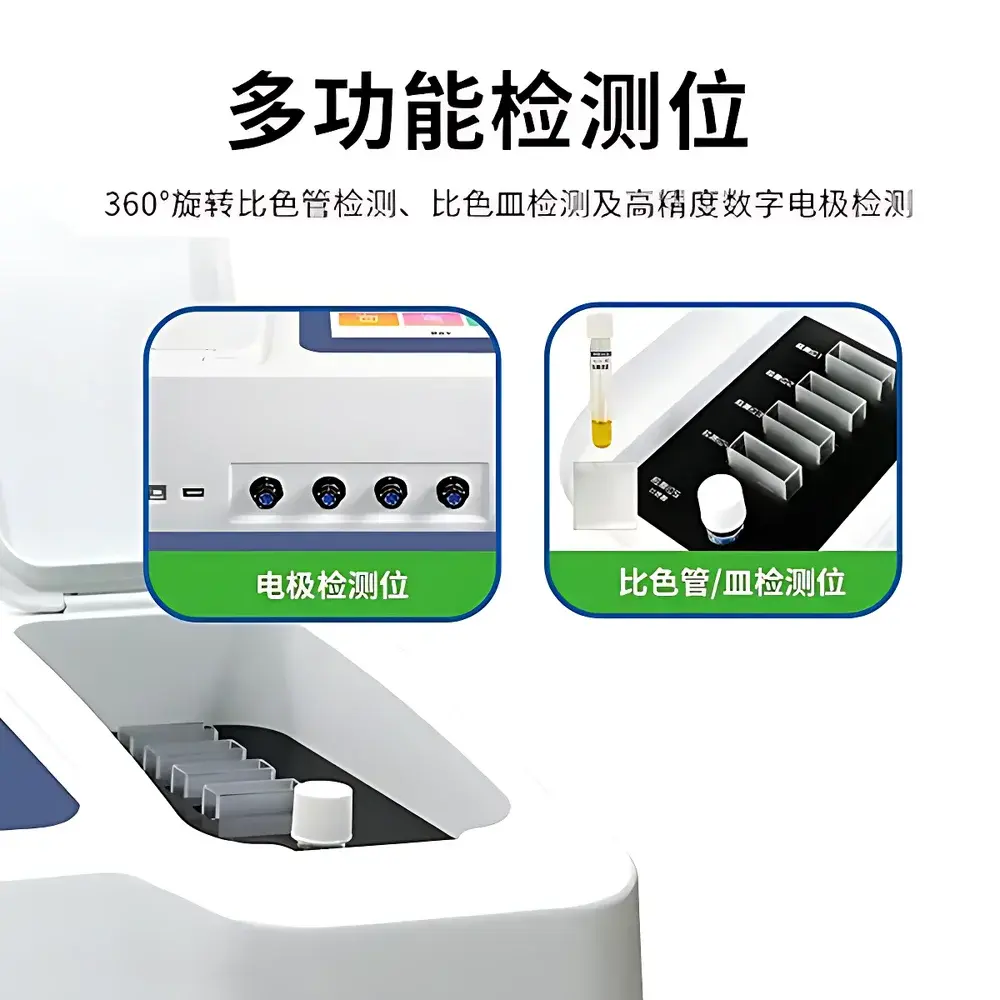
| Throughput | Automated multi-channel detection (up to 4 independent measurement positions: 1 for rotating cuvette, 2 for fixed-pathlength cuvettes [10 mm & 30 mm], 4 for digital electrode inputs) |
| Wavelength Range | 340–900 nm |
| Wavelength Accuracy | ±1 nm |
| Spectral Bandwidth | 4 nm |
| Photometric Accuracy | ±0.5% T |
| Photometric Repeatability | ≤0.2% T |
| Absorbance Resolution | 0.001 Abs |
| Optical Stability | ≤±0.005 Abs/20 min |
| Pre-stored Calibration Curves | 1000+ (user-editable and ISO/IEC 17025-aligned curve management) |
| Data Storage | 1,000,000 measurements with timestamp, operator ID, and method tag |
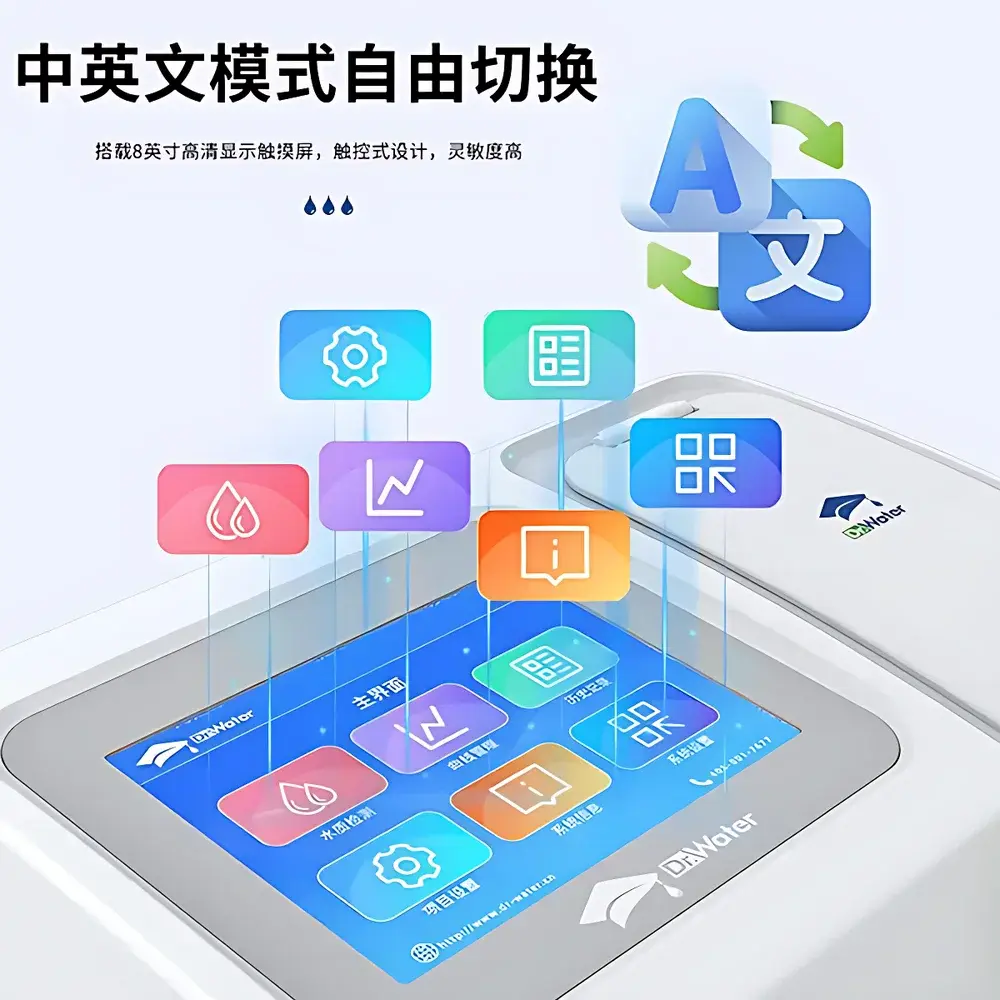
| Interface | 8-inch capacitive touch LCD (adjustable brightness), fully customizable bilingual UI (Chinese default, English optional) |
| Connectivity | USB-A port for flash drive export, thermal printer support |
| Compliance | HJ 535–2009, GB/T 5750.5–2023, compatible with GLP documentation workflows |
Overview
The Dr-T9002 Ammonia Nitrogen Analyzer by DoctorWater is a laboratory-grade, multi-modal photometric and electrochemical platform engineered for precise, trace-level quantification of ammonia nitrogen (NH3–N) in diverse aqueous matrices. It operates primarily on standardized colorimetric principles—specifically aligned with the Chinese national standard HJ 535–2009, which specifies either the Nessler reagent or salicylate-hypochlorite method for spectrophotometric determination. The instrument integrates a high-stability optical path featuring an imported cold-light LED source (rated lifetime >100,000 hours), fiber-optic light delivery, and dual-pathlength cuvette detection (10 mm and 30 mm), enabling accurate absorbance measurement across a broad spectral range (340–900 nm) with ±1 nm wavelength accuracy and ≤4 nm bandwidth. Its modular architecture supports concurrent operation of photometric and digital electrode-based detection modes, allowing seamless expansion to pH, ORP, conductivity, DO, and ion-selective measurements without hardware modification.
Key Features
- Triple-mode detection capability: 360° rotating cylindrical cell holder (eliminates orientation-dependent pathlength variance), dual fixed-pathlength cuvette positions (10 mm / 30 mm), and four independent digital electrode input channels.
- High-fidelity optical system: Fiber-coupled LED illumination, photodiode detection, and real-time drift compensation ensure ≤±0.005 Abs/20 min baseline stability and ≤0.2% T photometric repeatability.
- Intelligent calibration framework: Supports single-point, multi-point, and slope-intercept calibration with automatic curve fitting (linear, quadratic, logarithmic); all curves are timestamped, user-annotated, and exportable for audit review.
- GLP-ready data integrity: Each measurement record includes operator ID, method ID, calibration status, environmental temperature, and raw absorbance values—structured for traceability under ISO/IEC 17025 and FDA 21 CFR Part 11 (when paired with validated LIMS integration).
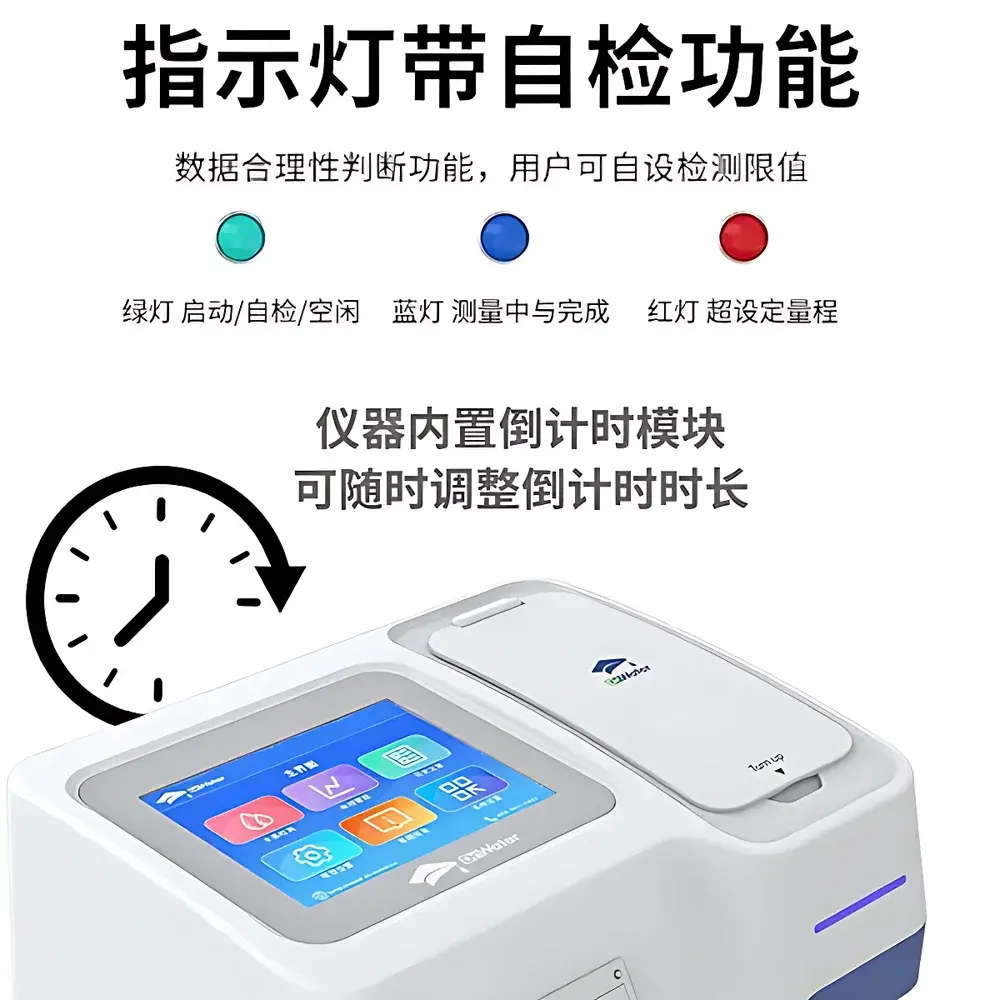
- Adaptive interface: 8-inch capacitive touchscreen with adjustable luminance, configurable language (English optional), guided workflow prompts, and real-time visual feedback via tri-color status LED ring (green = ready/idle, blue = measuring/completed, red = out-of-range or fault).
- Onboard data governance: Internal storage for 1 million test records; one-click filtering by date, parameter, or batch ID; graphical trend visualization; USB mass-storage export in CSV/Excel-compatible format; optional thermal printout with QR-coded report summary.
Sample Compatibility & Compliance
The Dr-T9002 is validated for use with raw and treated water samples including municipal wastewater, industrial effluents (e.g., from pulp/paper, electroplating, pharmaceutical synthesis), groundwater, surface water, aquaculture systems, and boiler feedwater. It accommodates turbid or colored matrices through built-in blank subtraction and pathlength optimization. All photometric protocols comply with HJ 535–2009 and reference equivalents such as ISO 7150-1:1984 and ASTM D1426–15. Electrode interfaces meet IEC 62255-2 for digital sensor communication. The unit’s ABS housing meets UL 94 V-0 flammability rating and resists common lab solvents and chlorine-based disinfectants. CE marking is pending; RoHS-compliant construction is verified.
Software & Data Management
Firmware v3.2 embeds a deterministic real-time OS supporting audit-trail logging (enabled by default), user role-based access control (admin/operator/guest), and method versioning. Data files include embedded metadata compliant with ASTM E1702–17 for analytical data exchange. USB exports retain full precision (6-digit absorbance, 4-decimal concentration), and optional cloud sync (via third-party middleware) enables remote QC charting and inter-laboratory comparison. Calibration logs auto-generate PDF reports with uncertainty estimation per GUM guidelines when reference standards are entered.
Applications
- Regulatory compliance testing for discharge permits (e.g., EPA NPDES, China MEP discharge limits)
- Process control in activated sludge, MBR, and denitrification bioreactors
- Source water vulnerability assessment and watershed nutrient loading studies
- Educational labs requiring ISO-aligned teaching protocols for environmental chemistry
- Contract testing laboratories performing accredited analysis per CNAS-CL01:2018
- Pharmaceutical facility water system monitoring (PW, WFI pre-checks per USP )
FAQ
Does the Dr-T9002 support method validation per ISO/IEC 17025?
Yes—its calibrated optical path, documented uncertainty budgets, electronic signature-capable audit trail, and traceable calibration certificate templates fulfill Clause 7.7 requirements for equipment verification.
Can custom calibration curves be imported from external spectrophotometers?
Yes, via CSV upload using defined column headers (wavelength, absorbance, concentration); curves are validated for monotonicity and R² ≥0.999 before activation.
Is electrode calibration automated?
No—electrode calibration remains manual per manufacturer specifications, but the system logs calibration date, buffer IDs, slope/mV offset, and user signature.
What is the maximum allowable turbidity for reliable colorimetric NH₃–N measurement?
Up to 50 NTU when using the 30 mm pathlength mode with appropriate blank correction; samples >100 NTU require centrifugation or filtration per HJ 535–2009 Section 7.2.
How is firmware updated?
Via USB drive using signed .bin files; update process includes checksum verification and rollback capability if interrupted.
Related Products







