
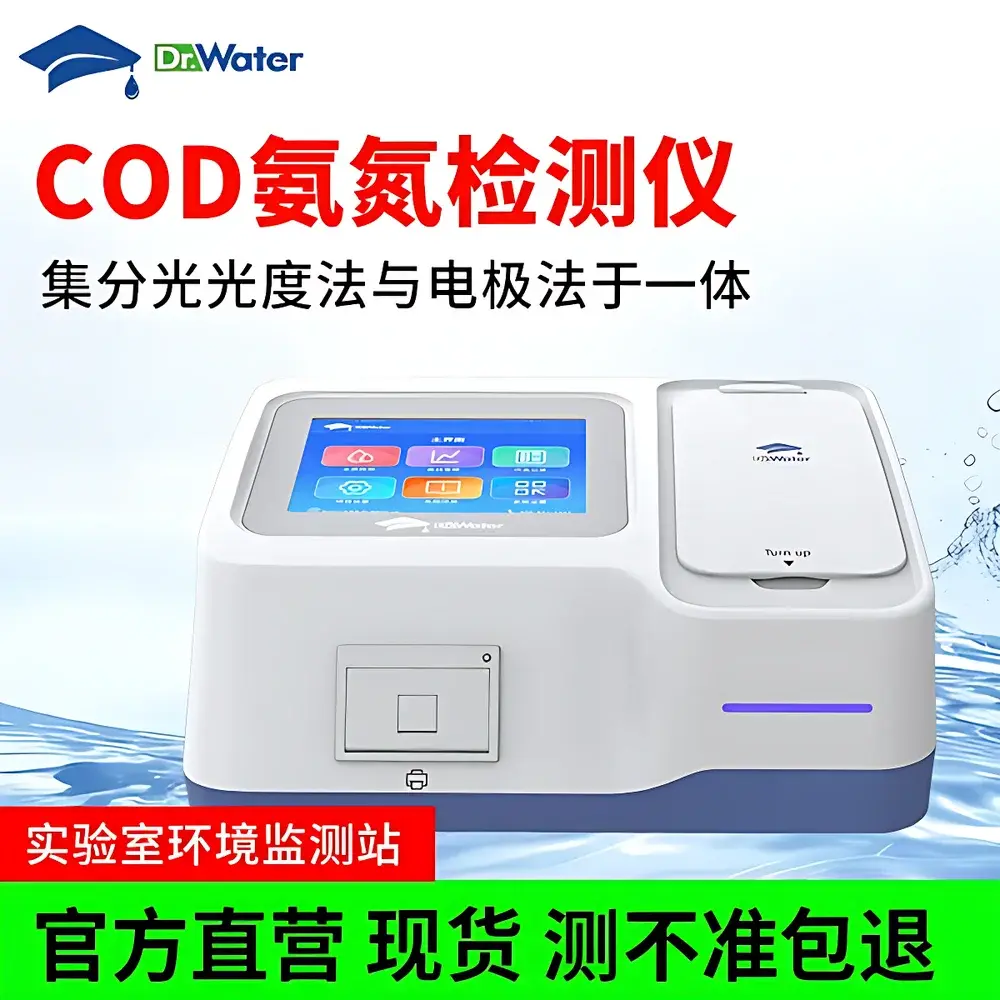
Dr-T9010 COD & Ammonia-N Analyzer by Doctor Water
| Brand | Doctor Water |
|---|---|
| Origin | Hunan, China |
| Model | Dr-T9010 |
| Instrument Type | Laboratory Benchtop Analyzer |
| Measurement Principle | Rapid Digestion Spectrophotometry (COD) & Nesslerization or Salicylate Method (Ammonia-N) |
| Wavelength Range | 340–900 nm |
| Wavelength Accuracy | ±1 nm |
| Wavelength Repeatability | <0.2 nm |
| Spectral Bandwidth | 4 nm |
| Photometric Accuracy | ±0.5% T |
| Photometric Repeatability | ≤0.2% T |
| Absorbance Resolution | 0.001 Abs |
| Optical Stability | ≤±0.005 Abs/20 min |
| Detection Range (COD) | 2–20,000 mg/L |
| Detection Range (NH₃-N) | 0.02–100 mg/L (configurable per method) |
| Accuracy | ≤±5% |
| Repeatability | ≤±2% |
| LOD (COD) | 2 mg/L |
| Measurement Time | ≤10 min (post-digestion) |
| Calibration | Single- or Multi-point with Pre-stored Curves (n=1000) |
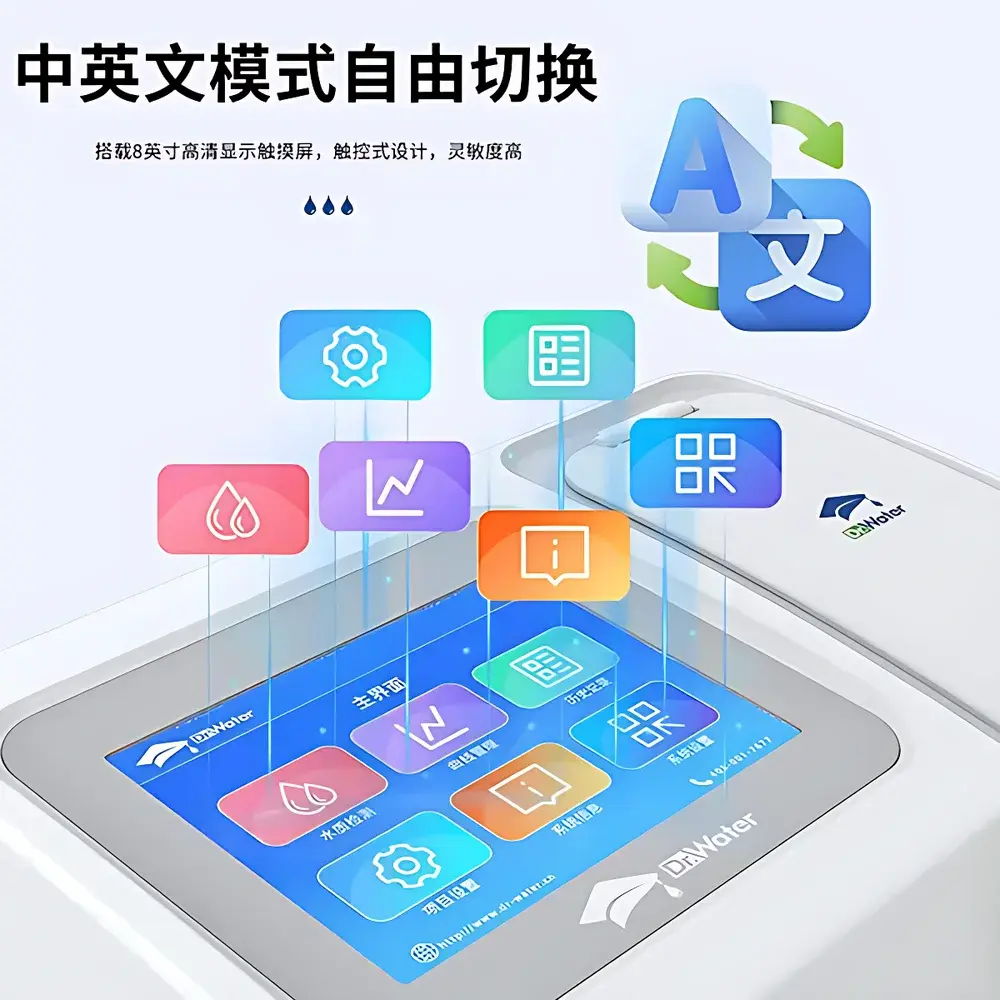
| Display | 8-inch HD Capacitive Touchscreen |
| Data Storage | 1,000,000 records |
| Interface | USB-A for U-disk export & thermal printer |
| Power Supply | AC 100–240 V, 50/60 Hz |
| Dimensions | 392 × 315 × 170 mm |
| Weight | 4.4 kg |
| Housing Material | Flame-retardant ABS with Chemical Resistance |
Overview
The Dr-T9010 COD & Ammonia-N Analyzer is a laboratory-grade benchtop spectrophotometric system engineered for precise, standardized quantification of chemical oxygen demand (COD) and ammonia nitrogen (NH₃-N) in aqueous matrices. It implements rapid digestion spectrophotometry per HJ/T 399–2007 (COD) and colorimetric determination via Nesslerization or salicylate reaction per HJ 535–2009 (NH₃-N), ensuring regulatory alignment with Chinese environmental monitoring protocols. The instrument integrates dual optical detection paths—fiber-optic-coupled photometry for absorbance measurement across 340–900 nm—and dedicated digital electrode interfaces for concurrent electrochemical parameters (e.g., pH, ORP, conductivity). Its modular optical architecture employs a high-stability cold light source (rated >100,000 h lifetime) and precision monochromator with ±1 nm wavelength accuracy, enabling reproducible quantitation under variable ambient lighting conditions.
Key Features
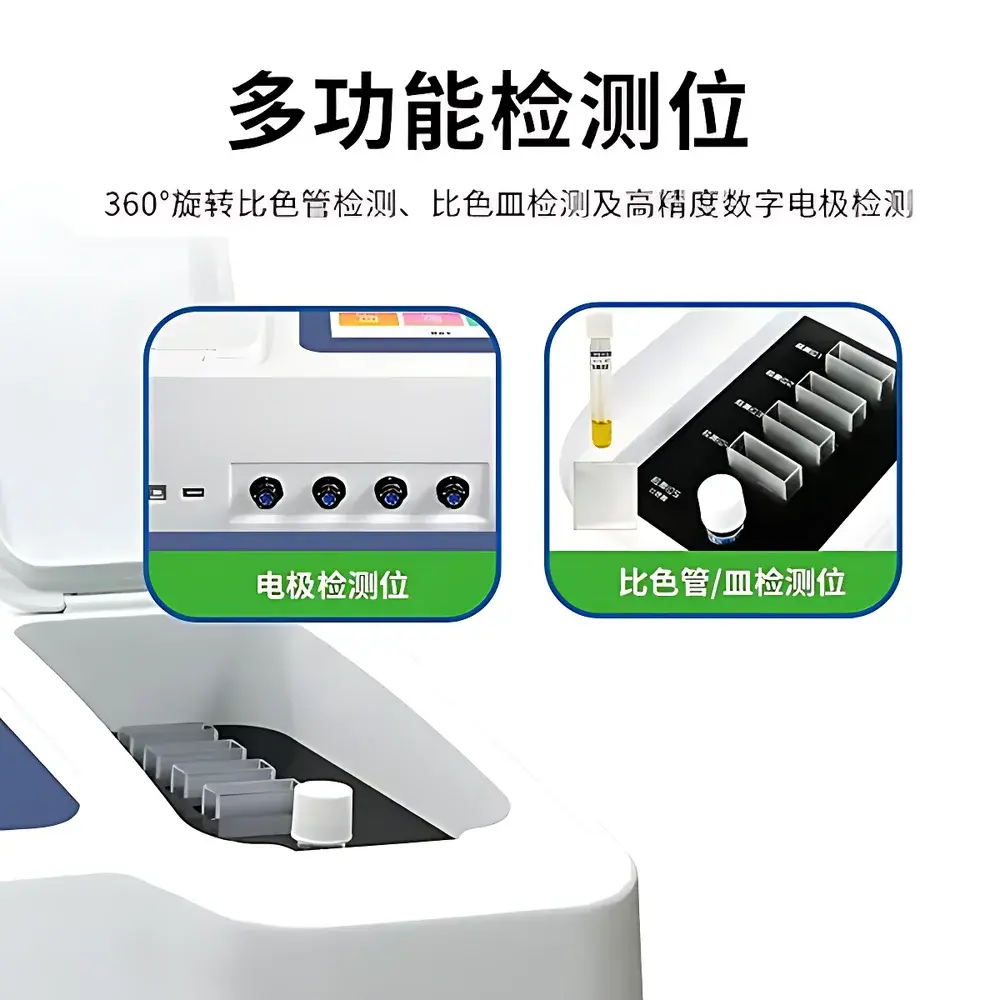
- Triple-mode sample introduction: 360° rotating tube holder (eliminating cuvette orientation error), dual fixed-position cuvette slots (10 mm and 30 mm pathlength), and four independent digital electrode ports.
- High-fidelity optical detection: Fiber-optic light path design minimizes stray light; spectral bandwidth fixed at 4 nm ensures compliance with ISO 7027 and EPA 410.4 requirements for turbidity-related interferences.
- Intelligent photometric validation: Real-time optical stability monitoring (≤±0.005 Abs/20 min) and automatic dark-current correction prior to each measurement cycle.
- Adaptive user interface: 8-inch capacitive touchscreen with adjustable brightness, supporting both guided workflow mode and direct parameter entry; optional English-language firmware available upon configuration.
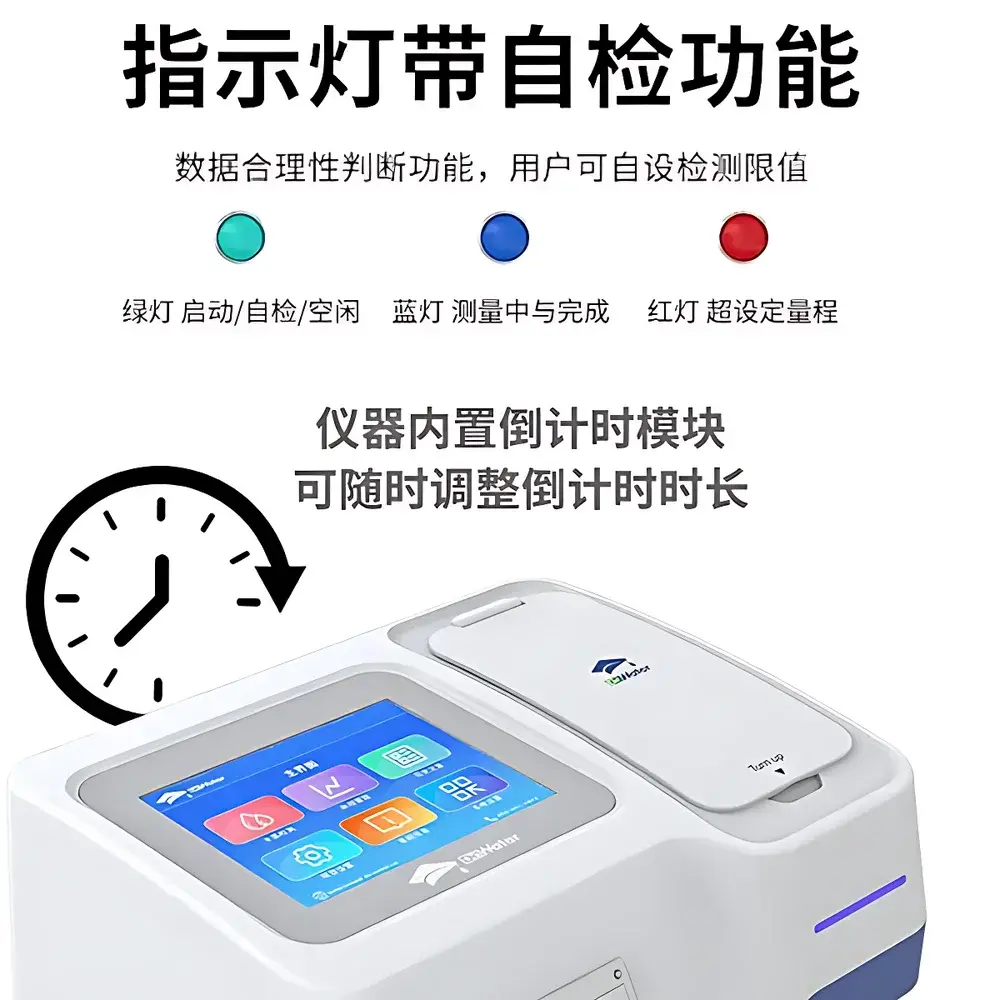
- Robust data integrity architecture: Built-in audit trail for calibration events, measurement timestamps, operator ID tagging (via optional login), and automatic flagging of out-of-range results using user-defined thresholds (visual red/green status indicators).
- Comprehensive onboard calibration suite: Supports single-point verification, multi-point linear/nonlinear curve fitting, and recall of up to 1,000 pre-validated method curves—including those traceable to NIST SRM-certified standards.
Sample Compatibility & Compliance
The Dr-T9010 accommodates diverse water matrices including municipal wastewater, industrial effluents (e.g., textile dyeing, electroplating, pharmaceutical synthesis), groundwater, surface water, and treated reuse streams (e.g., reclaimed irrigation water). Its digestion module meets the thermal profile and reflux time specifications outlined in HJ/T 399–2007 for low- and high-range COD analysis. For ammonia-N, the system supports both mercury-free salicylate methodology (suitable for GLP-compliant labs avoiding Hg-based reagents) and classical Nesslerization where permitted. All optical measurements adhere to ISO 6060 (COD) and ISO 7150-1 (ammonia) photometric validation criteria. While not certified to FDA 21 CFR Part 11 out-of-the-box, the firmware supports electronic signature enablement and full audit log export (CSV/Excel) for GMP-aligned QA/QC environments.
Software & Data Management
Data acquisition, processing, and reporting are managed through an embedded Linux-based OS with deterministic real-time response. Each measurement record stores raw absorbance values, calculated concentration, method ID, calibration timestamp, operator tag (if enabled), and environmental metadata (ambient temperature, humidity if external sensor integrated). Internal storage retains 1 million datasets with searchable filters (date range, parameter, site ID). Export options include USB mass-storage mode (U-disk), direct thermal printout (built-in 58 mm printer), and batch CSV generation compatible with LIMS integration. All exported files contain ISO 8601 timestamps and MD5 checksums for data integrity verification. Firmware updates are performed via signed .bin packages to prevent unauthorized modification.
Applications
The Dr-T9010 serves as a primary analytical platform in municipal water quality control laboratories, third-party environmental testing facilities, and industrial process monitoring units. Typical use cases include: daily COD/NH₃-N screening in activated sludge bioreactors; compliance verification against discharge limits per GB 8978–1996; source water characterization for drinking water treatment optimization; nutrient loading assessment in aquaculture ponds; and R&D support for wastewater treatment technology validation (e.g., MBR, A/O, electrocoagulation). Its multi-parameter expansion capability (pH, DO, conductivity, turbidity, heavy metals via electrode add-ons) enables cross-parameter correlation studies—such as nitrification efficiency tracking via simultaneous NH₃-N and NO₂⁻/NO₃⁻ trending—without instrument switching.
FAQ
Does the Dr-T9010 comply with international standards such as ISO or ASTM?
Yes—the optical subsystem conforms to ISO 7027 (turbidity), ISO 6060 (COD spectrophotometry), and ISO 7150-1 (ammonia), while its electrical safety and EMC performance meet IEC 61010-1:2010 requirements.
Can the instrument be validated for GLP or GMP environments?
It supports essential GLP/GMP functions: full audit trail, electronic signatures (with optional authentication module), calibration history logging, and data immutability via write-protected export formats.
What digestion reagents are required for COD measurement?
Standard potassium dichromate–sulfuric acid digestion reagents compliant with HJ/T 399–2007; pre-filled sealed vials are available as consumables.
Is remote software update supported?
Firmware updates require local USB delivery; no cloud-based OTA functionality is implemented to maintain air-gapped security for regulated lab networks.
How is photometric drift compensated during extended operation?
Automatic zero-point recalibration occurs before every measurement cycle using internal reference optics; long-term drift is tracked via daily self-test logs and flagged if exceeding ±0.005 Abs/20 min threshold.
Related Products







