
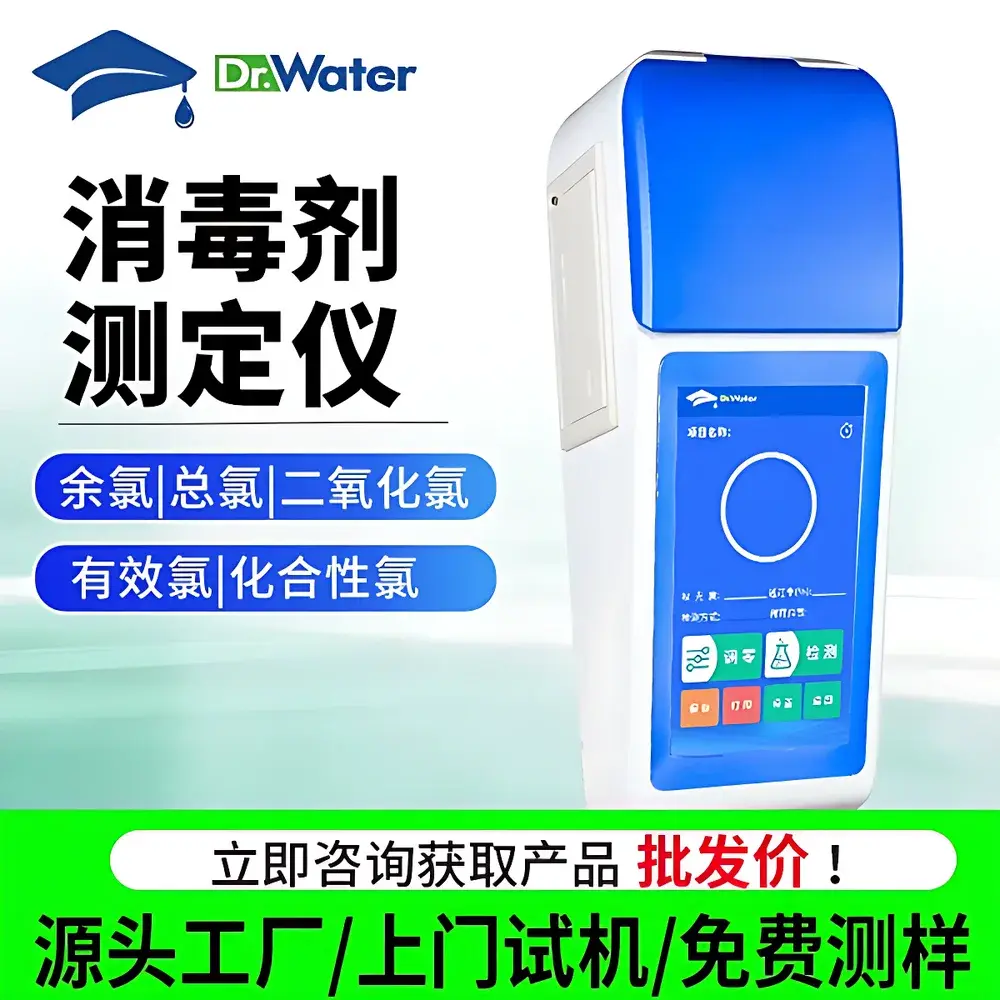
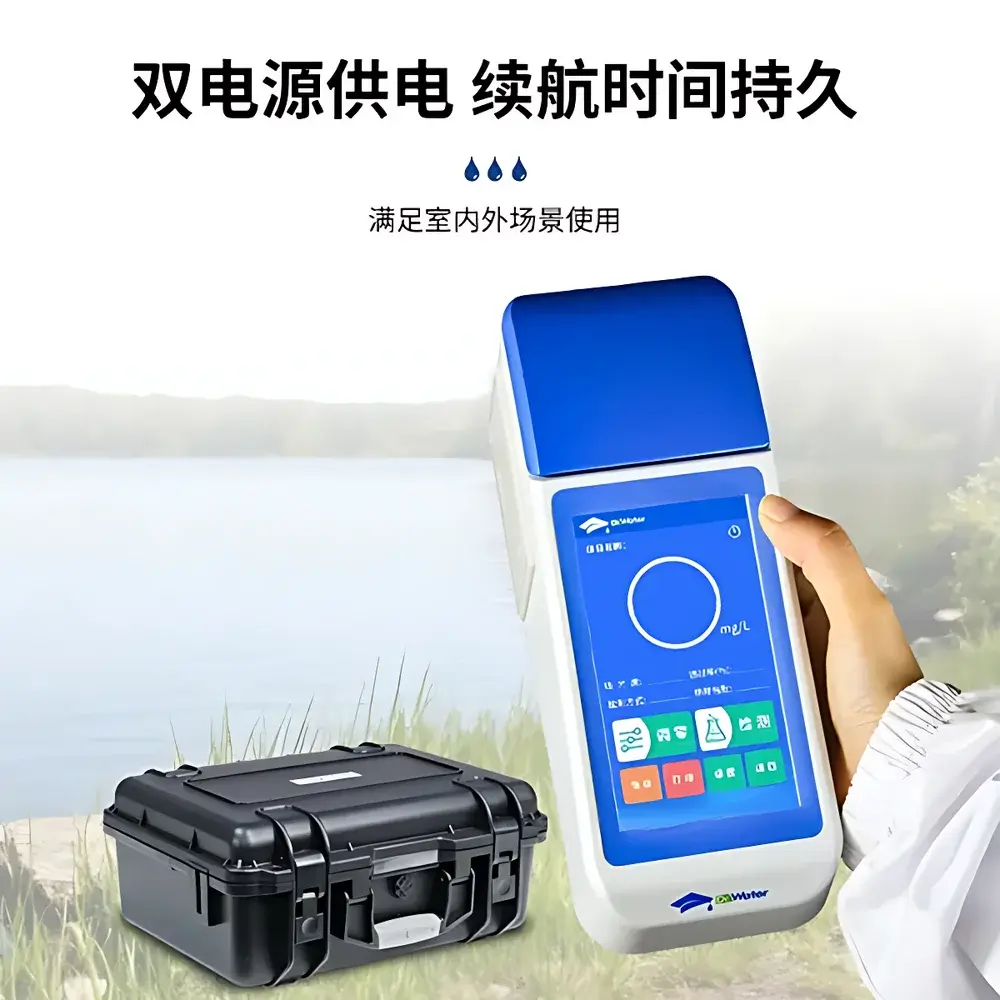
Dr-W5 Portable Multi-Parameter Water Quality Analyzer for Free Chlorine, Total Chlorine, and Chlorine Dioxide
| Brand | DoctorWater |
|---|---|
| Origin | Hunan, China |
| Model | Dr-W5 |
| Instrument Type | Portable/HANDHELD Water Quality Analyzer |
| Detection Parameters | Free Chlorine, Total Chlorine, Chlorine Dioxide, Available Chlorine, Combined Chlorine (Disinfectant Residuals) |
| Measurement Range (Free Chlorine) | 0.02–2.00 mg/L |
| Repeatability | ≤ ±2% |
| Accuracy | ≤ ±5% |
| Wavelength Range | 330–900 nm |
| Wavelength Accuracy | ±5 nm |
| Optical Stability | ≤ ±0.005 Abs/20 min |
| Display | 5-inch HD Color Touchscreen |
| Light Source | Imported Cold Light LED (Lifespan >100,000 h) |
| Sample Format | 16 mm & 25 mm Cuvettes |
| Power Supply | Rechargeable Li-ion Battery + AC Adapter |
| Data Storage | Up to 1,000,000 Records |
| Interface | USB Type-C (Charging & Data Transfer) |
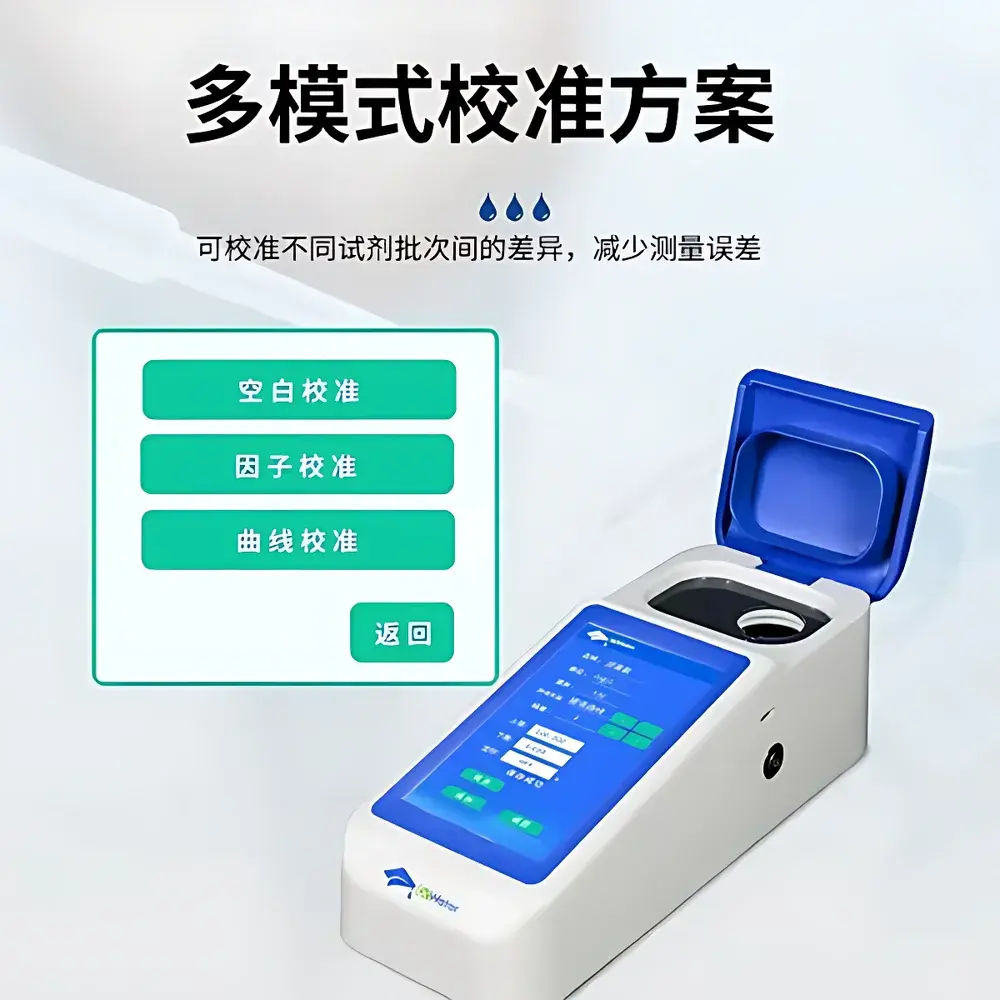
| Calibration Modes | Blank, Factor, and Calibration Curve |
| Readout Modes | Concentration (mg/L) or Absorbance (Abs) |
| Housing Material | Corrosion-Resistant ABS |
| Operating Temperature | 0–50 °C |
| Operating Humidity | 0–95% RH (non-condensing) |
| Rated Power | 1.2 W |
Overview
The Dr-W5 Portable Multi-Parameter Water Quality Analyzer is an engineered solution for on-site and routine quantification of key disinfectant residuals in water systems—including free chlorine, total chlorine, chlorine dioxide, available chlorine, and combined chlorine. Designed in alignment with Chinese national standard methodologies (e.g., GB/T 5750.11–2023 for chlorine species), the instrument employs spectrophotometric detection based on colorimetric reactions between target analytes and proprietary reagents. Its optical architecture integrates an auto-wavelength positioning system, a high-stability cold-light LED source (rated >100,000 hours), and precision interference filters spanning 330–900 nm—enabling selective absorbance measurement at optimal analytical wavelengths for each parameter. The Dr-W5 operates on the principle of Beer-Lambert law correlation between analyte concentration and measured absorbance, with dual-algorithm processing (interpolation + regression curve fitting) to enhance linearity and reduce matrix-induced drift.
Key Features
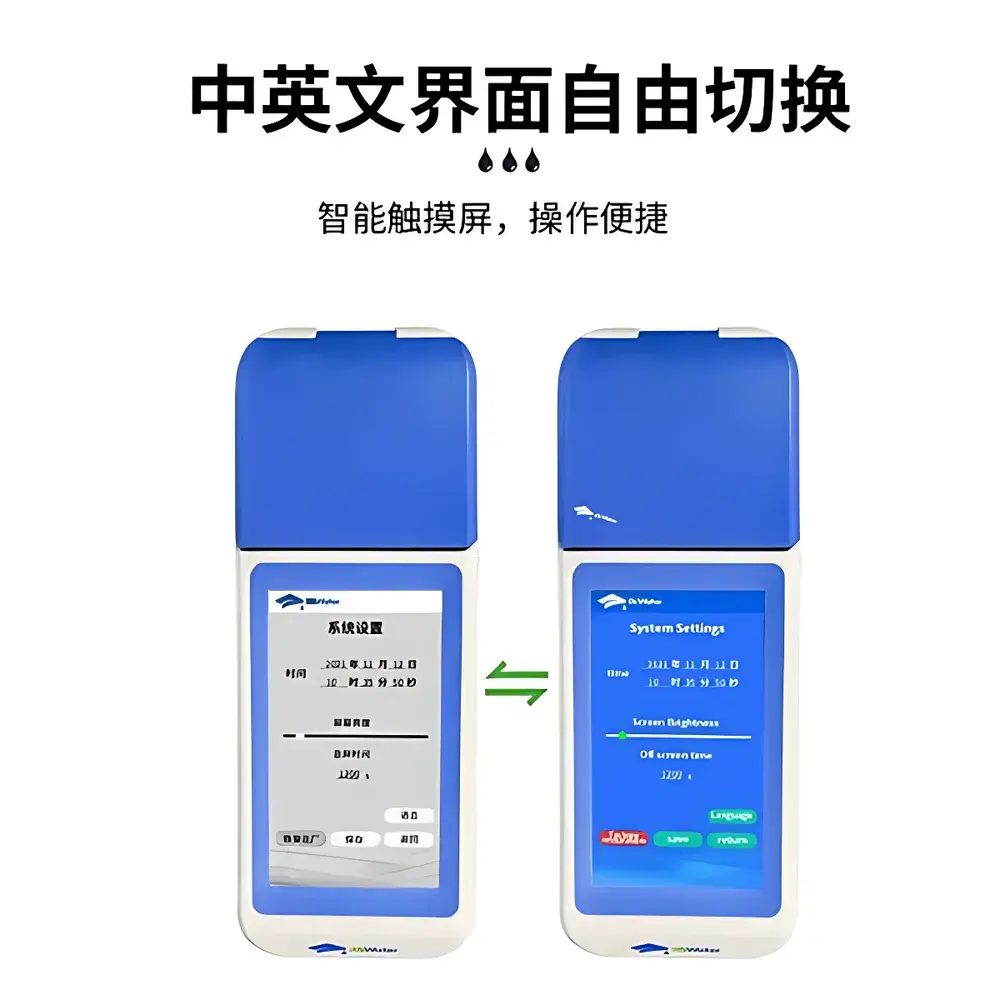
- 5-inch HD color capacitive touchscreen with intuitive GUI and seamless toggle between English and Chinese language modes
- Startup stabilization monitoring: automatically suppresses transient optical fluctuations during warm-up, eliminating early-readout instability
- Dual-calibration engine supporting blank calibration, factor-based calibration, and full multi-point calibration curves—critical for inter-batch reagent consistency under GLP-aligned workflows
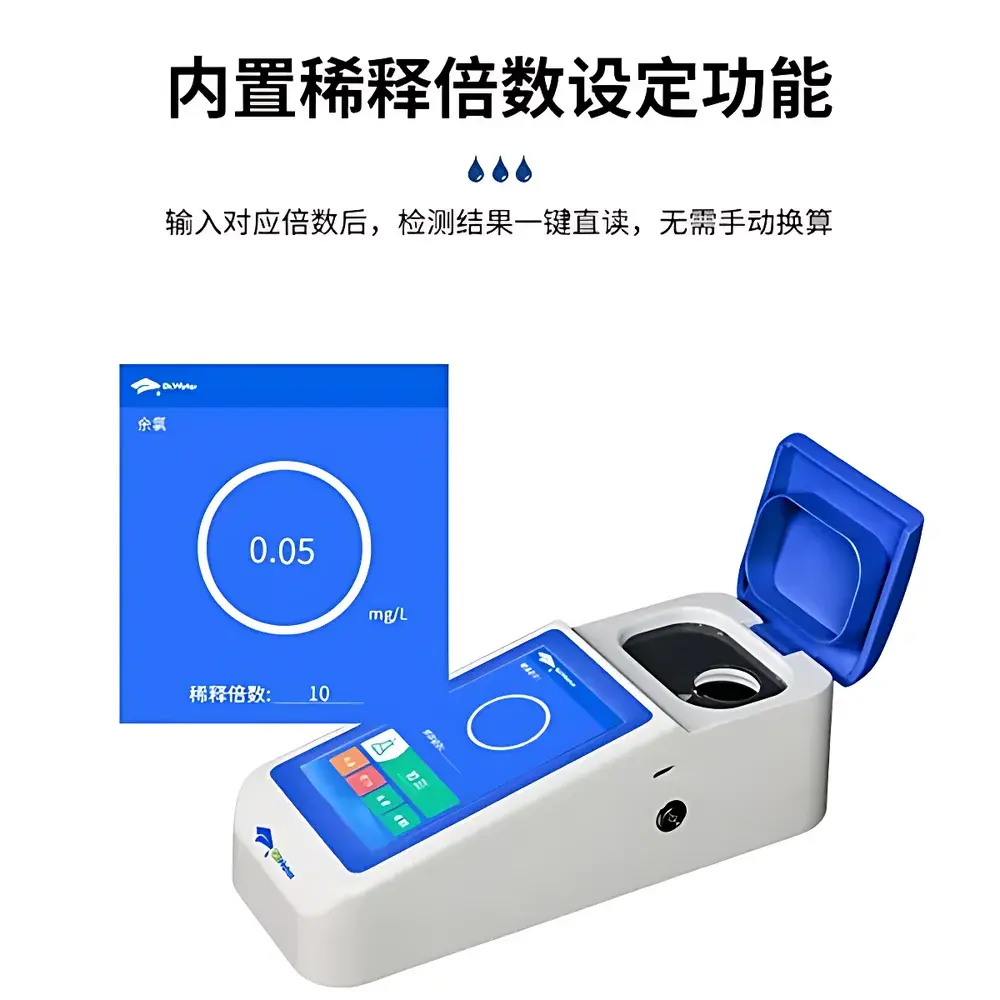
- On-device dilution factor entry: direct concentration readout without manual calculation, compliant with ISO 8466-1 guidance on dilution handling
- Programmable timed measurement: enables unattended operation for scheduled sampling in distribution networks or treatment plants
- User-defined alarm thresholds: visual and audible alerts triggered when results exceed preset limits, supporting rapid nonconformance identification
- Interference compensation algorithm: corrects for spectral overlap from coloration and signal attenuation due to light scattering—particularly valuable in raw or mildly turbid waters
- Multi-mode turbidity assessment: configurable settings for standard, low-turbidity, signal-averaging, and rapid-settling turbidity evaluation (per ISO 7027-1)
- Dual-power architecture: field-ready lithium-ion battery (with self-diagnostic low-power warning) plus universal AC adapter for continuous lab use
- Integrated thermal printer and USB Type-C interface for real-time data export, audit trail generation, and firmware updates
Sample Compatibility & Compliance
The Dr-W5 accepts standard 16 mm and 25 mm round glass or quartz cuvettes, ensuring compatibility with widely adopted reagent kits used across municipal, industrial, and regulatory laboratories. It supports analysis of drinking water, treated effluent, process water in pharmaceutical manufacturing (aligned with USP and EP 2.2.43), beverage production lines, and swimming pool maintenance. While not certified to ISO/IEC 17025 as a standalone testing system, its optical performance—wavelength accuracy (±5 nm), photometric stability (≤±0.005 Abs/20 min), and repeatability (≤±2%)—meets technical prerequisites for method validation per ISO 8466-2 and ASTM D1253/D3370. All calibration and measurement logs are timestamped and stored locally, enabling retrospective review required under basic GMP documentation practices.
Software & Data Management
The embedded firmware provides full lifecycle data handling: measurement, configuration, storage, retrieval, and export. Each record includes date/time stamp, operator ID (optional), sample ID, parameter name, measured value, unit, calibration status, and raw absorbance. With capacity for 1 million entries, data can be reviewed directly on-device or exported via USB Type-C to CSV or PDF formats. No cloud dependency is required; however, the structured output format facilitates integration into LIMS environments through third-party import scripts. Audit-trail functionality—though not FDA 21 CFR Part 11-compliant out-of-the-box—supports traceability essential for internal QA/QC audits and environmental reporting under local regulatory frameworks.
Applications
- Real-time verification of residual disinfectant levels at water treatment plant exit points and distribution system nodes
- Routine monitoring in bottled water and soft drink facilities to ensure compliance with Codex Alimentarius standards
- Field verification for public health inspections (e.g., school water fountains, hospital sterilization loops)
- Process control in pharmaceutical clean steam condensate and purified water systems
- Emergency response deployment during flood or infrastructure failure events requiring rapid chlorine decay profiling
- Environmental compliance checks for wastewater discharge permits involving chlorine quenching efficacy
FAQ
What chlorine species does the Dr-W5 measure independently?
It quantifies free chlorine, total chlorine, chlorine dioxide, available chlorine, and combined chlorine as discrete parameters using dedicated reaction chemistries and wavelength-specific detection.
Is the instrument suitable for use in high-humidity field environments?
Yes—rated for operation at 0–95% relative humidity (non-condensing) and equipped with ABS housing resistant to common acids, alkalis, and oxidants encountered in water treatment settings.
Can calibration curves be imported or edited externally?
No—calibration curves must be generated in situ using certified reference standards; however, up to 10 user-defined curves may be saved and recalled.
Does the device meet international regulatory requirements for drinking water testing?
It implements nationally recognized methods and delivers performance metrics consistent with ISO and ASTM guidelines for portable photometers; formal regulatory acceptance depends on local accreditation policies and method validation by the end-user laboratory.
How is optical drift managed during extended field use?
Through automatic baseline correction at startup, real-time dark-current compensation, and periodic optical stability verification every 20 minutes—ensuring sustained photometric integrity across multi-hour deployments.
Related Products







