
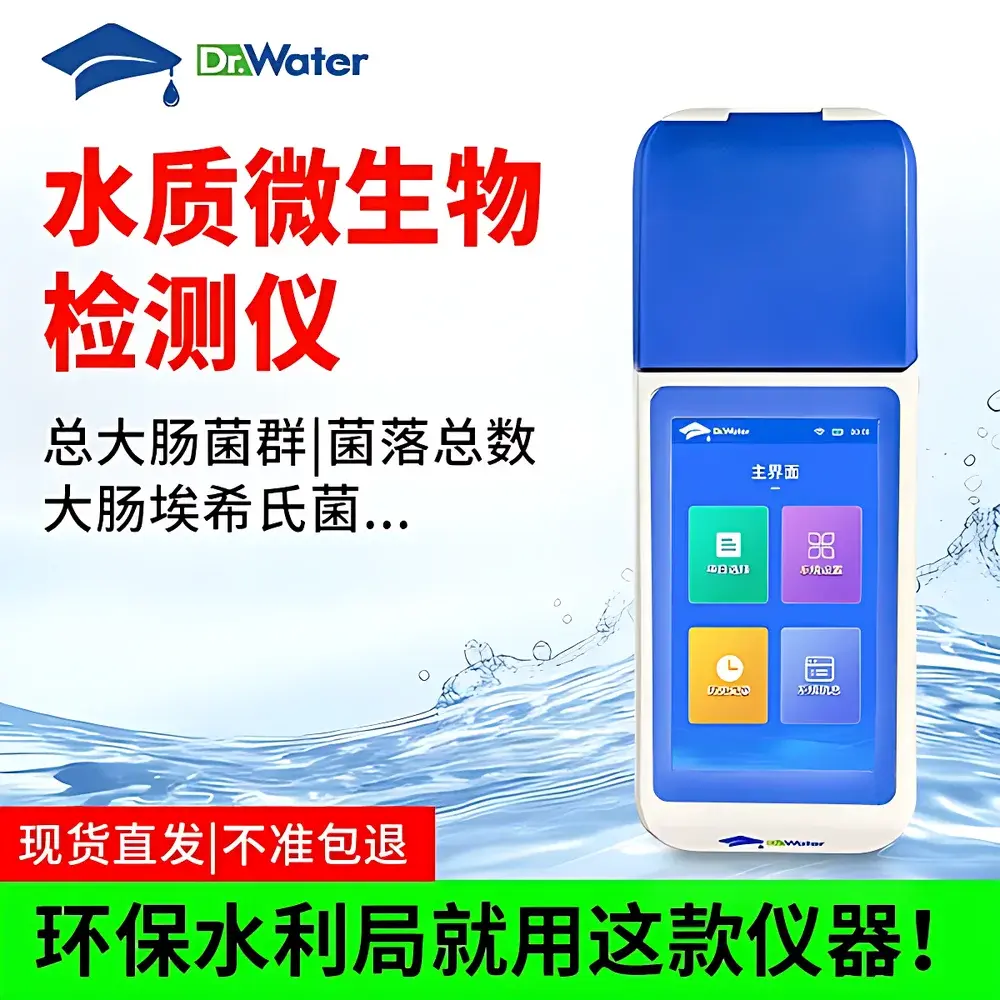
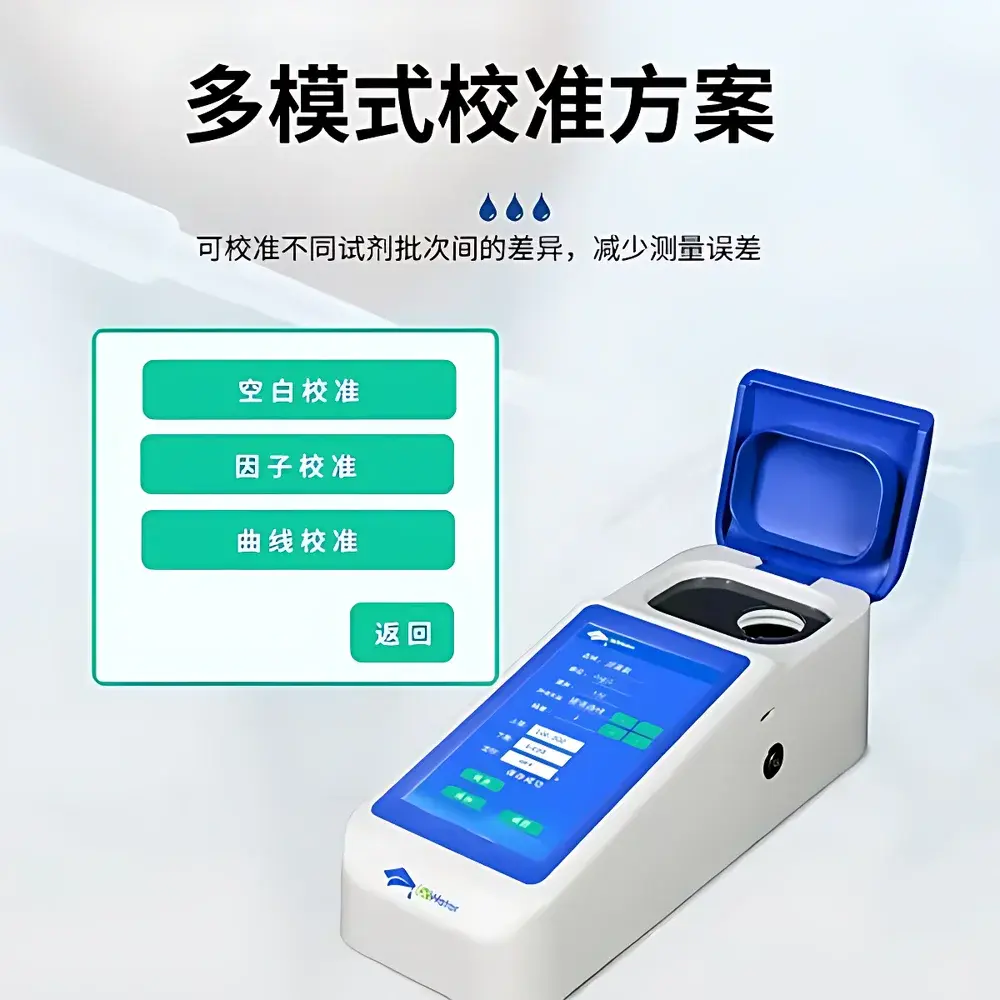
Dr-Water Dr-W130 Microbial Water Quality Analyzer
| Brand | Dr-Water |
|---|---|
| Origin | Hunan, China |
| Model | Dr-W130 |
| Wavelength Range | 330–900 nm |
| Wavelength Accuracy | ±5 nm |
| Photometric Accuracy | ≤±5% |
| Repeatability | ≤±2% |
| Absorbance Resolution | 0.001 Abs |
| Optical Stability | ≤±0.005 Abs/20 min |
| Light Source | Imported Cold LED (Lifespan >100,000 h) |
| Display | 5-inch HD Color TFT Touchscreen |
| Sample Format | 16 mm & 25 mm Cuvettes |
| Calibration Modes | Blank, Factor, and Calibration Curve |
| Data Storage | Up to 1,000,000 Records |
| Power Supply | Rechargeable Li-ion Battery + AC Adapter |
| Interface | USB Type-C (Charging & Data Transfer) |
| Housing Material | Corrosion-Resistant ABS |
| Readout Modes | Concentration & Absorbance |
| Turbidity Measurement Modes | Standard, Low-Turbidity, Signal-Averaging, and Rapid-Settling |
Overview
The Dr-Water Dr-W130 Microbial Water Quality Analyzer is a portable, spectrophotometric instrument engineered for quantitative determination of microbiological indicators in water—specifically total coliforms, Escherichia coli, and heterotrophic plate count (HPC)—using standardized colorimetric and enzymatic substrate methods compliant with GB/T 5750.12–2023 (China’s Standard Methods for Examination of Drinking Water – Microbiology). It operates on the principle of absorbance measurement at user-selectable wavelengths (330–900 nm), leveraging a precision optical path with automatic wavelength positioning and temperature-stabilized cold LED illumination. Its design prioritizes field-deployable robustness without compromising laboratory-grade photometric integrity: optical stability remains within ±0.005 Abs over 20 minutes, and photometric accuracy is maintained at ≤±5% across the operational range. The system supports both standard membrane filtration and multiple-tube fermentation assay readouts via pre-programmed calibration curves, enabling direct concentration reporting without manual dilution factor calculation.
Key Features
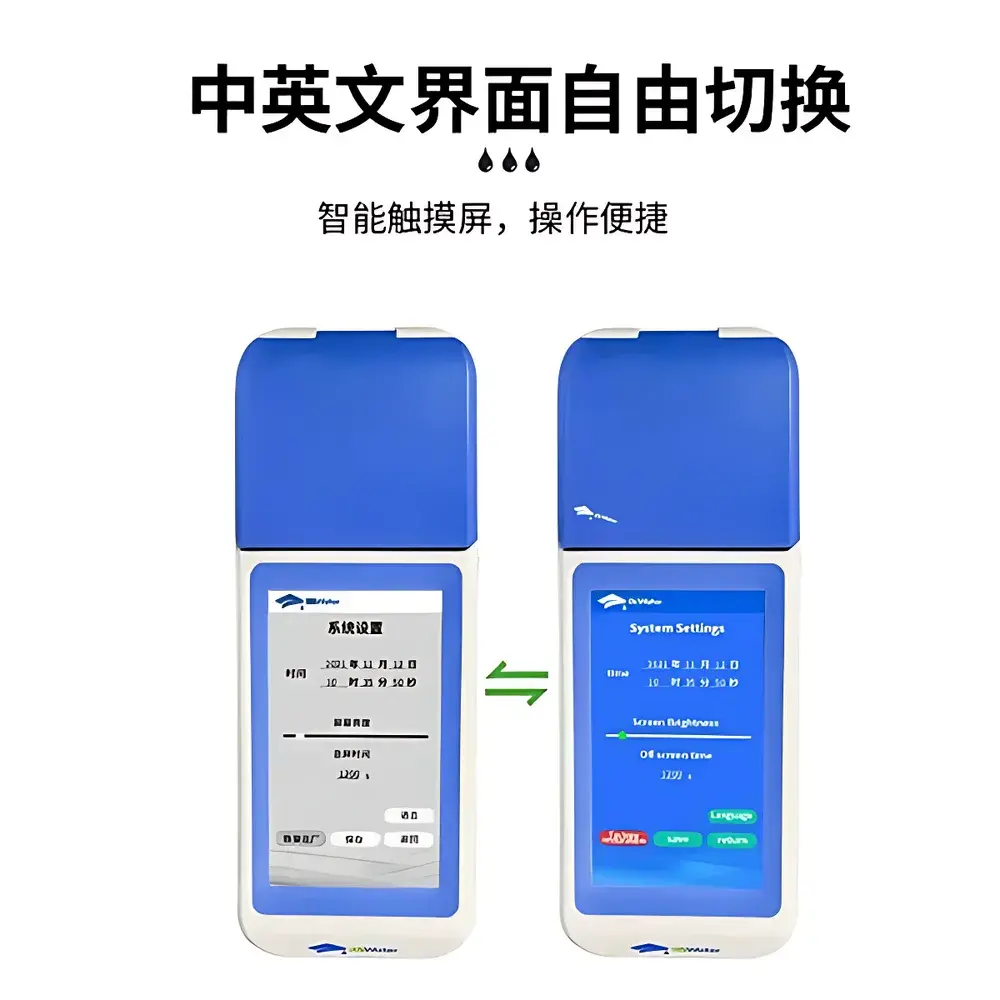
- 5-inch high-resolution color TFT touchscreen with intuitive GUI and seamless switching between English and Chinese language interfaces.
- Dual-algorithm processing engine combining interpolation and regression curve fitting to minimize inter-batch reagent variability and enhance result reproducibility.
- Startup stabilization monitoring that suppresses transient photometric drift during warm-up, ensuring reliable baseline establishment before sample measurement.
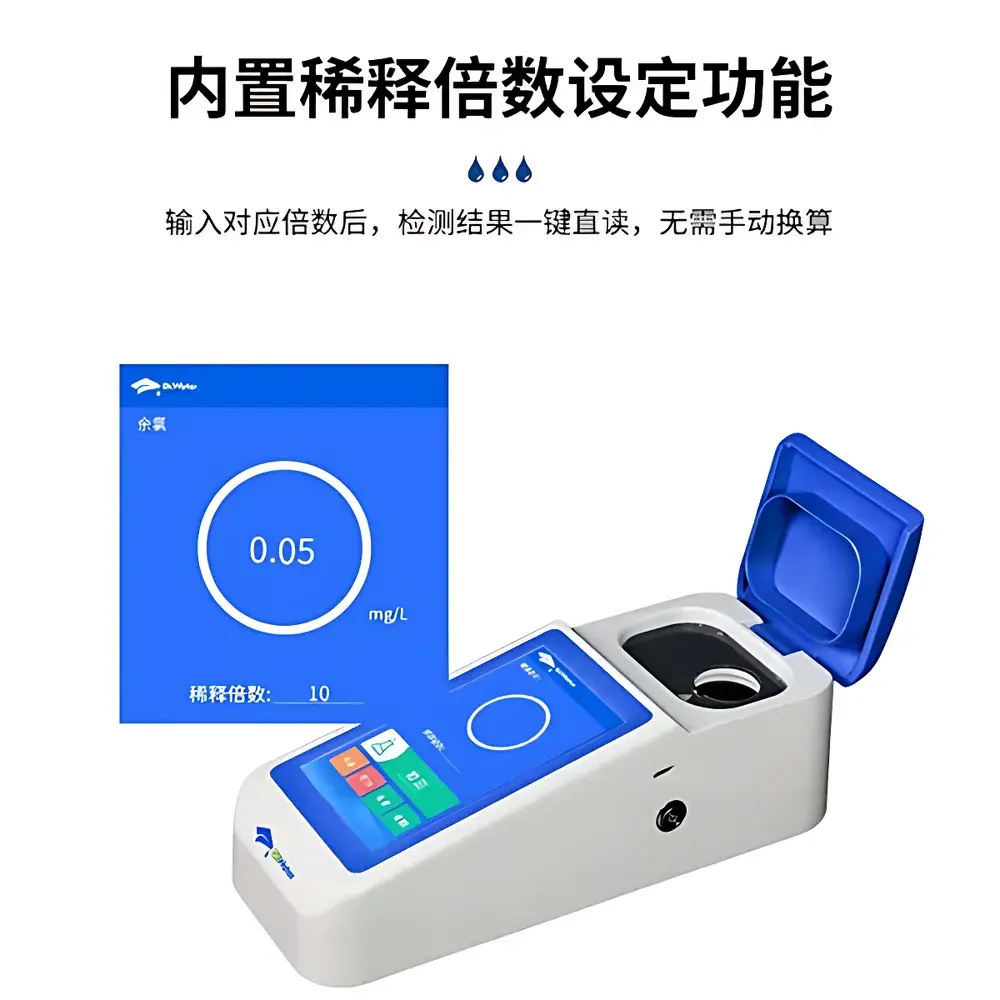
- Integrated dilution factor input function: users enter dilution ratio directly; instrument auto-adjusts final concentration output in real time.
- Programmable timed assay mode for unattended operation—ideal for batch processing in water utilities or environmental labs with high throughput demands.
- Triple calibration architecture: blank correction, factor-based normalization, and full multi-point calibration curve generation—each supporting traceable validation per ISO/IEC 17025 requirements.
- User-definable alarm thresholds with visual and audible alerts when measured values exceed regulatory limits (e.g., WHO or EPA drinking water guidelines).
- Optical interference compensation algorithm mitigates spectral distortion from sample coloration, turbidity, or light attenuation—critical for raw surface water or wastewater matrices.
- Four configurable turbidity measurement modes: Standard (for routine compliance), Low-Turbidity (optimized for purified water), Signal-Averaging (enhanced SNR for low-concentration assays), and Rapid-Settling (accelerated sedimentation correction for suspended solids).
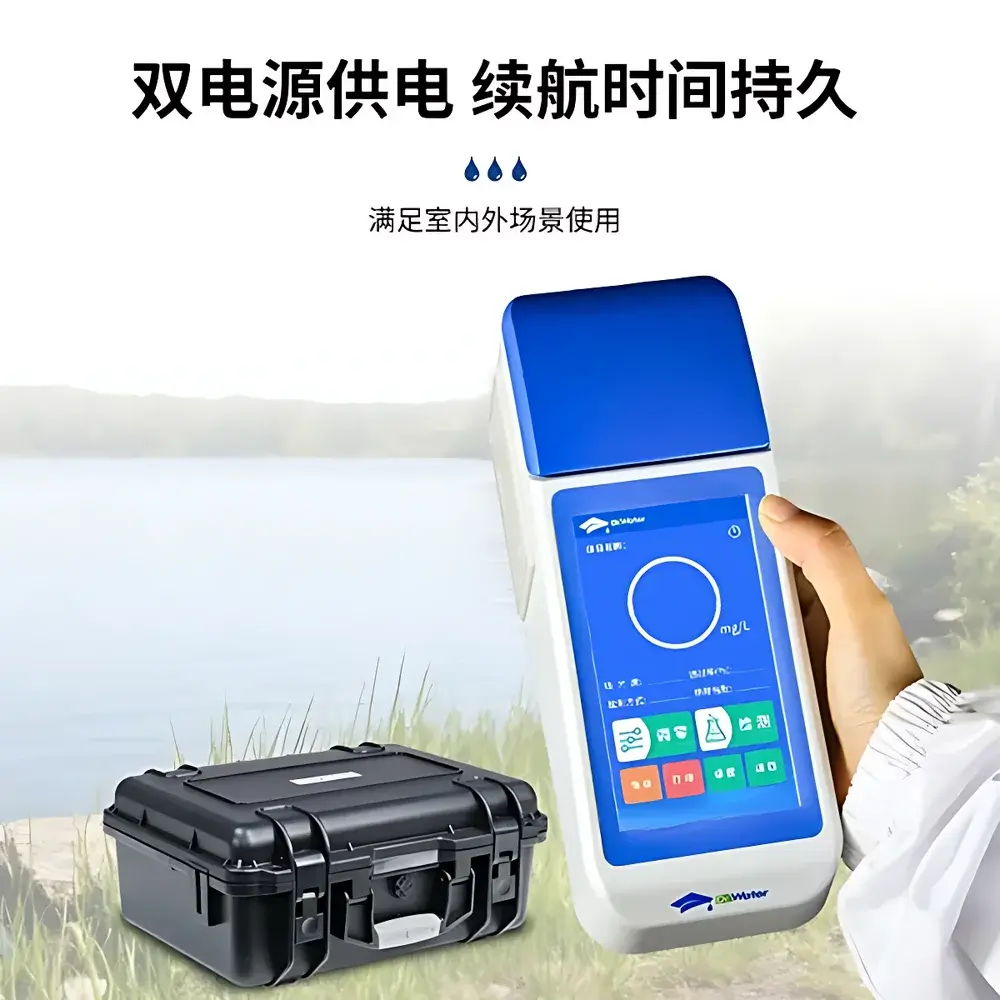
- Dual-power architecture: long-life rechargeable Li-ion battery (field-rated >8 h continuous use) plus universal AC adapter—supported by intelligent battery diagnostics and low-power warning.
Sample Compatibility & Compliance
The Dr-W130 accommodates standard 16 mm and 25 mm round-bottom glass or plastic cuvettes, compatible with widely adopted microbiological test kits—including chromogenic substrates for β-glucuronidase (EC detection) and ONPG/MUG-based formulations. It meets functional performance criteria aligned with ISO 9308-1:2014 (enumeration of E. coli and coliform bacteria), ASTM D6162 (standard test method for E. coli in water using membrane filtration), and GB/T 5750.12–2023. Its optical architecture satisfies GLP documentation requirements: all measurements include timestamped metadata (operator ID, calibration status, cuvette ID, ambient temperature), and firmware enforces audit-trail logging for critical configuration changes. While not FDA 21 CFR Part 11–certified out-of-box, its data export structure (CSV/Excel-compatible) facilitates integration into validated LIMS environments under site-specific SOPs.
Software & Data Management
Onboard firmware provides full local control of measurement protocols, calibration history, and user permissions. All data—including raw absorbance, calculated concentrations, calibration curves, and QC checks—are stored internally (up to 1,000,000 records) with time/date stamping and operator tagging. USB Type-C interface enables bidirectional data transfer: export datasets to external PCs or import updated calibration templates and method files. Built-in thermal printer delivers immediate hard-copy reports with customizable headers (site ID, analyst name, method reference). Data export formats conform to ISO/IEC 17025 Annex A3 requirements for electronic record integrity, including checksum verification and immutable file naming conventions (e.g., “DRW130_20240522_143247_Coliform_GB5750”).
Applications
The Dr-W130 serves as a primary screening tool across decentralized and centralized water quality workflows. It is routinely deployed in municipal drinking water distribution systems for routine coliform surveillance; in bottled water and beverage manufacturing facilities for HACCP-mandated process control; in environmental monitoring programs for surface and groundwater source assessment; and in public health laboratories supporting outbreak investigations per national communicable disease protocols. Its portability and battery endurance make it suitable for emergency response deployments following natural disasters or infrastructure failures. In pharmaceutical water systems (PW, WFI), it supports periodic microbial trend analysis when paired with validated rapid test kits meeting USP turbidity and water quality guidance.
FAQ
Does the Dr-W130 comply with international regulatory standards for microbiological testing?
Yes—it supports methodologies referenced in ISO 9308-1, ASTM D6162, and GB/T 5750.12, and its photometric performance meets minimum accuracy and stability benchmarks required for accredited environmental testing laboratories.
Can the instrument store and recall multiple calibration curves for different reagent lots?
Yes. Up to 50 independent calibration curves can be saved onboard, each tagged with lot number, expiration date, and technician ID—enabling full traceability across reagent batches.
Is remote software update supported?
Firmware updates are performed via USB Type-C connection using Dr-Water’s certified update utility; no cloud connectivity or internet dependency is required.
What maintenance is required to ensure long-term optical stability?
Routine cleaning of the cuvette chamber and optical window with lint-free ethanol wipes every 100 measurements; annual verification of wavelength accuracy using NIST-traceable holmium oxide filters is recommended.
How does the instrument handle highly colored or turbid samples?
The integrated interference compensation algorithm dynamically corrects for spectral overlap and scattering effects, and the Rapid-Settling turbidity mode allows empirical settling time adjustment prior to reading—minimizing false positives in complex matrices.







