
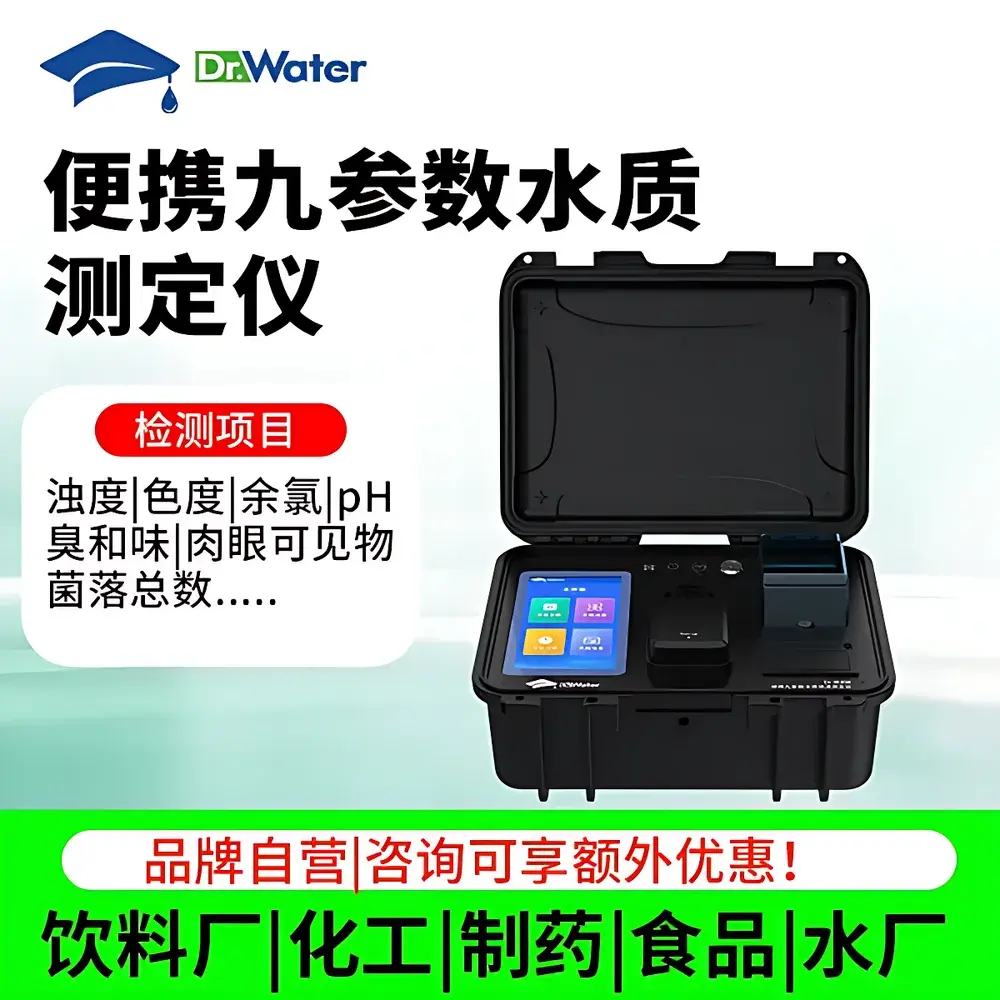
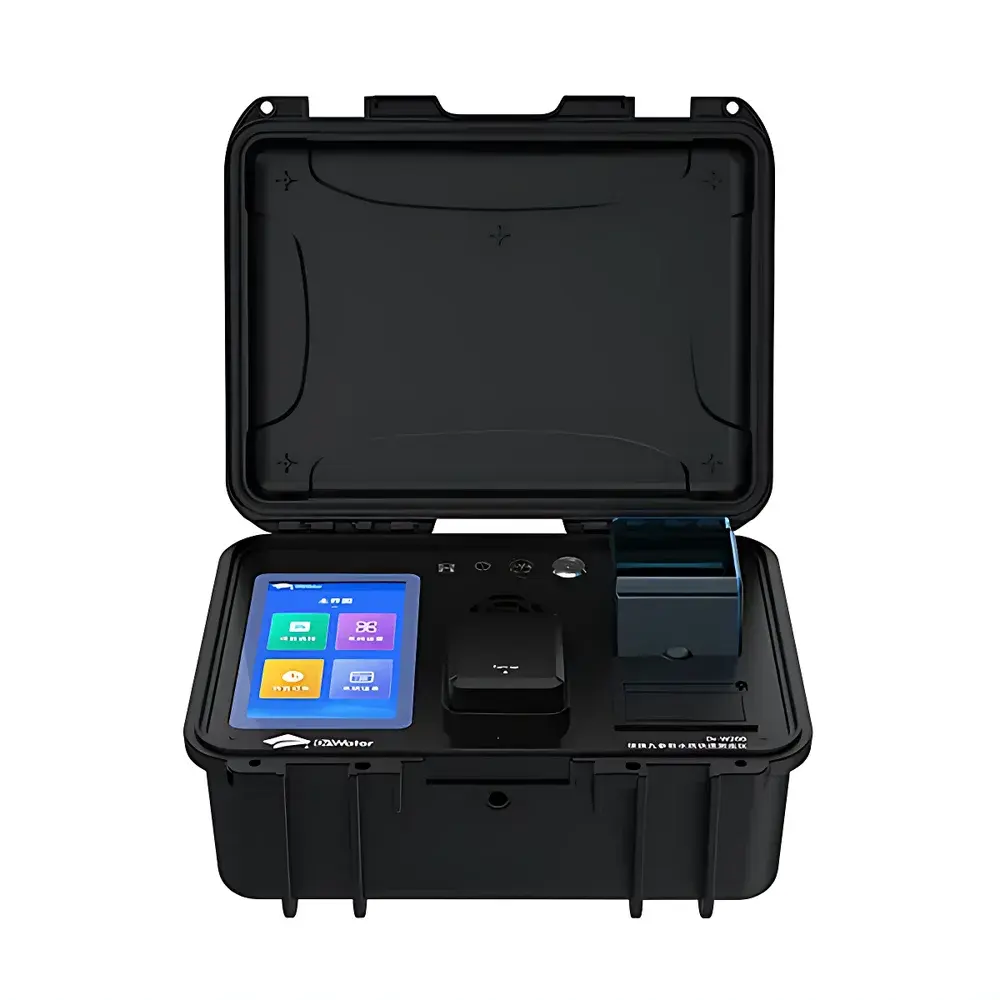
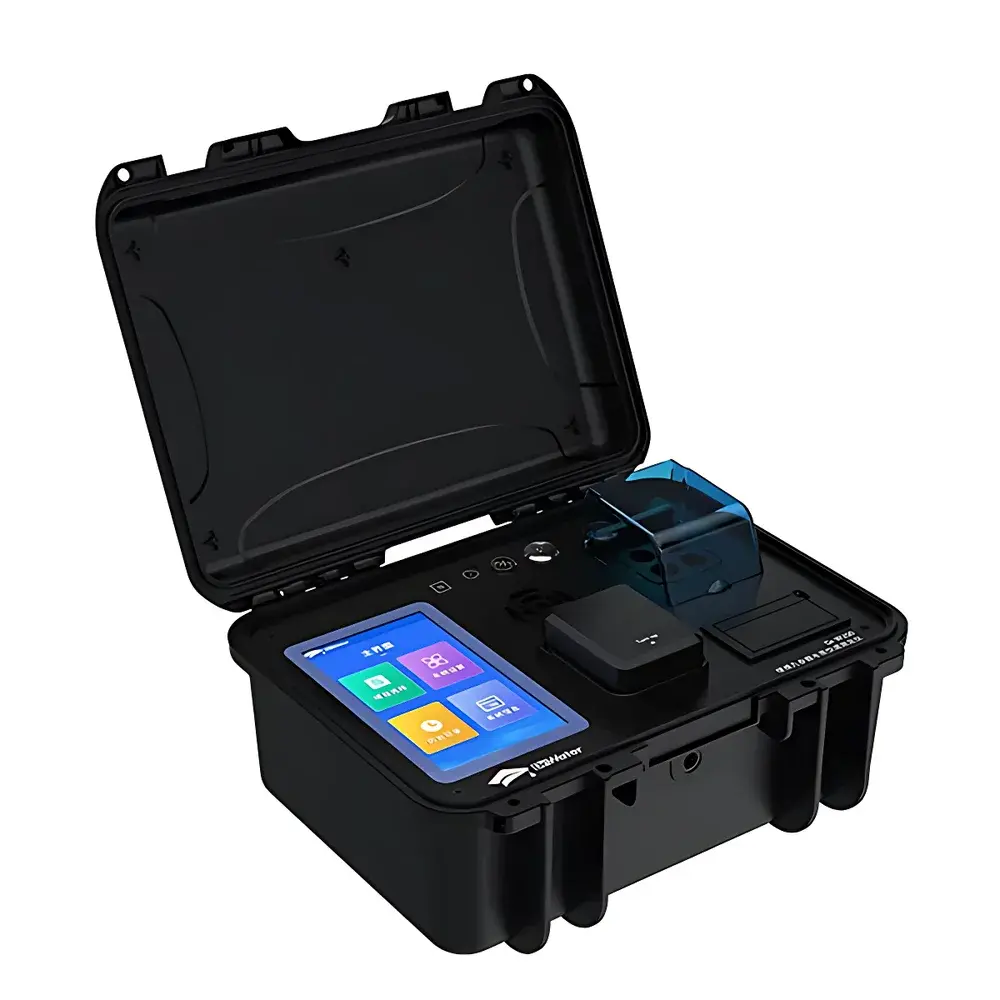
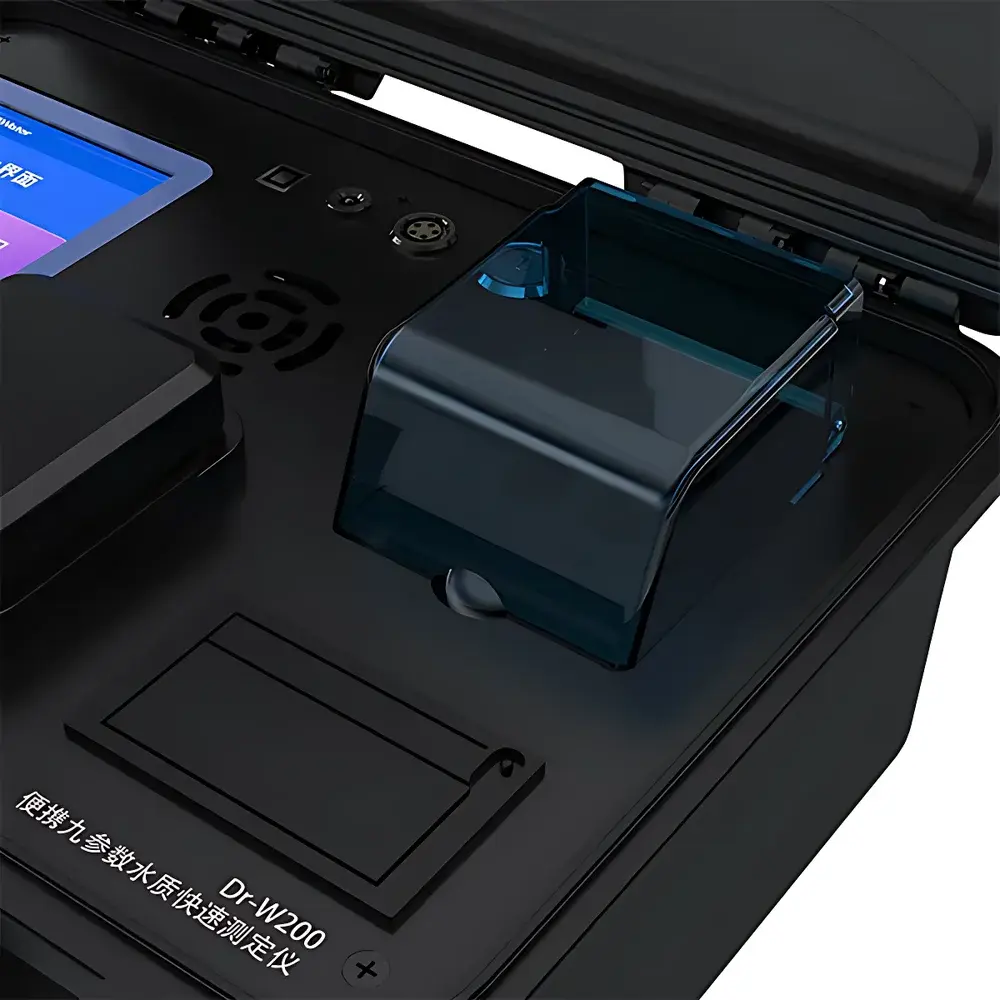
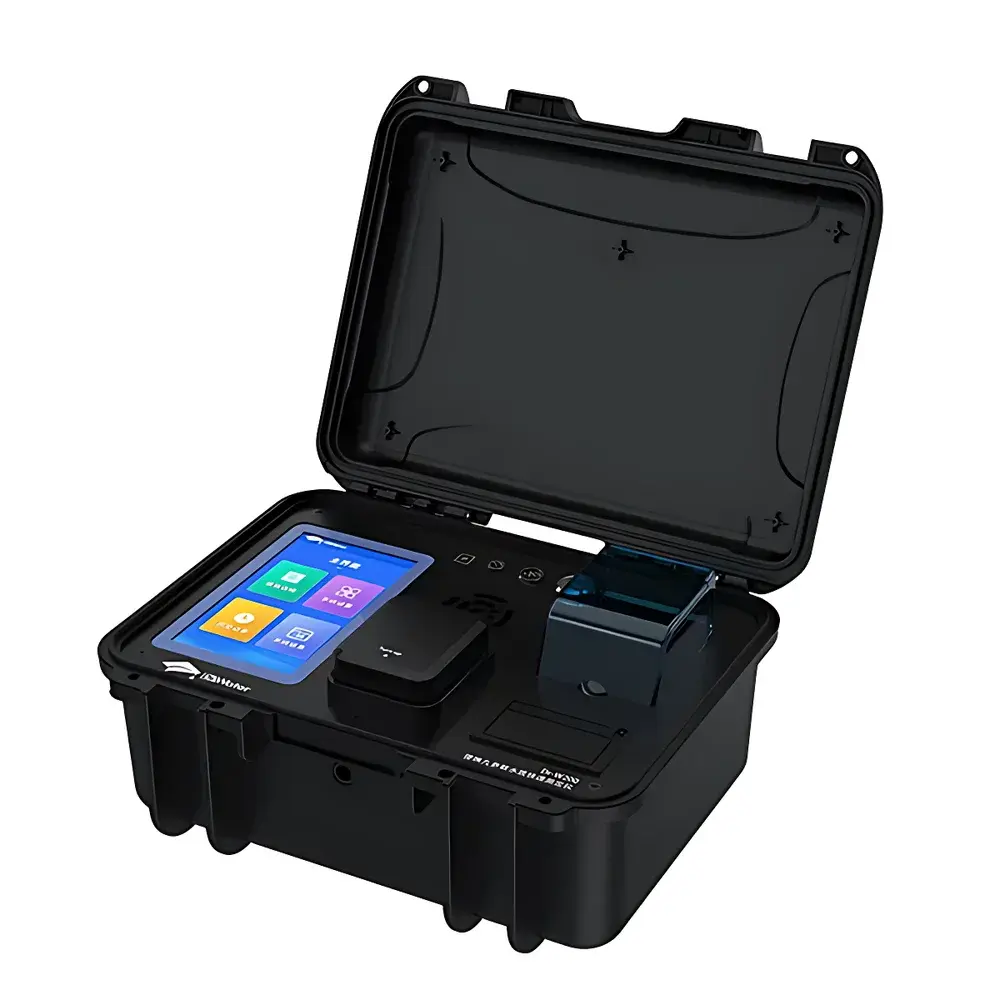
Dr-Water Dr-W200 Portable 9-Parameter Water Quality Analyzer
| Brand | Dr-Water |
|---|---|
| Origin | Hunan, China |
| Model | Dr-W200 |
| Instrument Type | Portable/HANDHELD Water Quality Analyzer |
| Detection Principle | Colorimetric Method |
| Measured Parameters | Turbidity (0–20 NTU / 0–200 NTU / 0–1000 NTU), Color, Free Chlorine, Chlorine Dioxide, Permanganate Index (COD<sub>Mn</sub>), pH, Odor & Taste, Visible Particulates, Total Coliforms, Heterotrophic Plate Count (HPC) |
| Repeatability | ≤ ±2% |
| Accuracy | ≤ ±5% |
| Wavelength Range | 330–900 nm |
| Wavelength Accuracy | ±5 nm |
| Optical Resolution | 0.001 Abs |
| Optical Stability | ≤ ±0.005 Abs/20 min |
| Display | 7-inch HD color TFT capacitive touchscreen |
| Light Source | Imported long-life cold LED (≥100,000 h) |
| Detection Positions | Dual-path 16 mm & 25 mm cuvette slots + dedicated electrode port |
| Calibration Modes | Blank, Factor, and Multi-point Curve Calibration |
| Data Storage | 1,000,000 records with timestamp, sample ID, and operator tag |
| Power Supply | Rechargeable Li-ion battery (field operation) + AC adapter (lab continuity) |
| Battery Diagnostics | Real-time SOC monitoring with low-power alert |
| Connectivity | USB 2.0 interface |
| Printing | Integrated thermal printer |
| Operating Environment | 0–50 °C, RH 0–95% (non-condensing) |
| Housing Material | Flame-retardant ABS with chemical resistance |
| Rated Power | 1.2 W |
Overview
The Dr-Water Dr-W200 Portable 9-Parameter Water Quality Analyzer is an engineered field-deployable instrument designed for rapid, standardized assessment of drinking water quality in compliance with GB/T 5750 (China’s Standard Methods for Examination of Drinking Water) and aligned with core principles of ISO 8466-1 (calibration of analytical instruments) and EPA Method 180.1 (turbidity and residual chlorine). It employs dual-beam colorimetric photometry with automatic wavelength positioning across a broad spectral range (330–900 nm), enabling simultaneous quantification of nine critical parameters—including turbidity (in three operational modes), free chlorine, chlorine dioxide, permanganate index (as a surrogate for organic load), pH, color, odor/taste screening (via user-validated sensory log entry), visible particulates (qualitative visual assessment), total coliforms (via membrane filtration support), and heterotrophic plate count (HPC)—within a single compact platform. Its optical architecture integrates a thermally stabilized cold LED light source and precision interference filters to ensure long-term photometric integrity (<±0.005 Abs/20 min drift), minimizing recalibration frequency in variable ambient conditions.
Key Features
- Triple-mode turbidity measurement: Standard, Low-Turbidity (enhanced sensitivity <1 NTU), and Rapid Sedimentation Mode—optimized for flocculation monitoring in treatment plants.
- Dual-path optical detection: Independent 16 mm and 25 mm cuvette holders accommodate standard reagent vials and high-volume field samples without cross-contamination risk.
- Interference compensation algorithm: Dynamically corrects for spectral overlap from natural color and light scattering artifacts, improving accuracy in humic-rich or iron-stained waters.
- Intelligent calibration suite: Supports blank, factor-based, and multi-point curve calibration—enabling traceability across reagent lots and batch-to-batch variability mitigation per GLP documentation requirements.
- Embedded dilution factor engine: Users input dilution ratio; the system auto-adjusts final concentration output—eliminating manual calculation errors and supporting ISO 5667-3-compliant sample handling protocols.
- Thermal equilibrium management: Patented air-circulation path maintains internal component temperature within ±1.5 °C across 0–50 °C ambient—preserving photodiode linearity and electrochemical sensor stability.
- Regulatory-ready data governance: Timestamped records include operator ID, location tag (manual entry), method ID, calibration status flag, and raw absorbance values—facilitating audit readiness under ISO/IEC 17025 and USP <1225> verification frameworks.
Sample Compatibility & Compliance
The Dr-W200 accepts untreated, filtered, or preserved grab samples in standard glass or plastic cuvettes (16 mm or 25 mm OD). For microbiological parameters (total coliforms, HPC), it interfaces with standard membrane filtration assemblies (e.g., Millipore® or Sartorius® compatible units) and supports post-filtration colony enumeration via integrated image-assisted counting guidance—not direct culture—but enables full chain-of-custody logging. All colorimetric assays comply with GB/T 5750.4–5750.12 series and reference equivalents including APHA Standard Methods 2130B (turbidity), 4500-Cl G (free chlorine), and 4500-COD (permanganate index). The device meets IP67 ingress protection (when sealed in supplied carry case), CE marking for electromagnetic compatibility (EN 61326-1), and RoHS Directive 2011/65/EU material restrictions.
Software & Data Management
The embedded firmware (v3.2+) provides ISO/IEC 17025-aligned data integrity controls: role-based access (admin/operator), electronic signature capture, immutable audit trail (with tamper-evident hashing), and 21 CFR Part 11–compatible optional digital signature module (available upon configuration). Data export supports CSV and PDF report generation with embedded QC flags (e.g., “Calibration Expired”, “Out-of-Range Dilution”). USB mass storage mode allows direct transfer to LIMS or ELN systems without proprietary drivers. Internal storage retains 1,000,000 records with cyclic overwrite protection for flagged “critical” entries (e.g., non-compliant results). Thermal printouts include QR-coded result summaries for field verification traceability.
Applications
The Dr-W200 serves as a primary screening tool in municipal drinking water distribution networks (DMA validation), emergency response (post-flood or infrastructure failure), regulatory surveillance by CDC and environmental protection bureaus, routine QC at bottled water and beverage facilities (per GB 19298 and FDA 21 CFR 129), and process monitoring in pharmaceutical water systems (PW/WFI pre-check per USP <1231>). Its portability and battery endurance (>12 h continuous use) make it suitable for remote wellhead testing, rural water kiosk verification, and mobile lab deployments where grid power is unavailable.
FAQ
Does the Dr-W200 comply with international drinking water standards such as WHO Guidelines or EU Directive 98/83/EC?
It implements analytical methods harmonized with GB/T 5750, which are technically equivalent to APHA Standard Methods and align with WHO-recommended detection limits for turbidity (<1 NTU), free chlorine (0.2–4 mg/L), and pH (6.5–8.5). Full equivalence requires site-specific validation per ISO/IEC 17025.
Can the instrument store calibration curves for multiple reagent brands?
Yes—up to 50 user-defined calibration curves can be saved, each tagged with reagent lot number, expiry date, and technician ID, supporting multi-vendor procurement strategies.
Is external software required for data analysis or reporting?
No—on-device reporting includes statistical summaries (mean, SD, CV%), trend charts over time, and pass/fail evaluation against customizable limit sets. Exported CSV files are compatible with Excel, R, or Python-based QA pipelines.
What maintenance is required for long-term optical stability?
Annual verification of wavelength accuracy (using NIST-traceable holmium oxide filter) and photometric linearity (neutral density filters) is recommended. No optical alignment tools are user-serviceable; field service kits include cleaning swabs and reference standards.
How does the instrument handle high-color, low-turbidity samples—common in surface water sources?
The interference compensation algorithm applies real-time correction using dual-wavelength referencing (e.g., 525 nm/850 nm pair), reducing color-induced bias in turbidity readings by >85% compared to single-wavelength systems, as verified per ISO 7027-1 Annex C.
Related Products







