
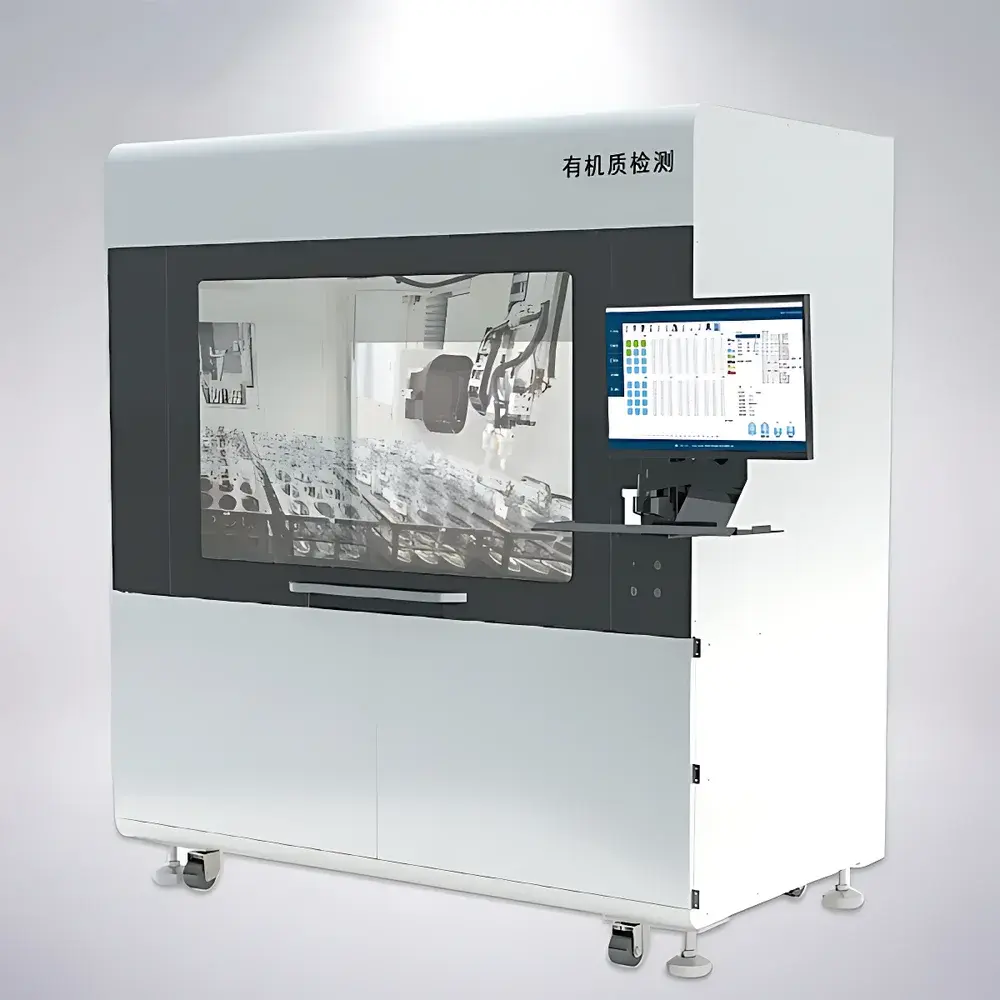
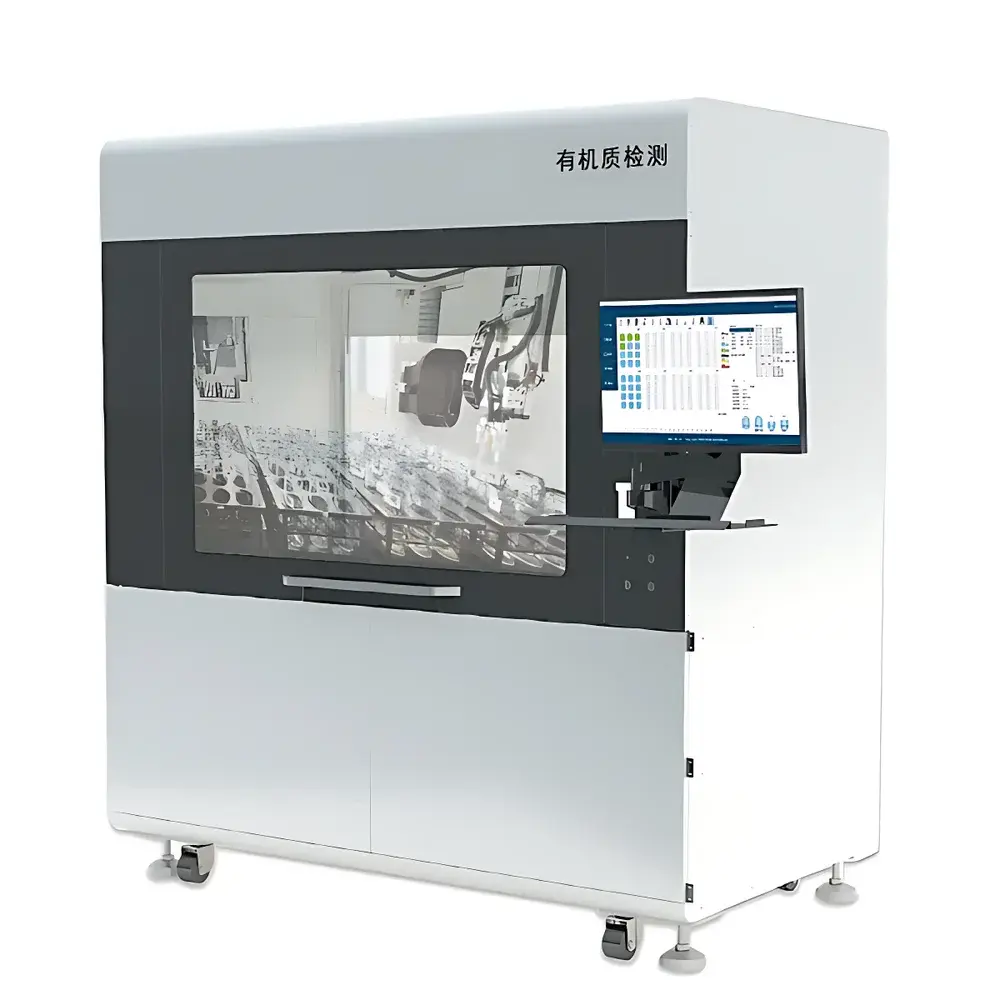
Drick DRK-06 Black-Light Laboratory Smart Organic Matter Analysis Platform
| Brand | Drick |
|---|---|
| Origin | Shandong, China |
| Manufacturer Type | OEM Manufacturer |
| Country of Origin | China |
| Model | DRK-06 Black-Light Laboratory |
| Price | USD 70,000 (FOB Qingdao) |
| Standard Compliance | NY/T 1121.6–2006 |
| Sample Capacity | 96 positions (customizable) |
| Throughput | 96 samples per 13 hours for organic matter analysis |
| Heating Stations | 3 |
| Liquid Dispensing Station | 1 |
| Titration Station | 1 |
| Dispensing Accuracy | <0.5% RSD |
| Background Illumination | Adjustable color temperature 6000–7000 K, illuminance 0–10000 lux (linear control) |
| Dimensions (L×W×H) | 1700 mm × 960 mm × 1850 mm |
Overview
The Drick DRK-06 Black-Light Laboratory Smart Organic Matter Analysis Platform is an integrated, fully automated benchtop system engineered for standardized quantification of soil and agricultural organic matter content in accordance with NY/T 1121.6–2006. It implements a closed-loop photometric titration workflow grounded in the classical potassium dichromate oxidation method—where organic carbon is oxidized under acidic, heated conditions, followed by back-titration of unreacted dichromate with ferrous ammonium sulfate (FAS). The platform replaces manual manipulations with programmable robotic motion, precision liquid handling, thermally regulated digestion, and real-time endpoint detection via high-fidelity chromatic analysis under controlled spectral illumination. Designed for routine QC/QA laboratories in agronomy, environmental monitoring, and soil testing centers, the DRK-06 ensures analytical reproducibility, operator safety, and full traceability across all procedural steps—from sample loading to final report generation.
Key Features
- Intelligent 3-axis robotic arm equipped with servo-controlled electric gripper, replicating human dexterity for precise cup handling, orientation alignment, and collision-avoidant transport across 96-position sample carousel.
- Automated reagent dispensing module with gravimetric calibration and pressure-compensated positive displacement pumps, achieving <0.5% RSD volumetric accuracy for sulfuric acid, potassium dichromate, and FAS solutions.
- Triple independent heating stations with PID-controlled aluminum block heaters (range: ambient to 200 °C), enabling simultaneous reflux digestion of up to three batches under standardized thermal profiles per NY/T 1121.6–2006.
- Dedicated photometric titration station featuring a calibrated RGB sensor array and tunable 6000–7000 K white-light backlight (0–10000 lux, linear dimming), eliminating ambient light interference and enabling robust endpoint discrimination based on Fe2+/Fe3+ redox color transition (green → brown).
- Integrated wash station with programmable solvent rinse cycles (deionized water, ethanol) and vacuum-assisted drying to prevent cross-contamination between runs.
- Modular hardware architecture compliant with IEC 61000-6-2/6-4 EMC standards; CE-marked power supply and Class I electrical safety certification.
Sample Compatibility & Compliance
The DRK-06 accepts standard 50 mL borosilicate glass digestion cups (or compatible polypropylene alternatives) and supports heterogeneous solid matrices including air-dried soil, compost, sludge, and plant tissue homogenates. Sample preparation (e.g., grinding, sieving ≤2 mm) remains external per NY/T 1121.6–2006 requirements. All operational parameters—including digestion time/temperature, titrant addition rate, and color threshold sensitivity—are configurable via firmware and locked into method templates to enforce regulatory adherence. The system satisfies GLP documentation requirements through mandatory audit trails, user authentication (role-based access), and timestamped digital logs of every actuator command, sensor reading, and result calculation—fully compatible with 21 CFR Part 11–compliant LIMS integration via HL7 or ASTM E1467 interfaces.
Software & Data Management
Controlled by Drick’s proprietary LabCore v3.2 software (Windows 10 IoT Enterprise), the platform provides a validated GUI with dual-mode operation: guided wizard mode for routine analysts and advanced script mode for method developers. All raw sensor data (RGB intensity curves, temperature ramps, dispense weight deltas) are stored locally in encrypted SQLite databases with SHA-256 checksums. Export options include CSV (with ISO 8601 timestamps), PDF analytical reports (including calibration certificates and uncertainty budgets), and XML files structured to ASTM E1384 metadata standards. Audit trail records retain operator ID, session start/stop times, parameter modifications, and electronic signatures—retained for ≥10 years per internal retention policy.
Applications
- Routine organic carbon quantification in national soil survey programs and certified agricultural testing labs.
- Method validation and inter-laboratory comparison studies requiring high inter-operator repeatability (RSD <2.5% at 1.5–5.0% OM level).
- Long-term stability monitoring of compost maturity and biochar carbon sequestration potential.
- Regulatory compliance testing for EU Soil Thematic Strategy reporting and China’s National Soil Pollution Prevention Action Plan (2016–2030).
- Research-grade method development for modified Walkley-Black protocols, including catalyst-assisted oxidation variants.
FAQ
Does the DRK-06 support alternative organic matter standards such as ISO 14238 or ASTM D2974?
Yes—method templates for ISO 14238 (modified Walkley-Black) and ASTM D2974 (loss-on-ignition correlation) can be configured via LabCore’s script editor, provided user-defined calibration curves and thermal ramp profiles are validated internally.
Can the 96-position carousel accommodate different cup sizes or custom racks?
The base configuration uses 50 mL round-bottom cups; custom rack adapters for 15 mL or 100 mL formats are available as optional accessories upon request and mechanical verification.
Is remote monitoring or cloud-based data backup supported?
Local network monitoring via HTTP API is enabled; cloud backup requires on-premise IT infrastructure integration (e.g., SFTP push to institutional NAS) — no direct vendor cloud service is provided to ensure data sovereignty and GDPR/PIPL compliance.
What maintenance intervals are recommended for the robotic gripper and optical sensor?
Gripper lubrication and end-effector wear inspection every 6 months; RGB sensor recalibration using NIST-traceable color standards every 12 months or after 5000 titration cycles.
How is reagent carryover mitigated during high-throughput operation?
Each dispensing tip undergoes triple-rinse with deionized water and air purge prior to next aspiration; tip washing is synchronized with carousel rotation to minimize cycle time impact.




