
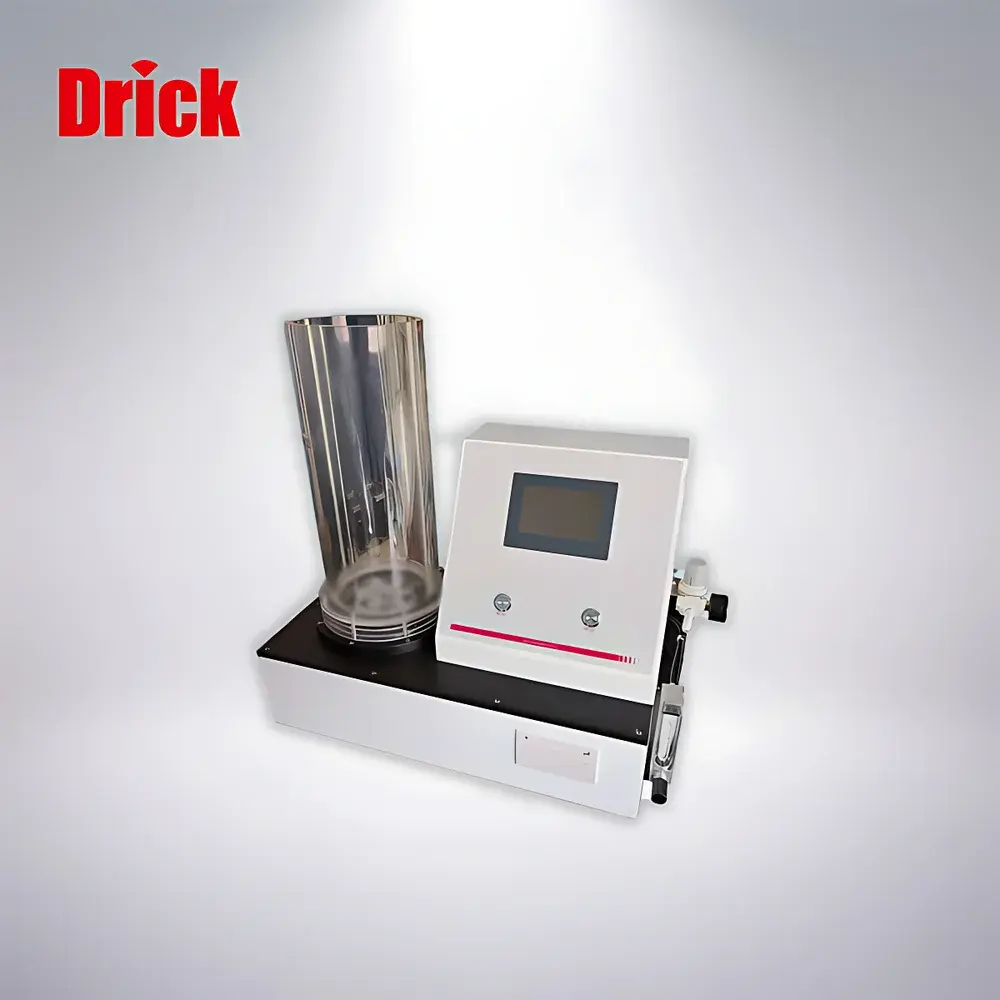
Drick DRK-10 Dispersibility Tester for Tissue Paper
| Brand | Drick |
|---|---|
| Origin | Shandong, China |
| Manufacturer Type | OEM/ODM Producer |
| Country of Origin | China |
| Model | DRK-10 |
| Power Supply | 220 VAC, 50 Hz |
| Dimensions (L×D×H) | 610 × 300 × 580 mm |
| Net Weight | 26 kg |
| Rotational Speed Range | 0–600 rpm |
| Air Supply Pressure | 0.2–0.6 MPa |
| Air Flow Rate | 0.1–15 L/min (adjustable) |
| Test Duration | ≤9999 s |
| Liquid Volume per Test | 5 L |
| Display | 5-inch color LCD |
| Interface | RS232 serial port |
| Compliance | GB/T 20810–2018 |
Overview
The Drick DRK-10 Dispersibility Tester for Tissue Paper is a purpose-built laboratory instrument engineered to quantify the disintegration behavior of tissue-grade paper products under controlled hydraulic and mechanical agitation—directly aligned with the test methodology specified in GB/T 20810–2018, “Tissue Paper (including Tissue Paper Base Stock).” Unlike generic dissolution or erosion testers, the DRK-10 replicates the dynamic fluid shear environment encountered in municipal wastewater conveyance systems, where rapid fiber separation and dispersion are critical for preventing pipe blockages and ensuring compatibility with modern sewage infrastructure. The system employs a standardized 5-liter dispersion vessel, precision-controlled rotational agitation (0–600 rpm), regulated compressed air injection (0.1–15 L/min), and timed immersion cycles to simulate real-world flushing conditions. Its design reflects fundamental principles of hydrodynamic dispersion kinetics, wherein fiber network integrity, hydrogen bonding disruption, and wet tensile loss are evaluated through observable disintegration endpoints—not inferred from indirect proxies.
Key Features
- Embedded real-time operating system with intuitive, WYSIWYG interface optimized for routine QC workflows in high-throughput lab environments.
- Proprietary motion control firmware driving a high-resolution stepper motor, enabling smooth, stepless speed adjustment across the full 1–500 rpm operational range with <±1 rpm repeatability.
- Optically transparent acrylic dispersion cylinder—enabling direct visual assessment of fiber suspension homogeneity, clumping onset, and complete dispersion without sample extraction or post-test imaging.
- Dedicated pneumatic flow regulation module featuring calibrated needle valve and digital pressure transducer, ensuring stable air delivery within ±0.02 MPa across the 0.2–0.6 MPa supply band.
- One-touch automated drain actuation via solenoid valve—eliminating manual siphoning and minimizing operator-induced variability during cycle termination.
- Integrated thermal printer compliant with ESC/POS protocol; outputs timestamped test ID, parameters (speed, duration, airflow), and pass/fail determination per GB/T 20810–2018 Clause 6.4.
- RS232 serial interface supporting ASCII-based data export for traceability integration into LIMS or Excel-based QA reporting templates.
Sample Compatibility & Compliance
The DRK-10 accepts standard-width tissue paper specimens (typically 100 mm × 100 mm or 100 mm × 150 mm per GB/T 20810–2018 Annex A), including embossed, laminated, lotion-infused, and recycled-content grades. It accommodates both finished consumer rolls and base stock reels prior to converting. All mechanical and pneumatic subsystems operate within validated tolerances defined by the national standard, with documented calibration procedures traceable to CNAS-accredited reference labs. While GB/T 20810–2018 remains the primary compliance benchmark, the instrument’s agitation profile and volume geometry are functionally comparable to ISO 12625-5:2021 (tissue paper—part 5: dispersibility) and ASTM D6889–22 (standard test method for flushability of nonwoven fabrics), facilitating cross-standard correlation studies. The unit meets CE marking requirements for electrical safety (EN 61010-1) and electromagnetic compatibility (EN 61326-1).
Software & Data Management
No proprietary PC software is required; all test configuration, execution, and result logging occur onboard. Parameter sets—including rotational speed, air flow setpoint, dwell time, and pass/fail thresholds—are stored in non-volatile memory with user-defined naming (e.g., “Premium 2-ply”, “Eco-recycled”). Each test record includes UTC timestamp, operator ID (via numeric keypad entry), environmental temperature/humidity (optional external sensor input), and raw sensor logs (motor current, pressure feedback, timer status). Audit trails are retained for ≥10,000 cycles and exportable as CSV via RS232. For GLP/GMP-regulated environments, optional firmware upgrade enables 21 CFR Part 11-compliant electronic signatures and immutable record locking—validated per IQ/OQ protocols available upon request.
Applications
- Quality assurance in tissue manufacturing: batch release testing against internal dispersibility specifications exceeding GB/T 20810–2018 minimum thresholds.
- R&D formulation screening: evaluating impact of fiber blend ratios (eucalyptus vs. bamboo vs. recycled pulp), wet-strength resin dosage, and surfactant additives on dispersion kinetics.
- Third-party certification: supporting EcoCert, Green Seal, or NSF/ANSI 336 flushability claims through standardized test documentation.
- Academic research: investigating hydrolytic degradation mechanisms of cellulose fibers under turbulent flow, correlating DRK-10 results with rheological slurry viscosity and particle size distribution (PSD) via laser diffraction.
- Regulatory pre-submission: generating reproducible datasets for municipal wastewater authority acceptance criteria or product stewardship program submissions.
FAQ
Does the DRK-10 comply with international flushability standards beyond GB/T 20810–2018?
Yes—the agitation energy input, vessel geometry, and liquid-to-solid ratio align with test envelopes defined in ISO 12625-5 and ASTM D6889, enabling comparative analysis when referenced to those standards’ pass criteria.
Can test parameters be modified outside the published ranges?
No. Firmware-enforced limits prevent operation beyond 600 rpm, 15 L/min airflow, or 9999 s duration to maintain mechanical integrity and metrological validity per standard clause requirements.
Is calibration certification included with shipment?
A factory-issued calibration report (covering rotational speed accuracy, air flow linearity, and timer deviation) is provided. Full ISO/IEC 17025 calibration with uncertainty budgets is available as an optional service.
What maintenance is required for long-term reliability?
Quarterly inspection of O-rings, quarterly cleaning of air filter elements, and annual verification of stepper motor torque response—documented in the included Maintenance Logbook.
How is pass/fail determined during testing?
Per GB/T 20810–2018 Section 6.4: visual observation at 10 s, 30 s, 60 s, and 300 s intervals; “pass” requires complete dispersion into individual fibers with no visible aggregates larger than 2 mm after 300 s.
Related Products



