
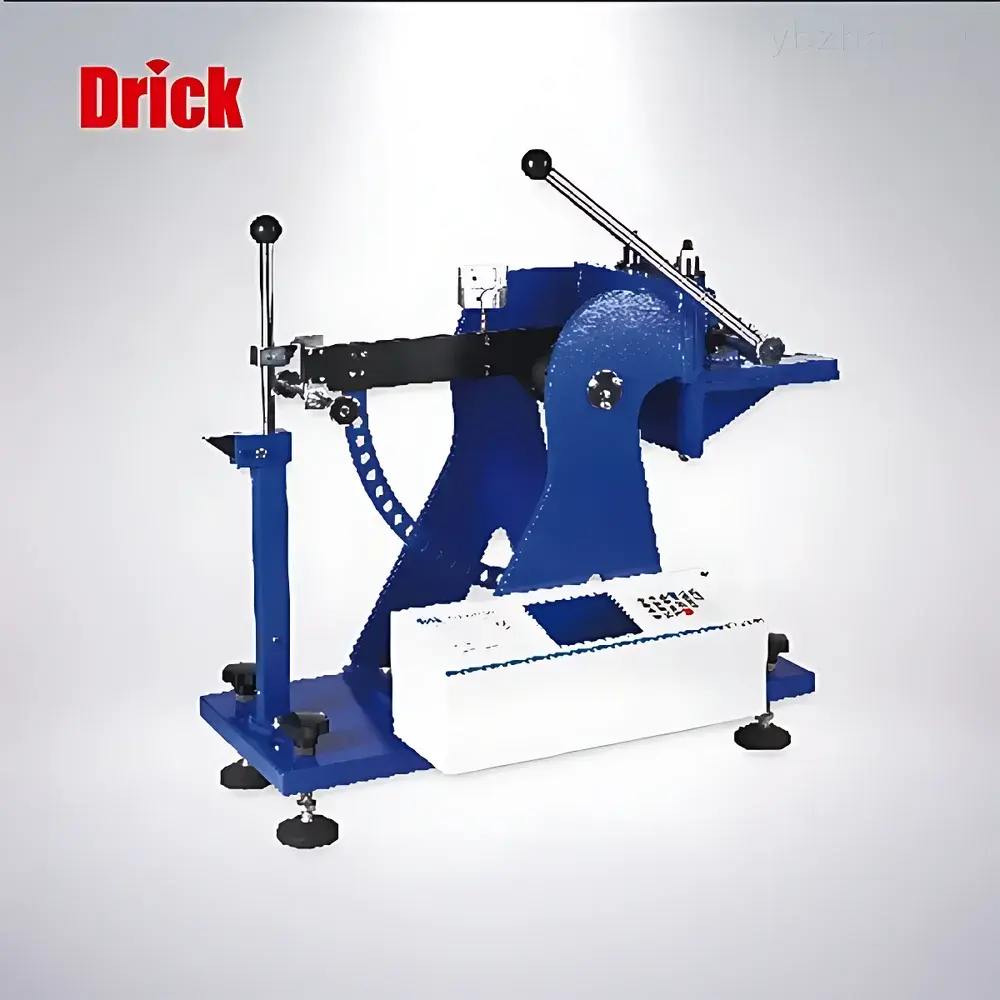
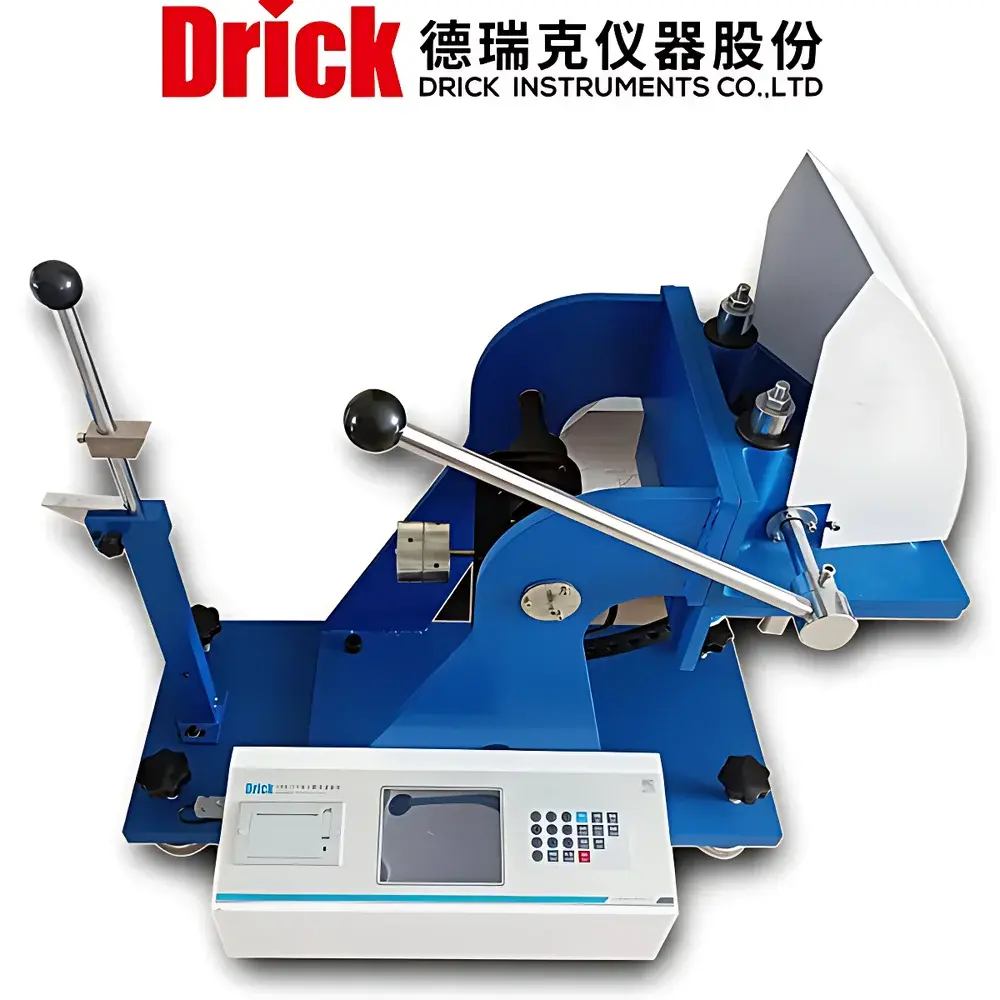
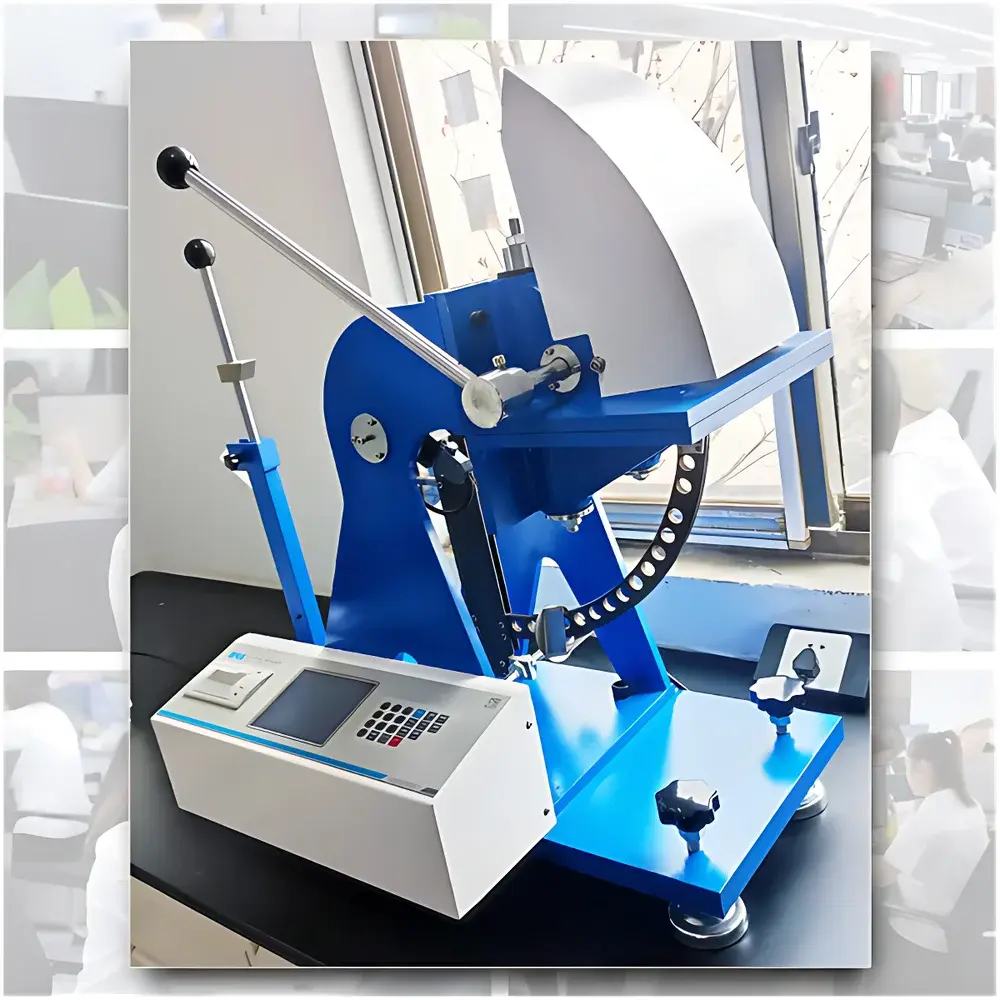
Drick DRK-104 Electronic Puncture Resistance Tester for Corrugated Board
| Brand | Drick |
|---|---|
| Origin | Shandong, China |
| Manufacturer Type | Direct Manufacturer |
| Country of Origin | China |
| Model | DRK-104 |
| Price | USD 4,200 (FOB) |
| Standard Compliance | ISO 3036, GB/T 2679.7–2005 |
| Measurement Unit | Joules (J) |
| Display | LCD with Chinese GUI |
| Output | Thermal line printer |
| Control System | Microprocessor-based embedded control |
| Sample Clamping | Spring-loaded dual-plate pneumatic-free mechanical clamp |
| Safety Mechanism | Interlocked release handle with automatic reset |
| Energy Range | 0.1–10 J (typical for corrugated board testing) |
| Resolution | 0.01 J |
| Repeatability | ≤±1.5% RSD (per ISO 3036 verification protocol) |
Overview
The Drick DRK-104 Electronic Puncture Resistance Tester for Corrugated Board is a precision mechanical energy-integration instrument engineered to quantify the puncture resistance of single- and multi-ply corrugated fiberboard, solid fiberboard, and other rigid packaging substrates. It operates on the principle of pendulum-based energy absorption: a standardized triangular pyramid-shaped puncture head—conforming to ISO 3036 and GB/T 2679.7–2005 dimensional tolerances—is mounted on a calibrated swinging arm. Upon release, gravitational potential energy is converted into kinetic energy as the pendulum swings, driving the puncture head through the specimen. The energy required to fully penetrate the material—including initial yielding, localized tearing, and plastic deformation around the puncture zone—is measured via angular displacement of the pendulum and translated into joules (J) using a calibrated torsional spring system and high-resolution optical encoder. This method captures the holistic mechanical response of fibrous composite structures under dynamic localized stress, making it indispensable for evaluating structural integrity in shipping containers, e-commerce packaging, and cold-chain transport solutions.
Key Features
- Microprocessor-controlled embedded system with real-time energy calculation and digital signal processing for enhanced measurement reproducibility
- LCD graphical interface with intuitive Chinese-language menu navigation—designed for operator efficiency in QC labs without specialized software training
- Spring-actuated dual-plate clamping mechanism ensuring consistent 100 ± 5 kPa compressive preload across 100 × 100 mm test specimens per ISO 3036 requirements
- Interlocked manual release handle with mechanical auto-reset function, eliminating operator-induced timing errors and ensuring repeatable pendulum start position (±0.5°)
- Integrated thermal line printer delivering immediate hard-copy output of test values, date/time stamp, batch ID, and statistical summaries (mean, SD, CV%)
- Onboard data storage for ≥500 test records with timestamp and operator ID fields—supports traceability under GLP-compliant documentation workflows
- Modular mechanical architecture with accessible pivot bearings, calibrated counterweights, and field-replaceable puncture heads (standardized 60° apex angle, 1.5 mm tip radius)
Sample Compatibility & Compliance
The DRK-104 accommodates flat, dry, non-laminated fiber-based sheet materials ranging from 0.5 mm to 8 mm thickness, including fluted corrugated board (single-, double-, and triple-wall), solid bleached sulfate (SBS), chipboard, and recycled fiberboard. Specimen conditioning follows ISO 187 (23 ± 1°C, 50 ± 2% RH, 24 h equilibration). Instrument validation adheres to ISO 3036 Annex B procedures, including pendulum calibration checks using certified reference weights and puncture head geometry verification via optical profilometry. Regulatory alignment includes full technical equivalence to GB/T 2679.7–2005, enabling direct use in Chinese CNAS-accredited testing laboratories and export-oriented packaging certification submissions (e.g., ISTA 3A, ASTM D7370 prequalification).
Software & Data Management
While the DRK-104 operates as a standalone instrument, its embedded firmware supports USB data export in CSV format for integration with LIMS or enterprise QA platforms. All stored test records include audit trail metadata: test sequence number, operator code, environmental sensor logs (optional external hygrothermograph input), and pass/fail flags based on user-defined specification limits. Data encryption is not implemented; however, the device meets baseline FDA 21 CFR Part 11 readiness when deployed within controlled network environments where electronic signatures and change controls are externally managed.
Applications
This tester serves critical quality assurance functions across packaging value chains: incoming raw material inspection of linerboard and medium; in-process validation during corrugator operation; final container qualification for hazardous goods (UN-certified boxes); shelf-life simulation studies involving vibration-induced edge damage; and R&D evaluation of bio-based reinforcements (e.g., bamboo pulp blends, mycelium composites). It is routinely specified in supplier technical agreements for Tier-1 automotive packaging, pharmaceutical secondary cartons (per USP <661.2> mechanical stability guidance), and e-commerce fulfillment centers requiring ISTA 3E-compliant box performance baselines.
FAQ
What standards does the DRK-104 comply with?
It is fully aligned with ISO 3036:2017 and GB/T 2679.7–2005, including geometric specifications for the puncture head, pendulum moment of inertia tolerance (±0.5%), and energy scale linearity verification protocols.
Can the instrument be used for non-corrugated substrates such as solid fiberboard or paperboard?
Yes—provided the material thickness falls within 0.5–8 mm and exhibits sufficient rigidity to resist buckling prior to puncture; users must verify specimen flatness per ISO 536 prior to testing.
Is third-party calibration certification available?
Drick provides factory calibration certificates traceable to NIM (National Institute of Metrology, China); optional UKAS-accredited calibration services are arranged via authorized regional partners.
How is operator safety ensured during testing?
The release mechanism features a two-stage interlock: physical guard engagement prevents pendulum release unless both upper and lower clamps are fully seated, and the handle automatically returns to neutral post-test to block unintended re-triggering.
Does the DRK-104 support automated data transfer to ERP or SAP systems?
Direct API integration is not supported; however, exported CSV files can be ingested via standard middleware connectors (e.g., Dell Boomi, MuleSoft) or custom Python scripts using pandas libraries.





