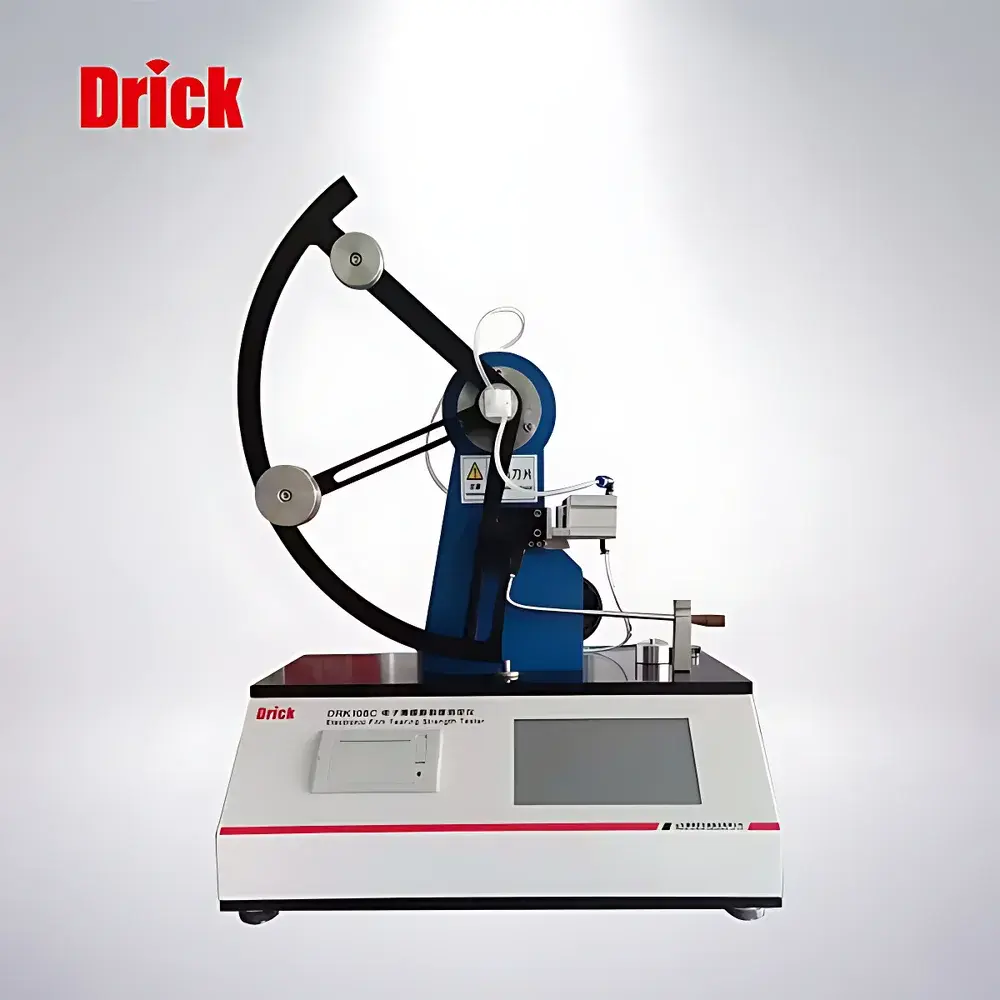
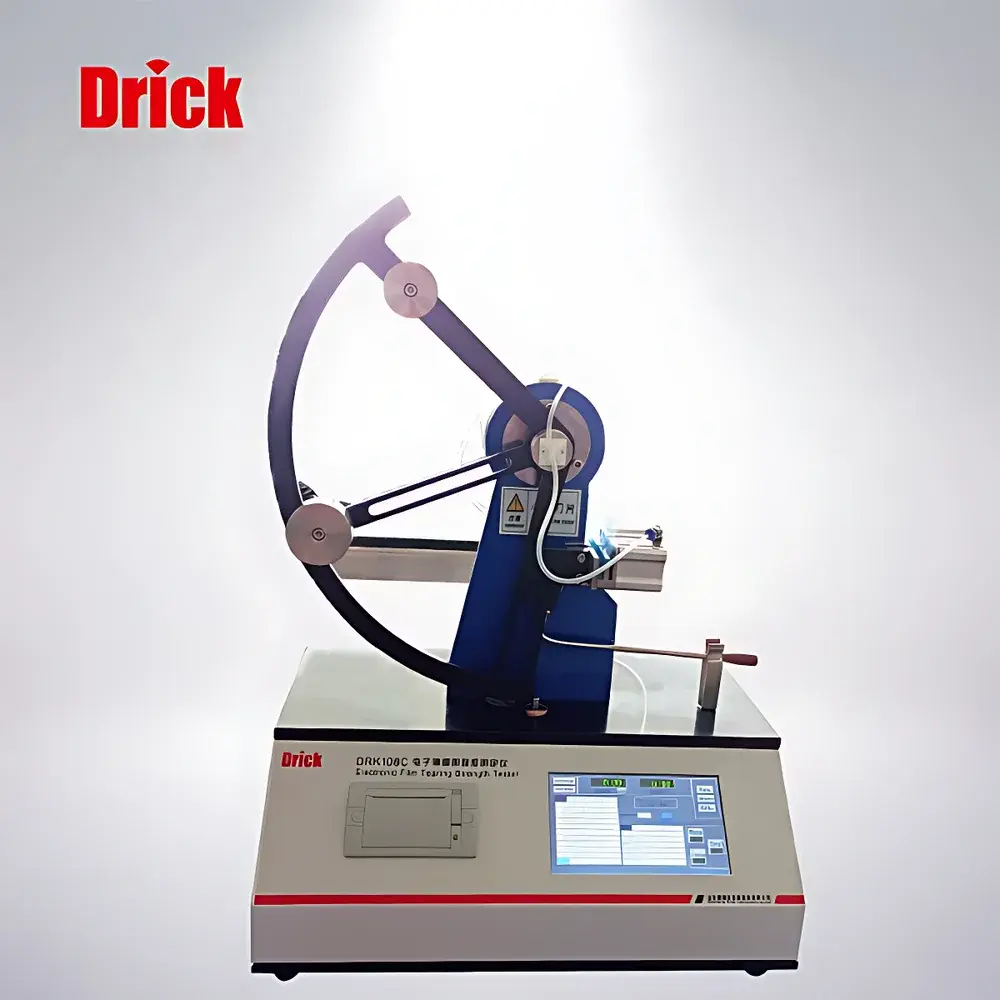
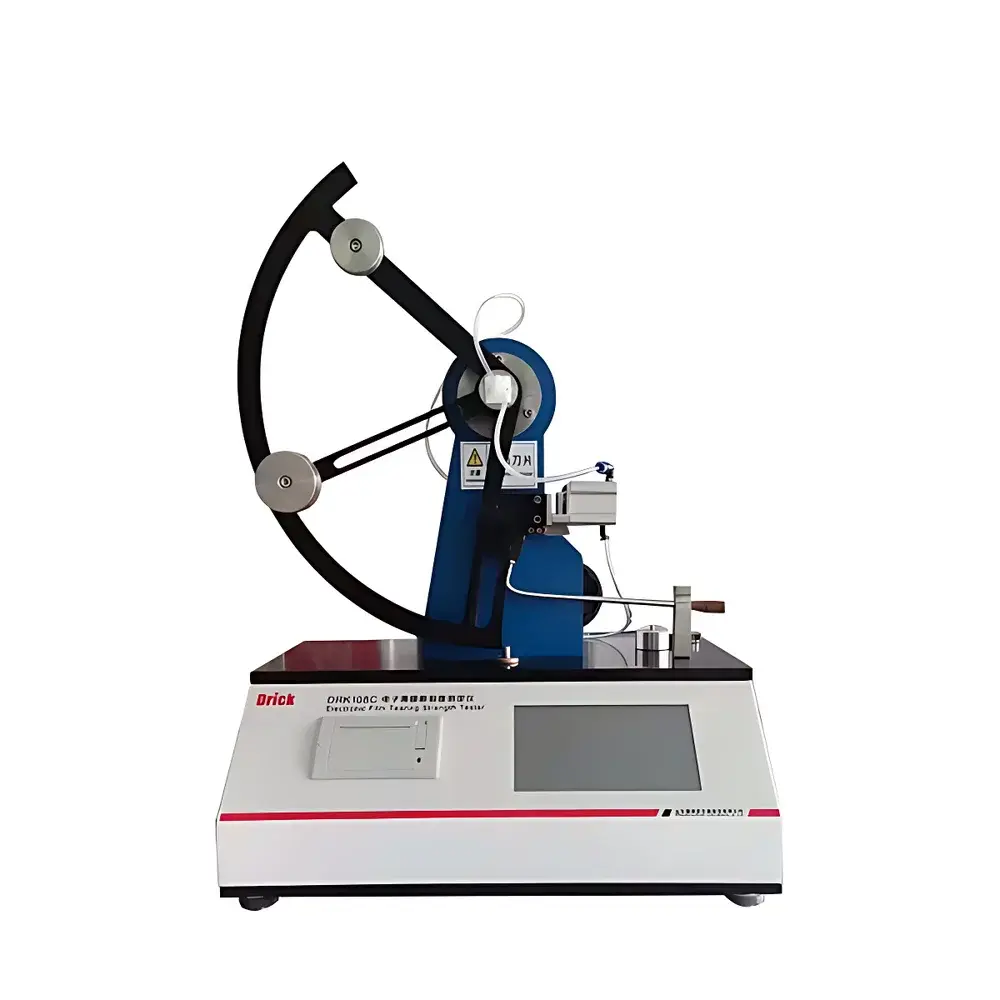
Drick DRK-108 Elmendorf Tear Tester (Compliant with GB/T 450–2002, ISO 1974, GB/T 10739–2002)
| Brand | Drick |
|---|---|
| Origin | Shandong, China |
| Manufacturer Type | Direct Manufacturer |
| Country of Origin | China |
| Model | DRK-108 |
| Measurement Range | (10–13,000) mN |
| Resolution | 10 mN |
| Accuracy | ±1% FS (20–80% of full scale), ±0.5% FS (outside range) |
| Repeatability | <1% FS (20–80% FS), <0.5% FS (outside range) |
| Tear Arm Length | (104 ± 1) mm |
| Initial Tear Angle | 27.5° ± 0.5° |
| Tear Distance | (43 ± 0.5) mm |
| Clamp Face Dimensions | 25 × 15 mm |
| Clamp Spacing | (2.8 ± 0.3) mm |
| Specimen Size | (63 ± 0.5) mm × (50 ± 2) mm |
| Operating Temperature | 20 ± 10 °C |
| Relative Humidity | ≤80% RH |
| Dimensions | 460 × 400 × 400 mm |
| Weight | 30 kg |
| Power Supply | AC 220 V ± 5%, 50 Hz |
Overview
The Drick DRK-108 Elmendorf Tear Tester is a precision mechanical instrument engineered for the quantitative determination of tear resistance in flexible sheet materials using the standardized pendulum (Elmendorf) method. Based on the principle of energy conservation, the device employs a calibrated oscillating pendulum arm that—when released from a defined height—converts gravitational potential energy into kinetic energy to initiate and propagate a controlled tear across a pre-notched specimen. The energy absorbed during tearing is directly proportional to the force required to propagate the tear, enabling calculation of tear resistance in millinewtons (mN). This method is universally recognized for its reproducibility, simplicity, and suitability for routine quality control in high-volume production environments. The DRK-108 complies fully with international and national standards including ISO 1974:2012 (Paper — Determination of tear resistance — Elmendorf method), GB/T 450–2002 (Sampling of paper and board), GB/T 10739–2002 (Standard atmospheric conditions for conditioning and testing), and GB 455.1 (Method for determination of tear resistance of paper), ensuring data traceability and regulatory acceptability in GLP-compliant laboratories and packaging QA/QC departments.
Key Features
- Integrated electromechanical architecture with compact footprint (460 × 400 × 400 mm) and robust cast-aluminum base for vibration damping and long-term stability.
- High-fidelity force acquisition system featuring a 24-bit analog-to-digital converter (10,000,000 resolution) coupled with a precision load transducer, delivering measurement repeatability better than 0.5% FS outside the 20–80% span and <1% FS within it.
- Dual-language graphical user interface (Chinese/English) with real-time switching capability—designed for multilingual technical staff without requiring firmware reload or configuration reset.
- Thermal line printer module with modular paper-loading mechanism; supports on-demand printout of individual test results, batch statistics (mean, standard deviation, coefficient of variation), and compliance-ready test reports.
- Modular clamp assembly with precisely machined 25 × 15 mm jaw faces and fixed 2.8 ± 0.3 mm inter-clamp spacing—ensuring consistent specimen alignment per ISO 1974 requirements.
- Calibrated tear geometry: 104 ± 1 mm lever arm, 27.5° ± 0.5° initial tear angle, and 43 ± 0.5 mm nominal tear path—guaranteeing geometric fidelity critical for inter-laboratory comparability.
Sample Compatibility & Compliance
The DRK-108 is validated for use with standardized specimens measuring (63 ± 0.5) mm × (50 ± 2) mm, pre-cut with a 20 mm notch as specified in ISO 1974. It accommodates a broad spectrum of flexible planar materials, including but not limited to: uncoated and coated papers, corrugated and solid fiberboard, nonwovens, woven and knitted textiles, polyethylene (PE), polypropylene (PP), polyester (PET), polyvinyl chloride (PVC), polyvinylidene chloride (PVDC), aluminum foil laminates, and bituminous roofing membranes. All test procedures align with ASTM D1922 (for plastic films), ISO 6383-1 (for plastics), and TAPPI T 414 (for paper), facilitating cross-industry data harmonization. Instrument calibration is traceable to national metrological standards; routine verification utilizes certified reference weights and angular displacement gauges per ISO/IEC 17025 guidelines.
Software & Data Management
Embedded firmware provides local data storage for up to 1,000 test records with timestamp, operator ID (optional), environmental conditions (manually entered), and statistical summaries. Export functionality supports USB mass-storage mode for CSV file transfer to LIMS or Excel-based analysis platforms. While the DRK-108 does not include network connectivity or remote access, its output format is compatible with 21 CFR Part 11–compliant audit trail systems when integrated via external laboratory informatics middleware. Raw force-vs-time profiles are not stored; however, all calculated tear values (mN), mean, SD, and CV are retained with full arithmetic transparency—enabling retrospective review and root-cause analysis without proprietary software dependencies.
Applications
- Quality assurance of paperboard packaging used in food, pharmaceutical, and electronics logistics—verifying resistance to handling-induced edge tearing during palletization and transit.
- Process validation of calendered nonwovens in medical gowns and filtration media, where tear propagation behavior correlates with barrier integrity under mechanical stress.
- R&D screening of biodegradable polymer films (e.g., PLA, PHA) against conventional PE benchmarks under identical Elmendorf test conditions.
- Supplier qualification audits for textile laminates used in automotive interior trim, where minimum tear thresholds are contractually mandated per OEM specifications (e.g., Ford WSS-M99P1111-A).
- Regulatory submission support for FDA 510(k) dossiers involving sterile barrier packaging—providing ISO 11607–aligned mechanical performance evidence.
FAQ
What standards does the DRK-108 explicitly support?
The instrument is configured and verified for ISO 1974:2012, GB/T 450–2002, GB/T 10739–2002, GB 455.1, and ASTM D1922. Calibration certificates reference CNAS-accredited traceability.
Can the DRK-108 test specimens thicker than 1 mm?
No. Per ISO 1974, the method is validated for materials ≤1.0 mm thickness. For thicker substrates (e.g., rubber sheets, composites), alternative methods such as trouser tear (ISO 34-1) or tongue tear (ASTM D624) are recommended.
Is operator training required for ISO 1974 compliance?
Yes. Proper specimen preparation (notch alignment, humidity conditioning per GB/T 10739–2002), pendulum release technique, and zero-point verification must be documented as part of laboratory SOPs to meet ISO/IEC 17025 clause 6.2 requirements.
Does the instrument include calibration tools?
A set of certified reference masses and angular calibration jigs is supplied with initial delivery. Annual recalibration by an accredited third-party provider is advised for GMP-regulated environments.
How is environmental monitoring integrated?
Ambient temperature and relative humidity must be recorded manually prior to each test session and logged alongside results—per GB/T 10739–2002, conditioning must occur at 23 °C ± 1 °C / 50% RH ± 2% RH for ≥24 h before testing.