
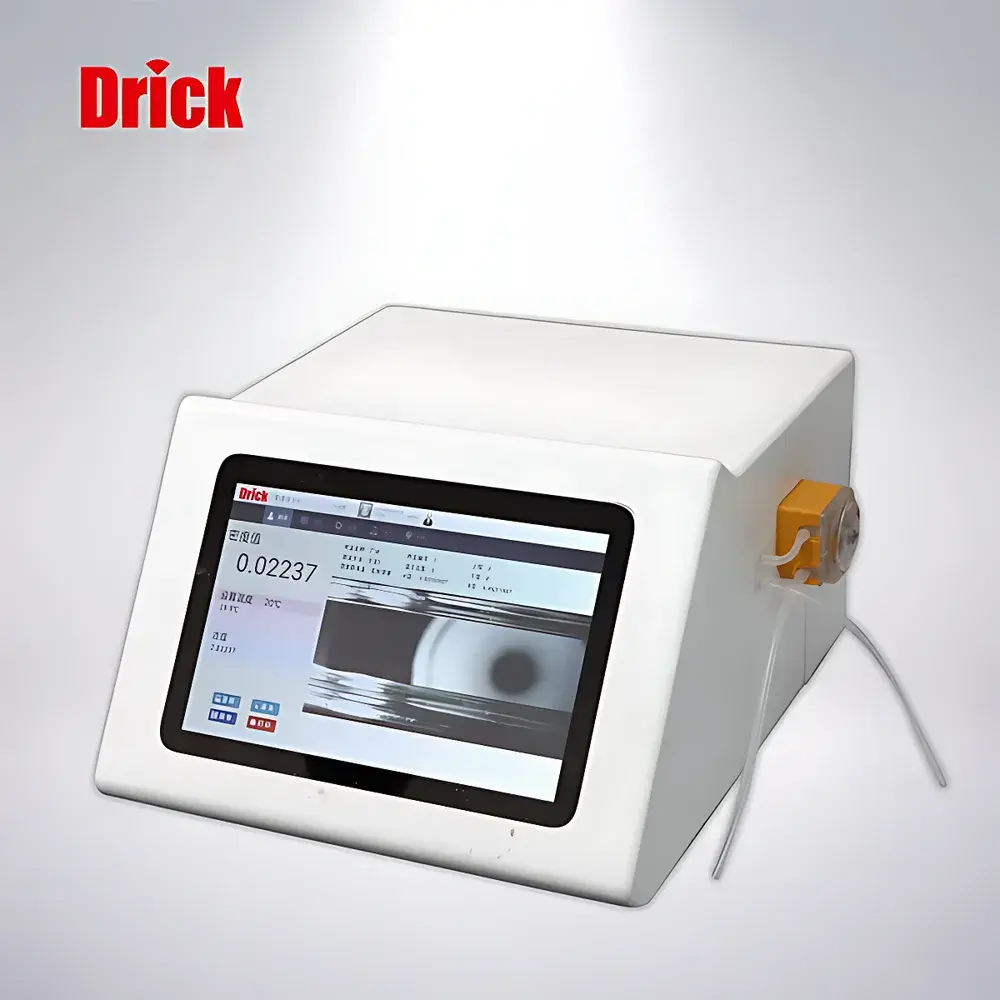
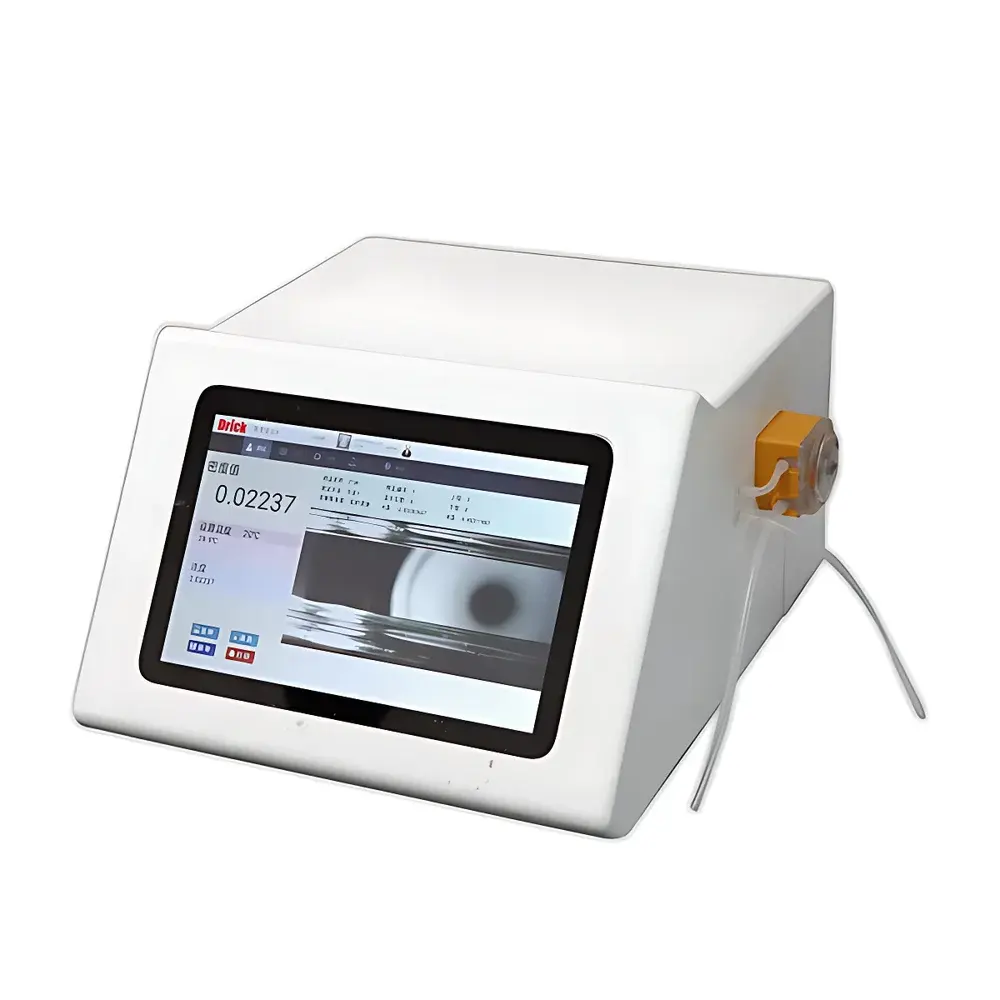
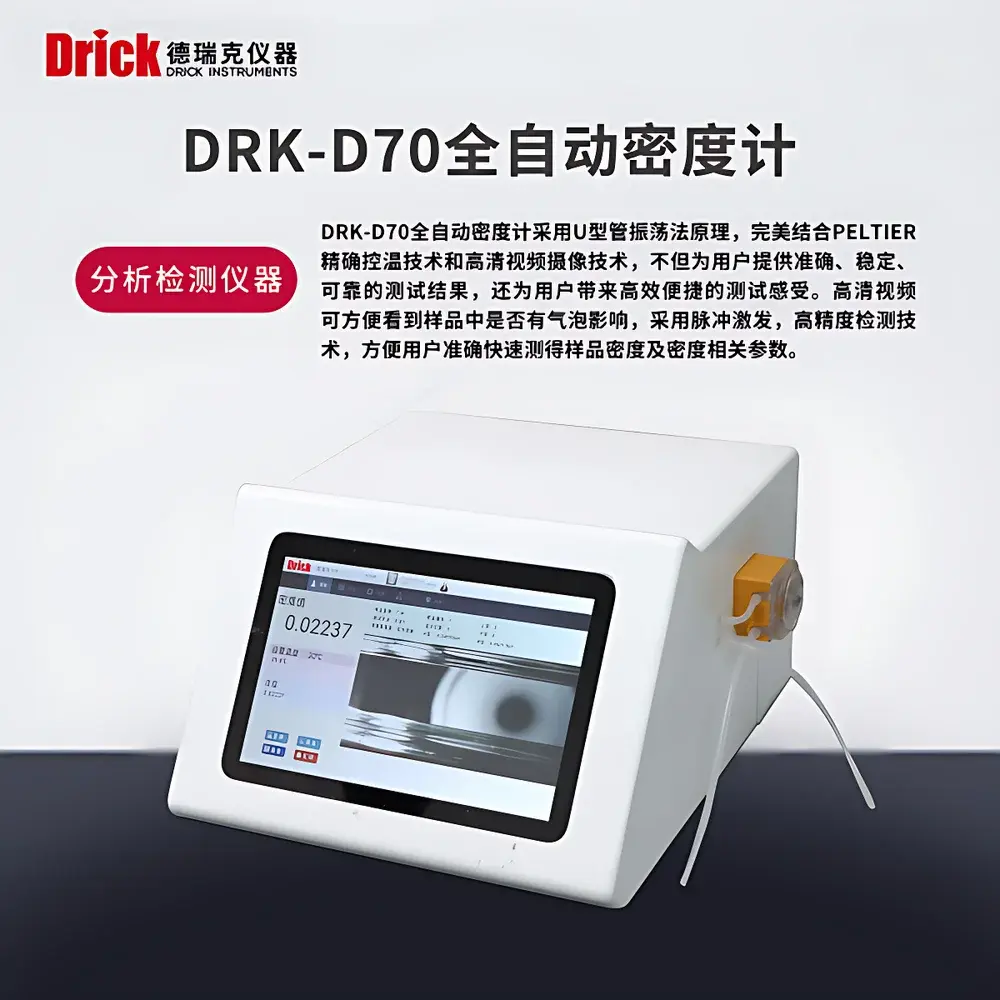
Drick DRK-D70 Automated Oscillating U-Tube Densimeter
| Brand | Drick |
|---|---|
| Origin | Shandong, China |
| Manufacturer Type | OEM Manufacturer |
| Origin Category | Domestic (China) |
| Model | DRK-D70 |
| Instrument Type | Oscillating U-Tube Densimeter |
| Form Factor | Benchtop Laboratory Instrument |
| Sample Type Compatibility | Solid and Liquid Samples |
| Density Range | 0 g/cm³ to 3 g/cm³ |
| Measurement Principle | U-Tube Oscillation Method |
| Display | Digital LCD |
| Temperature Control Range | 5 °C to 85 °C |
| Repeatability | ±0.00005 g/cm³ |
| Resolution | ±0.00001 g/cm³ |
| Compliance Context | ASTM D4052, ISO 12185, USP <841>, GLP/GMP-ready data integrity architecture |
Overview
The Drick DRK-D70 Automated Oscillating U-Tube Densimeter is a high-precision benchtop instrument engineered for traceable, temperature-controlled density determination of liquids and low-viscosity suspensions—and, with optional solid sample accessories, solid materials via displacement or sink-float methods. It operates on the fundamental physical principle of oscillating U-tube densimetry: a precisely machined borosilicate glass U-tube is filled with the sample and subjected to controlled electromagnetic excitation; the resulting natural oscillation frequency is inversely proportional to the square root of the sample’s density. This relationship—governed by the Hooke–Newton equation for elastic systems—is linearized and calibrated against certified reference standards (e.g., air, water, and NIST-traceable hydrocarbon mixtures) to deliver SI-traceable results in g/cm³ or kg/m³. Designed for routine QC laboratories and R&D environments where regulatory compliance and inter-laboratory reproducibility are critical, the DRK-D70 integrates Peltier-based thermal regulation with real-time PID feedback to maintain setpoint stability within ±0.02 °C across its full 5–85 °C operating range.
Key Features
- High-stability oscillating U-tube sensor with fused-silica capillary geometry and integrated temperature probe for simultaneous density/temperature co-measurement
- Benchtop footprint (320 × 280 × 220 mm) optimized for ISO 17025-compliant lab layouts and fume hood integration
- Digital LCD interface with multilingual support (English, Spanish, German, Chinese), local calibration storage, and user-level access control
- Automated thermal equilibration protocol with programmable ramp rates and dwell times to minimize thermal transients during measurement cycles
- Robust mechanical architecture featuring vibration-damping feet, sealed electronics enclosure, and corrosion-resistant fluid path materials (PTFE, borosilicate, stainless steel 316)
- Factory-calibrated with NIST-traceable density standards; supports user-defined recalibration using up to 10 custom reference points per method
Sample Compatibility & Compliance
The DRK-D70 accommodates a broad spectrum of sample matrices—including aqueous solutions, organic solvents, polymer melts (with optional heated inlet), pharmaceutical formulations, food-grade oils, and low-porosity solids (via Archimedean displacement). Its fluidic design minimizes carryover and supports rapid cleaning protocols using ethanol, acetone, or isopropanol. From a regulatory standpoint, the instrument meets the metrological requirements of ASTM D4052 (Standard Test Method for Density, Relative Density, and API Gravity of Liquids by Digital Density Meter), ISO 12185 (Crude Petroleum and Petroleum Products — Determination of Density by Digital Density Meters), and USP (Density and Specific Gravity). Audit trail functionality—including timestamped operator ID, method version, calibration history, and raw oscillation frequency logs—is enabled by default and structured to satisfy FDA 21 CFR Part 11 electronic record/electronic signature (ER/ES) expectations when paired with validated networked software.
Software & Data Management
The DRK-D70 operates standalone but is fully compatible with Drick’s optional DENSIS-Lab Suite v3.2—a Windows-based application supporting method creation, multi-parameter batch reporting (density, concentration, API gravity, % w/w), statistical process control (SPC) charting, and export to CSV, PDF, or LIMS-compatible XML formats. All measurements include embedded metadata: ambient pressure (optional external sensor), ambient humidity, operator ID, instrument serial number, and firmware revision. Data files are digitally signed and checksum-verified to ensure integrity. The system supports role-based permissions (Administrator, Technician, Reviewer) and configurable retention policies aligned with GLP and GMP documentation practices.
Applications
- Quality control of ethanol–water blends in biofuel production per ASTM D7344
- Density verification of active pharmaceutical ingredients (APIs) and excipients during formulation development
- Concentration monitoring of sodium hydroxide, sulfuric acid, or hydrogen peroxide solutions in chemical manufacturing
- Batch release testing of edible oils, syrups, and dairy-based emulsions under Codex Alimentarius guidelines
- Material characterization of thermoplastic resins (e.g., PP, PET, PC) and composite precursors in polymer R&D
- Environmental analysis of contaminated groundwater samples for volatile organic compound (VOC) screening via density deviation thresholds
FAQ
What density standards are recommended for daily verification?
Certified density reference fluids from Anton Paar, Sartorius, or AccuStandard—specifically those with stated uncertainties ≤ ±0.00002 g/cm³ at 20 °C—are advised for routine performance checks.
Can the DRK-D70 measure slurries or highly viscous liquids?
It is optimized for Newtonian or near-Newtonian fluids up to ~500 mPa·s; for non-Newtonian or particulate-laden samples, pre-filtration or centrifugation is required to avoid damping artifacts in oscillation decay profiles.
Is temperature calibration traceable to national standards?
Yes—the internal Pt100 sensor is factory-calibrated against a Fluke 1523 reference thermometer (NIST-traceable), with certificate of calibration provided with each unit.
How is data integrity ensured during power interruption?
The instrument features non-volatile memory that retains all unsaved measurements and method parameters; upon restart, it resumes from last stable state without data loss.
Does the DRK-D70 support automated sample changers?
It is mechanically and electrically compatible with third-party XYZ autosamplers via RS-232 and TTL trigger I/O; Drick offers integration support documentation but does not supply the robotic hardware.



