
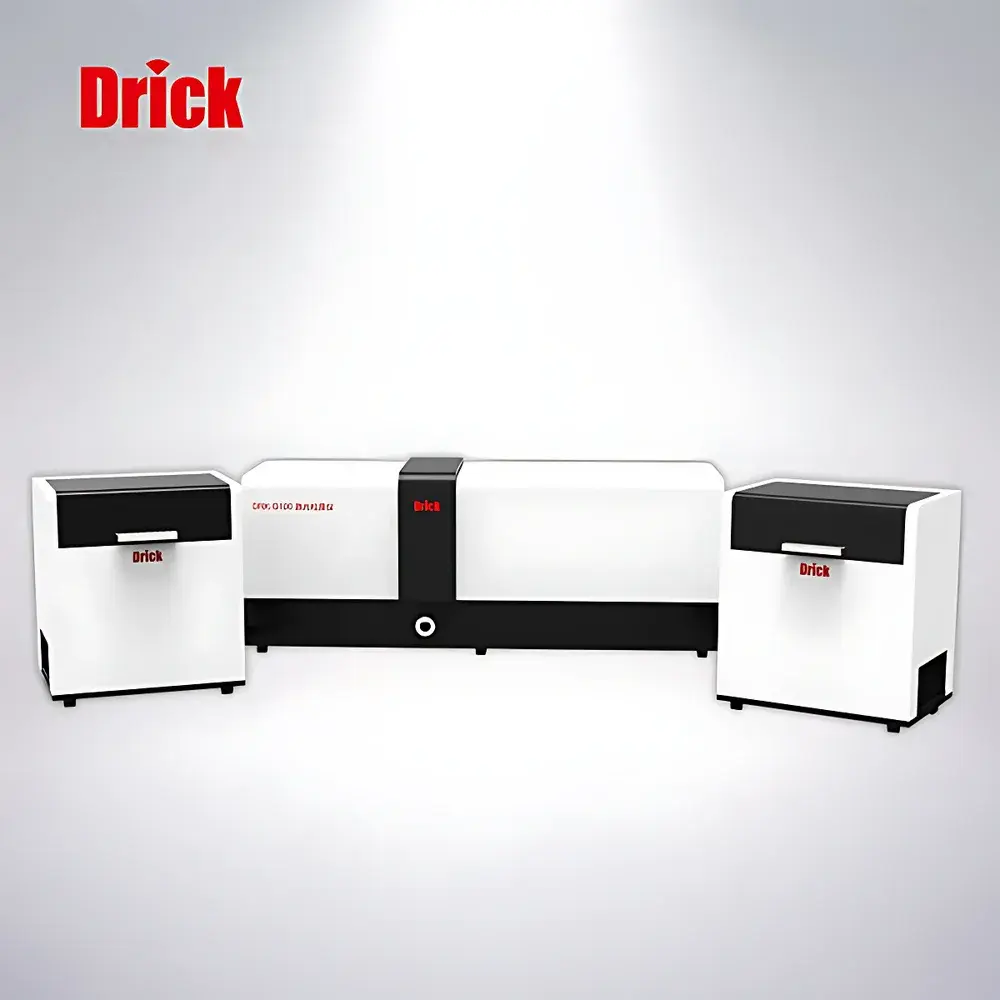
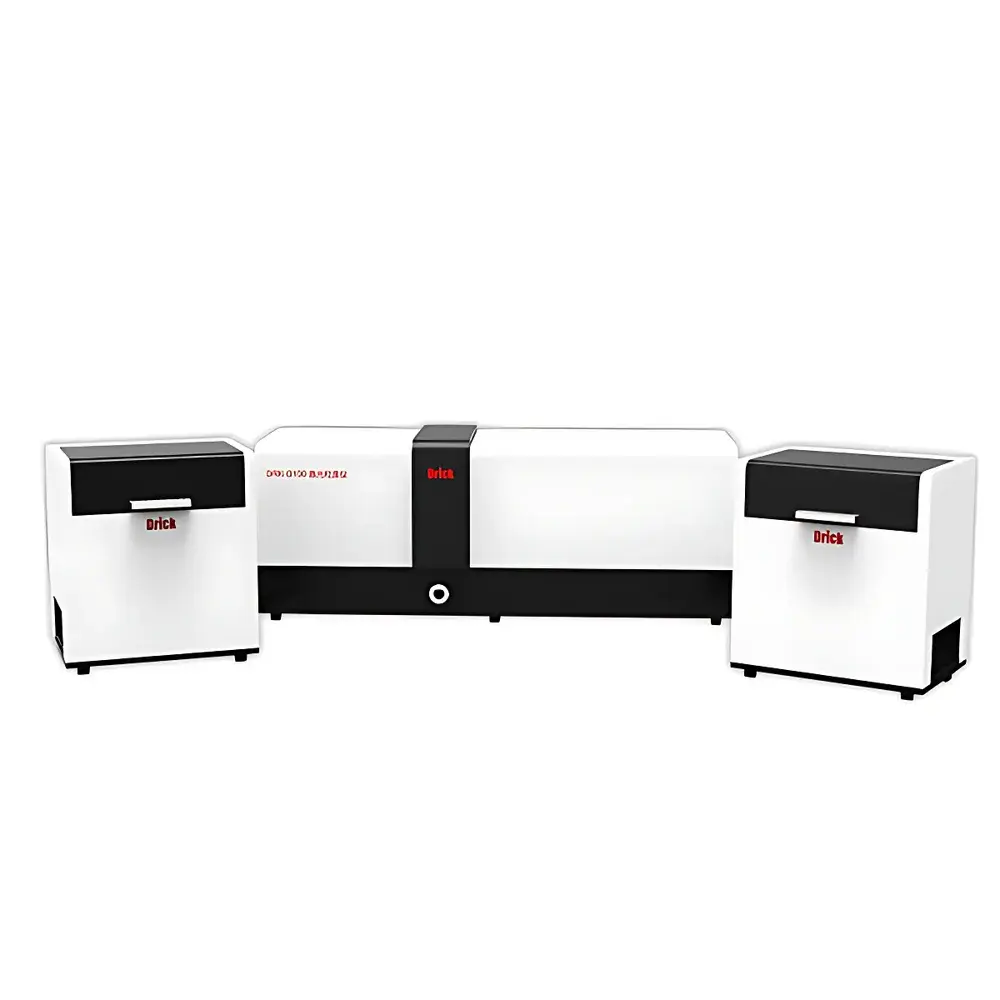

Drick DRK-G100 Full-Range Mie Scattering Theory Split-Body Laser Particle Size Analyzer
| Brand | Drick |
|---|---|
| Origin | Shandong, China |
| Manufacturer Type | Direct Manufacturer |
| Product Origin | Domestic (China) |
| Model | DRK-G100 |
| Instrument Type | Laboratory Laser Particle Size Analyzer |
| Measurement Range | Wet Dispersion: 0.1–1000 µm |
| Dry Dispersion | 0.1–1000 µm |
| Repeatability | <1% (D50, certified NIST-traceable standard reference material per GB/T 19077–2016 / ISO 13320:2020) |
Overview
The Drick DRK-G100 is a full-range, split-body laser particle size analyzer engineered for high-precision particle characterization in research laboratories and quality control environments. It operates on the fundamental principles of Mie scattering theory—rigorously solving Maxwell’s equations for spherical particles illuminated by monochromatic laser light—to deliver mathematically rigorous size distribution data across the entire 0.1–1000 µm range. Unlike simplified Fraunhofer approximation-based systems, the DRK-G100 applies iterative Mie inversion algorithms to raw angular scattering intensity profiles, enabling accurate sizing of both low-refractive-index polymers and high-absorption metal oxides without empirical calibration bias. Its modular split-body architecture physically isolates the optical bench (laser source, lens system, detector array) from the dispersion unit (wet module with ultrasonic probe and circulation pump; dry module with controlled air-jet dispersion), minimizing mechanical coupling noise and thermal drift—critical for sub-1% repeatability performance validated against national standard reference materials (e.g., GBW(E)120011 silica, D50 = 10.28 µm).
Key Features
- True Mie-theory-based inversion engine with real-time refractive index input (1.00–3.00, imaginary component 0.00–0.10) for optimal optical modeling of diverse materials including pharmaceuticals, ceramics, pigments, and battery cathode powders.
- Dual-mode operation: Integrated wet dispersion system featuring programmable ultrasonication (0–100 W, 0–300 s), adjustable flow rate (50–600 mL/min), and auto-cleaning cycle; plus dry dispersion module with precision-controlled air pressure (0.1–0.4 MPa) and vortex-assisted de-agglomeration.
- High-sensitivity 32-channel silicon photodiode detector array covering forward-scatter (0.02°–15°), side-scatter (15°–60°), and back-scatter (60°–165°) angular ranges—ensuring robust signal capture for submicron and coarse fractions simultaneously.
- Modular optical enclosure with temperature-stabilized laser diode (638 nm, <±0.05 nm wavelength stability) and vibration-damped optical baseplate, compliant with ISO 13320 Annex B recommendations for environmental control.
- Self-diagnostic optical alignment routine with real-time beam profile monitoring and automated lens cleaning sequence triggered by dust accumulation detection.
Sample Compatibility & Compliance
The DRK-G100 accommodates a broad spectrum of particulate samples—including aqueous suspensions, organic solvents (e.g., ethanol, acetone), non-aqueous slurries, and free-flowing dry powders—with minimal sample preparation. Its wet module supports pH-compatible materials (pH 2–12), while the dry module handles heat-sensitive or hygroscopic substances without solvent exposure. The instrument complies with ISO 13320:2020 (Laser diffraction methods for particle size analysis), GB/T 19077–2016 (Chinese national standard equivalent), and ASTM E2918–21 (Standard Practice for Reporting Particle Size Analysis Results). All measurement protocols support audit-ready reporting with embedded metadata (operator ID, timestamp, dispersion parameters, optical model settings) to meet GLP and GMP documentation requirements.
Software & Data Management
The proprietary Drick Particle Analysis Suite (v4.2) provides ISO/IEC 17025-aligned data acquisition and reporting. It features role-based user access control, electronic signature capability, and full 21 CFR Part 11 compliance—including secure audit trails, immutable raw data storage (.dps binary + ASCII export), and version-controlled method templates. Batch processing supports statistical comparison (t-test, ANOVA) across multiple distributions; advanced modules include fractal dimension estimation, shape factor correlation (via aspect ratio proxy), and ISO 9276-2-compliant moment-ratio analysis (D10, D50, D90, span, relative width). Export formats include CSV, PDF (with customizable report headers), and XML for LIMS integration.
Applications
The DRK-G100 serves critical roles in pharmaceutical formulation development (excipient and API particle sizing per USP and ), battery material QC (NMC, LFP, graphite anodes), catalyst manufacturing (zeolite, Pt/C), pigment dispersion optimization in coatings, and geological sediment analysis. Its dual-range capability eliminates the need for cross-instrument validation when transitioning between nano- and micron-scale batches—a key efficiency gain in R&D labs managing multi-scale product portfolios.
FAQ
Does the DRK-G100 support 21 CFR Part 11-compliant electronic records?
Yes—the software includes full audit trail logging, electronic signatures, and locked raw data archives meeting FDA requirements for regulated environments.
Can the system measure nanoparticles below 100 nm with reliable resolution?
It achieves reliable detection down to 0.1 µm (100 nm) in optimized wet dispersion mode using low-viscosity dispersants and high-power ultrasonication; sub-100 nm resolution requires complementary techniques such as DLS or TEM.
Is refractive index input mandatory for Mie calculations?
Yes—accurate optical modeling requires user-defined real and imaginary components; built-in material library includes >120 common substances with literature-sourced optical constants.
What maintenance intervals are recommended for long-term optical stability?
Annual factory recalibration is advised; quarterly internal verification using traceable standard reference materials (e.g., NIST SRM 1963) is required under ISO/IEC 17025.
How does the split-body design improve measurement reproducibility?
Physical separation of optics and dispersion units reduces thermal and mechanical interference, enabling stable baseline signals over extended run times—verified by <1% RSD on D50 for consecutive runs of certified standards.



