
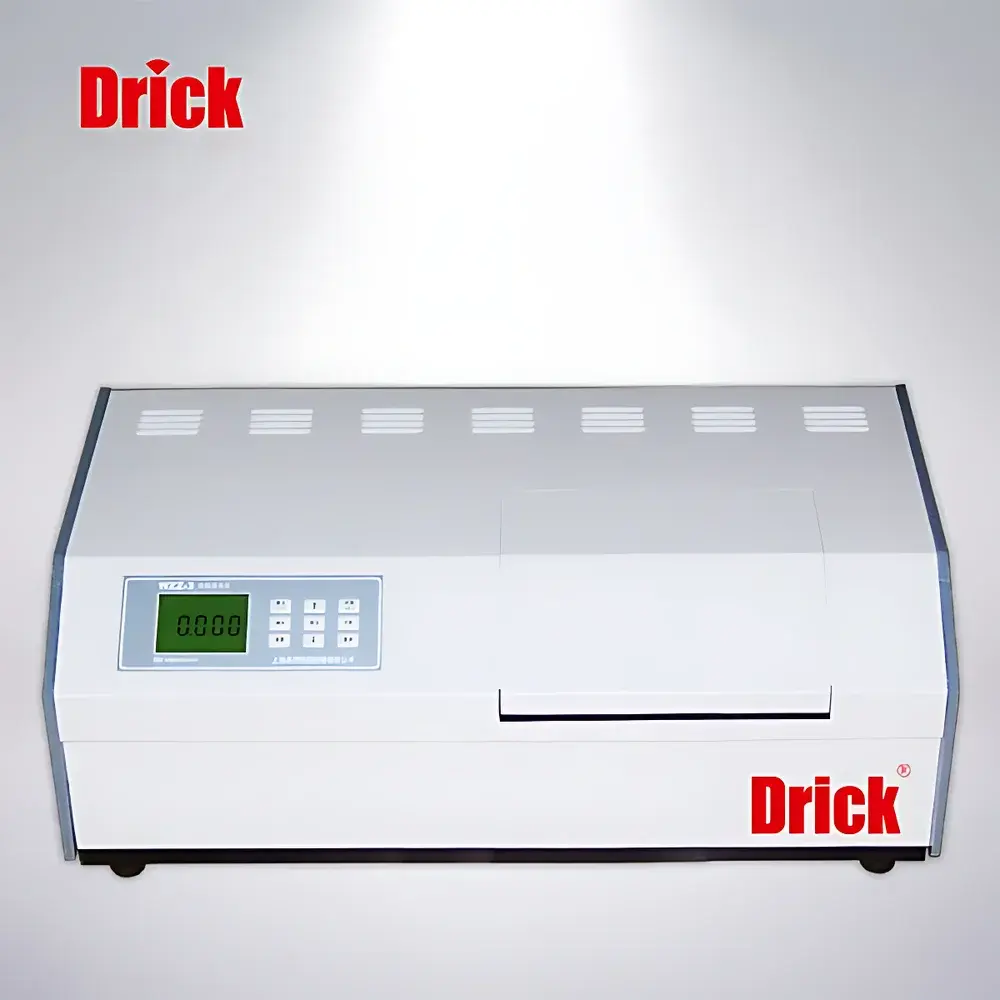
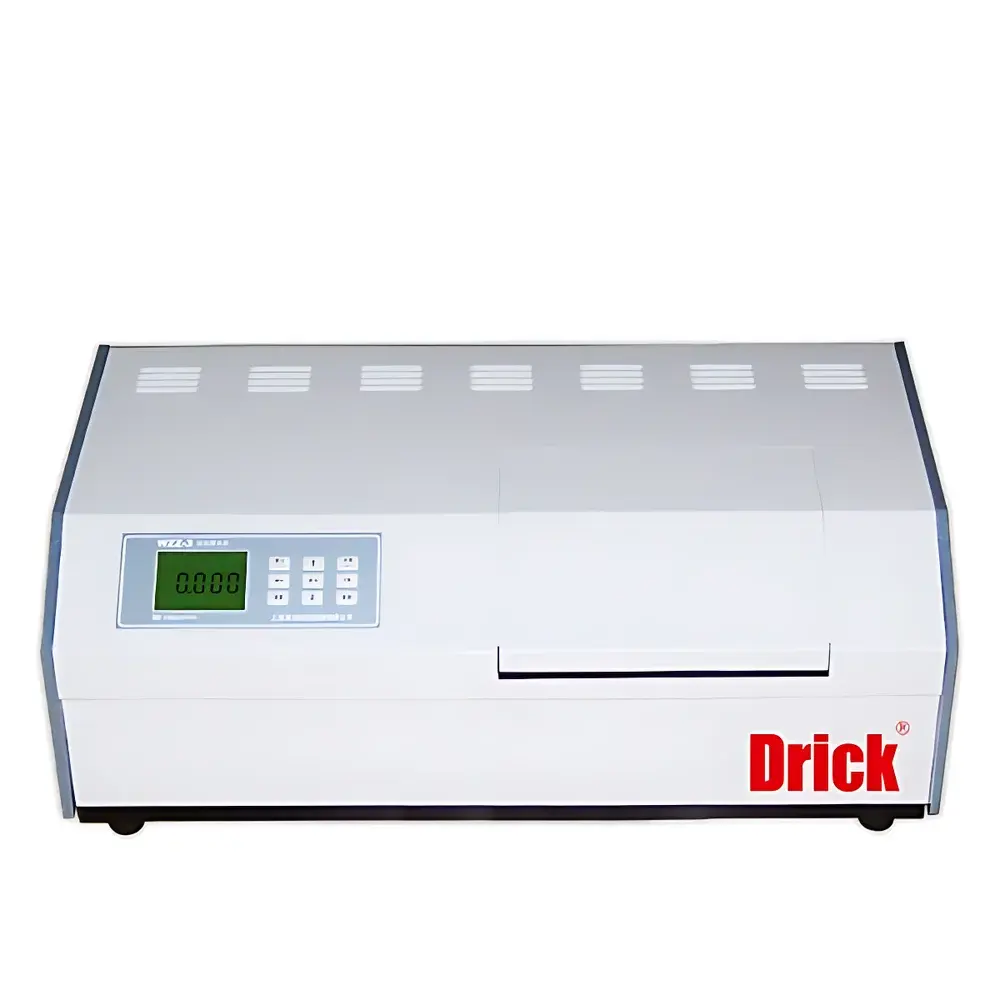
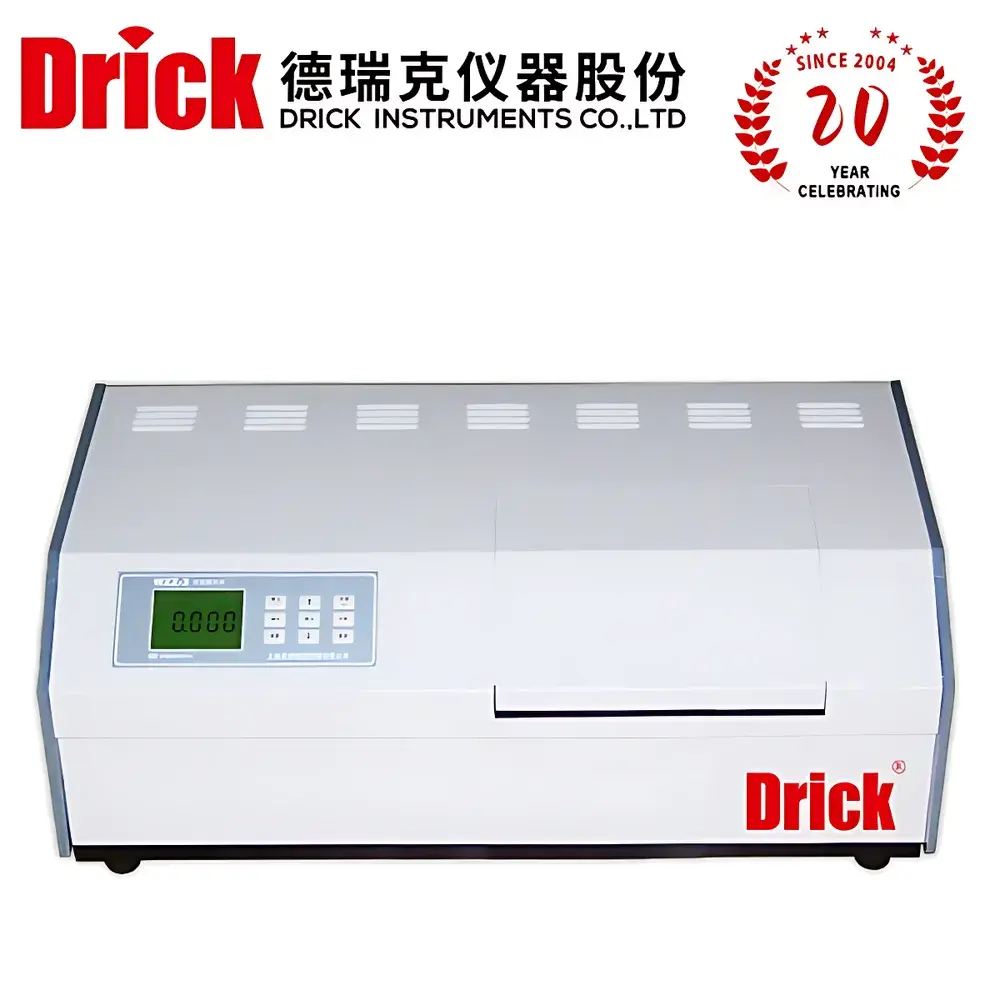
Drick DRK-Z30 Automated Polarimeter for Concentration, Purity, Sucrose Content, and Optical Activity Analysis
| Brand | Drick |
|---|---|
| Origin | Shandong, China |
| Manufacturer Type | Direct Manufacturer |
| Product Category | Domestic Instrument |
| Model | DRK-Z30 |
| Price Range | USD 11,200–14,000 (FOB) |
| Type | Automated Polarimeter |
| Temperature Control | Integrated Peltier-based Thermostatic Cell Holder (±0.1 °C stability) |
| Display | High-Resolution LCD with Real-Time Angle & Concentration Readout |
| Light Source | Stable 589.3 nm LED (Sodium D-line Equivalent) |
| Measurement Range | –45° to +45° (optical rotation) |
| Accuracy | ±(0.01° + 0.05% of reading) for α |
| Repeatability | ≤0.002° (standard deviation over 10 measurements) |
Overview
The Drick DRK-Z30 Automated Polarimeter is a precision optical instrument engineered for the quantitative determination of optical rotation in chiral substances—primarily used to assess concentration, enantiomeric purity, sucrose content (°Z), and specific optical activity in pharmaceutical intermediates, fine chemicals, food-grade syrups, and natural product extracts. Based on the fundamental principle of polarimetry—measuring the angular rotation of plane-polarized light as it passes through an optically active medium—the DRK-Z30 employs a high-stability 589.3 nm LED light source calibrated to match the sodium D-line spectral output, ensuring traceable alignment with pharmacopoeial standards (USP <781>, EP 2.2.7, JP 6.03). Its fully automated measurement cycle includes automatic zero calibration, real-time temperature-compensated data acquisition, and dual-scale reporting (degrees and degrees Z), making it suitable for routine QC labs operating under GLP or GMP-aligned workflows.
Key Features
- Integrated Peltier-controlled sample cell holder with programmable setpoint range from 15 °C to 40 °C (±0.1 °C stability), enabling temperature-dependent optical rotation studies per ICH Q5C guidelines.
- High-precision stepper motor-driven analyzer system with closed-loop position feedback, delivering angular resolution of 0.001° and repeatability ≤0.002° (n=10, 1 dm cell, sucrose standard).
- Dual-scale digital display: simultaneous readout in conventional angular units (°) and industry-standard sucrose scale (°Z), directly traceable to the International Sugar Scale defined by ICUMSA.
- LED light source with >10,000-hour lifetime, minimal thermal drift, and no warm-up delay—eliminating mercury lamp hazards and recalibration downtime.
- Robust mechanical architecture with vibration-damped base, precision-ground optical mounts, and sealed optical path—optimized for long-term stability in shared laboratory environments.
- Compliance-ready design: supports manual audit trail logging; optional RS232/USB interface enables integration with LIMS or custom data capture scripts.
Sample Compatibility & Compliance
The DRK-Z30 accommodates standard 100 mm and 200 mm pathlength cells (including jacketed thermostatic variants), supporting aqueous solutions, ethanol-based extracts, syrup matrices, and low-viscosity organic solvents. It meets essential metrological requirements for routine identity and assay testing in accordance with USP General Chapter <781> Polarimetry, EP 2.2.7, and ISO 5725-2:2019 (accuracy and precision validation). While not pre-certified for 21 CFR Part 11, its deterministic measurement logic, manual logbook support, and stable hardware platform provide a validated foundation for internal compliance documentation per FDA guidance on computerized systems in regulated environments.
Software & Data Management
The DRK-Z30 operates in standalone mode with embedded firmware controlling all measurement sequences, calibration routines, and unit conversions. Raw angular data, temperature metadata, and user-entered parameters (e.g., path length, concentration factor) are displayed in real time and can be manually recorded. For laboratories requiring electronic records, the instrument provides ASCII-formatted serial output (RS232 or USB virtual COM port) compatible with Excel, LabVIEW, or custom Python-based parsing tools. All firmware updates are delivered via secure USB flash drive—no cloud dependency or remote access functionality is implemented, preserving data sovereignty and network isolation.
Applications
- Pharmaceutical QC: Quantification of enantiomeric excess (ee%) in chiral APIs using specific rotation reference values; verification of stereochemical integrity post-synthesis or crystallization.
- Sugar Industry: Direct °Z determination in cane and beet sugar solutions, invert syrups, and high-fructose corn syrup blends per ICUMSA Method GS3/3-15.
- Food & Beverage: Monitoring sucrose inversion kinetics during thermal processing; authenticity testing of honey and fruit juice concentrates.
- Academic Research: Teaching core principles of molecular chirality and optical activity; supporting undergraduate physical chemistry and analytical lab curricula.
- Chemical Manufacturing: In-process control of asymmetric catalysis reactions; batch release testing of optically active intermediates (e.g., amino acids, tartaric acid derivatives).
FAQ
What is the wavelength accuracy of the LED source, and how is it maintained?
The 589.3 nm LED is factory-selected and spectrally verified against NIST-traceable reference filters; no field recalibration is required due to inherent diode stability and thermal management design.
Can the DRK-Z30 measure samples below 0.1 g/mL concentration?
Yes—detection limit depends on specific rotation magnitude and path length; with a 200 mm cell, typical lower quantitation limits range from 0.05–0.15 g/dL for compounds with [α]D > ±50°·mL·g⁻¹·dm⁻¹.
Is temperature correction applied automatically during measurement?
Temperature is continuously monitored at the cell block; while raw rotation data is reported uncorrected, the instrument’s stability allows direct comparison across batches when operated at fixed, documented setpoints per USP <781>.
Does the device support ASTM E1255 or ISO 11664-3 compliance?
It adheres to the photometric and geometric principles outlined in ISO 11664-3 (CIE colorimetry framework for polarization), though formal certification requires third-party metrological validation per local regulatory authority requirements.





