
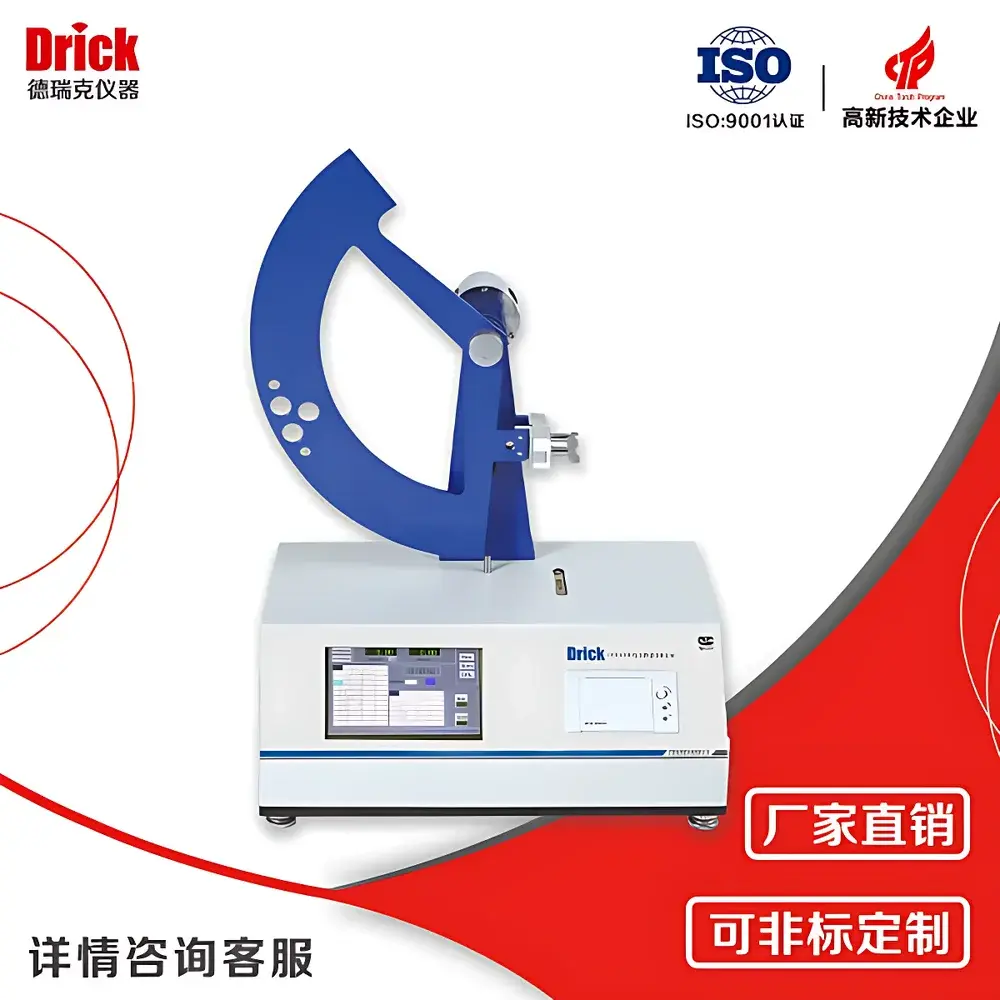
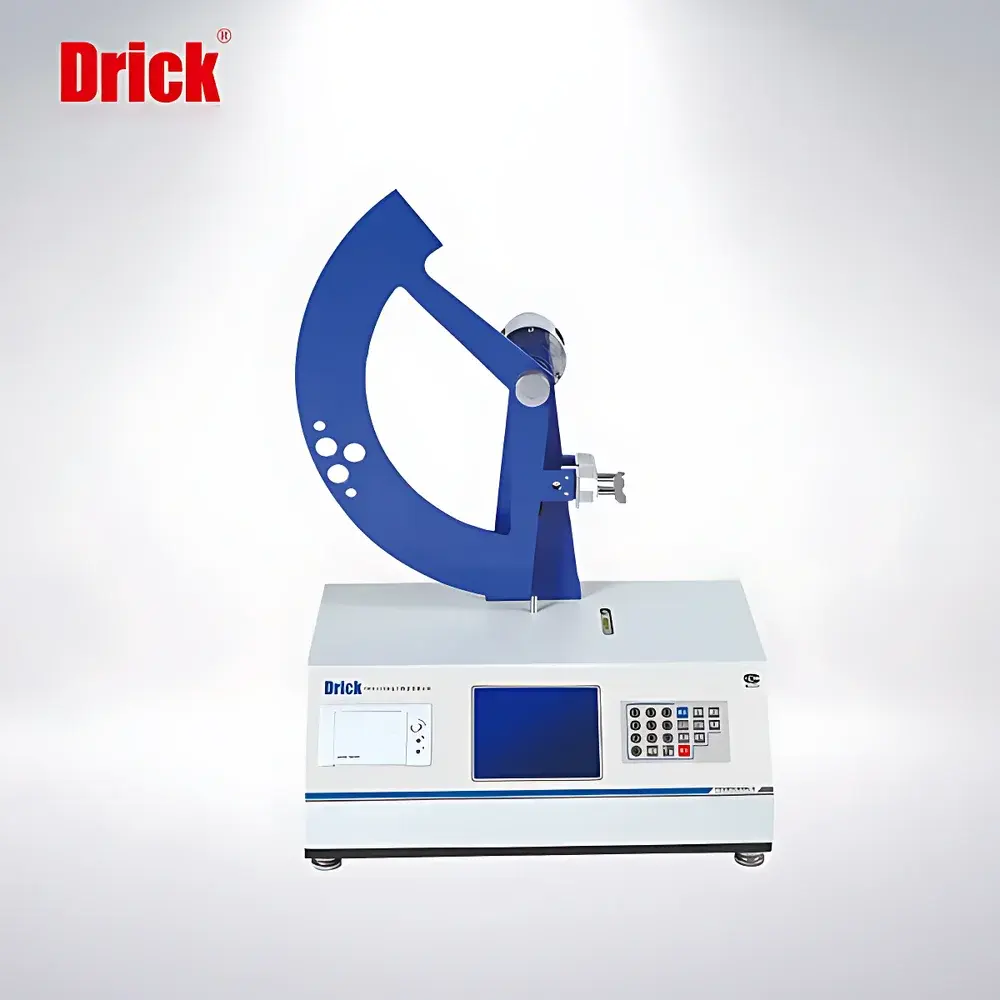
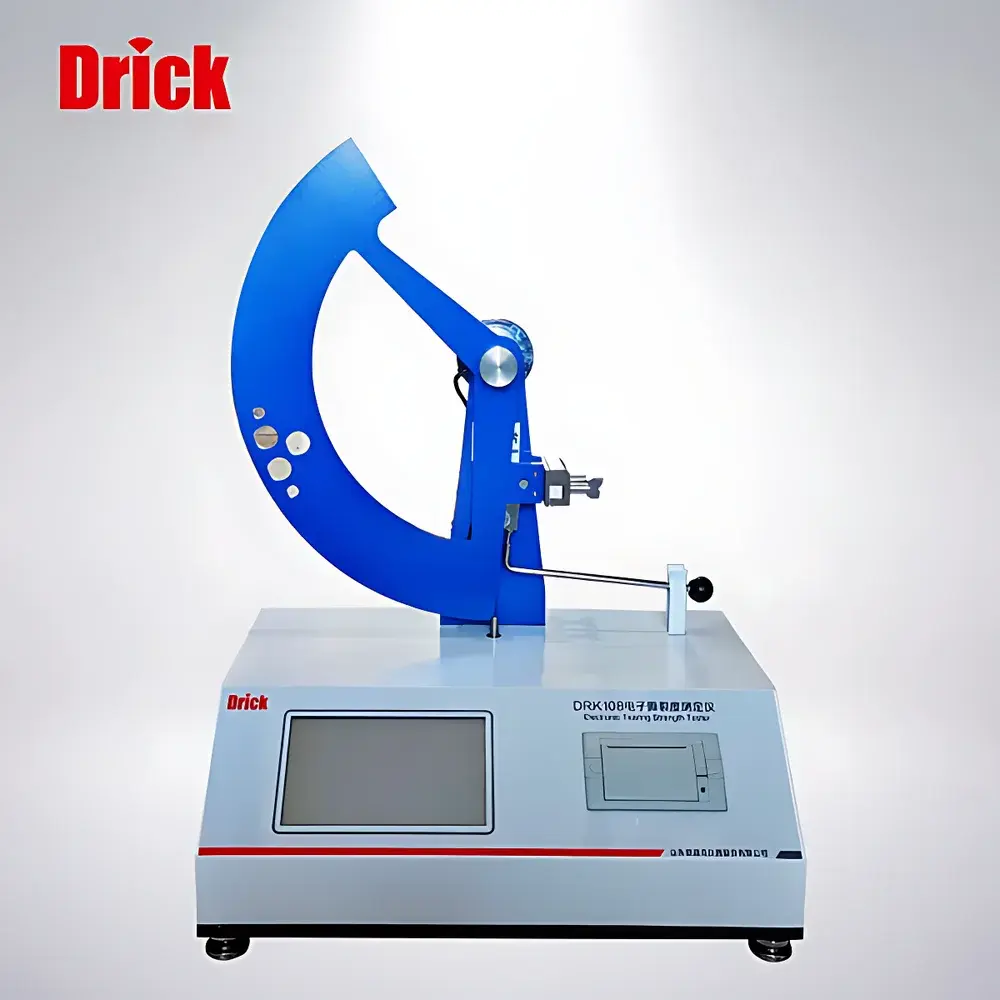
Drick DRK108 Electronic Elmendorf Tear Tester for Paper and Low-Strength Paperboard
| Brand | Drick |
|---|---|
| Origin | Shandong, China |
| Manufacturer Type | Manufacturer |
| Origin Category | Domestic |
| Model | DRK108 |
| Price | ¥50,000 CNY |
| Standard Compliance | ISO 1974, GB/T 455.1, GB/T 450–2002, GB/T 10739–2002 |
| Measuring Range | (10–13,000) mN |
| Resolution | 10 mN |
| Accuracy | ±1% of reading (20–80% of full scale), ±0.5% FS (outside range) |
| Repeatability | <1% (20–80% FS), <0.5% FS (outside range) |
| Tear Arm Length | (104 ± 1) mm |
| Initial Tear Angle | 27.5° ± 0.5° |
| Tear Distance | (43 ± 0.5) mm |
| Clamp Face Dimensions | 25 × 15 mm |
| Clamp Spacing | (2.8 ± 0.3) mm |
| Specimen Size | (63 ± 0.5) mm × (50 ± 2) mm |
| Operating Temperature | 20 ± 10 °C |
| Relative Humidity | ≤80% RH |
| Dimensions | 460 × 400 × 400 mm |
| Weight | 30 kg |
| Power Supply | AC 220 V ± 5%, 50 Hz |
| Data Acquisition | 24-bit high-precision ADC (resolution up to 1/10,000,000) |
| Display & Interface | Bilingual Chinese–English menu |
| Output | Integrated thermal printer (modular, fast print speed, easy paper replacement) |
| Statistical Output | Mean, standard deviation, coefficient of variation |
Overview
The Drick DRK108 Electronic Elmendorf Tear Tester is a precision-engineered instrument designed specifically for the quantitative determination of tear resistance in paper and low-strength paperboard according to the standardized Elmendorf method. It operates on the principle of pendulum-type energy absorption: a notched specimen is clamped between two jaws, and a calibrated pendulum—equipped with a fixed tear arm and defined initial tear angle—is released to propagate a controlled tear across a specified distance. The energy required to extend the tear is calculated from the angular displacement of the pendulum and converted into tear force (mN). This gravimetric-mechanical approach ensures high reproducibility and traceability under standardized environmental conditions (per GB/T 10739–2002 and ISO 187:1990), making the DRK108 suitable for routine quality control in paper mills, packaging converters, and accredited testing laboratories.
Key Features
- Elmendorf-compliant mechanical architecture with precisely engineered tear arm (104 ± 1 mm), initial tear angle (27.5° ± 0.5°), and tear distance (43 ± 0.5 mm) — all aligned to ISO 1974 and GB/T 455.1 tolerances.
- High-fidelity force transduction system incorporating a 24-bit analog-to-digital converter (ADC) with effective resolution of 1 part in 10,000,000 and a calibrated high-accuracy load cell — enabling stable digitization across the full 10–13,000 mN measurement range.
- Bilingual (Chinese–English) graphical user interface with intuitive navigation; language switching is performed in real time without system reset or configuration reload.
- Integrated modular thermal printer supporting on-demand report generation — includes automatic calculation and printing of arithmetic mean, standard deviation, and coefficient of variation for each test series.
- Rigid cast-alloy frame and optimized mass distribution ensure minimal vibration coupling and long-term mechanical stability during repeated pendulum release cycles.
- Compliance-ready design: supports audit trails for GLP/GMP environments through timestamped printouts and deterministic mechanical calibration pathways traceable to national metrological standards.
Sample Compatibility & Compliance
The DRK108 is validated for use with standard paper specimens (63 ± 0.5 mm × 50 ± 2 mm) and low-strength paperboard within defined grammage and caliper limits. Its clamp geometry (25 × 15 mm contact face, 2.8 ± 0.3 mm jaw separation) ensures consistent specimen alignment and minimizes edge slippage per ISO 1974 requirements. While primarily intended for paper-based substrates, the instrument’s modular mechanical interface allows adaptation for thin flexible materials—including plastic films, metallic foils, and nonwovens—provided specimen geometry and clamping force are verified per ASTM D1922 or ISO 6383 where applicable. Regulatory alignment includes full conformance with ISO 1974:2013, GB/T 455.1–1989 (revised under GB/T 455–2022 framework), GB/T 450–2002 (sampling), and GB/T 10739–2002 (standard atmospheric conditioning). Instrument calibration procedures follow traceable mass and angular displacement protocols compatible with national metrology institutes.
Software & Data Management
The DRK108 operates via embedded firmware with no external PC dependency. All data acquisition, statistical computation, and reporting occur onboard. Each test sequence stores raw pendulum displacement values, computed tear forces, and environmental metadata (if externally logged). The thermal printer outputs fully compliant test reports containing specimen ID, test date/time, operator ID (manually entered), mean tear force (mN), standard deviation (mN), coefficient of variation (%), and pass/fail status relative to predefined specification limits. While the system does not feature USB or Ethernet connectivity, its deterministic output format enables seamless integration into LIMS environments via optical character recognition (OCR) or manual entry protocols. Audit readiness is reinforced by immutable printed records satisfying minimum documentation requirements under ISO/IEC 17025:2017 Clause 7.8 and FDA 21 CFR Part 11 (for non-electronic signature applications).
Applications
This instrument serves as a primary test platform in pulp and paper manufacturing for evaluating fiber bonding integrity, refining efficiency, and additive impact on tear propagation resistance. In packaging R&D, it supports comparative analysis of corrugated board liner combinations, coated kraft grades, and sustainable fiber alternatives (e.g., bamboo or agricultural residue pulps). Quality assurance labs utilize the DRK108 for incoming raw material verification (e.g., recycled content batches), in-process monitoring of paper machine dry-end performance, and final product release against TAPPI T 414 or ISO 1974 specifications. Academic and governmental institutions deploy it in fundamental studies of fracture mechanics in anisotropic fibrous networks, particularly where correlation with tensile strength, burst index, or folding endurance is required.
FAQ
What international standards does the DRK108 comply with?
ISO 1974:2013, GB/T 455–2022 (replacing GB/T 455.1), GB/T 450–2002, and GB/T 10739–2002.
Is calibration certification included with delivery?
Yes — each unit ships with a factory calibration certificate referencing traceable reference masses and angular encoders, valid for 12 months under normal operating conditions.
Can the DRK108 measure materials other than paper?
It is validated for paper and low-strength paperboard; extension to films, foils, or textiles requires user validation per ASTM D1922 or ISO 6383 and may necessitate auxiliary fixtures.
What environmental conditions are required for valid testing?
Testing must be conducted in a conditioned room maintained at 23 ± 1 °C and 50 ± 2 % RH per GB/T 10739–2002 — though the instrument itself operates within 10–30 °C and ≤80 % RH.
Does the instrument support data export to Excel or LIMS?
No native digital export interface is provided; however, printed reports are structured for reliable OCR ingestion or manual transcription into laboratory information management systems.






