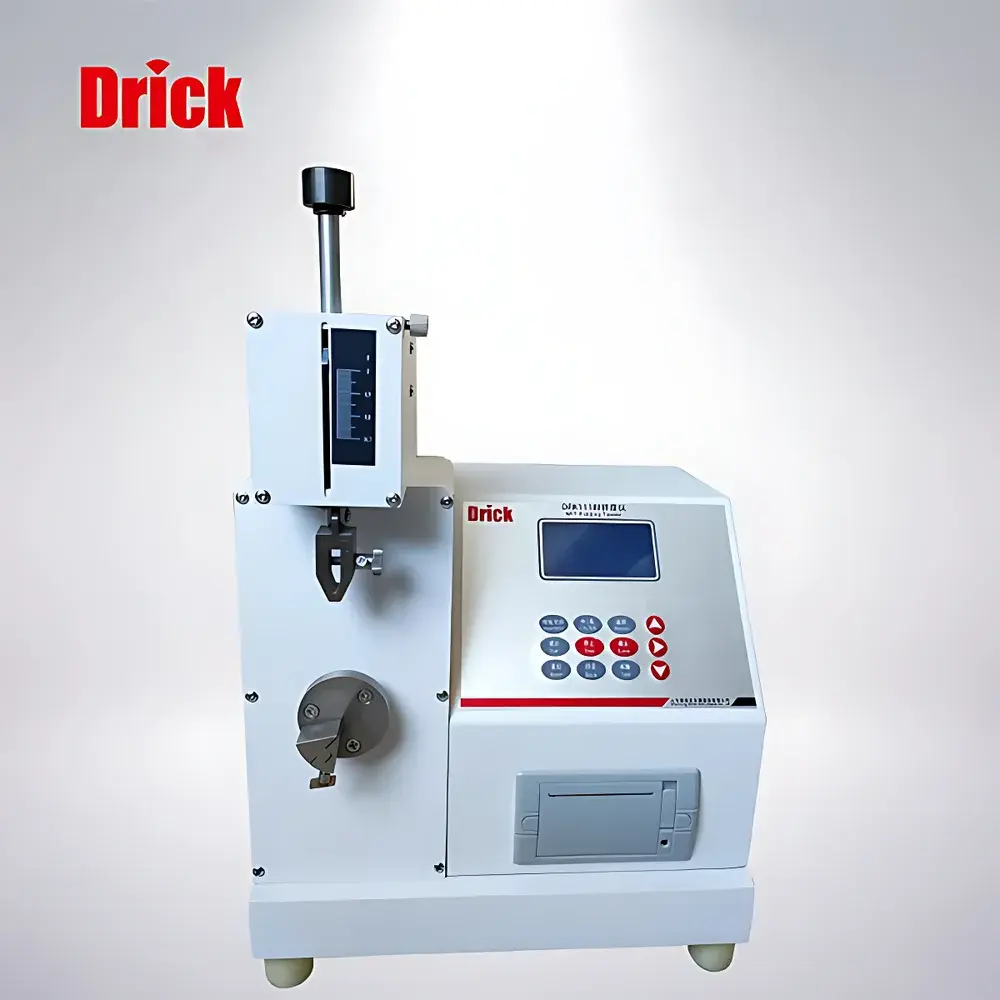
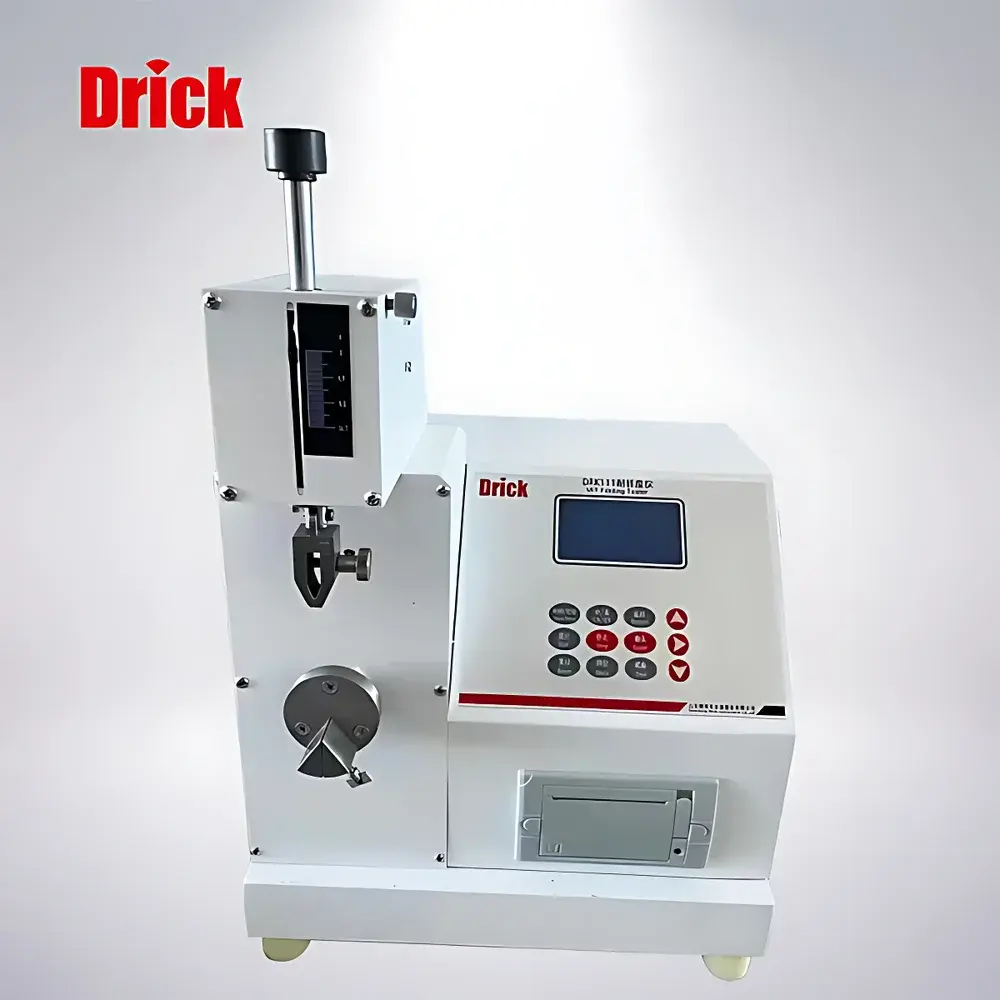
Drick DRK111A MIT Fold Endurance Tester
| Brand | Drick |
|---|---|
| Origin | Shandong, China |
| Manufacturer Type | Direct Manufacturer |
| Country of Origin | China |
| Model | DRK111A |
| Pricing | Upon Request |
Overview
The Drick DRK111A MIT Fold Endurance Tester is a precision-engineered instrument designed for the quantitative assessment of fold endurance in thin sheet materials—primarily paper, paperboard, and other flexible planar substrates with thicknesses under 1 mm. It operates on the standardized MIT (Massachusetts Institute of Technology) folding principle, wherein a fixed-length specimen is clamped between two opposing folding heads and subjected to repeated 135° double-fold cycles under controlled tension until failure. This method quantifies material fatigue resistance by counting the number of folds required to produce a visible crack or complete rupture. The DRK111A implements this principle with high mechanical repeatability, servo-controlled actuation, and integrated optical position sensing to ensure precise cycle registration and automatic return-to-zero positioning after each test sequence. Its design complies with internationally recognized test methodologies essential for quality control in packaging R&D, pulp & paper manufacturing, and regulatory compliance laboratories.
Key Features
- Microprocessor-based control system with real-time sampling, measurement, and display of fold count, tensile load, and cycle parameters
- Touchscreen LCD interface with Chinese graphical menu navigation—intuitive for operator training and routine QC use
- Servo-motor-driven folding mechanism ensuring consistent angular displacement (135° ±2°) and timing accuracy (175 ±10 folds/min)
- Adjustable tension range (4.9 N to 14.7 N) via calibrated spring-loaded loading system, meeting ISO 5626 and GB/T 2679.5 requirements
- Interchangeable folding blades with four standard gap widths (0.25 mm, 0.50 mm, 0.75 mm, 1.00 mm), each conforming to specified edge geometry (fold width: 19 ±1 mm; corner radius: R0.38 mm ±0.02 mm)
- Automatic zero-return function post-test, minimizing manual intervention and enhancing throughput in high-volume testing environments
- Onboard data storage for multiple test records—including individual fold counts, logarithmic transformations, mean values, maximum/minimum values, and coefficient of variation (CV%)—accessible via display or printout
- High-speed thermal printer for immediate hard-copy documentation of results, supporting traceability in GLP-compliant workflows
Sample Compatibility & Compliance
The DRK111A is validated for use with paper grades (e.g., kraft, corrugating medium, linerboard), coated and uncoated paperboards, cellulose-based composites, and synthetic films within the specified thickness limit (<1 mm). Its mechanical configuration satisfies dimensional and dynamic constraints defined in ISO 5626:1993 “Paper — Determination of folding endurance”, GB/T 2679.5–2022 “Paper and board — Determination of folding endurance (MIT method)”, and QB/T 1049–2018 “Fold endurance testers for paper and board”. The instrument’s tension stability (±0.343 N deviation due to rotational eccentricity) and angular repeatability are verified per manufacturer calibration protocols aligned with national metrological standards for mechanical testing equipment.
Software & Data Management
While the DRK111A operates as a standalone embedded system without external PC dependency, its firmware supports full audit-trail functionality for critical test parameters: date/time stamping, operator ID input (via keypad), test mode selection, tension setting, blade gap selection, and pass/fail threshold configuration. All measured data—including raw fold counts, statistical summaries, and system diagnostics—are retained in non-volatile memory and exportable via printed report. Though not FDA 21 CFR Part 11 compliant out-of-the-box, the device can be integrated into validated laboratory information management systems (LIMS) through RS-232 serial output (optional interface module available), enabling centralized data archiving and electronic signature support where required by GMP or ISO/IEC 17025-accredited facilities.
Applications
- Quality assurance of folding cartons, cereal boxes, pharmaceutical blister packaging, and retail packaging substrates
- R&D evaluation of fiber furnish composition, refining degree, sizing agents, and coating formulations on flex fatigue performance
- Supplier qualification testing against contractual fold endurance specifications (e.g., minimum 5,000 MIT folds for premium corrugated liners)
- Comparative analysis of recycled vs. virgin fiber blends in sustainable packaging development
- Process validation of creasing, scoring, and die-cutting operations where fold integrity directly impacts end-use functionality
FAQ
What standards does the DRK111A comply with?
It conforms to ISO 5626, GB/T 2679.5, GB/T 457, and QB/T 1049 for fold endurance testing of paper and board.
Can the instrument test materials thicker than 1 mm?
No—the mechanical design and standard test protocols are strictly limited to specimens ≤1 mm thick; exceeding this may compromise measurement validity and damage folding heads.
Is calibration certification included with delivery?
A factory calibration report is provided; users are advised to perform periodic verification using certified reference standards per internal SOPs or ISO/IEC 17025 requirements.
Does the DRK111A support data export to Excel or LIMS?
Direct USB or Ethernet connectivity is not built-in, but RS-232 output enables integration with third-party data acquisition software or LIMS via compatible interface hardware.
What maintenance is required for long-term reliability?
Routine cleaning of folding heads, periodic lubrication of drive rails, and annual verification of tension spring calibration are recommended per the maintenance schedule in the operator manual.
Related Products