
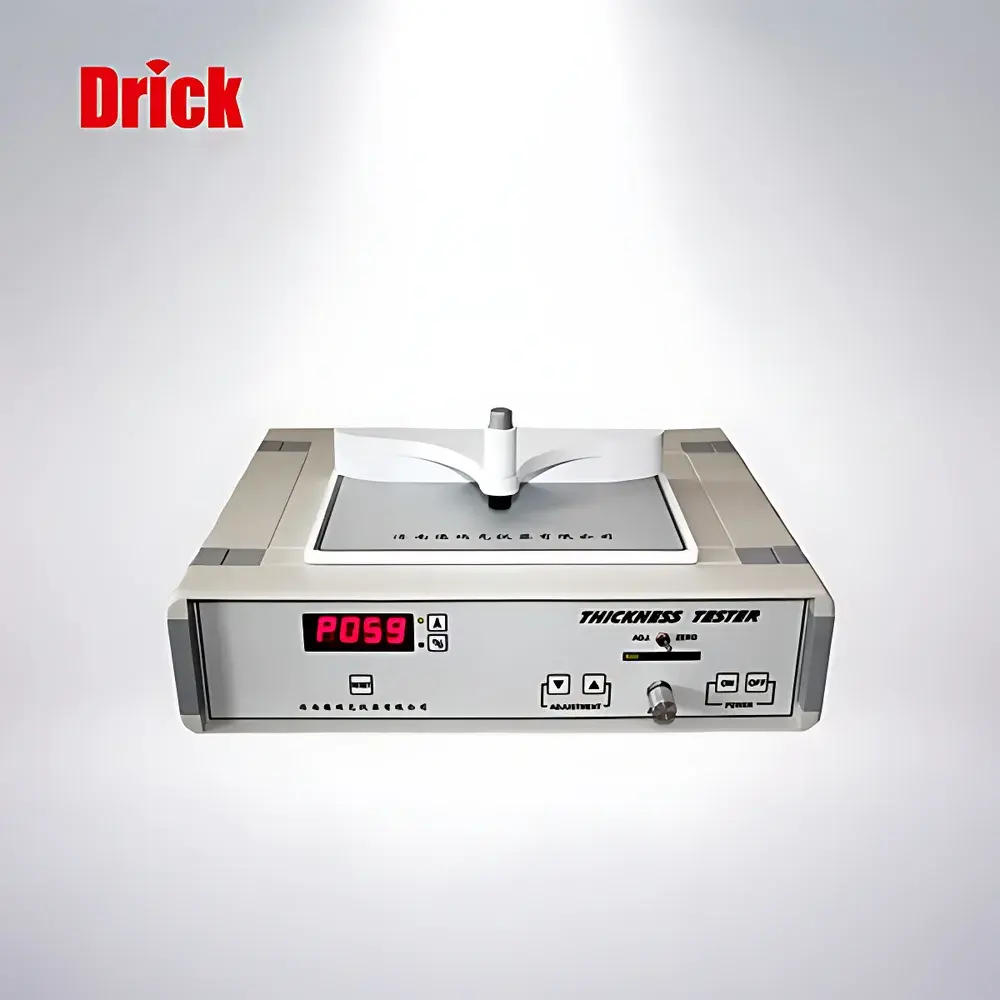
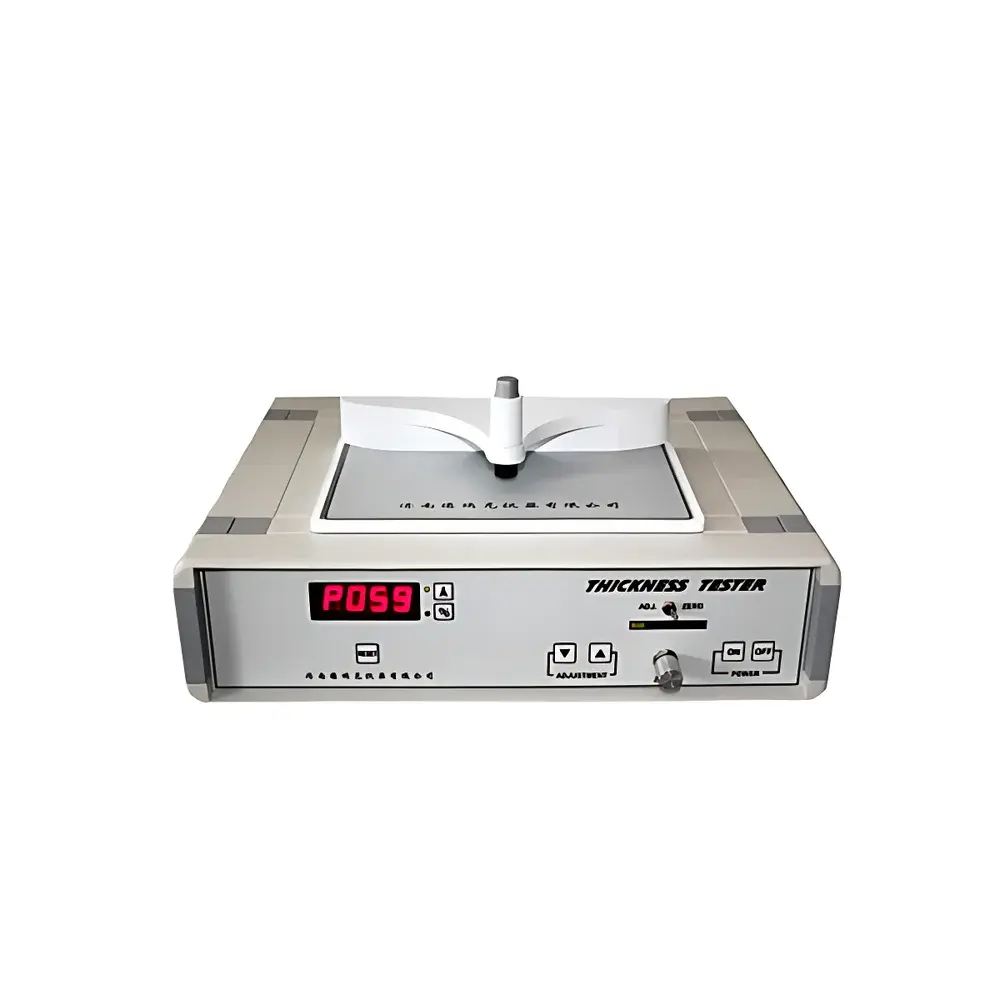
Drick DRK120 Portable Aluminum Coating Thickness Gauge for Tobacco & Food Flexible Packaging
| Brand | Drick |
|---|---|
| Origin | Shanghai, China |
| Manufacturer Type | Direct Manufacturer |
| Regional Classification | Domestic (China) |
| Model | DRK120 |
| Price | USD 6,700 (FOB Shanghai) |
| Measurement Principle | Eddy Current |
| Compliance | GB/T 4957–2003 (Non-magnetic Coatings on Non-ferrous Substrates) |
| Measuring Range | 10–1000 Å |
| Minimum Sample Area | ≥100 mm × 200 mm |
| Resolution | 10 Å |
| Accuracy | ≤ ±3% of Full Scale |
| Repeatability | ≤30 Å (at same point) |
| Application Scope | Vacuum-deposited Al coatings on PET, OPP, CPP, BOPP, and metallized paper substrates |
Overview
The Drick DRK120 is a handheld, eddy current-based thickness gauge engineered specifically for non-destructive measurement of ultra-thin aluminum coatings—typically 35–500 Å—on flexible polymer films used in high-barrier packaging applications. In tobacco and food packaging, vacuum metallization deposits a continuous, discontinuous, or semi-continuous aluminum layer onto substrates such as PET, BOPP, CPP, or metallized paper to significantly enhance oxygen transmission rate (OTR) and water vapor transmission rate (WVTR) resistance. Since aluminum is impermeable to gases and aromatic compounds—and provides complete light blocking—the functional integrity of the barrier relies directly on coating uniformity and nominal thickness. The DRK120 operates on the principle of high-frequency eddy current induction: a probe coil generates an alternating magnetic field that interacts with the conductive aluminum layer; changes in coil impedance correlate linearly with coating thickness under controlled substrate conductivity and geometry. Designed for production-floor deployment, it delivers rapid, operator-independent measurements without sample preparation or calibration drift—critical for inline process monitoring and QC release testing.
Key Features
- Compact, battery-powered design optimized for portable use in packaging converting lines, R&D labs, and supplier audit environments.
- Eddy current sensor calibrated per GB/T 4957–2003 for non-magnetic coatings on non-ferrous substrates—validated for Al-on-polymer systems with surface resistivity < 10⁶ Ω/sq.
- High-resolution digital display (10 Å resolution) with auto-zero function and real-time statistical output (mean, SD, min/max) across up to 99 stored readings.
- Probe geometry engineered for stable contact on low-tension, heat-sensitive films—no pressure-induced deformation or static interference.
- Robust industrial housing (IP54-rated) with anti-scratch sapphire window and temperature-compensated electronics (operating range: 10–40 °C).
- No consumables, no radiation source, and zero film damage—compliant with ISO 9001-controlled manufacturing workflows.
Sample Compatibility & Compliance
The DRK120 is validated for direct measurement on metallized films where the aluminum layer resides on the outer surface or sandwiched between polymer layers (e.g., PET/Al/CPP). It supports substrates with minimum dimensions of 100 mm × 200 mm and thicknesses from 12 µm to 150 µm. Compatibility extends to common base films including polyethylene terephthalate (PET), oriented polypropylene (OPP), cast polypropylene (CPP), biaxially oriented polypropylene (BOPP), and metallized kraft paper. All measurements conform to the metrological requirements of GB/T 4957–2003, which aligns with ISO 2360 for eddy current coating thickness gauges. For regulated environments—including facilities operating under GMP or ISO 22000—data output supports traceability via printed reports with timestamp, operator ID, and location tag (optional USB export module available).
Software & Data Management
While the DRK120 operates as a standalone instrument, optional PC connectivity (RS-232 or USB-C) enables integration with Drick’s proprietary DataLink v2.1 software. This platform supports batch logging, SPC charting (X̄–R, Cpk), automated pass/fail flagging against user-defined tolerance bands (e.g., 35 ± 5 Å), and CSV export for LIMS ingestion. Audit trails record all configuration changes, calibration events, and measurement sessions—fully compliant with FDA 21 CFR Part 11 requirements when paired with electronic signature modules. Raw data files include embedded metadata: probe serial number, ambient temperature/humidity, and firmware revision—ensuring full analytical traceability per GLP guidelines.
Applications
- Real-time verification of vacuum metallization line output during roll-to-roll processing.
- Final QC release testing for cigarette overwrap, pouch laminates, snack food wrappers, and coffee foil-laminates.
- R&D evaluation of new metallization parameters (voltage, deposition time, chamber pressure) on barrier performance correlation.
- Supplier qualification audits—measuring incoming rolls prior to lamination or printing.
- Troubleshooting delamination, pinhole formation, or uneven coating distribution via spatial mapping (manual grid scan).
FAQ
Does the DRK120 require substrate-specific calibration?
No—calibration is performed using certified Al-on-PET reference standards traceable to NIM (National Institute of Metrology, China); one-point calibration suffices for all standard packaging films meeting GB/T 4957 substrate criteria.
Can it measure aluminum thickness through adhesive or lacquer layers?
Yes, provided the topcoat is non-conductive and ≤2 µm thick; thicker dielectric layers attenuate signal strength and require offset correction per ASTM D7091 Annex A3.
Is the instrument suitable for measuring aluminum on paperboard or foil-laminated cartons?
It is validated only for flexible films and metallized papers—not rigid substrates or multi-layer composites exceeding 300 µm total thickness.
What maintenance is required?
Annual verification against reference standards is recommended; probe cleaning with isopropyl alcohol and lint-free swabs is sufficient for daily operation.
Does it meet international regulatory requirements for food contact material testing?
While the DRK120 itself is not a food contact compliance tester, its thickness data directly supports compliance with EU Framework Regulation (EC) No 1935/2004 and FDA 21 CFR 177.1390 by verifying barrier layer integrity—documentation is accepted in third-party audits.





