
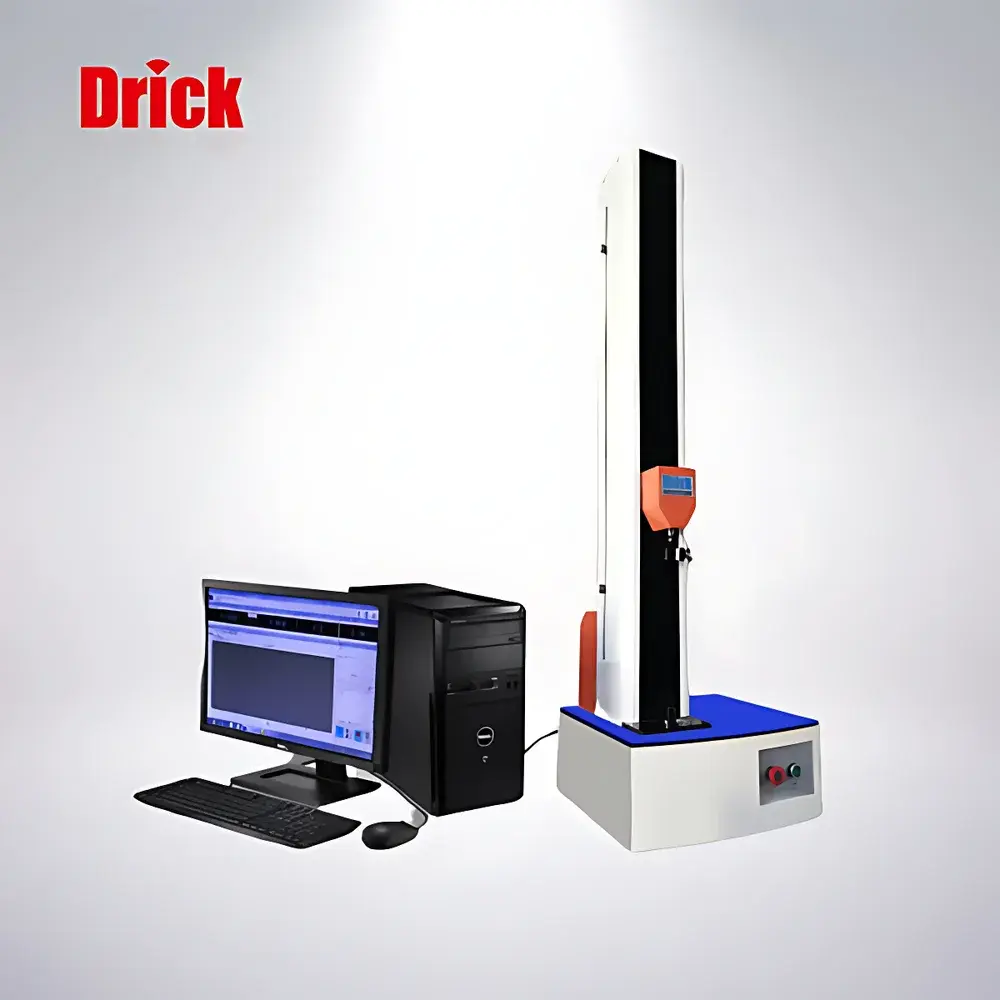
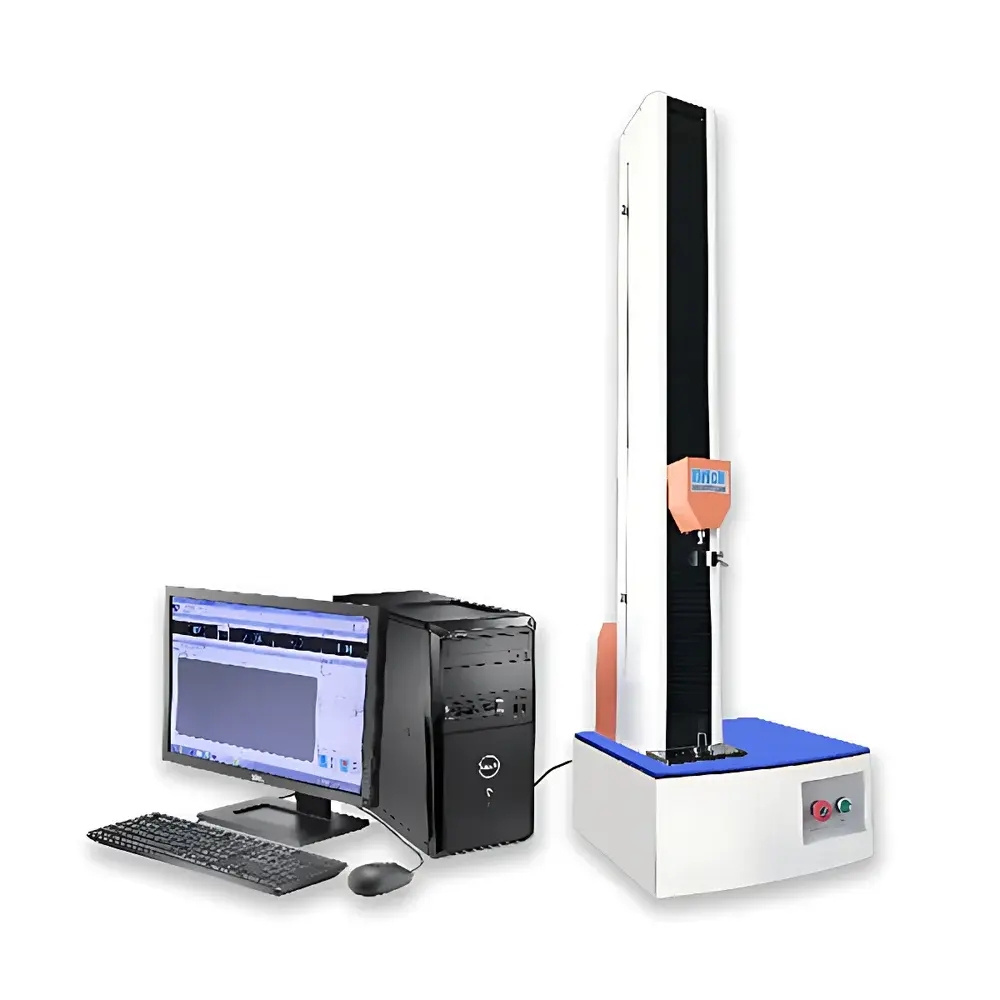
Drick DRK501 Pharmaceutical Flexible Packaging Performance Tester
| Brand | Drick |
|---|---|
| Origin | Shandong, China |
| Manufacturer Type | Manufacturer |
| Country of Origin | China |
| Model | DRK501 |
| Force Capacity | 500 N (standard), optional ranges: 50 N, 100 N, 5000 N |
| Accuracy | Better than Class 0.5 |
| Force Resolution | 0.1 N |
| Deformation Resolution | 0.001 mm |
| Test Speed | 1–500 mm/min (infinitely variable) |
| Standard Sample Width | 30 mm (50 mm optional) |
| Standard Travel | 1000 mm (400 mm / 700 mm / 800 mm optional) |
| Dimensions (L×W×H) | 500 × 300 × 1700 mm |
| Power Supply | AC 220 V, 50 Hz |
| Compliance | YBB00152002–2015, YBB00212005–2015, YBB00232005–2015, YBB00222005–2015, YBB00182004–2015, YBB00202005–2015, YBB00242002–2015, YBB00212004–2015, YBB00132005–2015, YBB00142005–2015 |
Overview
The Drick DRK501 Pharmaceutical Flexible Packaging Performance Tester is a precision-engineered universal mechanical testing system designed specifically for compliance-driven quality control in pharmaceutical packaging development and manufacturing. Based on the fundamental principles of uniaxial tensile and compressive force measurement—governed by Hooke’s law and standardized load-cell transduction—the DRK501 delivers traceable, repeatable mechanical characterization across a broad spectrum of soft-packaging components. Its architecture integrates high-resolution load sensing, programmable motion control, and real-time data acquisition to meet the stringent physical testing requirements defined in Chinese Pharmacopoeia packaging standards (YBB series) and aligned with international expectations for regulatory documentation under GLP and GMP frameworks.
Key Features
- High-precision ball-screw transmission mechanism ensures smooth, backlash-free axial movement and long-term mechanical stability.
- Imported servo motor drive provides low-noise operation, fine speed resolution (1–500 mm/min, infinitely variable), and consistent torque delivery across the full speed range.
- Dual-directional load cells (tension & compression) support bidirectional mechanical evaluation—including peel, puncture, break, and opening force measurements—without hardware reconfiguration.
- Modular sensor architecture allows up to four interchangeable load cells (50 N, 100 N, 500 N, 5000 N) to be mounted simultaneously; the embedded software automatically detects and calibrates each unit upon installation.
- Embedded real-time plotting engine displays synchronized force–time, force–displacement, and force–strain curves during test execution, enabling immediate visual validation of material response.
- Three-tier user permission management (Administrator, Supervisor, Operator) enforces role-based access control for method editing, result modification, and audit trail review—supporting 21 CFR Part 11–compatible electronic records when paired with validated software configuration.
- Integrated safety functions include automatic return-to-home, overload cutoff, error self-diagnosis, and non-volatile memory retention for test parameters and last-run results.
Sample Compatibility & Compliance
The DRK501 accommodates a wide range of pharmaceutical primary and secondary packaging substrates, including aluminum foil laminates, PVC/PVDC rigid blisters, cold-form aluminum composite films, pre-filled syringe plungers, rubber stoppers, crimp-on aluminum caps, and cartridge-based delivery systems. It supports standardized test configurations per multiple YBB technical guidelines: peel strength (YBB00132005–2015), seal integrity (YBB00152002–2015), cap removal torque equivalence (YBB00212004–2015), stopper puncture force (YBB00222005–2015), ampoule break strength (YBB00232005–2015), and piston sliding force for cartridges (YBB00242002–2015). All test methods are implemented as preloaded protocols within the software, ensuring alignment with documented standard operating procedures and facilitating internal audit readiness.
Software & Data Management
The DRK501 operates with proprietary Windows-based control software featuring ISO/IEC 17025–informed data handling architecture. Each test generates timestamped, digitally signed raw data files (.csv and .drk binary format), with full metadata capture—including operator ID, environmental conditions (if external sensors are connected), calibration status, and instrument firmware version. The software supports automated report generation compliant with ALCOA+ principles (Attributable, Legible, Contemporaneous, Original, Accurate, Complete, Consistent, Enduring, Available). Audit trails record all user actions—including parameter changes, result deletions, and method modifications—with immutable timestamps. Export options include PDF, Excel, and XML formats suitable for integration into LIMS or QMS platforms. Optional 21 CFR Part 11 add-ons provide electronic signature enforcement and enhanced access logging.
Applications
- Seal strength evaluation of heat-sealed blister lidding foils and pouches
- Tensile properties (UTS, elongation at break, Young’s modulus) of multilayer flexible films
- Peel adhesion testing of aluminum–polymer laminates and foil–paper composites
- Puncture resistance of rubber stoppers used in vials and syringes
- Opening force assessment of flip-off caps, pull-ring closures, and child-resistant packaging
- Break force quantification of glass ampoules and plastic ampoule alternatives
- Sliding force and friction coefficient measurement of silicone-coated plungers in prefilled syringes and autoinjectors
- Leak integrity verification via controlled pressure ramping (when interfaced with optional pneumatic modules)
FAQ
Does the DRK501 comply with international pharmacopoeial standards such as USP & EP?
While the DRK501 is explicitly validated against China’s YBB series standards, its mechanical architecture and measurement traceability (via NIST-traceable load cell calibration certificates) allow method adaptation to USP , USP , EP 3.2.1, and ISO 8504–1 for comparable mechanical tests—subject to site-specific method verification.
Can test data be exported in machine-readable format for regulatory submission?
Yes. Raw data and reports export to CSV, PDF/A-2, and XML formats with embedded digital signatures and full audit trail metadata—meeting FDA eCTD and EMA CTD structural requirements for mechanical testing evidence.
Is remote software update and calibration verification supported?
Firmware and software updates are delivered via secure HTTPS download; calibration status is verified through built-in self-test routines and periodic verification using certified reference standards traceable to national metrology institutes.
What maintenance intervals are recommended for long-term accuracy assurance?
Annual performance verification is advised per ISO/IEC 17025 Annex A.3, including linearity, repeatability, and zero-drift checks using certified deadweight standards. Ball-screw lubrication and encoder alignment inspection are scheduled every 12 months or after 5,000 test cycles.
Are custom夹具 (fixtures) available for non-standard container geometries?
Yes. Drick offers OEM fixture design services—including 3D-printed jigs, custom mandrels, and pneumatic clamping solutions—for non-standard formats such as dual-chamber vials, inhaler canisters, and wearable injector housings—subject to mechanical feasibility review and IQ/OQ protocol development.
Related Products






