
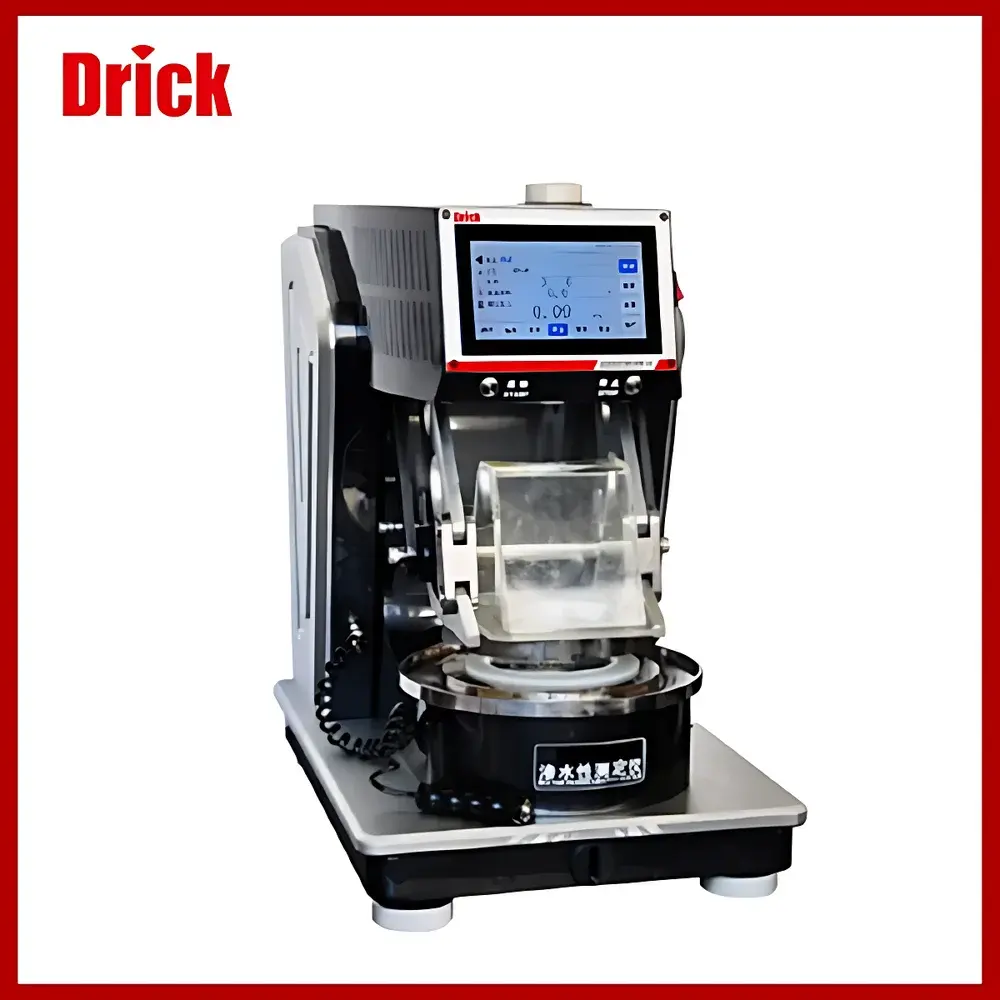
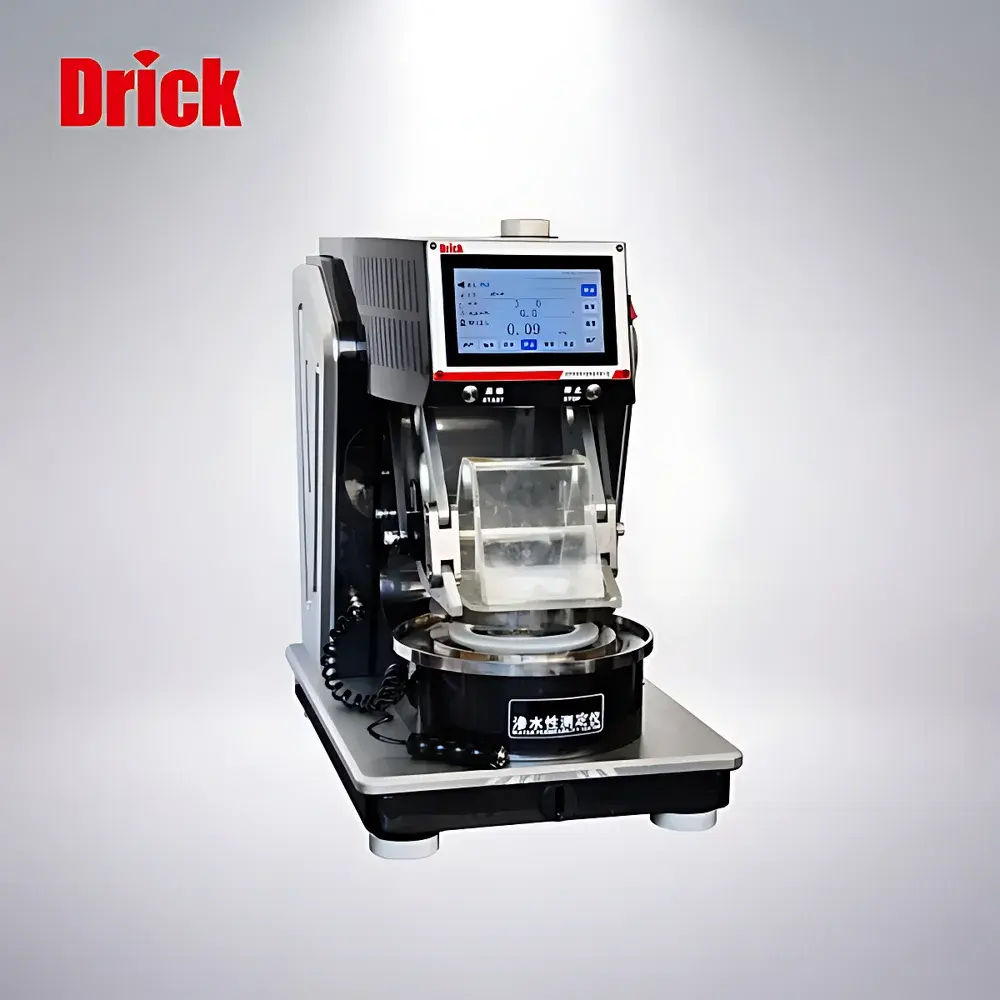
Drick DRK812H Medical Protective Clothing & Tight-Weave Fabric Hydrostatic Pressure Tester
| Brand | Drick |
|---|---|
| Origin | Shandong, China |
| Manufacturer Type | Direct Manufacturer |
| Country of Origin | China |
| Model | DRK812H |
| Display & Control | 7-inch color touchscreen with parallel metal membrane keypad |
| Sample Clamping | Pneumatic clamping system |
| Measurement Range | 0–300 kPa (0–30 mH₂O) |
| optional low-range mode | 0–50 kPa (0–5 mH₂O) |
| Resolution | 0.01 kPa (1 mmH₂O) |
| Accuracy | ≤ ±0.5% F.S. |
| Test Modes | Incremental pressure, constant pressure, flexure-assisted, and water penetration methods |
| Constant-pressure dwell time | 0–99999.9 s (±0.1 s timing accuracy) |
| Total test duration range | 0–9999999.9 s (±0.1 s) |
| Pressurization rate | digitally adjustable from 0.5 to 100 kPa/min (50–10,000 mmH₂O/min) |
| Sample clamp area | 100 cm² |
| Max flow rate | ≤200 mL/min |
| Interface | RS-232 serial port for thermal printer output |
| Power supply | AC 220 V, 50 Hz, 250 W |
| Dimensions (L×W×H) | 380 × 480 × 460 mm |
| Weight | approx. 25 kg |
Overview
The Drick DRK812H Hydrostatic Pressure Tester is an engineered precision instrument designed for quantitative evaluation of liquid barrier integrity in medical protective clothing and tightly woven technical textiles. It operates on the principle of controlled hydrostatic pressure application—measuring the resistance of fabric substrates to water penetration under standardized static pressure conditions. This method aligns with fundamental fluid mechanics principles governing capillary intrusion and membrane permeation thresholds. The instrument is purpose-built for compliance-driven quality assurance workflows in regulatory environments where objective, repeatable quantification of waterproof performance is mandatory—not only for product development but also for batch release and post-market surveillance.
Key Features
- Pneumatically actuated clamping mechanism ensures uniform, reproducible sample fixation across the full 100 cm² test area—eliminating edge leakage artifacts common in manual or spring-loaded systems.
- Dual-range pressure transducer architecture supports high-resolution testing across both clinical-grade (0–50 kPa) and industrial-grade (0–300 kPa) applications, with resolution down to 0.01 kPa (equivalent to 1 mmH₂O).
- Integrated 7-inch color touchscreen interface, complemented by tactile metal membrane keys, enables intuitive navigation through multi-step test protocols while maintaining operational reliability in glove-compatible lab environments.
- Four standardized test methodologies—incremental pressurization, constant-pressure hold, flexure-assisted hydrostatic loading, and water penetration onset detection—are programmable with independent parameter sets per method.
- Thermal printer interface (RS-232) provides traceable hard-copy output of test reports, including pressure-time curves, breakthrough thresholds, dwell durations, and operator ID metadata—supporting GLP/GMP documentation requirements.
- Digitally adjustable pressurization rates (0.5–100 kPa/min) allow precise emulation of real-world stress profiles—from slow saturation kinetics in surgical gowns to rapid surge pressures encountered in emergency response gear.
Sample Compatibility & Compliance
The DRK812H accommodates flat, non-stretch textile specimens up to 200 mm × 200 mm, including single-layer and laminated constructions used in ASTM F1670/F1671 barrier testing contexts. It fully satisfies the mechanical and procedural specifications outlined in GB 19082–2009 (Clause 5.4.1), GB/T 4744–1997 and GB/T 4744–2013, as well as AATCC Test Method 127. Its pressure calibration traceability follows ISO/IEC 17025–compliant internal verification procedures, and its timing subsystem meets Class 1 accuracy per ISO 9001 Annex A.2 for time-critical pass/fail determinations in regulated manufacturing settings.
Software & Data Management
While the DRK812H operates as a standalone embedded system, its RS-232 interface enables integration into centralized LIMS or MES platforms via ASCII-based command-response protocol. All test parameters—including user-defined pressure ramps, dwell times, and pass/fail criteria—are stored in non-volatile memory with timestamped audit trails. The instrument logs up to 20 batches × 30 tests with selective deletion capability, preserving raw pressure vs. time datasets for retrospective analysis. Exported data files conform to CSV structure, facilitating statistical process control (SPC) charting and trend analysis using industry-standard tools such as Minitab or JMP.
Applications
- Verification of hydrostatic head performance in ASTM F1670-compliant synthetic blood penetration barriers.
- Batch-to-batch consistency validation for ISO 13485-certified PPE manufacturers supplying healthcare institutions.
- R&D screening of novel microporous membranes, polyurethane-coated substrates, and electrospun nanofiber laminates.
- Quality control of military-spec tent fabrics, marine tarps, and industrial workwear subjected to prolonged moisture exposure.
- Supporting FDA 21 CFR Part 11 readiness when paired with validated third-party data acquisition software that implements electronic signatures and audit trail encryption.
FAQ
What standards does the DRK812H directly support?
GB 19082–2009, GB/T 4744–1997, GB/T 4744–2013, and AATCC 127.
Is calibration certification included with shipment?
Yes—a factory-issued calibration certificate traceable to NIM (National Institute of Metrology, China) is provided; annual recalibration is recommended per ISO/IEC 17025 guidelines.
Can the instrument be integrated into a networked QA lab environment?
Yes—via RS-232 serial communication using standard ASCII commands; Modbus RTU or Ethernet gateway adapters are available as optional accessories.
Does the system support automated pass/fail decision logic?
Yes—users may define threshold pressure values and minimum dwell durations; the instrument triggers audible/visual alerts and records outcomes accordingly.
What maintenance is required for long-term accuracy?
Quarterly verification of pneumatic seal integrity and annual transducer recalibration are advised; no consumables beyond standard O-rings are required.




