
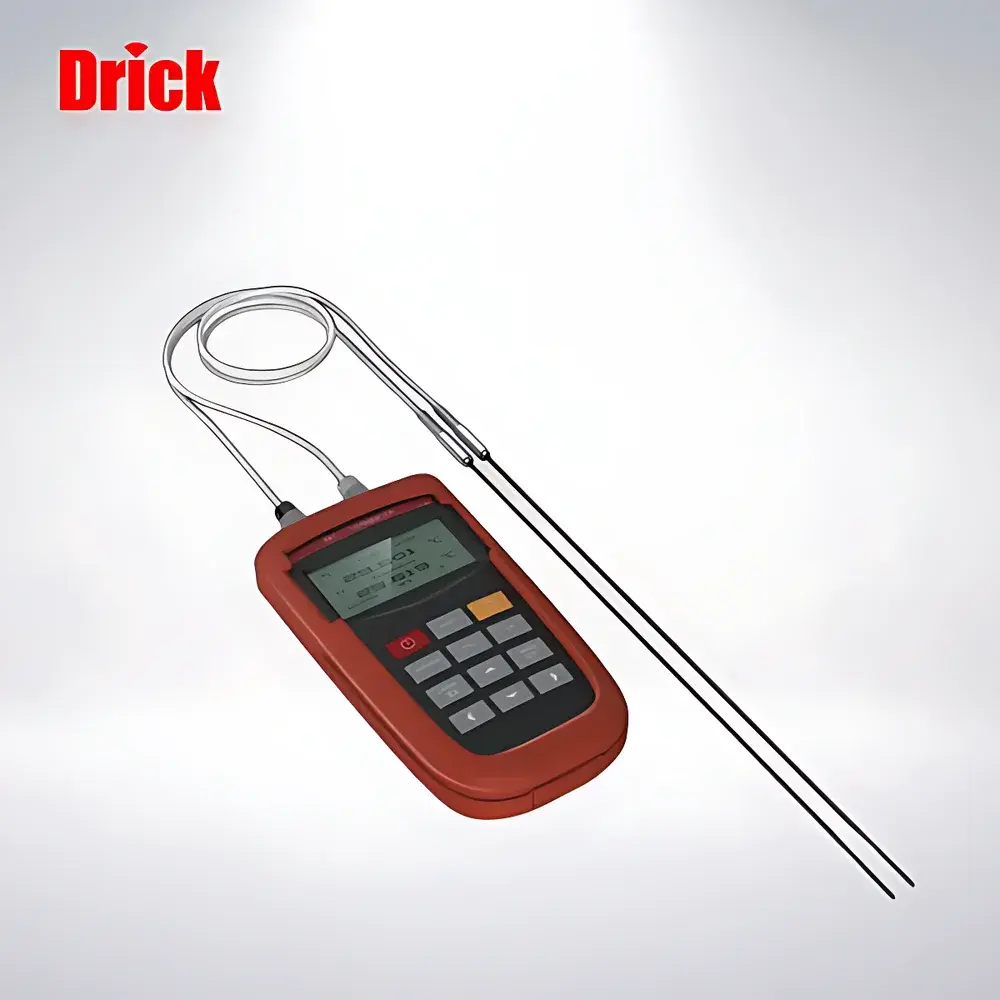
Drick GT11 High-Precision Handheld Thermometer for Laboratory and Field Use
| Brand | Drick |
|---|---|
| Origin | Shandong, China |
| Manufacturer Type | OEM/ODM Producer |
| Country of Origin | China |
| Model | GT11 |
| Probe Types | Pt385 (25Ω, 100Ω, 500Ω, 1000Ω) |
| Temperature Range | −200 °C to +850 °C (probe-dependent) |
| Temperature Accuracy | ±0.008 °C at 0 °C |
| Resistance Accuracy | Class 0.002 (20 ppm) |
| Resistance Range | 5–4000 Ω |
| Resistance Resolution | 0.0001 Ω (120 Ω), 0.001 Ω (1200 Ω), 0.01 Ω (4000 Ω) |
| Excitation Currents | 500 µA ±2%, 1 mA ±2% with current reversal (stray EMF < 0.1 µV) |
| Display Resolution | 0.001 °C / 0.0001 Ω / 0.001 °F / 0.001 K |
| Input Channels | 2 |
| Connector | DIN quick-lock |
| Dimensions | 160 × 83 × 38 mm |
| Weight | 255 g (incl. batteries) |
| Certifications | CE |
| Data Logging Capacity | 60,000 records with timestamps |
| Compliance | ITS-90 traceable, supports RTD curve interpolation per IEC 60751 & ASTM E1137 |
Overview
The Drick GT11 is a high-accuracy, dual-channel handheld thermometer engineered for metrological-grade temperature measurement in both laboratory calibration environments and demanding field applications. It operates on the principle of precision resistance thermometry—measuring the electrical resistance of platinum resistance temperature detectors (RTDs) and converting it to temperature using embedded ITS-90–compliant polynomial algorithms. Unlike conventional digital thermometers, the GT11 integrates low-noise, low-thermal-EMF excitation circuitry with automatic current reversal to eliminate parasitic thermoelectric voltages—a critical requirement for sub-millikelvin-level stability in reference-grade measurements. Its architecture is optimized for use with industrial Pt385 and standard Pt392 RTDs, enabling direct traceability to national metrology institutes when paired with certified reference sensors such as the T25-420-2 (−189 °C to +420 °C) or T100-350-385 (−200 °C to +350 °C). Designed for compliance-driven workflows, the GT11 serves as a primary transfer standard in accredited calibration labs, thermal validation studies, and process instrument qualification under ISO/IEC 17025, ASTM E2877, and FDA 21 CFR Part 11–aligned data integrity frameworks.
Key Features
- Dual independent input channels with DIN quick-lock connectors for rapid probe interchange without mechanical wear or contact resistance drift
- Two selectable excitation currents (500 µA and 1 mA) with programmable current reversal to suppress thermoelectric offset errors (< 0.1 µV)
- Real-time display of simultaneous temperature (°C/°F/K), resistance (Ω), deviation (REL), and statistical parameters (MAX/MIN/AVG/HOLD)
- Built-in ITS-90 interpolation engine supporting Pt385 (25/100/500/1000 Ω) and Pt392 (25/100 Ω) curves per IEC 60751 Ed. 3 and ASTM E1137
- High-resolution LCD with 0.001 °C temperature resolution and 0.0001 Ω resistance resolution at low ranges
- Onboard data logging capacity of 60,000 timestamped records (date/time stamped to internal RTC), exportable via USB to PC software
- Ruggedized housing (160 × 83 × 38 mm, 255 g) with IP54-rated ingress protection for field deployment in industrial or outdoor settings
Sample Compatibility & Compliance
The GT11 is compatible with all standard and custom-configured platinum RTDs meeting IEC 60751 Class A or AA specifications, including two-wire, three-wire, and four-wire configurations. It natively supports legacy and modern sensor types—industrial Pt385 elements (100 Ω nominal) for general-purpose calibration from −200 °C to +850 °C, and high-stability Pt392 standards (e.g., T25-420-2) for fixed-point and interpolation-based verification in metrology labs. The instrument’s resistance accuracy of ±0.003% at 120 Ω meets the requirements for secondary standard verification per ISO/IEC 17025 Clause 6.5.2. CE marking confirms conformity with EU Electromagnetic Compatibility (2014/30/EU) and Low Voltage (2014/35/EU) directives. While not intrinsically safe, its low-power design and absence of hazardous voltage outputs allow safe operation in non-classified environments per EN 61010-1.
Software & Data Management
The GT11 communicates bidirectionally with Windows-based calibration management software via USB virtual COM port. The software enables full configuration of measurement modes, statistical functions, logging intervals, and unit preferences. All recorded datasets include embedded timestamps synchronized to the instrument’s real-time clock, supporting audit-ready traceability. Export formats include CSV and XML, facilitating integration into LIMS, ERP, or electronic lab notebook (ELN) platforms. Audit trail functionality logs user actions (e.g., zeroing, calibration updates, parameter changes) with timestamps and operator ID fields—essential for GLP/GMP environments requiring compliance with FDA 21 CFR Part 11 Annex 11 and EU GMP Annex 11. Firmware updates are delivered via signed binary packages with SHA-256 checksum validation to ensure integrity.
Applications
- Primary and secondary calibration of industrial RTDs, thermocouples, and temperature transmitters against reference standards
- Thermal validation of environmental chambers, autoclaves, incubators, and pharmaceutical stability test equipment per USP and ISO 14644
- Field verification of temperature sensors in power generation (turbine bearing monitoring), petrochemical refineries (reactor feed lines), and HVAC commissioning
- Manual and semi-automated resistance thermometry systems when integrated with low-thermal-EMF switching matrices (e.g., ST-1204 or ST-4312)
- Replacement of mercury-in-glass thermometers in fixed-point cell characterization and bath uniformity mapping per ASTM E734 and ISO 9001:2015 Clause 7.1.5
FAQ
What RTD standards does the GT11 support?
The GT11 supports Pt385 (25 Ω, 100 Ω, 500 Ω, 1000 Ω) and Pt392 (25 Ω, 100 Ω) resistance temperature detectors, with built-in ITS-90 interpolation compliant with IEC 60751 and ASTM E1137.
Can the GT11 be used for accredited calibrations?
Yes—when operated within specified environmental conditions (25 °C ±5 °C, RH <75%) and paired with certified reference probes (e.g., T25-420-2), the GT11 meets uncertainty budgets required for ISO/IEC 17025 accreditation scopes covering temperature and resistance calibration.
Does the GT11 support four-wire RTD measurements?
Yes—the dual-channel design accommodates true four-wire (Kelvin) connections per channel, eliminating lead resistance error for highest-accuracy applications.
Is firmware update capability available?
Yes—firmware updates are distributed via secure USB interface using cryptographically signed binaries, ensuring version control and regulatory compliance in validated environments.
What is the maximum logging interval and retention period?
The GT11 stores up to 60,000 timestamped readings with millisecond-precision RTC tagging; data persistence exceeds 10 years under normal storage conditions, with no volatile memory dependency.





