
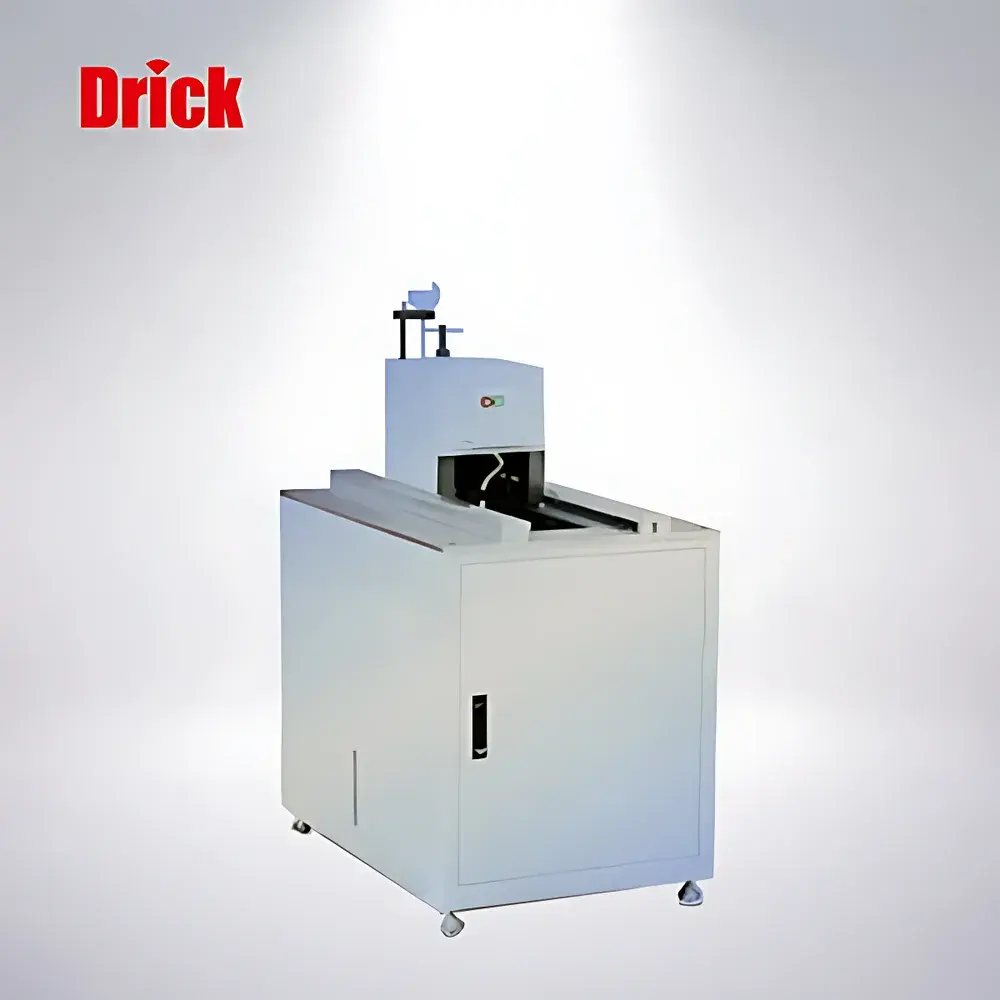
Drick XKC Pipe Notching Sample Preparation Machine
| Brand | Drick |
|---|---|
| Origin | Shandong, China |
| Manufacturer Type | Direct Manufacturer |
| Country of Origin | China |
| Model | XKC Pipe Notching Sample Preparation Machine |
| Price | USD 7,000 (FOB Qingdao) |
| Applicable Pipe Diameter | Ø63–Ø400 mm |
| Notch Length | 125–450 mm |
| Notch Depth | 19% of Pipe Wall Thickness |
| Positioning Accuracy (Depth & Length Feed) | ±0.1 mm |
| Milling Spindle Speed | 700 rpm |
| Power Rating | 180 W |
| Supply Voltage/Frequency | 380 V / 50 Hz, 5 A |
Overview
The Drick XKC Pipe Notching Sample Preparation Machine is an industrial-grade, precision-engineered instrument designed specifically for the standardized preparation of slow crack growth (SCG) test specimens in polyethylene (PE) pressure piping systems—particularly those used in natural gas distribution networks. It operates on a controlled mechanical milling principle, utilizing a fixed-speed rotating carbide-tipped cutter to produce geometrically consistent, ASTM/ISO-compliant notches along the outer surface of thermoplastic pipes. This process replicates the stress-concentration geometry required for environmental stress cracking resistance (ESCR) evaluation under standards such as GB/T 18476 and ISO 13479. The machine is not a general-purpose milling tool; rather, it is purpose-built to meet the dimensional repeatability, depth tolerance, and surface integrity requirements mandated by international pipe certification protocols and third-party testing laboratories.
Key Features
- High-precision linear feed mechanism with digital position feedback ensures ±0.1 mm repeatability in both notch depth and length—critical for minimizing inter-sample variability in SCG testing.
- Fixed rotational speed (700 rpm) optimized for PE and HDPE substrates, balancing material removal rate with thermal stability and edge quality to prevent micro-cracking or melt deformation at the notch root.
- Modular clamping system accommodates pipe diameters from Ø63 mm to Ø400 mm without retooling; jaw design maintains concentric alignment during cutting to eliminate eccentricity-induced notch asymmetry.
- Integrated safety interlock prevents spindle activation unless the pipe is fully secured and the guard is closed—compliant with IEC 60204-1 machinery safety directives.
- Robust cast-iron base and vibration-damped column structure minimize dynamic deflection during extended operation, preserving long-term calibration stability.
- CE-marked electrical cabinet with IP54-rated enclosure, suitable for controlled laboratory environments and QC floors in extrusion plants.
Sample Compatibility & Compliance
The XKC machine is validated for use with rigid and semi-crystalline thermoplastic pipes, primarily high-density polyethylene (HDPE) grades PE80 and PE100, as specified in EN 1555 and ISO 4427. It supports wall thicknesses ranging from 4.0 mm to 45.0 mm (corresponding to the 19% depth rule across the full Ø63–Ø400 mm diameter range). All mechanical dimensions and operational parameters align with the specimen geometry requirements defined in GB/T 18476–2001 (“Plastics — Polyethylene pipes for the conveyance of gaseous fuels — Determination of resistance to slow crack growth”) and ISO 13479:2019 (“Plastics pipes and fittings — Polyethylene (PE) pipes for the conveyance of gaseous fuels — Method for determining resistance to slow crack growth”). The resulting notched specimens are directly compatible with standard tensile testing frames equipped with constant-load or constant-strain-rate fixtures per ISO 16770.
Software & Data Management
The XKC is a manually operated, hardware-controlled system with no embedded software or touchscreen interface. All positioning and feed parameters are set via calibrated mechanical dials and locking verniers—ensuring deterministic behavior, zero firmware dependency, and full traceability under GLP/GMP audit conditions. No data logging or electronic records are generated onboard; however, the machine’s mechanical repeatability allows full integration into LIMS workflows when paired with external documentation protocols (e.g., printed calibration certificates, operator sign-off logs, and timestamped photo documentation of each specimen). Its design intentionally avoids digital control complexity to eliminate cybersecurity risks, software validation burdens, and regulatory uncertainty associated with Part 11 compliance in regulated manufacturing environments.
Applications
- Preparation of notched specimens for ASTM D5397 (Standard Test Method for Environmental Stress Cracking Resistance of Polyethylene Plastics) and ISO 16770 (Plastics — Polyethylene pipes — Determination of resistance to slow crack growth).
- Quality assurance in PE pipe extrusion facilities prior to hydrostatic pressure testing and ISO 4427 certification.
- R&D laboratories evaluating new PE resin formulations for improved ESCR performance under accelerated aging conditions.
- Third-party testing institutes performing accredited conformity assessments for gas infrastructure projects governed by national building codes (e.g., China’s CJJ 63, Germany’s DVGW GW 332).
- Failure analysis labs investigating field failures attributed to slow crack propagation in buried PE pipelines.
FAQ
Is the XKC machine compatible with non-PE pipe materials such as PP-R or PVC-U?
The machine’s kinematics and cutter geometry are calibrated for PE’s viscoelastic response at 700 rpm. Use with rigid PVC or PP-R requires independent validation of notch root morphology and fracture initiation consistency per ISO 13479 Annex B.
Does the system include calibration documentation traceable to national metrology institutes?
Yes—each unit ships with a factory calibration report (including dial indicator verification, depth gauge traceability, and spindle speed measurement), compliant with ISO/IEC 17025 requirements for supporting equipment.
Can the notch depth be adjusted to values other than 19% of wall thickness?
Mechanically yes, but deviation from 19% invalidates compliance with GB/T 18476 and ISO 13479; such configurations are intended only for internal R&D and must be explicitly excluded from certified test reports.
What maintenance intervals are recommended for the milling cutter and feed mechanism?
Carbide cutters should be inspected after every 200 notches; replacement is advised after 500 notches or upon visible flank wear exceeding 0.1 mm. Linear guide rails require bi-weekly lubrication with ISO VG 68 mineral oil.
Is technical support available outside mainland China?
Drick provides remote diagnostics and English-language operation manuals; local service partners are appointed in Southeast Asia, the Middle East, and South America for on-site calibration and repair.






